- English
- ePUB (mobile friendly)
- Available on iOS & Android
eBook - ePub
About this book
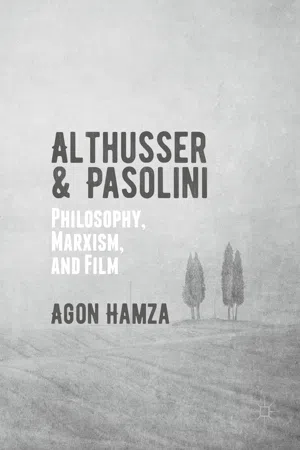
Agon Hamza offers an in-depth analysis of the main thesis of Louis Althusser's philosophical enterprise alongside a clear, engaging dissection of Pier Paolo Pasolini's most important films. There is a philosophical, religious, and political relationship between Althusser's philosophy and Pier Paolo Pasolini's films. Hamza teases out the points of contact, placing specific focus on critiques of ideology, religion, ideological state apparatuses, and the class struggle. The discussion, however, does not address Althusser and Pasolini alone. Hamza also draws on Spinoza, Hegel, Marx, and Žižek to complete his study. Pasolini's films are a treasure-trove of Althusserian thought, and Hamza ably employs Althusserian terms in his reading of the films. Althusser and Pasolini provides a creative reconstruction of Althusserian philosophy, as well as a novel examination of Pasolini's film from the perspective of the filmmaker's own thought and Althusser's theses.
Information
Topic
PhilosophySubtopic
Film & Video© The Editor(s) (if applicable) and The Author(s) 2016
Agon HamzaAlthusser and Pasolini10.1057/978-1-137-56652-2_11. Introduction: Althusser and Pasolini
Agon Hamza1
(1)
Slovenian Academy of Sciences and Arts, Ljubljana, Slovenia
Communists never cry in wilderness. Even when they are practically alone
— Louis Althusser, Essays in Self-Criticism (London: NLB, 1976), p. 39.
One does not really know a person until he has died.
— Pier Paolo Pasolini
This book deals with specific relations: philosophy, film, Christianity, and communism. These relations bear the names of the concepts that are presented by two singular people: Louis Althusser and Pier Paolo Pasolini. The two have hardly been discussed together. There are studies on the relation of other philosophers to Pasolini: such as Žižek, Badiou, Lacan, Agamben, and others. Althusser himself never wrote of Pasolini’s work, although in all probability, he must have been acquainted with it.1 What binds together these two names, and why is it important to maintain their living legacies?
Pier Paolo Pasolini was a very well-known Italian filmmaker, poet, novelist, activist, and a film critic. During the Second World War, together with his mother, he moved to the northern part of Italy, in the province of Friuli, bordering both the former Yugoslavia and Austria. There “he learned the local dialect in which he was to write some of his first poetry and here too he later became politicized by watching the struggles of the local peasants against their landowners.”2 Arguably, this place, and these struggles, turned him into a Marxist. His political activism and subsequently his membership of the Italian Communist Party were determined by the lives of the sub-proletariat in the suburbs of Rome. It was the life of the sub-proletariat in the suburbs of Rome and their class struggle that influenced his first film Accattone (1961). Some commentators insist that the murder of his brother Guido Pasolini, an Italian partisan, killed by the Yugoslav partisans and whom Pasolini mourned throughout his life as a martyr, has had a lifelong lasting impact on his treatment of that figure.
Pasolini’s major influences were Christianity and European ancient intellectual traditions. He was educated in both the classics of Greek and Latin, which are materialized in his film The Gospel According to St. Matthew, his script of a film on St Paul, as well as Medea and Oedipus, both referring to classical Greek tragedies. Even before he joined the Party, he believed that it was only the Communist Party that was able to provide and establish a new culture in the country. However, not long after he joined, he was expelled from the Party under the charges of obscene public behavior and corruption of minors. His first novel, Ragazzi di vita (Hustler), which was published in 1955, was very well received by the public, but very poorly by the Communist Party and the government. Ragazzi di vita initiated a lawsuit against Pasolini and his editor, and even though Pasolini was not sentenced, he was nonetheless subjected to the propaganda of yellow press in Italy. Indeed, he was charged and sent to court many times, with various allegations, including corrupting minors, blasphemy, pornography, insulting the national religion, and so on.
Pasolini’s private and public beliefs were in close coexistence. It is perhaps the sexual transgression of his private life (his relationships and affairs with young boys from the suburbs of Rome) that constituted or conditioned his public convictions and belief. Or, to formulate it in more concrete terms, we can argue that insofar as it was sexuality—especially the sexuality as it manifests itself in the working class, which did not fit the communist ideal of the proletariat with which communists worked— Pasolini had a particular interest in the “sub-proletariat” and in the function of sex in pauperized life. In fact, sexuality constitutes a crucial aspect of his work. However, although Ninetto Davoli, a 15-year-old boy, described by many commentators of Pasolini’s work and his biographers as the love of his life, appeared in a few films, his own sexuality was hardly discussed in his work, and especially in his films. Departing from this, how are we to explain the Trilogy of Life and his version of The Decameron (1971) and so on? We encounter the relation between law and sex: after all, Pasolini was quite interested in filming sex (sex scenes, close-ups, etc.), but it was not so much sexuality as a stumbling block in the identity of the working class (that element which disturbed the idyllic vision the Italian Communist Party of the proletariat), but rather sexuality as a creative force: both in sublime and in monstrous form, since the Trilogy of Life, and especially Salò, or the 120 Days of Sodom (1975), explored precisely the ascetic sexuality of fascism (in opposition to the lively and larger-than-life polymorphous sexuality of The Decameron, or The Arabian Night (1974) for that matter). Pasolini’s father was a military commander, who became a supporter of Mussolini, unlike his mother, who remained a Leftist and opposed the fascist regime. His last film, Salò, or the 120 Days of Sodom, which was released shortly after Pasolini’s murder, is based on 120 Days of Sodom by the Marquis de Sade and portrays the life of the rich fascist in the northern republic of Salò after the fall of Mussolini’s regime.3
Pasolini’s work, therefore, can be summarized thus: the immanent tension between Marxism and Christianity; the life of the poor and young workers in the outskirts of big cities in the age of consumerism; the struggle against law, in favor of desire. Later on, for Pasolini, the Italian Communist Party became the party of law and order which was against the so-called extra-parliamentary action; it used the Resistance as a cover-up, a supplement for its lethargy and nonactivity. For instance, his “Lutheran Letters are polemical interventions in the politics of the 1970s indictments of the Christian Democrats for corruption, of the communists for their acceptance of consumerism, and of Italian youth for the tyranny of fashion and of possessions.”4 Pasolini condemned the events of May 1968, and paradoxically enough, he sided with the police, as “the sons of the proletariat.” Further, according to him, the 1968 revolution contributed only to the ongoing capitalist revolutionizing of the bourgeois order through consumption. In fact, we should note that both Pasolini and Althusser were established figures before the events of May 1968, and indeed their reaction to the events was to be expected. However, these two intellectuals of the Left took different steps and positions toward these events and the revolution. Althusser’s position toward the events of May 1968 in France is ambiguous. Far from condemning the events, his critique was directed to the French Communist Party and its inability to become the leader of this revolutionary process. In fact, the French Communist Party denounced and opposed the students’ “revolutionary process,” qualifying them as false revolutionaries.
Indeed, Althusser was, arguably, the most influential French philosopher in the 1960s. His books Reading Capital (a collection of interventions from his seminar on Karl Marx’s Das Kapital) and For Marx marked the beginning of a new relation of philosophy to the work of Marx. Like Pasolini, Althusser’s relationship to Christianity was also tense and ambiguous. They were both raised in religious environments. Althusser was a member of the French Catholic Church and a member of a few Catholic organizations in France. In his youth, the main influential figures for Althusser were Jean Guitton, a Catholic philosopher and theologian, who later on became Althusser’s mentor, and Jean Lacroix, a French philosopher with whom Althusser later parted ways.5
Althusser was born in Algeria, where he spent most of his childhood. Like Pasolini, Althusser’s mother played a very important role in his upbringing, whereas his father was a lieutenant in the French army. During the Second World War, Althusser was held in captivity in a camp in Northern Germany, where among very few books he had access to was Blaise Pascal’s book Pensées. He read it throughout the years of captivity, and Pascal became one of the major influences of his work, especially with regard to his theory on the critique of ideology. He was a lifelong member of the French Communist Party, albeit a fierce critic. He was expelled from the Party only after the murdering of his wife. One has to think not only his letters to the Central Committee of the Party6 but his entire philosophical and political interventions were in a way a critique of the political lines of the French Communist Party: Stalinism, humanism, and so on.
Following this, we should point out that Pasolini was not at all a believer in an unorganized action, but he just concentrated on making visible the stumbling block to communist organization: the dirty, uncontrollable, useless dimension of the sub-proletariat, epitomized by its devious sexuality. This has to be said, because even though Pasolini evidently did think that the Communist Party, like the Church, was a machine for ossifying and de-sanctifying militancy, it is unclear if this was the destiny of institutionalization in general, or if institutions were simply not attuned to this “useless” dimension of the very people who were to be organized.
Althusser had no teachers, in the level of a father figure, neither in philosophy, nor in politics: “I did not have a father and continued indefinitely to play the role of ‘father’s father’ to give myself the illusion I did have one, or rather to assume the role in relation to myself.”7 Or, better still: “philosophically speaking, I had to become my own father. But that was only possible if I conferred on myself the essential role of the father: that of dominating and being the master in all situations.”8 Indeed, Althusser had a very lonely life, even though friends, comrades, and students surrounded him. The solitude can be discerned throughout his writings. It is for this reason that Gregory Elliott entitled one of his essays Althusser’s Solitude.9 However, in his A Response to John Lewis, Althusser writes: “Communists are never alone.”10 However paradoxical these positions are, we should note that by the latter, Althusser means that as a communist, a philosopher aims to transform the world, “which he cannot do alone without a genuinely free and democratic communist organisation, having close links with its grass roots and beyond them with other popular mass movements.”11 It is in this regard that Althusser and Pasolini differ: for Althusser, the Party (or any other form of organized political action) was a condition for politics, whereas Pasolini functioned (to paraphrase Lenin) as a communist without a Party.
Marxism has always had a complicated relation with religion. In fact, politics of radical emancipation can hardly be distinguished or separated from its religious influences. In the same way, we cannot separate religion from most of the great philosophical projects in the Western tradition. It is impossible for us to understand Descartes as devoid of religion, or Spinoza, Kant, Hegel, and so on. In contemporary philosophy, we cannot imagine the work of Slavoj Žižek, Alain Badiou, or Giorgio Agamben without their commitments to Christianity. It is important to note, however, that Marxism is by no means the secularized version of Christianity. As we will see in the following chapters, Christianity and religion are the conditions as well as intrinsic aspects not only for Marxism or communism, but also for philosophy as such. The same holds for Althusser and Pasolini—their intellectual projects cannot be comprehended without understanding their relation to Christianity, whether as believers or not.
Although he denounced religion, Althusser maintained a particular interest in the subject and developed close friendships with priests and theologians. It is through the friendship with Guitton that Althusser met the Pope and De Gaulle:
[T]hrough my friend Jean Guitton, I had contacts in Rome. I met John XXIII in some gardens as he did not like the Vatican except for his palace. It was springtime, and this pure-hearted man was enchanted by the flowers and the children. He had the appearance of a Burgundian who enjoyed red wine, but beneath that exterior he was a totally artless and profoundly generous man with a slightly Utopian vision, as you will discover. He took an interest in me as a member of the French Communist Party and explained at length that it was his desire to effect a reconciliation between the Catholic and the Orthodox Churches. He needed intermediaries to obtain the basis for an agreement on unity from Brezhnev. He was quite open about it. I pointed out...
Table of contents
- Cover
- Frontmatter
- 1. Introduction: Althusser and Pasolini
- 1. On Althusser
- 2. The Gospel According to Althusser
- Backmatter
Trusted by 375,005 students
Access to over 1.5 million titles for a fair monthly price.
Study more efficiently using our study tools.
Frequently asked questions
Yes, you can cancel anytime from the Subscription tab in your account settings on the Perlego website. Your subscription will stay active until the end of your current billing period. Learn how to cancel your subscription
No, books cannot be downloaded as external files, such as PDFs, for use outside of Perlego. However, you can download books within the Perlego app for offline reading on mobile or tablet. Learn how to download books offline
Perlego offers two plans: Essential and Complete
- Essential is ideal for learners and professionals who enjoy exploring a wide range of subjects. Access the Essential Library with 800,000+ trusted titles and best-sellers across business, personal growth, and the humanities. Includes unlimited reading time and Standard Read Aloud voice.
- Complete: Perfect for advanced learners and researchers needing full, unrestricted access. Unlock 1.5M+ books across hundreds of subjects, including academic and specialized titles. The Complete Plan also includes advanced features like Premium Read Aloud and Research Assistant.
We are an online textbook subscription service, where you can get access to an entire online library for less than the price of a single book per month. With over 1.5 million books across 990+ topics, we’ve got you covered! Learn about our mission
Look out for the read-aloud symbol on your next book to see if you can listen to it. The read-aloud tool reads text aloud for you, highlighting the text as it is being read. You can pause it, speed it up and slow it down. Learn more about Read Aloud
Yes! You can use the Perlego app on both iOS and Android devices to read anytime, anywhere — even offline. Perfect for commutes or when you’re on the go.
Please note we cannot support devices running on iOS 13 and Android 7 or earlier. Learn more about using the app
Please note we cannot support devices running on iOS 13 and Android 7 or earlier. Learn more about using the app
Yes, you can access Althusser and Pasolini by Agon Hamza in PDF and/or ePUB format, as well as other popular books in Philosophy & Film & Video. We have over 1.5 million books available in our catalogue for you to explore.