The field of development encompasses the study of the ways that society functions for the betterment of all individuals. The economic system is a fundamental element of development, and entrepreneurship is a principle component of the economic system. Entrepreneurships can create a positive “…change in the economic system through innovations brought about by individuals who generate or respond to economic opportunities that create value for both…individuals and society” (Sohmen 2001).
More than 100 years ago, Joseph Schumpeter (1934) recognized the importance of entrepreneurs’ contributions to the economic system as “key drivers” of economic progress. 1 And indeed, documented evidence of female entrepreneurs’ contributions to local and regional economies positions women’s entrepreneurial activity as “…an increasingly important part of the economic profile of any country” today (Allen et al. 2007, p. 9; Brush and Cooper 2012; Langan-Fox 2005). East Asia's rapid economic growth, one of the most dynamic in the world, is led by its labor force (Krugman and Wells 2004).
As “key drivers” of development , women make significant contributions to economic development in Asia. Yet while it is clear that entrepreneurships owned and operated by women contribute to both the formal and informal economies , and a prolific body of research on business and women exists (Brush and Cooper 2012), studies about women entrepreneurs still comprise less than 10% of all research in the business field. This begs several questions.
How do international organizations position female entrepreneurship in their international initiatives that promote economic development? To what extent are references to education included in the rhetoric that steers development at the international level? And, how do national governments in Japan , China , India , Singapore , and Indonesia plan for the advancement of female entrepreneurship? To what extent do the governments include educational programs that support their goals? And, finally, educational systems promote student learning. To what extent do female entrepreneurs in each of these countries rely on formal education to learn about entrepreneurship? How do they acquire information to design, plan, open, operate, and expand their businesses? What are the links between policy and practices for female entrepreneur? This book answers these questions. This chapter provides a background that contextualizes it.
The Field of Female Entrepreneurship: Definitions and Its Development
In the late 1960s, economies in general and labor markets in particular relied on the entrepreneurial process to close gaps in underdeveloped markets (for gap-filling, see Leibenstein 1968). In order to maintain an acceptable pace of economic development today, the International Labour Organization (ILO) reports that “…500 million new jobs will need to be created by 2020 in order to provide full employment.” Entrepreneurs can fill part of this demand.
What is an entrepreneur? There are numerous definitions of the term, yet one succinctly captures its essence. Pickle and Abrahamson (1990), p. 5, 9 describe the entrepreneur as “… one who organizes and manages a business undertaking, assuming the risk, for the sake of profit” (5). The entrepreneur “…evaluates perceived opportunities and strives to make the decisions that will enable the firm to realize sustained growth” (9).
The field of female entrepreneurship has continually expanded. The first journal article on women's entrepreneurship appeared in 1976 (Schwartz 1976). The scholarly literature continued to be published, and a few years later, policy reports on entrepreneurship and women followed. In 1979, for example, the Report of the President's Inter-Agency Task Force on Women Business Owners was publised. This was followed by the presentation of conference papers on various topics related to entrepreneurs (Hisrich 1985). Two conferences dedicated to the topic might have been the fuel that ignited a broader approach to the field’s study.
First, the policy-oriented Organization for Economic Cooperation and Development (OECD) Conference on women entrepreneurs in small- and medium-sized enterprises was held in 1998. Second, the Diana International Conference on Women’s Entrepreneurship Research provided an academic perspective to women entrepreneurship (http://www.babson.edu/Academics/centers/blank-center/global-research/diana/Pages/home.aspx) in 2003. Around the same time, the establishment of the Global Entrepreneurship Monitor (GEM) Reports set the stage for the reporting on the status of female entrepreneurs in the USA, and, later, 20 countries around the world. 2 The Reports have brought attention to the field, and, in so doing, have generated a steady and increasing interest in its scholarly work.
It was during this period that the field of female
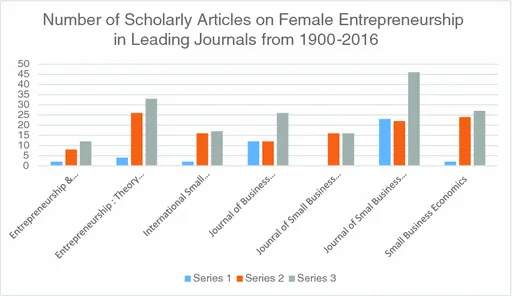
entrepreneurship became an even more popular area of investigation. Existing journals published special-issue volumes, and new journals offered additional breadth to study in the field. For example, The Journal of Entrepreneurship Theory and Practice published a special issue on women entrepreneurship in 2006, 2007 (de Bruin et al. 2006), and again in 2012 (Hughes et al. 2012). In between, a niche journal entitled the International Journal of Gender and Entrepreneurship was launched in 2009. Other pre-existing journals, such as the Journal of Business Venturing; Entrepreneurship: Theory and Practice; The Journal of Small Business Management), and two top European journals—the International Small Business Journal, and Entrepreneurship and Regional Development—started to publish papers on female entrepreneurship (Fig.
1.1).
This bar graph indicates the steady increase in the number of articles related to female entrepreneurship that were published from the twentieth century to today. Series 1(blue) indicates the number of articles in the 1900s. Series 2(orange) reflects the number of articles from 2000 to 2016. Series 3(grey) represents the total number of articles.
Various disciplines have published on the topic of female entrepreneurship . 3 For example, the business field has published work on entrepreneurship and opportunities, and activities and operations to develop those opportunities (see e.g., Morris et al. 2012). The sociological literature reveals the need to consider gender as a socially constructed phenomenon as it relates to entrepreneurship (Ahl and Nelson 2015) (Maslak, Education, Employment and Empowerment: The Case of a Young Woman in Northwestern China 2011) and reasons for successes and failures among female entrepreneurs (see e.g., Maslak 2011). The psychology field has also studied female entrepreneurs in terms of personal characteristics of the business owner (see e.g., Arasti et al. 2012; Brush 1992; Verheul et al. 2002). Others demonstrated the importance of comparative studies (Ahl 2006). Conceptual and theoretical understandings of female entrepreneurship have been advanced in the work of de Bruin et al. (2012) for example. And literature reviews provide an informative brushstroke to describe trends in the scholarly field (Brush 1992; Goyal and Yadav 2012; Jennings and Brush 2013; Mirchandani 1999; Gundry et al. 2002).
Just as subject matter has become more diverse, so has the method used to study it, albeit progress in this area is slow. Henry et al. (2015) reviewed the gender and entrepreneurship literature published over a 30-year span. Their review confirmed that scholars, even today, most often utilize a positivist research paradigm in their work. At the same time, the review identifies the need for more qualitative approaches to studies in the field. Qualitative studies enable understanding of process (versus product), which fundamentally shifts the type of research that is conducted. In so doing, new questions can be raised, and new understandings can be generated.
The vast majority of work on female entrepreneurship in the education field has been limited to either studies on curriculum development for entrepreneurial training programs (Bruni et al. 2004; Sohmen 2001) or entrepreneurship as it relates to formal education in terms of vocational education (Maslak, Vocational Education of Female Entrepreneurs in China: A Multitheoretical and Multidimensional Analysis of Successful Businesswomen’s Everyday Lives 2014). Although these works advance our understandings of female entrepreneurship and education, many facets of this field remain under-investigated.
This book attempts to extend the literature in the field in five ways, each of which is reflected in the five sections of the book. 4 Part I, Economies and D...