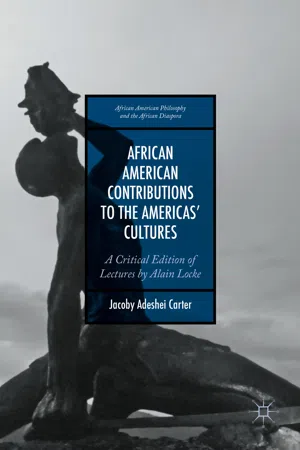
eBook - ePub
African American Contributions to the Americas’ Cultures
A Critical Edition of Lectures by Alain Locke
- English
- ePUB (mobile friendly)
- Available on iOS & Android
eBook - ePub
African American Contributions to the Americas’ Cultures
A Critical Edition of Lectures by Alain Locke
About this book
This book is a critical edition of six lectures by Alain Leroy Locke, the intellectual progenitor of the Harlem Renaissance. In them, Locke offers an Inter-American philosophical account of important contributions made by Afrodescendant peoples to the art, literature, and culture of various American societies. Locke offers a prescient vision of the intersection of the three Americas: Latin (South) America, the Caribbean, and North America. The book has two main parts: First, are the lectures, which all relate to the themes of black cultural contributions throughout the Americas, minority representation and marginalization in democratic contexts, the ethics of racial representation, the notion of cultural transformation and transparency, and the ethical issues involved in cross-cultural exchanges. The second portion of the book is a critical interpretive essay that elucidates the Inter-American philosophical significance of the lectures and their relevance to current philosophical discussions.
Information
Topic
FilosofiaSubtopic
Storia nordamericanaThe Negro’s Contribution to the Culture of the Americas
© The Author(s) 2016
Jacoby Adeshei CarterAfrican American Contributions to the Americas’ CulturesAfrican American Philosophy and the African Diaspora10.1057/978-1-137-56572-3_2Lecture 1: Race, Culture, and Democracy
Jacoby Adeshei Carter1
(1)
Department of Philosophy, John Jay College, CUNY, New York, New York, USA
Madames, Messieurs
Madames, Messieurs
It is, I assure you, both a great pleasure and a great opportunity to be here on a mission of intercultural exchange. The mutual sympathy and understanding between Haiti, your country, and mine, the United States, closer than ever at present, can never be too close for mutual benefit. And I hope you will allow me to stress the phrase, ‘mutual’, for relations between countries and cultures, to be sound, constructive and self-respecting, must be two-way relations of give-and-take. The new order of the new day in human relations is reciprocity, not aggression, mutual assistance not overlordship, fraternity, in short, not paternalism.
Fortunately during these recent years the relations of our two countries have been in the happy phase of reciprocity, as we now are able to realize they should always have been and as we all hope they will from now on continue to be. Enlightened nations today are beginning to see the larger significances of their institutional and cultural debts, of their common stakes in civilization rather than merely to count their territorial holdings and their balances of trade. To do so with consistency, however, requires a broad and humane perspective of history, with a good and honest memory, such as will balance, if I may illustrate concretely, the early and important assistance of Haiti to the United States during the Cornwallis campaign of our American Revolution with the much later payment in kind by our influential recognition of Haitian Independence; or later still, that welcome balancing of our moral accounts represented, on the one hand, by the ‘Good Neighbor’ treaty of 1934 and on the other, by Haiti’s repayment in kind, her prompt and brave decision early in 1942 to declare war on the Axis Powers and to join the embattled cause of democracy.
In its small way, the present undertaking is also an integral part of the same happy and helpful reciprocity. On the one hand, there is the good initiative of The Committee on Inter-American Artistic and Intellectual Relations, under whose auspices I have the occasion to visit Haiti, and on the other, the deeply appreciated reciprocal courtesy of M. Dartigue and your Ministry of Public Education, under whose kind patronage I have the honor to deliver this series of lectures. I am happy and proud to be, for the moment, a small cargo of good will and mutual understanding borne on the tide of those two converging streams, that will in the future carry so much more intellectual commerce between Haiti and the United States, let us carefully note, in both directions. As a matter of fact, when I left my post at Howard University, from which institution I have, too, the honor of presenting you the most cordial fraternal greetings, your own distinguished scholar, M. Dantes Bellegarde, was happily functioning at our institution as an exchange professor in Latin-American History. It is appropriate, too, to acknowledge at this point another even more immediately helpful collaboration, that of an esteemed Haitian friend, Dr. Camille Lhérisson, who has added to an already treasured friendship a heavy but happy debt of gratitude by translating the English text of my English manuscript for this series of lectures. After it has suffered the discount of my inept accent, I may need to assure you that it is good, nay, masterful French, but you will appreciate nonetheless his considerable contribution to this and other projects of Haitian-American rapprochement.
However, I am sanguine about the purpose and propriety of my mission, particularly in view of the double bond of sympathy and interest between us; for we have, have we not, both the fellowship of democracy and that of the confraternity of race. Indeed, I scarcely know which of the two to emphasize, facing the agreeable alternative of saluting you either as fellow-Americans, in the best and generic sense of that term, or as comrades of race. Small matter, however, for it is my eventual purpose to tie the two together, having chosen as my general subject: The Negro’s Contribution to the Culture of the Americas. In this way I hope to be able to make North American culture a little better understood and appreciated, and especially that part of it which has been vitally influenced by the American Negro. Also, though I hasten to confess myself less competent in this field, it is my purpose to show how importantly and strategically this Negro and originally African segment of culture exists as a common denominator, little known but quite historic and fundamental, between some of the most important national cultures of the Americas. For certainly in many places in North, Central and South America, including the variegated cultures of the Caribbean, Negro idioms and traditions have added vitality and flavor to art, music, dance, drama and folklore, and entered so deeply into the matrix of these cultures as to make it impossible for them to be eliminated or ignored.
Indeed, as our American cultures come into closer contact and understanding this will become increasingly apparent. Ultimately this linkage of a common indebtedness to African and Negro elements of culture may well introduce an important new spiritual dimension into our inter-American unity, and help develop among and between us the full potential of social and cultural democracy.
How can we hope to achieve cultural democracy unless we extend the formula of equality and fraternity across the boundaries and barriers of both race and nationality, to comprehend not merely the basic relations of persons within our several groups but also the relationships of groups themselves to one another? The parity of nations, races, and cultures is, in my opinion, the next and necessary step in the evolution of the democratic ideal. We shall not achieve this on the political plane successfully unless it is reinforced by a moral and spiritual conviction that this is the foundation principle of just and enduring group relations, and such a spiritual faith can only arise from the transformation of those provincialisms, which narrow unnecessarily our traditional conceptions of ourselves, still rooted in our various cultures. The mainstay of our pride in them is by reason of their exclusiveness and asserted superiorities. We shall see later how contrary to fact these superstitions of culture really are. We have, it is true, a certain obvious distinctive character in our several cultures, and probably always will have them. But in the really more important factors of our culture,—Christianity, democratic institutions, modern industrial technology, science and scientific method, the logic of thought and reason, the basic art forms, the fundamental aesthetic and moral reactions, are common to us all. Their national aspects are primarily matters of particular emphasis and flavor. We have also, in addition to this common civilization, a basic solidarity of interests which we must learn to recognize, appreciate, mature, and promote. Only cultural parochialism stands between us and this larger perspective; and when we finally outgrow such subjective limitations, a new panorama of the past and of the future of mankind will open out before our enlightened eyes.
As the fog of chauvinism lifts from the language of history, we shall finally realize that for nearly a century and a half we have been victims of a political conception of culture, inappropriate, undemocratic, and inhumane. Earlier centuries, in spite of other lacks, had a truer and greater outlook on the world. Medieval Europe had its grand over-concept of Christendom: the Renaissance, equally universal in a secular way, had its humanism uniting all Europe culturally without regard to nationality; and in the cosmopolitan Eighteenth Century, so close were the intellectual and cultural relations both of France with England and with Germany, and they in turn with the Lowland Countries, that men were scarcely conscious of that great divide which we know today as the dichotomy of the Anglo-Saxon and Latin thought and feeling. Strange but true, that as our world has enlarged and our intercommunications immeasurably improved, our conception of culture and human solidarity has narrowed and shrunk. Yet just so, has nationalism, in the nineteenth and early-twentieth centuries, beclouded our view of the true facts of culture history and excluded from all but a few more scientifically minded among us, the wider and more humane notions of human kinship. Let us not chide the Nazi or Japanese racialists with the blame for the totalitarian concept of culture and nationality and the master-race interpretation of history. For we, too, have subconsciously at times openly held modified forms of the same characteristic notions. We too, have believed that culture and race were somehow organically related and that civilization was both the sole product and property of those classes, nations or ethnic groups that have sat in the seat of political and economic power. The facts are all to the contrary. Some of the richest growths of culture have been transplanted crops not native to the land in which they flowered; some of the finest idioms of the arts, music, dance and folklore especially, have come from lowly peasant stocks, often alien peasant-folk at that: a great deal of what is best in culture derives not from pure but from crossed and hybrid strains which seem to be enriched by this process of cultural cross-fertilization. Incidentally, but importantly, the cultural products of the Negro in all parts of the Americas where he has been in considerable numbers have demonstrated and exemplified these basic truths about the nature of culture, traditional opinions notwithstanding. Indeed long before modern anthropology came along to correct our thinking on these matters, the practical results of Negro creative interaction with both Anglo-Saxon and Latin elements of American culture has demonstrated, to any eye that would see clearly, the same conclusions.
Here in this instance we have the spiritual products of the lowliest folk becoming a dominate force in certain areas of a country’s culture; indeed as in the case with Negro musical idioms in the United States and Brazil providing the major component in what has come to be accepted as the nationally characteristic idiom. This is not an isolated instance; it could be cited on several other scores and with reference to many other nations both with respect to the cultural influence of the Negro and that of the American Indian. The tradition, as I have already pointed out, has not been favorably set for us to learn the obviously important democratic lesson involved in such situations, but these lessons are there, like Shakespeare’s silent “sermons in stones,” to be eventually recognized. Indeed if we would truly democratize our culture, we must learn them. We might even go so far as to say that our culture had been more democratic than we ourselves have been.
But today, from both scientific and practical angles it is being brought home to us that civilization is not the product of a single people, and that all great national cultures are composite in character and derivation. In the long run we shall probably discover this as, in the realm of social ideas, the one great spiritual lesson stemming from the chastening and clarifying ordeal of the present world crisis. When that time comes democracy will be more than a political formula; it will be a living faith and spirit of human brotherhood; a firm creed and conviction of human interdependence. We are still far from a general recognition of this; however.
One may well stop at this point to consider why. American thinking, generally weaned from colonial dependence by now, has nevertheless retained, it seems, one lingering colonial trait. It follows the European cult of nationalism and the traditional European identification of nationality with culture. We have all projected this political pattern on our several national lives, hardly realizing what a misfit it is. For the typical American state, whether of North or South America, is both multi-racial and multi-national in its human and cultural composition. In America, we are Switzerlands, only even more intermingled.
These newer nations have no need or reason to make the mistake of projecting Old World patterns and traditions upon an essentially new type of culture. By so doing they not only belie their own basic structure but postpone the development of their potentialities as pioneers of that cosmopolitan culture typical of complete democracy and of an increasingly international world. To realize the obscuring force of the national myth in the realm of culture, one needs only stop a moment to contrast with the actual facts the oversimplified notion, for example, of the culture of the United States as exclusively or predominantly Anglo-Saxon. Need one refer to its medley of peoples and races, its flourishing foreign language press and periodicals,—some non-English newspapers, and more significant even, its mélange of traditions and cultural elements, among which the Negro element has its weighty and now acknowledged share. Or again, we can refer to the same traditional illusion of cultural uniformity about bilingual Canada, with its more than dual culture, if we include, as we should, that of the Canadian Indian. So, political conventions to the contrary, we have few if any monotype cultures in the Western hemisphere: it is not the typical or predominant American pattern. So we must build our several national societies on actual American realities, not on outworn European stereotypes. Accordingly, if we would face the fertile future rather than the stagnant and sterile past, particularly if we would avoid the old clashes and enmities of arrogant and competitive nationalism, we American nations must mold ourselves on the formula of national units that embrace and prize and integrate cultural diversity, weaving many strains of culture into a richer and harmonious pattern of a composite civilization. Only in this way can we reconcile our valued and still valuable political nationalism with the oncoming cultural internationalism.
More than this; there are national problems too which can only be solved by a similar formula. For only in this way can we fruitfully merge cultural elements that migration and the accidents of history have juxtaposed within our several national boundaries. Traditionally hostile or incompatible with one another, here they are represented in our mixed populations by considerable segments of loyal descendants. Hitherto, they have met in a sort of truce of democratic convenience or mutual indifference. It is high time now, especially since we need a more vital solidarity within democracy and between the democracies, that this truce be worked through to real cultural concord and understanding. In the United States this relatively new philosophy of society and culture is being described as and promoted as “cultural pluralism.” It is, a promising creed and already has many powerful intellectual and scientific adherents. I should like to commend it as the only fully democratic notion of culture and the only realistic and safe concept of nationality. For the majority factions, it imposes modesty, tolerance and a fraternal spirit; for the minority groups it is a boon of protection, self-respect and reciprocity.
Already under its influence, in the United States, and still more deliberately in Mexico, the culture of the American Indian is being completely revalued. It is no longer being regarded as a despised and isolated folk culture, alien to that of the educated elite, but rather as something which, in addition to being a precious heritage of those who are its direct descendants, has contributed to the general culture, and has possibilities, when properly appreciated and developed, of making further contributions. The same is true of the enlightened contemporary view of the Negro’s folk culture in North America, and the parallel movement for a higher evaluation of the Afro-Cuban, the Afro-Brazilian, and the Afro-Antillean factors in their respective regional cultures is part of the same tendency. There is a democratic lesson for all our societies in such ideas and their reversal of old values. The old aristocratic notion of higher and lower culture, stratified according to social tradition, is thus being replaced by a more democratic conception of interacting group cultures, with cultural superiority determined only in particular instances by the force and direction of the creative influence. And never, let us add, cultural superiority or inferiority in general.
An especially illuminating case is that of the North American Negro. Here because of the Negro’s adoption of the language and religion of the dominant majority, there was even less separation of culture between the two groups. Nevertheless there has been a strong counter-influence on the part of the Negro minority. Though disparaged socially and economically, and disadvantaged in formal culture, many distinctive and idiomatic traits in our racial tradition and expression have had very considerable influence on the general culture. This is quite generally known and admitted with respect to the marked Negro role in the formation of a characteristic American type of music, but it is equally true of many other cultural fields,—dance, drama, folk-lore and art, as these lectures will point out in due course. What concerns us primarily, for the moment, however, is the general lesson in the situation of a handicapped minority becoming culturally influential despite such handicaps. As often before in human history an oppressed minority has exerted spiritual power and become a dominant cultural force.
To some it may seem a paradox that certain of the most representative aspects of American culture should derive from the folk-life and folk-spirit of the humbler and more disadvantaged element of the population. But there is a deep and sufficient,—and we must add, a universal reason. It is only because, even in being characteristically racial, these creative expressions have also been basically and universally human, and have thus obtained a contagious and irresistible hold upon human sympathy and understanding. Let us try to illustrate this concretely, and perhaps at the same time track down the paradox that seems to underlie it. Everyone will admit that the American Negro Spiritual is a case in point, and no one will care to deny that it is a unique and priceless genre of creative musical expression. Here it is, on the one hand unmistakably racial, but on the other, deeply human and universal; in some respects typically and characteristically Negro, in others representatively American.
Interpretation of the “spirituals” has divided critical opinion into two opposing schools of thought, two critical camps between whose contending claims we are often disposed to give up the issue with a Shakespearean curse: “A plague on both your houses!” The racialists point out the obvious Negro idioms of song, imagination, and speech; the spirituals they say are Negro through and through; they mirror the Negro soul; the spirituals are black. Another group of critics, in a minority, but not for that matter, wrong, point out, with considerable warrant of fact that the spirituals are dialect folk-versions of Anglo-Saxon, Christian worship, taken over by ear and word of mouth from the King James Bible and Protestant evangelical hymns by the illiterate, converted slaves. The framework and substance of the Spirituals, these partisans say, is Anglo-Saxon and colonial American, and so, except for the tincture of Negro dialect and song, the spirituals are “white”.
There is a great fallacy at the heart of this controversy. The Negro spiritual, like much else in the realm of art, has two parent cultures. It is a rare and rich culture hybrid, a unique and distinct Afro-American product, explainable only in terms of its dual inheritance. From the Negro side, it distills a racial temperament and a quite peculiar folk experience and fuses it with the great tradition of Protestant Christianity, stemming from the Nordic side. The composite blend transcends its individual ingredients in that alchemy of great creative art which Browning describes as the magic which “makes out of three sounds, not a fourth sound, but a star.” Proof of this is the timeless and deep human universality that makes these songs common spiritual currency circulating everywhere at par and with immediate, almost spontaneous acceptance. As a synthesis of several strands of human experience, as effectively reaching down to common denominators of human emotion, the Negro spiritual has broken through the bonds of that which is provincially racial, though remaining, at the same time racially representative because of its special idiom and flavor. The true facts of the situation, therefore, justify no chauvinism of race and make it foolish to engage in partisan culture politics over fusions of culture which are so obviously sound and productive and in which, as in physical fatherhood and motherhood, both cultures play an essential ro...
Table of contents
- Cover
- Frontmatter
- Introduction
- 1. The Negro’s Contribution to the Culture of the Americas
- 2. “Like Rum in the Punch”: The Quest for Cultural Democracy
- Backmatter
Trusted by 375,005 students
Access to over 1.5 million titles for a fair monthly price.
Study more efficiently using our study tools.
Frequently asked questions
Yes, you can cancel anytime from the Subscription tab in your account settings on the Perlego website. Your subscription will stay active until the end of your current billing period. Learn how to cancel your subscription
No, books cannot be downloaded as external files, such as PDFs, for use outside of Perlego. However, you can download books within the Perlego app for offline reading on mobile or tablet. Learn how to download books offline
Perlego offers two plans: Essential and Complete
- Essential is ideal for learners and professionals who enjoy exploring a wide range of subjects. Access the Essential Library with 800,000+ trusted titles and best-sellers across business, personal growth, and the humanities. Includes unlimited reading time and Standard Read Aloud voice.
- Complete: Perfect for advanced learners and researchers needing full, unrestricted access. Unlock 1.5M+ books across hundreds of subjects, including academic and specialized titles. The Complete Plan also includes advanced features like Premium Read Aloud and Research Assistant.
We are an online textbook subscription service, where you can get access to an entire online library for less than the price of a single book per month. With over 1.5 million books across 990+ topics, we’ve got you covered! Learn about our mission
Look out for the read-aloud symbol on your next book to see if you can listen to it. The read-aloud tool reads text aloud for you, highlighting the text as it is being read. You can pause it, speed it up and slow it down. Learn more about Read Aloud
Yes! You can use the Perlego app on both iOS and Android devices to read anytime, anywhere — even offline. Perfect for commutes or when you’re on the go.
Please note we cannot support devices running on iOS 13 and Android 7 or earlier. Learn more about using the app
Please note we cannot support devices running on iOS 13 and Android 7 or earlier. Learn more about using the app
Yes, you can access African American Contributions to the Americas’ Cultures by Jacoby Adeshei Carter in PDF and/or ePUB format, as well as other popular books in Filosofia & Storia nordamericana. We have over 1.5 million books available in our catalogue for you to explore.