eBook - ePub
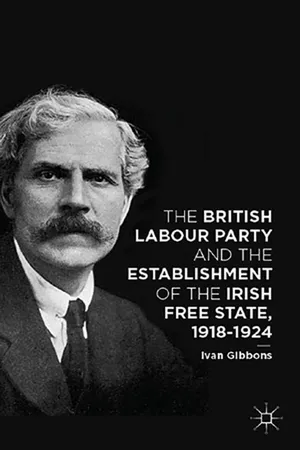
The British Labour Party and the Establishment of the Irish Free State, 1918-1924
- English
- ePUB (mobile friendly)
- Available on iOS & Android
eBook - ePub
The British Labour Party and the Establishment of the Irish Free State, 1918-1924
About this book
This book examines the rapidly evolving relationship between the British Labour Party and the emerging Irish nationalist forces, from which was formed the first government of the Irish Free State as both metamorphosed from opposition towards becoming the governments of their respective states.
Information
1
The Evolution of the British Labour Party and Irish Nationalism, 1914–1921
The First World War and its immediate aftermath played a crucial role in both the transformation of the Irish political landscape and the rapid development of the British Labour Party from peripheral political grouping to alternative party of government. Although the political progress made by the Labour Party in this period was by no means uninterrupted, and indeed at times was faltering and halting, by 1921 it found itself on the brink of power as the official opposition to Lloyd George’s peacetime coalition government. Labour now provided a progressive alternative to the Conservative Party, potentially uniting trade unionists and ideological socialists with the former Liberal-voting middle class. As a result, it now hovered in expectation of soon becoming the governing party, and the leadership became determined to conduct itself prudently and responsibly in order to realise its potential.
As the character of the British Labour Party changed dramatically, so did that of Irish nationalism over the same period. The pre-war demand for a moderate amount of Home Rule inside the United Kingdom had, by 1918, transformed into widespread support for a separatist philosophy envisaging an independent Irish Republic, not only outside the United Kingdom but also outside the British Empire. The British Labour Party’s political response to this rapidly developing revolutionary Irish nationalism was strongly influenced by its growing desire to appear a moderate and respectable alternative party of government.
Given the importance of its political status after the First World War, it is difficult to recall that, arguably, the Labour Party in Britain prior to 1914 was not a national party. It had few individual members and was organised in a fragmented federal structure based on affiliation from trade unions (representing two million members) and socialist societies such as the ILP and the Fabian Society (totalling thirty to forty thousand members). Prior to 1914, the party never succeeded in attracting more than 7 per cent of the popular vote and was widely regarded as being merely an appendage of the Liberal Party. Indeed, its strength in the House of Commons failed to increase and even dropped after 1910. In reality, the infant Labour Party in the years before the First World War saw its role more as a pressure group on the ruling Liberal Party on behalf of its own economic group – the manual working classes. As the labour historian Richard Lyman reminds us, ‘on the eve of the First World War there were few indications indeed that the Labour Party was destined ever to rule in Britain’.1 It did not seriously regard itself as an alternative governing party, and given this perspective it tended to ignore, or at least not formally embrace, issues not directly related to improving the economic and social position of the working classes, particularly those which it believed were not capable of being resolved on rational lines and which ran the risk of engendering emotive or sectarian passions. Trade unionists saw the party as little more than a weapon for the defence of the unions’ position, and Lyman goes so far as to assert that, by 1914, the Triple Alliance (of miners, transport workers and railwaymen) was ‘of greater portent than the stagnating Labour Party’.2
Despite this, Labour was desperate above all to be a parliamentary party. It sought respectability and, in time, desired to extend its support beyond the working class in order to attract middle-class, intellectual and, in particular after the First World War, disillusioned former Liberal voters. As part of this attempt to position itself as a moderate and responsible party it disagreed, for example, with the militant suffragettes, whose tactics were criticised by the chairman of the PLP, Ramsay MacDonald, who stated bluntly that he believed that ‘the violent methods are wrong and their nature reactionary and antisocial’.3 However, irrespective of the quest for parliamentary respectability, the Labour Party’s centre of gravity at least until 1922 was extra-parliamentary. The PLP was small and ineffective, and decisions about the national party’s growth were made by the National Executive Committee (NEC) and annual conference, both of them dominated by the trade unions.
There has been substantial debate on whether the ‘forward march of Labour’ was inevitable or was a result of the impact of the First World War, the emergence of the working-class franchise or the growth of class-consciousness or a combination of all three. Historians have discussed whether Labour’s rapid progress before 1914 was fuelled by class conflict, the formation of an organised PLP or the political attachment to it of trade unionism. They have also questioned whether its obvious under-performance in contrast to its potential performance prior to 1914 can be explained by inequalities in the voting system. There is further debate on whether the Liberal Party was resilient in the face of such competition until it was destroyed by the First World War and whether the Liberals, just as much as Labour, were disadvantaged by the random inequalities of the voting system. Again, though the First World War was responsible for much social and political change, there is an argument that the Liberal Party faced substantial problems in containing the challenge of Labour prior to the war, as it was unable to absorb the organised working class inside its federal system of sectional interests, thus driving the working class to look to Labour not for socialism, but for the representation of its own sectional interest. If so, the question has to be asked: at which point did the transfer became inexorable?
Undoubtedly the First World War brought about a sudden shift in the direction of Labour politics, with its dramatic impact on values, organisation and ideas, improving incomes and employment, blurring distinctions inside the working class and leading to a decline in deferential attitudes and increasing expectations of political and social change. Furthermore, according to Sidney Webb, the Labour Party in the First World War became the ‘diplomatic representatives of the wage-earning class’ but also, as members of the wartime coalition, representatives of the government in relation to the working class. Labour therefore became ‘deeply involved in the business of the state and acquired a stake in the country’s official business’.4
However, the experiences of Labour in the First World War were not without internal division. The historical consensus is that the nation urgently required collectivist action for its very survival and ultimate victory, and as a result the Labour Party benefited politically as the contribution of organised labour to the war effort enhanced its political power and prestige. Conversely, the Liberal Party suffered because of the disastrous split between Lloyd George and Asquith and because the party was seen to have no ideological mechanism to cope with the sudden crisis. However, it must be remembered that the Labour Party also did not have a united policy on the war. Ramsay MacDonald resigned as leader of the PLP in opposition to the war. He was replaced by Arthur Henderson, who joined the War Cabinet officially as President of the Board of Education in May 1915 but in reality as labour adviser. The PLP, which contained many members of the ILP, was against the war, but the NEC supported it, with the result that a combination of the NEC and pro-war MPs overturned PLP opposition and determined Labour policy in favour of the war effort. In effect, the trade union element in the party was in favour of the war, and the ILP against. More Labour ministers joined Lloyd George’s coalition in December 1916 when he promised state control of mines and shipping and an effective system of food rationing. Henderson became a member of the five-man inner War Cabinet. Two other Labour MPs, George Barnes and John Hodge, became Minister of Pensions and Minister of Labour respectively in what were new ministries. In addition, other Labour MPs were appointed to junior posts.
The First World War also highlighted the weaknesses of the Liberal Party. The party had no clear policy on how to prosecute the war. Asquith was against conscription; Lloyd George was in favour. The irrelevance of a traditional free trade policy became obvious during the war as blockades and the necessity of state controls and intervention in order to prosecute the war successfully emphasised increasingly the impotence of the traditional Liberal economic approach. As a result, not only did Lloyd George split from Asquith in 1916, but the Liberal leadership now split from its party.
Thus the First World War had a dramatic effect on the fortunes of the British political parties. The Liberal Party, split between the Asquith and Lloyd George factions in 1916, spent the rest of the war pulling itself to pieces, with the result that it emerged at the end of the war as a weak, disunited minority party. In contrast, the Labour Party, also split over the war, emerged in 1918 as a united and confident party with its organisation updated and refashioned, committed to a coherent party programme. This achievement was largely that of Arthur Henderson, whose tact and patience ensured that the division between pro- and anti-war sections of the party did not become a permanent gulf. The deep personal differences that characterised the Liberal Party on this issue were not present in the Labour Party, where the federal structure enabled pro- and anti-war sections to continue to work closely together on social issues.
Henderson resigned from the War Cabinet in August 1917 when Lloyd George rebuked him for his intention to attend an International Socialist congress in Stockholm, which would also have been attended by German socialists. Henderson’s resignation was to have profound implications for the future of the Labour Party, as it enabled him to concentrate on the reorganisation of the party and the development of a identifiable post-war Labour foreign policy. Working with MacDonald and the anti-war group, Henderson as party secretary was able to effect the rapprochement between the two wings, as both worked on restructuring the party and framing an alternative post-war foreign policy. This was to be the ‘Memorandum on War Aims’, which proposed the establishment of a League of Nations and international trusteeship of African colonies.
Henderson’s new party constitution allowed full membership to individual men and women who were not trade unionists – in effect opening up membership to the progressive middle class. From now on, five out of 21 NEC seats had to be reserved for local constituency-based Labour parties and four for women. The new constitution which was adopted at the February 1918 party conference was dominated by Clause IV urging the common ownership of the means of production. Henderson took the initiative in reorganising the Labour Party as a broadly based national organisation with the explicit aim of contesting the next general election as an independent party. This meant that Labour would no longer simply act as an appendage to the Liberal Party, a role it had begun to distance itself from when it joined Lloyd George’s coalition in 1916 while the bulk of the Liberal Party went into opposition with Asquith. Henderson also realised that the Representation of the People Act of 1918 had created a fluid and unprecedented political landscape with a vastly expanded electorate, offering immense opportunities for a brand new party. In Labour’s case, these opportunities were increased by the enhanced relevance and reputation of trade unions given their pivotal role in the war. Therefore, in late 1917 a reorganised Labour Party emerged that was substantially different from its predecessor. Trade unions remained the dominant element, but they now had to share power with other interests, especially Fabian socialists, intellectuals and, in particular, individual party members organised in constituency parties.
The June 1918 conference adopted ‘Labour and the New Social Order’ as the party’s manifesto for the post-war general election. This encapsulated four principles: the ‘National Minimum’ (wages, working conditions, etc.); ‘Democratic Control of Industry’ (nationalisation); ‘Revolution in National Finance’ (involving heavy taxation of large incomes to subsidise social services); and ‘Surplus for Common Good’ (stipulating use of the balance of the nation’s wealth to expand opportunities in education and culture). The manifesto specifically stressed that, on Ireland,
The Labour Party unhesitatingly recognises the claim of the people in Ireland to Home Rule, and to self-determination in all exclusively Irish affairs; it protests against the stubborn resistance to a democratic reorganisation of Irish Government maintained by those who, alike in Ireland and Great Britain, are striving to keep minorities dominant, and it demands that a wide and generous measure of Home Rule should be immediately made and put into operation.5
The Labour Party that contested the 1918 general election was a completely different political entity from that which existed prior to the First World War. The adoption of the new constitution meant that Labour was now a potential party of government. For a start, it was now a clearly independent party and was no longer dependent on the Liberals for its electoral survival; in fact, it had surpassed them in importance. The development of a unitary political structure rather than a loose federation of Labour interests, the establishment of constituency parties and the introduction of an individual membership scheme (to attract middle-class and women voters), and the incorporation of a socialist commitment (Clause IV) into the party’s constitution, had ensured Labour’s emergence after the First World War as a modern political party. Although the Labour Party that thus evolved was described as ‘all things to all men’, it did now provide an effective progressive alternative to the Conservatives, uniting as it did trade unionists, ideological socialists and the liberal middle class (including many refugees from the Liberal Party).
The new philosophy of public ownership enshrined in Clause IV as adopted in 1918 offered a less violent and more democratic route to socialism after the Russian Revolution. Further, familiar with, and less suspicious of, the concept of collectivism because of its crucial role in winning the war, the professional middle class were far more attracted, as a result, to the idea of such a policy providing practical advantages in peacetime as well. Clause IV was a useful device in sharpening the Lib–Lab divide while its very vagueness allowed it to act as a unifying force (or a flag of convenience) inside the Labour Party itself. The policy statement ‘Labour and the New Social Order’ in 1918 stated the party’s continued belief in the validity of parliamentary government as the means of achieving the new society to be built on the machinery of state control established during the war.
Although Labour’s electoral record before 1914 was anything but impressive, and even though the Liberals prior to the war had much success in utilising the principles of collectivism through ‘New Liberalism’, it is usually argued that ultimately the Liberal Party could not hope to satisfy the political ambitions of an increasingly sophisticated working class because of its inability to absorb the organised working class within the caucus system which it had developed in the 1860s and 1870s. As the Liberals entered a period of ideological confusion unable to reconcile an essential collectivism with the concept of Liberal individualism, the Labour Party reorganised itself and started to attract Liberal middle-class voters, especially when the Liberals regrouped and accepted partnership with the Conservatives in the early 1920s, allowing Labour to claim the mantle of being the only progressive party. The importation of many intellectual middle-class former Liberals into the Labour Party after 1918 was significant given the electoral losses of the Labour leadership in that year’s general election. The intellectual and organisational atrophy surrounding the Liberals after 1918 and the rise in the number of working-class voters as a result of the Representation of the People Act of 1918 further accelerated the decline of the Liberals and the comcomitant rise of Labour.
At the end of the war, the PLP favoured remaining in office but the NEC took an opposite view, and this was confirmed at a special party conference on 14 November. Although a remodelled Labour Party was now a potential party of government, by the time of the 1918 election it had not had time to construct an effective political organisation. This meant that while its electoral vote increased markedly, the party did not do especially well in terms of parliamentary seats. A total of 361 candidates stood and 57 Labour MPs were elected in the 1918 ‘coupon’ election. This was a remarkable increase in effort since 1910, when 78 candidates stood in the February general election and only 56 in December. Significantly, in 1918 Labour was second to the winner in 79 seats and often ahead of the Liberals. This was crucially important, as the old two-member seats which had allowed Labour and the Liberals to run in tandem were abolished by that year’s Representation of the People Act. Henceforth, the onus of ‘splitting the progressive vote’ would be on the Liberal Party.
Paradoxically, the Labour leaders Ramsay MacDonald, Arthur Henderson and Philip Snowden were all defeated in the 1918 general election. This meant that the party was largely rudderless at the crucial moment when it was attracting large numbers of disillusioned former Liberals. The less than dynamic William Adamson became party leader in the House of Commons, where the new PLP consisted of 25 miners, 24 other trade unionists, five MPs sponsored by the new local constituency Labour parties and three ILP members. It did seem that MacDonald and Snowden had been electorally punished for their outspoken pacifism, and MacDonald’s moderate tone and style in reassuring the middle class were, in particular, badly missed as the labour movement now veered towards industrial militancy rather than constitutional argument on the floor of the House of Commons as a means of promoting the socialist message. It had long been apparent that those Labour MPs who had joined the wartime coalition had been invited because of the strength of the industrial movement that they led rather than because of the strength and influence of the PLP. At this pivotal juncture in the party’s development the quality of the trade union contribution to the Labour Party must be at least questionable, hampering as it did the level of effective co-ordination between the two wings of the labour movement. The Transport and General Workers’ Union regarded the House of Commons as ‘a convenient place of retirement for redundant officials’, and this view was indicative of the trade unions’ general contempt for the parliamentary process during this period. In 1920, the TUC indicated its preference for industrial rather than political action when it organised a ‘Council for Action’ to prevent munitions being ferried by sea to Poland in preparation for a military assault on Soviet Russia. This was clearly unconstitutional action bypassing the PLP and consequently reducing its credibility. It introduced a vogue for ‘direct action’ at a time of economic slump and high unemployment with the result that the parliamentary party now became overshadowed in terms of political effectiveness by the General Council of the TUC.
Henderson returned to Parliament in a by-election in 1919, and the incompetent Adamson was replaced as parliamentary leader by J. R. Clynes in 1920. Henderson was the foremost figure in the PLP between 1919 and 1922, but his reputation was established by his extra-parliamentary activity, such as organising the Labour Commission of Inquiry in Ireland in 1920, rather than by his reputation as a performer in the House of Commons. Indeed, as regards Westminster, Henderson was biding his time until the next general election could strengthen the PLP both numerically and in terms of quality. The 1918 general election result was followed by gains in local elections in 1919 and by 14 by-election victories between 1918 and 1922. In the 1922 general election, 142 seats out of 411 contested were won (although, ironically, Henderson was defeated, only to return in a by-election in January 1923), and so for the first time the party overtook the Liberals in terms of seats won. The social composition of Labour MPs also began to change, with fewer trade-union-based working-class members and more middle-class ILP-sponsored c...
Table of contents
- Cover
- Title
- Copyright
- Dedication
- Contents
- Acknowledgements
- List of Abbreviations
- Introduction
- 1 The Evolution of the British Labour Party and Irish Nationalism, 1914–1921
- 2 Labour Policy on Ireland, 1918–1921
- 3 Partition Established: The Labour Party and the Government of Ireland Act 1920
- 4 The Establishment of the Irish Free State: The British Labour Party in Opposition, 1921–1923
- 5 Labour in Government, 1924: The Boundary Commission Controversy
- 6 The Boundary Commission, 1925
- Conclusion
- Notes
- Bibliography
- Index
Trusted by 375,005 students
Access to over 1.5 million titles for a fair monthly price.
Study more efficiently using our study tools.
Frequently asked questions
Yes, you can cancel anytime from the Subscription tab in your account settings on the Perlego website. Your subscription will stay active until the end of your current billing period. Learn how to cancel your subscription
No, books cannot be downloaded as external files, such as PDFs, for use outside of Perlego. However, you can download books within the Perlego app for offline reading on mobile or tablet. Learn how to download books offline
Perlego offers two plans: Essential and Complete
- Essential is ideal for learners and professionals who enjoy exploring a wide range of subjects. Access the Essential Library with 800,000+ trusted titles and best-sellers across business, personal growth, and the humanities. Includes unlimited reading time and Standard Read Aloud voice.
- Complete: Perfect for advanced learners and researchers needing full, unrestricted access. Unlock 1.5M+ books across hundreds of subjects, including academic and specialized titles. The Complete Plan also includes advanced features like Premium Read Aloud and Research Assistant.
We are an online textbook subscription service, where you can get access to an entire online library for less than the price of a single book per month. With over 1.5 million books across 990+ topics, we’ve got you covered! Learn about our mission
Look out for the read-aloud symbol on your next book to see if you can listen to it. The read-aloud tool reads text aloud for you, highlighting the text as it is being read. You can pause it, speed it up and slow it down. Learn more about Read Aloud
Yes! You can use the Perlego app on both iOS and Android devices to read anytime, anywhere — even offline. Perfect for commutes or when you’re on the go.
Please note we cannot support devices running on iOS 13 and Android 7 or earlier. Learn more about using the app
Please note we cannot support devices running on iOS 13 and Android 7 or earlier. Learn more about using the app
Yes, you can access The British Labour Party and the Establishment of the Irish Free State, 1918-1924 by I. Gibbons in PDF and/or ePUB format, as well as other popular books in Politics & International Relations & British History. We have over 1.5 million books available in our catalogue for you to explore.