eBook - ePub
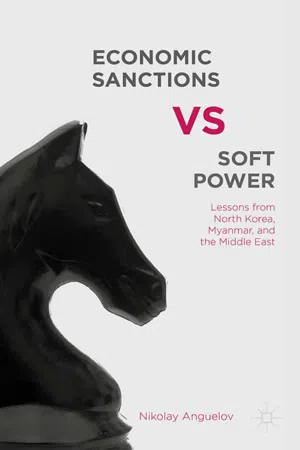
Economic Sanctions vs. Soft Power
Lessons from North Korea, Myanmar, and the Middle East
- English
- ePUB (mobile friendly)
- Available on iOS & Android
eBook - ePub
About this book
The book examines the industrial growth of sanctioned nations in terms of their ability to foster trade partnerships with countries that choose to evade or not comply with sanctions. When those "black knight" nations find strong local market competitive advantages in the absence of firms from sender nations, incentives develop to support local political status quos. For those reasons, the political resilience of rogue and repressive regimes is analyzed in terms of their economic incentives to remain repressive. The resilience is based on the fact that the local politicians are also the local businessmen. Through the growth of international production networks, their business opportunities augment and the rents associated with that growth also increase. As business opportunities grow in the absence of competition, so does the amount of rent extraction and protection. Rent protecting leads to strengthening economic and political leadership, because the wealth is used for creating further rents by providing economic benefits to the regime supporters. Economic Sanctions vs. Soft Power shows how the system of self-enforcing economic rents builds political rents and lowers opportunities for the development of viable political oppositions.
Information
Chapter 1

Economic Sanctions: An Overview
This chapter summarizes the extant literature on sanctions. The focus is on the evidence of sanction effectiveness that has led to their current popular use. Examined are ways to quantify sanction effectiveness historically and a discussion, if offered, of the applicability of those methods today.
Theoretical Background
The term “economic sanctions” refers to restrictions on trade and international financial assistance (Carter, 1987). Today, economic sanctions are at the forefront of international diplomacy. Their use as a means of achieving foreign policy goals has grown in popularity since the end of the Cold War (al-Roubaie and Elali, 1995; Dashti-Gibson et al., 1997; Hart, 2000). This growth is mainly due to the fact that sanctions are an alternative to military intervention. Other reasons for the popular use of sanctions today are: (1) a post–World War II awareness of the human cost of war; (2) the growing interdependence on the international economy, which has made nations more vulnerable to trade disruptions; and (3) the end of the Cold War, which has made more countries vulnerable to Western economic pressure (Rowe, 2000; Winkler, 1999).
Economic sanctions are “the deliberate, government-inspired withdrawal or threat of withdrawal, of customary trade or financial relations” (Hufbauer et al., 2009: 3). The “sender” is the country that is the primary originator of the sanctions. The “target” is the country that is the object of the sanctions (Hufbauer et al., 2009: 44). The four main types of trade limitations are: “(a) restrictions on the flow of goods, (b) restrictions on the flow of services, (c) restrictions on the flow of money, and (d) control of markets themselves in order to reduce or nullify the target’s chance of gaining access to them” (Miyagawa, 1992: 16).
Sanctions may be intended to compel the target country to change its policies or government. They may be used as tools of punishment against the target country in two ways. One is when sanctions are implemented against the target country for specific policies it has enacted within its borders. Another way that sanctions can be used as a diplomatic tool of punishment is when their benefits are meant for specific policy outcomes in the sender nation. Sender countries can employ sanctions in order to demonstrate their opposition to the target country’s policies in regard to specific domestic constituents, its citizens at large, other potential targets, and the international community (Carter, 1987).
As a leader in world affairs, the United States often imposes sanctions on less powerful countries. In many of these instances, the tactic is a credibility tool intended to signal the government’s position to both domestic and international audiences. America uses sanctions to both demonstrate its power and uphold confidence in its position as a world leader. A combination of increasingly combative international pressures and political polarization on the domestic front compels the government to continuously prove its credibility in this manner. Therefore, the American government operates under an ever-increasing scrutiny of its willingness to lead through action. In this system, any loss of confidence resulting from the imposition of sanctions would be minimal compared to the possible harm that would result from the government’s inability or unwillingness to act decisively in the face of international discourse (Hufbauer et al., 2009: 5).
Whang (2011) explains that in America, sanctions have become a convenient tool of political muscle-flexing aimed not at solving international disputes, but rather at showing local constituents and political rivals a strong presidential leadership initiative. The results of Whang’s study indicate that the benefits of sanctions are felt directly at home in the form of both political gains and a positive effect on presidential approval ratings. However, it is unclear if America’s approval rating increases internationally.
Drury (2001) put it bluntly by stating that domestic political gain is the hard currency behind sanctions. Such gain comes in several forms. As Whang (2011) points out, for the president it can be to the effect of both higher approval ratings and building important political coalitions. This outcome occurs when increasing presidential popularity leads to political entrepreneurship from members of Congress. Attempting to maximize their own political gain, the policy entrepreneurs show willingness to ingratiate themselves with a popular president. In the process, partnerships that can lead to building valuable political capital are forged, fostered, and cultivated. This process of building political capital has become very important in today’s polarized congressional environment.
In America, economic sanctions can be an immediate tool of presidential legislative action because of the fast track authority rule. Fast track augments the president’s power delegated to the office under Article I, Section 8 of the Constitution to conduct international trade disputes with other nations. The ambiguity of the statement puts sanctions under that scope, because they affect the direct trade of American goods and services with the sanctioned nation. Due to their authority to sign executive orders for the implementation of sanctions, presidents do not need congressional approval to impose sanctions as they see fit. The only exception is made in cases addressing disputes that deal with direct threats to national security. In those cases, the proposed sanctions are voted on by Congress within ninety days and they are either approved or rejected as proposed, without the ability of Congress to change specific terms (Kang and Greene, 1997). This provision is a safeguard against the lobbying efforts of domestic businesses that would be inadvertently hurt by the imposition of new sanctions. While it may seem like a rather long time for the deliberation of matters of national security, 90 days is considered a fairly short time period for the US Congress to act on anything, especially in the current climate of congressional partisan infighting that often leads to ideological standoffs. Kirshner (2005) argues that this polarized environment allows the president to conduct negotiations in a virtual absence of checks and balances. Both the awareness that Congress will have to vote within ninety days with the possibility of not having made any amendments, and additionally the strong possibility that even if Congress does not approve the sanctions the president will still be able to enact them by evoking the “failure to act” rule,gives presidents significant freedom to choose both the diplomatic issues and the nations with which to engage (Kaempfer and Marks, 1993). The failure to act rule allows the president to sign legislation through an executive order if he or she deems the issue to have implications for national security, even if Congress does not support the legislation. The overwhelming concern here is that, in this day and age, national security implications have become subjective, and therefore anything can become fair game for evoking the failure to act rule. The ambiguity of this provision put in place in an environment of increasing international interdependence provides a platform for augmenting presidential power. Therefore, it becomes foolish for a president not to implement sanctions. It is an immediate, easily publicized, powerful platform for showing leadership, building political capital, and creating coalitions. The United States is not alone in embracing the popular use of sanctions. The United Nation’s Security Council has also increasingly deployed sanctions toward applying diplomatic pressure, mainly because sanctions are an easy and low-cost alternative to employing military force.
However, the effect of sanctions internationally is unclear. Recent studies show that their failure rate is relatively high. Sanctions, overwhelmingly, fail to produce their intended results, mostly because they seldom cause a change in the overall pattern of behavior of political leaders in targeted nations. Rather, sanctions can lead to unintended negative humanitarian consequences for the populations they intend to help. They are generally the marginalized and oppressed members of the targeted nation societies (de Jonge Oudraat, 2010). For these and many other reasons, there exists a disagreement over the use of economic sanctions today. Many scholars debate whether sanctions are even an effective means of achieving foreign policy goals (Galtung, 1967; de Jonge Oudraat, 2010; Doxey, 1971; Kaempfer and Lowenberg, 1988; Marinov, 2005; Pape, 1997).
The general theory of economic sanctions proposes that sanctions would result in economic hardships, which would lead to political instability, and the ultimate result would be local government compliance with the sender government’s demands (Galtung, 1967). According to this theory, the main goal of economic sanctions is to lower aggregate welfare of a targeted state by reducing international trade. The justification is that the importance of trade has become so strong that it is a viable motivator to put pressure on a target government to the degree that it would change its political behavior (Pape, 1997). Therefore, the economic effect of sanctions is the most important predictor of their success (Dashti, Davis and Radcliff, 1997; Pape, 1997; Drury, 1998; Hart, 2000).
Supporting evidence of the theory has been found by Morgan and Schwebach (1997) and more recently by Hufbauer et al. (2009), who argue that often sanctions have an impact when they establish a significant level of economic hardship. A vein of research has found that in some cases measures of GDP growth, amount of international trade and capital, and FDI flows decline following the imposition of economic sanctions, while measures of unemployment, inflation, and debt rise (Manby, 1992; LeoGrande, 1996; Gibbons, 1999; Hufbauer and Oegg, 2003; Allen, 2008).
The degree to which sanctions affect the target economy depends on the target’s vulnerability to changes in trade with respect to capital flows, and foreign assets flows, as well as the transaction costs associated with the target’s response. Transaction costs of sanction response are the effort and resources governments must spend in finding alternative to the sender nation trading partners.1 The uniqueness of the target’s exports, the level of global demand for the target’s goods and services, and the target’s ability to evade sanctions, define the target’s transaction costs of finding alternative trading partners (Askari et al., 2005).
Special attention has been placed on foreign asset flows with respect to foreign direct investment (FDI). Hufbauer and Oegg (2003) find that on average, sanctions resulting in a 10 percent loss in FDI stock reduce a target country’s GDP by approximately 6 percent. FDI receives special attention in sanction research, in relation to foreign aid, for example, because of its interconnectivity with all trade activity. Even without an explicit ban on foreign investment, restrictions on other types of trade might cause additional indirect investment outcomes by creating an environment of political uncertainty. Political uncertainty is found to be a major deterrent of future FDI (Lensink and Morrissey, 2006).
Some research suggests that economic sanctions succeed by causing conflict or political turmoil in the target country (Kaempfer and Lowenberg, 1988; Marinov, 2005; Nossal, 1989). Conflict is defined as creating divisions between the elite and the general population, among the elites, or among both (Olson, 1979). Such divisions assist the sender in destabilizing the regime, resulting in a supposed change in leadership. This is the desired outcome, but is in fact the anomaly in real world outcomes. In most cases, conflict results and creates enough internal instability to encourage the target to bargain with the sender (Marinov, 2005). An argument also exists that even if sanctions do not result in a change in behavior of the target, they can still be considered successful if their main goal is to serve the symbolic function of signaling the sender’s disapproval of the target’s behavior and policies (Hovi et al., 2005).
Despite the high failure rate, economic sanctions have been successful in some cases. Links have been made between sanctions and the overthrow of Rafael Trujillo in the Dominican Republic in 1961, Salvador Allende in Chile in 1973, Idi Amin in Uganda in 1979, and Jean-Claude Duvalier in Haiti in 1986, and hastening the end of apartheid in South Africa (Carter, 1987). Case studies have illustrated the successful economic impact of sanctions in Nicaragua, South Africa, Iraq, India, and Pakistan that did not necessarily result in the overthrow of dictators, but still contributed to reaching the diplomatic goals of the United States. For example, in 1981 the United States imposed economic sanctions against Nicaragua that blocked trade and suspended foreign aid. The costs of the Contra War in the late 1970s and the economic policies adopted by the Sandinistas had already contributed to the country’s poor economic conditions, and the addition of sanctions had a significant effect in causing further economic hardship. LeoGrande (1996) shows that as a result of sanctions in 1985, Nicaragua’s GDP had decreased by 5.9 percent and inflation had increased dramatically. By 1988, its GDP had fallen by one-third and the standard of living decreased significantly. In South Africa, Manby (1992) estimates that economic sanctions led to a 7 percent drop in imports between 1985 and 1989. For the period between 1985–1990, sanctions and disinvestment cost the country approximately $20 billion.
Al-Roubaie and Elali (1995) show that sanctions against Iraq resulted in a 9 percent decrease in GDP. The direct impacts were reflected in decreased export earnings, decreased national income, an increase in unemployment, and increases in the price of goods and services. In 1998, the United States imposed economic sanctions on India and Pakistan. Morrow and Carrierre (1999) find that during the first few months following the imposition of sanctions, there was a reduction in capital flows to India. In Pakistan, private inflows ceased almost entirely and the Pakistani rupee depreciated significantly. The authors show that GDP growth decreased by 3 percent and the stock market fell by more than 34 percent when compared to other Asian markets.
As with most diplomatic tools, when it comes to sanctions it is seldom an all or nothing scenario (Hovi et al., 2005; Hufbauer and Oegg, 2003). In a comprehensive study on the effectiveness of economic sanctions, Hufbauer et al. (2009) examine 174 cases of economic sanctions in order to determine when they result in the achievement of foreign policy goals. The authors find sanctions to be at least somewhat successful in 34 percent of the examined cases. The general findings of the literature on sanction success conclude that the likelihood of success depends on country specific conditions such as the economic health and stability of the target, the relationship between sender and target, regime type, and the types of policy goals sought by the sender (Dashti, Davis and Radcliff, 1997; Drury, 1998; Hart, 2000; Miljkovic, 2002; Hufbauer et al., 2009).
Theoretical Gaps From Changing Realities
The period after World War II saw major growth in the development of the academic literature on sanctions. As noted, their increased rate of implementation, particularly after the Cold War, has led to some researchers questioning their newly popular use. The concerns mainly have to do with the effect of unilateral sanctions, that is, sanctions imposed by one nation, given the impacts of globalization. As early as the 1970s, and to this day, arguments are put forth that as a tool of diplomacy, the efficacy of sanctions may be diminishing in an increasingly globalized world because the economic leverage of any one country, even that of the United States—historically the largest economy in the world—has decreased (Doxey, 1971; Pape, 1997). As economies become more interdependent, it becomes easier for nations that are being sanctioned to minimize penalty impact by finding alternative trading partners and investment sources.2 Such partnerships become viable options to trading with America because of the fairly recent aggregate economic growth in the developing world.
Historically, the world economic balance had been centered in the West with America’s power dictating international trade policy and flows. However, since 2002, the impressive growth of the economies of the East and South has changed global economic power dynamics (Anguelov, 2014; Kaplan, 2010, Zakaria, 2011). As a result, increasing numbers of studies have focused on the limitations of sanctions. Many of these studies offer evidence not only of limitations, but also of sanction ineffectiveness (Choi and Luo, 2013; Early, 2009, 2011; Kaempfer, Lowenberg, and Mertens, 2004; Kozhanov, 2011; Peksen, 2009; Whang, 2010; Wood, 2008).
Whang (2010) examines data on sanctions, mostly championed by the United States, imposed between 1903 and 2002 in a multitude of nations, and finds that the overall success rate has been very low. The main reason is, as de Jonge Oudraat (2010) succinctly puts it, sanctions do not cause change in the political behavior of the governments in target nations. For such a change in political behavior to occur, the ruling regimes must feel challenged by local political descent against the policies that have resulted in the sanctions. A clear opposition must develop and that opposition must gain critical mass in popularity. However, because sanctions disproportionately mobilize the political power of the ruling regime, that scenario almost always fails to come to fruition.
An important reason for this failure is that even the most repressive regimes have local support. When sanctions are imposed, those in power feel threatened and respond by augmenting their level of repression in an effort to stabilize their ruling position. Government leaders increase the protection for core supporters who aid in suppressing popular dissent. Wood (2008) explains this dynamic and offers supporting empirical evidence of the proliferation of such behavior in all sanctioned nations in the 1970s, 80s, and 90s. A unifying feature in those examples of sanctioned nati...
Table of contents
- Cover
- Title
- Introduction
- 1 Economic Sanctions: An Overview
- 2 Myanmar—20 Years of Sanctions and Their Lasting Effect
- 3 Myanmar’s Sanction Legacy: The Results of Nonengagement
- 4 Absorb and Control: How North Korea Responds to Economic Sanctions
- 5 Alternatives to Sanctions
- 6 Sanctions or Soft Power: Implications for Competitiveness
- 7 Engage or Not? Conclusions and Policy Implications
- Notes
- References
- Index
Trusted by 375,005 students
Access to over 1.5 million titles for a fair monthly price.
Study more efficiently using our study tools.
Frequently asked questions
Yes, you can cancel anytime from the Subscription tab in your account settings on the Perlego website. Your subscription will stay active until the end of your current billing period. Learn how to cancel your subscription
No, books cannot be downloaded as external files, such as PDFs, for use outside of Perlego. However, you can download books within the Perlego app for offline reading on mobile or tablet. Learn how to download books offline
Perlego offers two plans: Essential and Complete
- Essential is ideal for learners and professionals who enjoy exploring a wide range of subjects. Access the Essential Library with 800,000+ trusted titles and best-sellers across business, personal growth, and the humanities. Includes unlimited reading time and Standard Read Aloud voice.
- Complete: Perfect for advanced learners and researchers needing full, unrestricted access. Unlock 1.5M+ books across hundreds of subjects, including academic and specialized titles. The Complete Plan also includes advanced features like Premium Read Aloud and Research Assistant.
We are an online textbook subscription service, where you can get access to an entire online library for less than the price of a single book per month. With over 1.5 million books across 990+ topics, we’ve got you covered! Learn about our mission
Look out for the read-aloud symbol on your next book to see if you can listen to it. The read-aloud tool reads text aloud for you, highlighting the text as it is being read. You can pause it, speed it up and slow it down. Learn more about Read Aloud
Yes! You can use the Perlego app on both iOS and Android devices to read anytime, anywhere — even offline. Perfect for commutes or when you’re on the go.
Please note we cannot support devices running on iOS 13 and Android 7 or earlier. Learn more about using the app
Please note we cannot support devices running on iOS 13 and Android 7 or earlier. Learn more about using the app
Yes, you can access Economic Sanctions vs. Soft Power by N. Anguelov in PDF and/or ePUB format, as well as other popular books in Politics & International Relations & International Relations. We have over 1.5 million books available in our catalogue for you to explore.