eBook - ePub
Media, Margins and Popular Culture
- English
- ePUB (mobile friendly)
- Available on iOS & Android
eBook - ePub
Media, Margins and Popular Culture
About this book
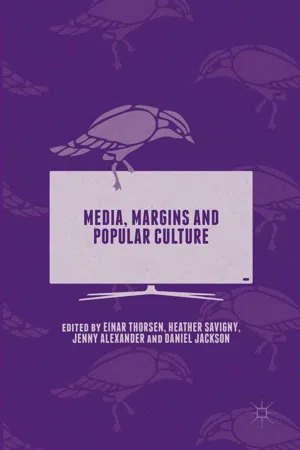
This collection brings together leading research on contemporary and popular culture, focussing on marginalised voices and representations; socially marginalised, marginalised in media and media scholarship. It spans five continents, with contributions on topics like gender, sexuality, nation, disability, disciplinary boundaries, youth and age.
Information
Part I
Gender and Genre
1
No Small-Talk in Paradise: Why Elysium Fails the Bechdel Test, and Why We Should Care
Christa van Raalte
Discussions of women in film are always about a great deal more than they may appear to be at first sight. Feminist film theory, which Sue Thornham characterises as ‘the exploration of the complex triangular relationship between “Woman” as a cinematic representation, women as historically and culturally positioned subjects, and the feminist theorist, who speaks … as a woman’ (1997: 171), has made a significant contribution to the development of feminist theory and thus, by extension, to the political project of feminism. For a while, the relationship between representations of women in movies and the status of women and opportunities for women in the real world has been neither straightforward nor insignificant. After a century of feminist activism, women are still marginalised in many areas of human activity throughout the Western world, and women remain marginalised in the outputs of the culturally powerful dream factory, that is, the Hollywood film industry. One need not look for a simplistic, causal relationship between these two facts to infer that this is not a coincidence.
In 1974, Molly Haskell observed that the image of woman in film functions predominantly as ‘the projection of male values’, ‘the vehicle of male fantasies’ or ‘the scapegoat of male fears’ (1987: 39). For all its limitations, she speculates that the despised ‘woman’s film’ offers the female filmgoer a degree of ‘compensation for all the male-dominated universes from which she has been excluded: the gangster film, the western, the war film, the policier, the rodeo film, the adventure film’ (1987: 155). Forty years on, Hollywood has evolved a new range of gender representations, inhabiting new and re-versioned movie genres in dialogue with new cultural sensitivities and anxieties, as well as new technological and economic contexts. Nevertheless, the representation of women in mainstream film remains problematic – both in qualitative terms (women are not found in 51% of key dramatic roles, or even 51% of speaking roles, across the range of mainstream releases) – and in qualitative terms (women still fulfil a relatively narrow range of roles and narrative functions and are still largely defined in terms of their relationship to men). The modern ‘chick flick’ continues to offer a degree of ‘compensation’ for the marginalisation or even the complete absence of women in a range of male-dominated movie universes. Despite the box office success enjoyed by some recent female-led action films, these exceptions, however notable, remain just that: exceptions that effectively prove the gendered rule.
Meanwhile, feminist film theory has also evolved, developing a complex, highly nuanced and sometimes conflicting set of understandings about how Woman operates as a textual sign, how women respond as audiences and how both relate to a wider social context. Film, however, continues to engage feminists who regard the medium to be significant in a number of ways: as an explicit and implicit reflection of cultural values and ideology; as a contributory factor within culture and ideology with the power to shape perceptions and understanding; as a conceptual laboratory within which to explore notions of agency, identity and desire; and as a battleground where different theoretical approaches and ideological positions lock horns.
In this chapter, I will examine some of these concerns through the prism of the Bechdel test, a cultural meme that has recently gained some currency in the popular press and attracted some opprobrium from film critics. I will apply the test to the sci-fi blockbuster Elysium (Blomkamp, 2013), arguing that the utilisation of the film’s two female leads, and the pointed manner in which they are deprived of an opportunity to pass the Bechdel test, brings into focus some critical concerns about the continued marginalisation of women in 21st-century Hollywood film.
The Bechdel Test: Why a 30-year-old joke still matters
The Bechdel test started life as a joke in cartoonist Alison Bechdel’s comic strip Dykes to Watch Out For. It was the subject of a 1985 episode titled ‘The Rule’, in which a woman tells her friend that for her to watch a film it has to meet three conditions. It has to have (1) at least two women in it (2) who talk to each other (3) about something besides a man. This, it is implied, excludes the majority of movies to be found playing in a mainstream cinema (Bechdel, 2005).1 The test has gained currency among feminists over the intervening years and has been somewhat refined along the way to maintain the spirit of the original, such that many commentators look for two named women, and more recently stipulate that they should talk for more than 60 seconds (Sarkeesian, 2012). Gathering momentum after the turn of the current century, largely due to the proliferation of alternative film and culture blogs, it crossed over into mainstream discourse with its usage (by male critics) in Entertainment Weekly and The New Yorker (Harris, 2010; Friend, 2011).
The significance of the Bechdel test becomes apparent on visiting the various fan sites that feature lists of films that pass or fail the test. Putting aside various long-running debates about disputed examples, this material points to a clear sense that those films that are taken seriously (by critics, financiers and fans alike) overwhelmingly depict the male-dominated universes identified by Haskell. The sceptic is advised to engage in a simple thought experiment: to draw up a list of films that would fail the reverse-Bechdel test. It is difficult to identify Hollywood films, of any genre, that fail to offer (1) at least two named men (2) who talk to each other (3) about something other than a woman. This reverse-test serves to underline the extent of the discrepancy and thus the degree to which women, women’s concerns and women’s voices are indeed marginalised across the outputs of the mainstream industry.2
The Bechdel test in contemporary commentary: Popular interest and critical objections
In the spring of 2013, Stacy Smith and her team at the Annenberg School for Communication, University of Southern California, published the latest in a series of reports on gender imbalance in the feature film industry. They analysed the 100 highest grossing films at US box-offices for the past five years and found that less than a third of speaking characters were female. For 2012, in fact, the figure was 28.4%, down from an unedifying high of 32.8% in 2009 (Smith et al., 2013). Smith’s report attracted a considerable amount of media coverage – both in the blogosphere and in the traditional media – which in turn seemed to reawaken popular interest in ‘The Bechdel test’ – an attractive motif for journalists, since it expresses with laudable economy many of the concerns addressed in Smith’s study.
Both fans and popular film critics made the connection between Smith’s study and the summer blockbuster Pacific Rim, with one fan proposing an alternative ‘Mako Mori’ test, focusing on narrative arc rather than interaction (Romano, 2013). Then in October, four Swedish independent cinemas and one cable network, supported by the Swedish Film Institute, announced that they would be applying an ‘A’ rating to films, based on the Bechdel test (Associated Press, 2013). This gave rise, as might be expected, to some impassioned responses from the test’s detractors (Koivunen et al., 2013).
Since the publication of the Annenberg report, the Swedish rating exercise and the associated media debate, the Bechdel test has been used (and misused) with increasing frequency on popular film sites, in the mainstream press and in commentaries on a diverse range of cultural phenomena including television drama, music videos, games, social media and even WWE wrestling. A term that has gained such widespread usage clearly speaks to a phenomenon in need of naming, and as such is worthy of serious academic attention despite (or possibly because of) its origins in popular culture. Indeed it is beginning to be utilised in academic writing (see for example Lawrence, 2011; Garcia et al., 2014; Law, 2014; Tešija et al., 2014), although largely in contexts other than that of mainstream Hollywood film for adult audiences – the context in which it was coined.
Nevertheless, the test induces very mixed reactions and more than a little discomfort among serious cultural commentators. As Charlie Jane Anders remarks in the blog io9, ‘The Bechdel test has become a huge part of our conversation about pop culture, but we all feel compelled to dismiss it or minimize it.’ (Anders, 2014), and indeed male film critics and feminist writers alike have been inclined to dismiss the test as simplistic, reductive or irrelevant. Mallory Andrews, for example, writing in the film blog Indiewire, takes issue with the test on the grounds that ‘[p]assing [it] … does not a female-positive film make’ (Andrews, 2014), while Robbie Collins opines, in the Telegraph, that ‘it fosters a way of thinking about films that has almost nothing to do with cinema’ (Collins, 2013).
The objections are, almost exclusively, predicated on the things the test is not. It is not a measure of film quality: Apocalypse Now would not pass, nor would The Good, the Bad and the Ugly, Citizen Kane or (notably) Run Lola Run … in fact, pick any title from the usual popular lists of greatest films and the chances are it will fail the Bechdel test. Neither can it be used to determine the feminist credentials of a film: Mean Girls would pass, as would any number of cheerleader films, Carry On films and Katharine Cookson dramatisations. Despite its almost exclusive focus on heterosexual relationships, Sex and the City also passes the test: they talk about shoes, after all.
However, the Bechdel test does effectively highlight the extent to which women are consistently marginalised across mainstream film, in terms of both the number of speaking roles and the extent to which female characters are predominantly defined in terms of their relationships with men. Its simplicity, I would argue, is a point in its favour, making it immune to the kind of post-modern sophistry that might otherwise serve to obscure some unpalatable truths about modern culture and the society that produces and consumes it. And while it does not grapple with qualitative issues of ideology and representation, it does have the virtue of being relatively objective. It is its simplicity and clarity that makes it so appealing to popular commentators like Aja Romano, for whom it is ‘hitherto unrivaled for its basic stark illustration of how difficult it is to find movies that feature women as characters independent from male storylines’ (Romano, 2013). The same simplicity endows it with considerable rhetorical power, as Mark Harris remarks: ‘The wonderful and tragic thing about the Bechdel test is not [ … ] that so few Hollywood films manage to pass, but that the standard it creates is so pathetically minimal’ (2010). This simplicity is deceptive, however. The specific criteria of the test actually speak to key theoretical issues with regard to the representation of women in film, which helps to explain why these apparently ‘minimal’ standards prove so challenging for mainstream film.
A joke to take seriously: The Bechdel test as a critical tool
The first criterion of the test concerns a minimum number of women. As Smith’s study clearly demonstrates, there is an issue with the representation of women in film in a purely statistical sense. The 30% of speaking characters that are female do not constitute a proportionate sample of the population, and when a population is under-represented in this sense within media texts, the burden of representation placed upon each character is always problematic. The problem is exacerbated, moreover, in the case of the single female lead since, as Claire Johnston (1973) and successive feminist critics have compellingly argued, within a classical narrative structure she will invariably be required to fulfil the role of ‘Woman’, a mythical creation having little to do with actual women and everything to do with defining masculinity. Multiple female characters undercut this and open up the possibility of a broader understanding of what it might mean to be a woman. The fact that the test takes no account of the narrative prominence of female characters and fails female-led action films such as Salt (2010) is not an oversight but a key element of the perspective it brings.
The requirement for the two characters to talk – as opposed to simply share a scene, or take part in some form of physical interaction – is particularly interesting. Women’s voices have been problematised throughout history and culture. Kaja Silverman in The Acoustic Mirror (1998) notes the various ways in which women’s speech is repressed, silenced, rendered unreliable or damaging or emptied of authority in film narratives. Moreover, conversation between women raises the possibility of a relationship between them as independent human beings without reference to a male character. In a similar vein, the stipulation that the conversation should be about something other than a man serves to highlight the prevalence of female characters whose narrative roles are defined entirely in terms of the male characters in a film. In practice, films that easily pass this requirement tend to be, themselves, about something other than a man.
This is not to say that such films will be ‘feminist’ texts – indeed the feminist potential of film discourse is always contested and never straightforward, not least due to the practice of ‘reading against the grain’ that is central to so much feminist writing on film. Arguably, any relationship or conversation between women, however, that is not male-orientated opens up spaces within the text to explore questions and concerns that are frequently marginalised, raising the possibility, however tentatively, of a discourse and a narrative that is not entirely phallocentric.
The activists responsible for persuading Swedish exhibitors to adopt the ‘A’ certificate focus on just this point when challenging their detractors: ‘Instead of rejecting the Bechdel test and the A rating as simplistic, critics should focus on the obvious. What does it mean that, in film, women can barely be imagined to have important things to say to each other?’ (Koivunen et al., 2013). They go on to analyse some of the negative responses they received to their initiative, which betray some disturbing underlying attitudes such as those of the critic who suggested that the test is of no significance since many pornographic films would pass it. Apart from questioning the veracity of this claim, Koivunen and her collaborators suggest it might be ‘relevant to consider why pornography comes to these critics’ minds when imaginin...
Table of contents
- Cover
- Title Page
- Copyright
- Contents
- List of Figures and Tables
- Notes on Contributors
- Introduction: Marginalised Voices, Representations and Practices
- Part I: Gender and Genre
- Part II: Sexuality, Artistry and Self-Fashioning
- Part III: Nation and Its ‘Others’
- Part IV: Disability and Diversity
- Part V: Disciplinary Boundaries
- Part VI: The Three Ages of ‘Man’ (Youth, Age, Minoritarian Masculinity)
- Index
Trusted by 375,005 students
Access to over 1.5 million titles for a fair monthly price.
Study more efficiently using our study tools.
Frequently asked questions
Yes, you can cancel anytime from the Subscription tab in your account settings on the Perlego website. Your subscription will stay active until the end of your current billing period. Learn how to cancel your subscription
No, books cannot be downloaded as external files, such as PDFs, for use outside of Perlego. However, you can download books within the Perlego app for offline reading on mobile or tablet. Learn how to download books offline
Perlego offers two plans: Essential and Complete
- Essential is ideal for learners and professionals who enjoy exploring a wide range of subjects. Access the Essential Library with 800,000+ trusted titles and best-sellers across business, personal growth, and the humanities. Includes unlimited reading time and Standard Read Aloud voice.
- Complete: Perfect for advanced learners and researchers needing full, unrestricted access. Unlock 1.5M+ books across hundreds of subjects, including academic and specialized titles. The Complete Plan also includes advanced features like Premium Read Aloud and Research Assistant.
We are an online textbook subscription service, where you can get access to an entire online library for less than the price of a single book per month. With over 1.5 million books across 990+ topics, we’ve got you covered! Learn about our mission
Look out for the read-aloud symbol on your next book to see if you can listen to it. The read-aloud tool reads text aloud for you, highlighting the text as it is being read. You can pause it, speed it up and slow it down. Learn more about Read Aloud
Yes! You can use the Perlego app on both iOS and Android devices to read anytime, anywhere — even offline. Perfect for commutes or when you’re on the go.
Please note we cannot support devices running on iOS 13 and Android 7 or earlier. Learn more about using the app
Please note we cannot support devices running on iOS 13 and Android 7 or earlier. Learn more about using the app
Yes, you can access Media, Margins and Popular Culture by Heather Savigny, Einar Thorsen, Daniel Jackson, Jenny Alexander, Heather Savigny,Einar Thorsen,Daniel Jackson,Jenny Alexander in PDF and/or ePUB format, as well as other popular books in Social Sciences & Literary Criticism. We have over 1.5 million books available in our catalogue for you to explore.