eBook - ePub
Sport and the British World, 1900-1930
Amateurism and National Identity in Australasia and Beyond
- English
- ePUB (mobile friendly)
- Available on iOS & Android
eBook - ePub
Sport and the British World, 1900-1930
Amateurism and National Identity in Australasia and Beyond
About this book
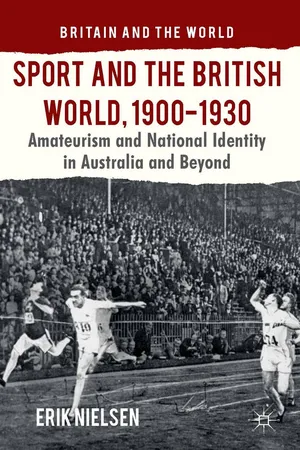
This book provides a lively study of the role that Australians and New Zealanders played in defining the British sporting concept of amateurism. In doing so, they contributed to understandings of wider British identity across the sporting world.
Information
1
Introduction
The question of the impact of Britishness on identity has regained a foothold within Australian historiography in the past decade. Neville Meaney’s work, particularly articles published in 2001 and 2003, has been central to this renewed interest.1 Sport played a cursory role in this preliminary discussion, with Meaney and John Rickard arguing over whether the behaviour of crowds at test matches was suggestive of a significant nationalist response.2 In 2006 Tony Collins chided both these historians for assuming that vociferous Australian barracking represented nationalism, and situated Australian sporting culture within Australia’s British inheritence.3 Despite Collins’ intervention, sport still seems firmly outside the fold as far as Australian considerations of Britishness are concerned. A symposium in the December 2013 issue of History Australia considered the impact of nationalism and transnationalism on Australian historiography but made only sparing mention of sport. It was referred to as shorthand for diversion from serious debates within Australian political culture as Britain reoriented itself towards Europe in the 1960s; however. James Curran assured readers that the ‘talk of crisis and anxiety’ that he and fellow Meaney protégé Stuart Ward had identified in this period did not suggest ‘that this crisis of meaning diverted forever the Australian gaze from the sports pages in the newspapers’.4 Curran’s flippant aside speaks volumes for the assumption that sport belongs outside serious consideration of Australian understandings of Britishness.
This study takes the opposite view, and argues that sport has much to offer our understanding of Britishness in an Australian context. This is particularly true of amateur sport, which historians identify as the dominant form of Australian sport at the same time that Britishness dominated Australian political culture. Amateurism has been described by Richard Cashman as ‘the core and enduring ideal which dominated Australian sport for over a century’.5 In a similar vein, Stuart Ward has argued that ‘[f]or much of the twentieth century, Australian political culture was characterised by a deep attachment to the British embrace’.6 A study of how these two issues influenced each other is vital to establishing the importance of sport in Australia during the nation’s formative years. This monograph explores the interrelated significance of these concepts to the development of Australian sporting culture by providing an examination of how the Amateur Athletic Union of Australasia (AAUA or Australasian Union) helped define amateurism in Australia and New Zealand between 1897 and 1927. It did so through a complex set of relationships across the British world – with metropolitan Britain, with former British territories (the United States) and with fellow British Dominions (Canada). The central pan-British relationship to this organisation was the Australasian relationship, which tied Australia and New Zealand together.7 Amateurism and Britishness were deeply entwined and influenced the development of each other in Australasian athletics through this period. Amateurism in Australasia subverted classic English conceptions and provided a dynamic that influenced the way that identity was expressed in regional and imperial contexts. In one sense, this study offers a fresh interpretation about the role of amateurism and identity in Australasian sport. At a deeper level, it is about the way a group of men made sense of the world and their place in it. The ideological tenets of amateurism are questioned as the actions and intent of its proponents are put under hitherto unparalleled historical scrutiny. The result is that Australasian amateur officials are shown to be less beholden to abstract notions of pure sport prevalent in England than historians have previously argued. The amateur community in Australasia contained individuals from a more diverse social background than those in England and North America, which meant that it engaged in activities that were considered outside the pale of amateurism in these other locales. The development of amateurism in Australasia influenced the development of identity in both an imperial and local sense. Tensions erupted between Australasian and English amateur officials due to the unwillingness of the latter to engage in tours to Australasia. Australasian relations with Britain were thus focused through channels outside the amateur mainstream. While historians such as Bill Mandle have argued that dissension with English norms resulted in the formation of national identities, this study takes its cues from historians such as James Belich, Neville Meaney and Tony Collins who stress continuity with British norms in Australia and New Zealand.8 It instead argues that disputes with the leaders of English amateurism were overcome by forming relationships with like-minded officials. Although these figures were less influential within English sport itself, their links with the Australasian Union placed that body closer to the centre of British sport. This process continued beyond Britain itself, with a relationship with Canadian amateur figures created on the same basis. This relationship was not strong enough to harmonise notions of amateurism between the two communities. In addition to defining amateurism and Britishness, this introduction will outline recent developments in the historiography of both. But first it is necessary to briefly outline the development of amateur athletics in Australasia.
The formation of the Australasian Union was the culmination of a three-decade-long process that began with the formation of independently acting clubs. The first amateur athletic club in Australia was the Adelaide Amateur Athletic Club (AAC), which was formed in 1867 by prominent members of the social elite of Adelaide.9 The club was charged with establishing amateur athletics in response to professional footraces, which were seen to introduce unwary young men to betting and ‘sharp practice’.10 John Lancelot (later Sir Lancelot) Stirling, an athlete from Adelaide, won an amateur hurdle championship of England in 1870, although the peak body of amateur athletics in England, the Amateur Athletic Association (AAA), was not founded until later in the decade.11
Despite this success, the Adelaide AAC was superseded by clubs in New South Wales. This was in no small measure due to the enthusiastic stewardship of Richard Coombes, who had arrived in Melbourne from England in 1886 before quickly moving on to Sydney. The first club formed in Sydney was the Sydney AAC, founded in 1872, with ten other clubs formed before 1883.12 This growth ultimately saw the formation of the New South Wales Amateur Athletic Association (NSWAAA) in 1887, the same year that the New Zealand Amateur Athletic Association (NZAAA) was established. Coombes was amongst the speakers who persuaded representatives of seven clubs to form the NSWAAA at a meeting on 20 April 1887 and was appointed to a nine-man committee to formulate the rules of the association.13 He served as vice-president of the association from 1887 until 1893, when he became president until his death in 1935. Coombes was elected to the International Olympic Committee (IOC) in 1905 and served until 1933. In addition to his athletics work, Coombes had parallel careers in sports as diverse as rowing, coursing – the antecedent of modern greyhound racing – and rifle shooting.14 Coombes’ role as an athletics administrator was supplemented by key roles in the development of the New South Wales National Coursing Association and the Australian Coursing Union.15 However, Coombes’ main sporting interest was athletics, and he bought to Australia a reputation as ‘a champion walker and cross-country runner’.16 As a journalist, Coombes wrote for newspapers such as the Sydney Referee on a multitude of topics, including athletics, coursing and rifle shooting.17
After the establishment of an effective association in New South Wales, Coombes set about promoting contests with the newly formed association in New Zealand. Coombes invited a team from New Zealand to compete at the New South Wales championship of 1890 and helped arrange the first Australasian championships with the inclusion of Victoria in 1892.18 The success of these championships saw the foundation of a regional body, the Australasian Union, in 1899 following the Australasian Amateur Conference of 1897.19 It survived until 1927, long after New Zealand had declined to join the Australian Commonwealth, with Coombes serving as president throughout the body’s existence.20
The formation of the Australasian Union influenced the manner in which athletes from Australia and New Zealand represented themselves on the world stage. Australian and New Zealand athletes competed at the Olympic Games of 1908 and 1912 as part of a combined Australasian team. Many historians have argued that representation at the Olympic Games creates a sense of national identity.21 This is not surprising due to the importance that identity has played in the development of sports history as a discipline in Australia. Bill Mandle asserted that a sense of Australian nationalism was engendered through the success of Australian cricket teams playing against England in the nineteenth century.22 Mandle influenced the ‘Imaginary Grandstand’ paradigm that argues that sport was significant to Australian culture as it produced an Australian identity. In this view, sport allowed for a sense of national identity to be embraced by Australians and to be expressed to an international audience. John Hoberman has described this process as sportive nationalism.23 David Montefiore has critiqued the so-called ‘Mandle Thesis’ for its focus on questions of national identity, arguing that internal reforms established the popularity of cricket. Cricket administrators were able to claim ascendency over players after a glut of international matches saw the popularity of cricket diminish in the 1880s as a result of these reforms.24 Montefiore moves the focus away from outward expressions of identity to internal aspects in establishing the significance of sport. This study argues that the path to creating an Australian identity in athletics was influenced by this integration with New Zealand, a phenomenon that might be termed the ‘Australasian amateur athletic relationship’. This identity was pan-British, not ‘nationalism pure and simple’, as Bill Mandle has described the reaction of Australians to cricket success against England in the late nineteenth century.25 Central to this pan-British identity was a shared commitment to the concept of amateurism.
Amateurism
Barbara Keys defines the moral code of amateurism as prescribing ‘not only playing without material reward [such as cash prizes or wages] but also a “gentlemanly” style, effortless and scrupulously fair’.26 To adherents of amateurism, professionalism destroyed the spirit of sport as it became overshadowed by the self-interest of the participants.27 For example, Lincoln Allison defines amateurism as being ‘about doing things for the love of them, doing them without reward or material gain or doing them unprofessionally’. The last aspect of this definition illustrates that amateurism is in part a negative definition. Allison identifies two aspects of sport that amateurism defines itself against, namely ‘the conflicting models of commercialism and professionalism’.28 Allison advocates a form of sport that reflects the positive aspects of his definition – while eschewing commercialism, professionalism and the punitive measures that were used to enforce amateurism. He finds the efforts of Avery Brundage, the President of the IOC between 1952 and 1972, to enforce the amateur code as ‘repulsive in its fanaticism’.29 Allison’s definition is ultimately philosophical. This study is concerned with what happens when the philosophy of amateurism meets the expediencies of creating a vibrant amateur athletic culture. How do amateur administrators act when faced with the realities of establishing themselves within Australasian sporting culture? Do they act the same way as administrators in other parts of the world? What can this tell us about the wider issue of Britishness?
Proponents of amateurism express a desire to purify sport of the pernicious influence of professionalism.30 The late Australian philosopher of sport, Bob Paddick, defined the distinction between amateurism and professionalism as the distinction between ‘an activity done for its own sake and an activity done for some further purposes’. Furthermore,
amateurism is the having of certain kinds of reasons for action. The reasons are all contained within the activity; there are no further reasons. Another way to express the same idea is to say that it is done for enjoyment, or it might be called ‘play’. Another name for amateurism is disinterestedness.31
As noted at the outset, amateurism became ‘the core and enduring ideal which dominated Australian sport for over a century’.32
The development of amateurism as a social force is often seen by historians in concert with the development of athleticism, or the games cult, in British public schools.33 Due to the deference that colonial society continued to pay Britain throughout the nineteenth century, the burgeoning Australian elite schooling system relied on British-trained masters influenced by the games cult to take charge.34 The employment of games enthusiasts soon became unavoidable as schoolmasters ‘were recruited almost exclusively from Oxford and Cambridge’, which acted as ‘little more than finishing schools for public school boys’ in this period.35 L. A. Adamson, a graduate of Rugby School who was headmaster of Wesley College, Melbourne, from 1902 un...
Table of contents
- Cover
- Title Page
- Copyright
- Contents
- Series Editors’ Preface
- Acknowledgements
- List of Abbreviations
- 1. Introduction
- 2. The Commercialisation of Australasian Amateur Athletics
- 3. The Role of Race and Class in Defining the Australasian Amateur Community
- 4. ‘Imperialism and Nationalism in Action’? Reconfiguring the Athletic Relationship with Britain
- 5. North American Cousins: Relations with the United States and Canada
- 6. A Question of Nationalism? The Dissolution of the Australasian Amateur Athletic Relationship
- Conclusion
- Notes
- Select Bibliography
- Index
Trusted by 375,005 students
Access to over 1.5 million titles for a fair monthly price.
Study more efficiently using our study tools.
Frequently asked questions
Yes, you can cancel anytime from the Subscription tab in your account settings on the Perlego website. Your subscription will stay active until the end of your current billing period. Learn how to cancel your subscription
No, books cannot be downloaded as external files, such as PDFs, for use outside of Perlego. However, you can download books within the Perlego app for offline reading on mobile or tablet. Learn how to download books offline
Perlego offers two plans: Essential and Complete
- Essential is ideal for learners and professionals who enjoy exploring a wide range of subjects. Access the Essential Library with 800,000+ trusted titles and best-sellers across business, personal growth, and the humanities. Includes unlimited reading time and Standard Read Aloud voice.
- Complete: Perfect for advanced learners and researchers needing full, unrestricted access. Unlock 1.5M+ books across hundreds of subjects, including academic and specialized titles. The Complete Plan also includes advanced features like Premium Read Aloud and Research Assistant.
We are an online textbook subscription service, where you can get access to an entire online library for less than the price of a single book per month. With over 1.5 million books across 990+ topics, we’ve got you covered! Learn about our mission
Look out for the read-aloud symbol on your next book to see if you can listen to it. The read-aloud tool reads text aloud for you, highlighting the text as it is being read. You can pause it, speed it up and slow it down. Learn more about Read Aloud
Yes! You can use the Perlego app on both iOS and Android devices to read anytime, anywhere — even offline. Perfect for commutes or when you’re on the go.
Please note we cannot support devices running on iOS 13 and Android 7 or earlier. Learn more about using the app
Please note we cannot support devices running on iOS 13 and Android 7 or earlier. Learn more about using the app
Yes, you can access Sport and the British World, 1900-1930 by E. Nielsen in PDF and/or ePUB format, as well as other popular books in History & Australian & Oceanian History. We have over 1.5 million books available in our catalogue for you to explore.