- English
- ePUB (mobile friendly)
- Available on iOS & Android
eBook - ePub
About this book
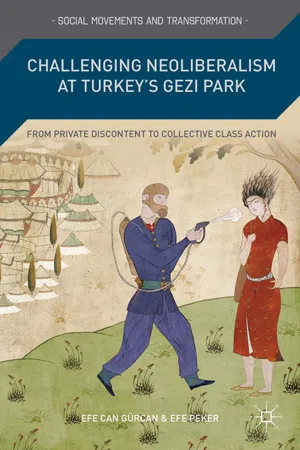
In Challenging Neoliberalism at Turkey's Gezi Park, Gürcan and Peker explore the events of May 31, 2013, when what began as a localized demonstration against the demolition of Gezi Park, a public park in Istanbul turned into a nationwide protest cycle with an unprecedented form and scale never before seen in Turkey's history.
Information
1
New Social Movement Theories and Their Discontents
The rise of neoliberalism as a global political economic project in the 1980s was parallel in time with what Ellen Meiksins Wood (1998) calls a tendency of “retreat from class” as an explanatory concept in social sciences. As she puts it, “the most distinctive feature of this current is the autonomization of ideology and politics from any social basis, and more specifically, from any class foundation”, which leads to a “rejection of the materialist analysis of social and historical processes” (Wood 1998, 2, 5). A significant repercussion of the escape from class in academia has been the outpouring of a post-Marxist literature on the “new social movements” (or the “cultural turn”) with poststructuralist or postmodernist leanings that reject the centrality of class analysis in the name of identity/civil society centrism. Post-Marxist attempts put into question the analytic relevance of social class and condemn any attempt to reclaim its conceptual centrality as an archaic and dogmatic practice of determinism.
This chapter is an attempt to provide a critique of new social movement (NSM) theories. The first section is devoted to a critical presentation of the main arguments of NSM theories based on the work of Alain Touraine, Alberto Melucci, and Manuel Castells. The second section discusses the Turkish counterpart of the European new social movement trend, which is known as the “(neo-)liberal Left” tradition for its post-Marxist/poststructuralist/postmodernist tendencies as well as its emphasis on civil society centrism, essentialism/demonization of the state, and other notions that exclude social classes, imperialism, and neoliberalism. In the final section we elaborate further on our Marxist critique of NSM theories and discuss the ramifications of these perspectives for the Turkish liberal Left’s response to the GPPs.
1a. The ABCs of New Social Movement Theories
NSM theories started out as an attempt to make sense of the neoliberal restructuration of the global political economic system starting from the 1980s, which ironically amounted to adopting the very epistemological assumptions of the neoliberal Weltanschauung. Spearheaded by European critical social scientists, they set out to critique the top-down approach of the new generation of US-based social movements theoreticians, who assigned a secondary role to cultural factors and agency (Polletta and Jasper 2001, 286, Buechler 1995). Alain Touraine, a French sociologist, is considered to be one of the founding fathers of NSM theories (Melucci 1989). Touraine contends that the “postindustrial condition” increases the autonomy and differentiation of social actors insofar as the state cedes to be an agent of social integration (Touraine 1988, 32–33). He explains that NSMs emerged among systemic transformations that led to drastic changes in the structure of society (Touraine 1988, 25). Using a mainstream economistic language, Touraine’s actor-centered approach views culture as a “stake” or “resource” that needs to be controlled and appropriated by social agents, and suggests placing culturally defined social action and agency at the center of sociological inquiry (Touraine 1988, 6–8). Accordingly, Touraine’s work defines social movements as “actors, opposed to each other by relations of domination and conflict [that] have the same cultural orientations and are in contention for the social management of this culture and of the activities it produces” (Touraine 1988, 9).
Building on a critique of modernity that allegedly denies all particularisms, insists on universal values and norms, and promotes a unilinear and evolutionist understanding of history, Touraine advocates for the necessity of “liberating” social actors from social systems’ structural confines by emphasizing the actors’ presumed autonomy in deciding their own cultural orientations (Touraine 1988, 3–5, 10–11, 26–27). Touraine’s rejection of social actors’ determination by external/structural factors and social systems leads him to the conclusion that “the subject can no longer be defined in historical terms” (Touraine 1988, 40). He goes on: “societies are less and less ‘in’ history; they produce themselves their historical existence by their economic, political, and cultural capacity to act upon themselves and to produce their future and even their memory” (Touraine 1988, 155). According to Touraine, the biggest “capital” or “investment” of social movements is their particularistic historicity, or simply their self-consciousness defined as the “capacity of a society to construct its practices from cultural models and through conflicts and social movements” (Touraine 1988, xxiv, 8, 11–12, 41). By acquiring historicity, social movements are able to ensure unity and control upon their activities so as to create and shape social situations (Touraine 1988, 11, 26).
At first glance, Touraine’s notions of social agency, particularism, and historicity seem to resonate with the GPPs in that most protesters stood up for the preservation of their secular lifestyles constrained by the AKP’s social interventionist policies. These interventions included, for instance, the stigmatization and limitation of alcohol consumption, abortion, C-section, public show of affection and love, nonmarital relationships, etc. However, as the following chapters of this book reveal, such social interventionist policies cannot be dissociated from their political economic background that set the stage for cultural struggles. This, of course, is not to neglect the fact that cultural struggles also have a determinative influence over political economic processes. The main point here is to stress that a fuller appreciation of cultural-ideological struggles requires an in-depth understanding of class dynamics and the historically and geographically specific processes of neoliberal restructuring. This, however, invalidates Touraine’s thesis that the actors are more and more outside of history insofar as they become purely “autonomous,” that is, under-determined by the course of universal history and other material forces.
Similar to Touraine, Alberto Melucci, the scholar who coined the term “new social movement theory,” builds on the assumption of “postindustrial information society” (Melucci 1996, 6). This argument advocates that the development of communication technologies gave rise to the emergence of a global media system so as to undermine class-based social conflict and analysis (Melucci 1996, 8–9). Melucci understands social movements as “complex networks among the different levels and meanings of social action” (Melucci 1996, 4). He points out that social movements’ capacity for autonomous action depends on their “collective identity” defined as “an interactive process through which several individuals or groups define the meaning of their action and the field of opportunities and constraints for such an action” (Melucci 1996, 67). Social movements are then expected to forge their collective identity, acquire autonomy, and express themselves through the use of symbolic resources and communicative networks (Melucci 1996, 79, 92, 113–114). As such, Melucci proposes to conceive of inequality and power on the grounds of control over the master codes, that is, “powerful symbolic resources that frame the information” (Melucci 1996, 178–179). Melucci further claims that the real power originates in the capacity of the global media to organize the people’s mind (Melucci 1996, 179).
Following Touraine’s lead, Manuel Castells provides an action- and outcome-oriented definition of social movements. Social movements are “purposive collective actions whose outcome, in victory as in defeat, transforms the values and institutions of society” (Castells 2010, 3). Similar to Touraine, he suggests analyzing social movements based on three categories: the movement’s “identity” (“the self-definition of the movement of what it is, on behalf of whom it speaks”), “adversary” (“the movement’s principal enemy”), and “societal goal” (“the movement’s vision of the kind of social order, or social organization it would wish to attain”) (Castells 2010, 74). Castells believes that the primary source of “purposive collective actions” is collective identity, that is “the process of construction of meaning on the basis of a cultural attribute, or a related set of cultural attributes, that is given priority over other sources of meaning” (Castells 2010, 6). Furthermore, NSMs rely on social networks, namely decentered forms of organizations that mobilize people by producing and distributing cultural codes (Castells 2010, 362). Castells propounds that the articulation of collective identity by social movements is primarily shaped by a global condition of what he calls “informational capitalism” or “network society,” giving privilege to the primacy of communication and media technologies (Castells 2010, 1). According to Castells, the state’s role in representing a unitary identity is seriously challenged by globalization as it provides fertile ground for the proliferation of plural identities as autonomous constructs. In addition, globalization supposedly decentralizes power and develops empowering communication and media technologies (Castells 2010, 271–272, 300–308, 342–343).
As Melucci and Castells would agree, there is no doubt that social media (Facebook, Twitter, etc.), alternative media, and other new communication technologies (smart phones, computers, etc.) played a significant role in the emergence and development of the GPPs in Turkey. However, the power of communication is only one side of the coin, and the source and content of collective action cannot be reduced to its means of communication. There is a myriad of other factors that are at least as important as the existence of communication networks and technologies. The latter does not mean anything by itself without the existence of strong movement strategies, leadership and membership dynamics, political consciousness, and so on. We will seek to demonstrate in the coming chapters that the strength of the GPPs emanated from a combination of mutually reinforcing collective action and leadership mechanisms, including the legacy of past struggles and historical experiences as well as the active involvement of socialist parties and groups, which are casted off as “vanguardism” by most NSM scholars.
In addition, as will be shown in what follows, what the GPPs rejected was not Castell’s amorphous notion of “informational capitalism,” but rather the Islamically articulated and legitimated urban neoliberal political economic policies of the AKP government itself. This very fact also invalidates Castell’s bold argument that the state is weakened in absolute terms and decentralized by some abstract “global forces” originating from information and technological revolutions. In fact, during the GPPs, the state came to use technological surveillance mechanisms both in the streets and on the Internet so as to arrest the social media users who supported or were directly involved in the protests. Social media and communication technologies, in this sense, are a double-edged sword in that the government also uses them to monitor the protesters more easily and spread disinformation (DigitalTrends 2013, TheGuardian 2013f, Today’sZaman 2013a). Even outside the particular context of the GPPs, it is well known that the state, as exemplified in the US government, employs social media and communication technologies to build a “centralized” intelligence database, contrary to Melucci and Castell’s assertions on “information society” that decentralizes and weakens states (Damon 2013, Washington’sBlog 2013, GlobalResearch 2011). Likewise, the increasing state potential to monitor and manipulate information reveals the inaccuracy of Touraine and Melucci’s overemphasis of the increasing potential of social actors to become autonomous, and independently define the meaning of their action.
1b. The Echoes of NSM Theories in Turkey: The (Neo)Liberal Left
Having its roots in the civil society centrism, essentialism/demonization of the state, and culturalism of the European New Left, the (neo-)liberal Left in Turkey constitutes a political-intellectual tradition that is represented by former Marxists, post-Marxists, liberals, poststructuralists, and postmodernists.1 Despite a few internal disagreements on minor issues, the liberal Left seems to agree on the democratizing effects of “globalization” and transnationalism as well as the need to drop or trivialize the concepts of social classes, the national state (unless it is essentialized/demonized), and imperialism (Aladağ 2013). Using Wood’s (1998, 7) language, the neoliberal Left perspective in Turkey can be regarded at best as “another repetition of banal and hoary right-wing social-democratic nostrums,” where “the idea that capitalist democracy need only be ‘extended’” for the creation of a just society lies at the heart of the analyses. Moreover, this intellectual tradition rejects “old-fashioned” notions such as US imperialism, equates anti-imperialism with chauvinistic nationalism and putchism, and argues fiercely for Turkey’s integration into the European Union (EU) for “democratization”—with nothing to say on the EU’s imperialist political-cultural initiatives (Engel-Di Mauro 2006). Reducing the whole history of the Turkish Republic to top-down authoritarianism and oppression, the proponents of the liberal Left contend that Turkey is dominated by “modernist and secularist elites,” who need to be overthrown by an alliance of liberal democrats and Islamists for the sake of “consolidating civil society” constrained by the all-dominating, all-encompassing state.
Tülin Öngen, a Marxist political scientist of Ankara University argues that the liberal Left has been a major constituent of the AKP’s hegemonic bloc known as the “Liberal-Islamist coalition” since the latter’s coming to power in 2002. This coalition aimed to neutralize and pacify the secular political opposition in Turkey by “colonizing people’s cognitive and lively world at a rapid pace” based on an artificial counter-hegemonic discourse (SolNews 2010). Accordingly, the liberal Left discourse draws on such euphonic notions as “civilianization” (as opposed to military dominance), “normalization,” “pluralism,” “identities,” “othering,” “human rights,” “freedom,” the “military-bureaucratic tutelage regime,” “elite rule,” “status-quoism,” and “anti-Kemalism.” In her influential article on the blind liberal support for the AKP government, French journalist Ariane Bonzon called these liberal intellectuals “useful idiots” of the Islamists, who “played a much more important role than one would expect from their small number and electoral weight. It was through them that the AKP built their image of a post-Islamist, liberal, democratic and reformist party” (Bonzon 2013). That the AKP pragmatically—and temporarily—used the ideological support of these liberals was openly admitted by the AKP party chairman for Istanbul Aziz Babuşçu in April 2013. Babuşçu declared that unlike the first decade of the AKP rule, they would not be needing the liberals’ support in their second decade, because “the Turkey that we will construct, the future that we will bring about, is not going to be a future that they will accept” (T24OnlineNews 2013b).
In what follows, we briefly outline the work of major Turkish liberal Leftist scholars, the majority of whom have published in the Anglo-Saxon academia and whose work pertain to sociological interests: Nilüfer Göle, Ferhat Kentel, Murat Belge, Ahmet İnsel, Mete Tunçay, and Baskın Oran. The rationale behind such discussion is not to provide a systematic critique of their conceptualization of the Turkish Republic, secularism, and modernism. Rather, we aim to reveal the civil society-centric, liberal democratic, and cultural reductionist essence of their New Left/NSM perspective so as to explain two points: a) why they sought to build a strategic and partially ideological alliance with Islamic neoliberalism, and b) how they accordingly failed to explain the multifaceted aspects of the GPPs.
Within the Turkish liberal Left, the scholar whose work most directly resonates with the NSM theories is Nilüfer Göle. A former student of Alain Touraine, Göle’s work points to the centrality of lifestyles and aesthetic values of secularism and Islamism in Turkey. Similar to most European New Leftists employing artificially counter-hegemonic, euphonic, yet blurred notions, Göle’s work is invested in “explor[ing] the plurality of cultural contexts and religious beliefs, the alternative sources of tolerance, public goods and pluralism” (Göle 2003, 18). In a repetitive and poetic fashion, Göle insists on the task of “searching for a plurality of sources of tolerance,” which is “closely associated with an intellectual endeavor to go beyond the Enlightenment version of modernity” (Göle 2003, 17). She goes on to embrace Islamism as a “critique addressed to mono-civilizational definitions of modernity,” where the latter is a detrimental “grand narrative” along with secularism, which obstructs the “definition of self” and the individual choice of alter-modern/Islamist lifestyles (Göle 2003, 19, 21, 24).
Parallel to Göle and Touraine’s appeal to pluralism, individual autonomy, and unconstrained social agency, Ferhat Kentel offers an “alternative” reading of modern Turkey that puts in the foreground the “polarization between religion and secularism” rather than that of social classes, in the name of pluralism, individualism, autonomization, and liberal democracy (Kentel 1998, 1, 5). Kentel goes so far as to assert that the Islamic individual as the catalyst for a new alternative and autonomous expression has become an eligible candidate for a “new ‘Left’ as an actor of democracy” (Kentel 1998, 14). Indeed, Kentel also believes that “new types of communities replace the nation that is no longer able to satisfy these subjects” insofar as the borders allegedly disappear (Kentel 2011, 61). The references to Göle and Kentel serve to reveal the rationale behind the idea of the Turkish liberal Left to strategically and ideologically ally with Islamism.
Establishing the centrality of a dichotomy between “authoritarian secularism” and “democratic Islamism,” which portrays the latter as the natural ally and agent of the New Left, many liberal Leftists conclude that Turkey’s problems are not class-related, or have anything to do with neoliberal capitalism. Instead, they are caused entirely by a lack of “liberal democracy” or an “excess of secularism” complemented by a vague problematic of “cultural oppression” and “othering.” Regarding the case of Turkish “despotic modernism,” Göle asserts that secularism has supposedly turned into an elitist “fetish of modernity,” which in turn made modernity function as a fetish in itself (Göle 2002, 184). According to Göle’s eclectic framework that rather carelessly combines Touraine, Clifford Geertz, Erving Goffman, Cornelius Costoriadis, Henri Lefebvre, and Pierre Bourdieu, the foundation and development of the Republic created nothing but a state ruled by loosely and superficially defined secular/despotic “elites.” This conceptualization leaves no room for a political economic analysis that accounts for the ways in which different classes create the conditions for the waging of cultural struggles. Göle portrays elites as “social groups such as intellectuals and the technical intelligentsia (engineers and technicians) which, through secular and modern education, have acquired a ‘cultural capital’” (Göle 1997, 46–47). This translates into the sphere of the Turkish liberal Leftist politics such that the liberal Left can (or should) well unite with Islamists, who represent the popular and oppressed “periphery” against the representatives of the dominating “center,” promoting top-down/elitist modernism, secularism, and “Jacobinism”—instead of capitalism itself.2
Murat Belge is another major figure of the Turkish liberal Left, whose intellectual evolution originates from a post-Althusserian stance on new social movement theories. In his book Socialism, Turkey, and the Future, Belge openly contrasts class movements with new social movements (feminisms, ecologists, anti-war movements, etc.) by criticizing the “class-reductionism” of Marxism (as cited and quoted in Aladağ 2013, 136, 139–140). According to Belge’s New Left account, the most important problem in contemporary Turkey is the crisis of democracy and the despotic rule of Kemalist elites and institutions (Belge 2009). In parallel, Turkish socialism’s emphasis on anti-imperialism and class struggle does nothing but further intensify this crisis by also propagating chauvinistic-nationalist ideas as well as militarism. Like other liberal Leftists, Belge contends that Turkey’s accession into the EU can play a crucial role in overcoming the “crisis of democracy.” Accordingly, he disapproves of the anti-imperialist position of many Turkish socialists vis-à-vis the EU. Us...
Table of contents
- Cover
- Title
- Introduction: Neoliberal Globalization, State Intervention, and Collective Action
- 1 New Social Movement Theories and Their Discontents
- 2 Debunking the Myth of “Middle Classes”: The Class-Structural Background of the GPPs
- 3 “Neoliberalism with Islamic Characteristics”: Political, Economic, and Cultural Conjuncture of the GPPs
- 4 Organizational-Strategic Aspects of the GPPs: Leadership and Resistance Repertoires
- 5 Forging Political Consciousness at Gezi: The Case of “Disproportionate Intelligence”
- 6 Looking Ahead: “Gezi Spirit” and Its Aftermath
- Notes
- Bibliography
- Index
Trusted by 375,005 students
Access to over 1.5 million titles for a fair monthly price.
Study more efficiently using our study tools.
Frequently asked questions
Yes, you can cancel anytime from the Subscription tab in your account settings on the Perlego website. Your subscription will stay active until the end of your current billing period. Learn how to cancel your subscription
No, books cannot be downloaded as external files, such as PDFs, for use outside of Perlego. However, you can download books within the Perlego app for offline reading on mobile or tablet. Learn how to download books offline
Perlego offers two plans: Essential and Complete
- Essential is ideal for learners and professionals who enjoy exploring a wide range of subjects. Access the Essential Library with 800,000+ trusted titles and best-sellers across business, personal growth, and the humanities. Includes unlimited reading time and Standard Read Aloud voice.
- Complete: Perfect for advanced learners and researchers needing full, unrestricted access. Unlock 1.5M+ books across hundreds of subjects, including academic and specialized titles. The Complete Plan also includes advanced features like Premium Read Aloud and Research Assistant.
We are an online textbook subscription service, where you can get access to an entire online library for less than the price of a single book per month. With over 1.5 million books across 990+ topics, we’ve got you covered! Learn about our mission
Look out for the read-aloud symbol on your next book to see if you can listen to it. The read-aloud tool reads text aloud for you, highlighting the text as it is being read. You can pause it, speed it up and slow it down. Learn more about Read Aloud
Yes! You can use the Perlego app on both iOS and Android devices to read anytime, anywhere — even offline. Perfect for commutes or when you’re on the go.
Please note we cannot support devices running on iOS 13 and Android 7 or earlier. Learn more about using the app
Please note we cannot support devices running on iOS 13 and Android 7 or earlier. Learn more about using the app
Yes, you can access Challenging Neoliberalism at Turkey’s Gezi Park by E. Gürcan,E. Peker in PDF and/or ePUB format, as well as other popular books in Social Sciences & Politics. We have over 1.5 million books available in our catalogue for you to explore.