eBook - ePub
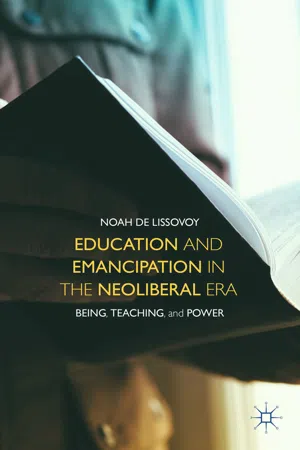
Education and Emancipation in the Neoliberal Era
Being, Teaching, and Power
- English
- ePUB (mobile friendly)
- Available on iOS & Android
eBook - ePub
About this book
This book describes how neoliberalism as societal philosophy works to limit human potential in our school systems. Analyzing contemporary school reform and control, punishment, and pathologization in schools, this book outlines a theory of emancipation and a process by which pedagogy can build solidarity in classrooms and society more broadly.
Information
Topic
EducationSubtopic
Education Theory & PracticeChapter 1
The (Ir)rationality of Austerity
Austerity is everywhere the order of the day. From the level of regional and national economies to the level of individual choices and expectations, we are told that long-held habits of profligacy must come to an end. The books must be balanced and discipline restored to an out-of-control state and populace. Austerity, as the systematic cutting back on public spending, is the form that this discipline takes. Furthermore, cutbacks in the present increasingly are not thought of in terms of a temporary contraction within a cyclical economy but rather as the route toward a permanent reduction of the state itself—and a corresponding absorption into the private sphere of an increasing number of modes and sites of social life. Austerity is an essential moment in the broader neoliberalization of society within which a rationality of markets, entrepreneurialism, and competition is taken as the only legitimate frame for organizing public policy and public life. Austerity is at once neoliberalism’s political-economic strategy in relation to the public sphere and the moral-ideological schema it proposes to a global society in protracted crisis. Never only a technical intervention, austerity always figures itself also as a necessary and virtuous assault, as a contemporary Nemesis—a leveling karmic force of justice against the outrages and excesses of a decadent society.
In terms of economic strategy, the argument underlying austerity initiatives is that excessive government debt poses a threat to future generations and undermines business and consumer confidence in the economy. Furthermore, state spending is said to crowd out private investment and lead to inflation, and as a strategy to stimulate the economy and decrease unemployment, it is considered counterproductive in interfering with equilibria set by market mechanisms. By contrast, cuts associated with austerity measures are supposed to restore confidence to entrepreneurs by creating the anticipation of lowered tax burdens and increased opportunities for private investment, and they are touted as the best strategy for economic growth (even though evidence is notably lacking). An underlying predisposition toward privatizing the provision of goods and services is associated with these arguments; austerity, in this regard, is ostensibly a means to rescue increasing sectors of society from the “tyranny” of bureaucratic and irrational state administration. Schooling has lately become a privileged site for the implementation of austerity arguments and initiatives, and as many have observed, the starving of the public school system is deeply connected to its overall fragmentation.
Neoliberal austerity originally took the form of “structural adjustment” programs visited on the Global South by international financial institutions, in particular the International Monetary Fund (IMF) and World Bank. These programs required governments facing economic crises to undertake deep cutbacks, deregulation, and privatization in exchange for aid. However, structural adjustment has now forcefully hit the centers of the global capitalist economy, as Europe and the United States are increasingly in thrall to their own deficit hawks and fiscal disciplinarians. They have retold the narrative of the recent global debt crisis as a story of impulsive consumers and out-of-control sovereign debt—even if the true story of this crisis is one of overleveraged banks and unchained war spending. By contrast, Keynesian economists have convincingly argued that austerity measures imposed on states in crisis have failed to produce the economic growth they promised and that instead they have contributed to continued recession or stagnation as demand is undercut and as whole populations enter into a downward spiral of increasingly widespread immiseration coupled with increasingly severe conditions on assistance imposed by financial elites (Blyth, 2013; Krugman, 2012). Indeed, given the overwhelming evidence against its effectiveness, the persistence of austerity as a favored economic strategy should lead us to consider whether its official rationales in fact accurately represent its underlying rationality, as I will discuss.
Furthermore, neoliberal austerity is the grim face as much of a particular moral-ideological framework as it is of a political-economic philosophy. In this ideological framework, austerity is visited upon us at once as punishment and as savior—indeed, in the form of an expiation that will tame our evil spirits. As moral pedagogy, austerity is meant not simply to teach us to take responsibility for ourselves (to wean us painfully from the comforts of the “nanny state”) but also, more deeply, to accustom us to an entirely different tonality of the social—to teach us to live within a deeply bleak and foreshortened horizon (Klein, 2007). In gutting wages and public sector services in health, welfare, and education and in attempting to reframe the purpose of the state entirely in terms of security and surveillance functions, austerity does us the favor of teaching us our place, of punishing the hubris in us that aspires to something more than mere survival—and laying to rest the dreams of collective prosperity and solidarity that have lived not only in socialist or utopian narratives but even in other moments and experiences of capitalism itself. It is clearly this punitive morality, rather than an interest in the mere policy rationales, that lurks in the passionate rhetoric of the Tea Party conservatives, for instance, and energizes neoliberal educational “reformers” furious at the presumption of teacher unions and community activists.
And yet, even an analysis of austerity as a moral-ideological schema does not quite get to the deepest sense and order of its operation. Both the reasoning and the rage of neoliberalism, as they are called forth aggressively in the assaults associated with austerity, are connected to a more fundamental determination of the mode of being of neoliberalism and a more fundamental determination of the dialectics of capitalism itself. Progressive and critical exposés of the hidden agendas of austerity have usefully opened up the problem but have not resolved it. It certainly makes sense to understand the drive to shrink the public sector, lower wages, increase the vulnerability of workers, and privatize social support systems as part of a historical project of class struggle from the top in order to redistribute wealth upward (Harvey, 2005). Likewise, the moral pedagogy of austerity clearly works ideologically to deflect a generalized anxiety and anger from its proper target and to focus it instead, on the one hand, on the victims of neoliberalism and, on the other hand, on the state itself, as critics have described (Wacquant, 2009). However, the persistence of austerity in the face of its failure to deliver on its promises, the rigidity of its formulations, and its effort to render other arguments and discourses not merely less compelling but, in fact, inadmissible all point to a dialectic of neoliberal austerity that unites public policy, political rhetoric, and the ethics of individual conduct within a more fundamental logic of the social itself, as I will describe.
Immiseration and Education
Though austerity is hardly a new weapon in the neoliberal arsenal, in recent years it has risen to new prominence by increasingly setting the parameters for economic and social policy in Europe and the United States. It should be pointed out, as Césaire (1955/2000) did in relation to the brutality of Nazism, that the terrors of austerity were road-tested in the Global South before moving to the center of debate in the North; they only raise the ire of liberals now that they are reaching the capitalist “core.” That said, austerity is indeed now wreaking havoc globally, including in the centers of international capital—not simply in terms of absolute levels of immiseration but also in terms of damage done to basic democratic institutions and expectations of social solidarity. Of particular interest in this context is the pernicious combination of the slow starvation of and sudden assault on public school systems, which destabilize and fracture communities both inside and outside of schools.
The ravages that a zealous fiscal discipline has wrought on Europe are well known. In a series of devil’s bargains, Greece, in particular, has traded away the livelihood of its citizens, and its own sovereignty, for a series of ill-conceived bailouts, the benefits of which have flowed immediately to creditors. Strict controls on debt and deficit ratios, rollbacks on job and wage protections, and a manufactured consensus that asks working people to take responsibility for a structural financial crisis that is properly European, if not global, in extent has ravaged this society (Kuttner, 2013). Others face similarly dismal policies and prospects, and even the continent’s leading economies confront harsh retrenchments that seek to recover solvency and profitability for elites by fleecing regular people. As economists continually point out, this is a doomed strategy, even on its own terms, and yet austerity persists and insists. This curious paradox—why should elites persevere in a strategy that is apparently ultimately harmful to their own interests?—is at the center of the austerity problem (Callinicos, 2012), and I will consider it in the next section.
In the United States, in spite of the enactment of modest stimulus programs by the Obama administration in the wake of the 2008 crisis, the political consensus is similarly framed around the sacredness of budget cuts, “entitlement” reform, and a moralizing discourse that impugns the state for living beyond its means. The influential budget proposals of Paul Ryan, built on spending freezes and Medicare privatization, are no longer draconian enough for conservatives, who seem to almost want to destroy the ability of the state to function properly at all. Democrats long ago conceded the budget argument to the Right, and the disastrous recommendations of the Bowles-Simpson commission have come to be seen as moderate and reasonable. The postrecession “recovery” is anemic; gains in the stock market belie continuing widespread unemployment and poverty. And yet the passion for austerity abides and multiplies. Furthermore, in the broader “economy of racism” (Brown and De Lissovoy, 2011) that structures capitalism in the United States, it is people of color who are hurt the most by austerity and who are scapegoated most aggressively for its painful effects.
Education has been one of the most important sectors in which neoliberal austerity measures have recently been implemented. This is perhaps because antipublic arguments for efficiency and privatization have circulated in this sector for decades. Now, seizing the moment, corporate foundations, conservative think tanks, and big city mayors have sought to radically reorganize education through defunding and fragmenting public systems. Chicago, New York, Washington, DC, Philadelphia, New Orleans, and other city districts have experienced massive school closures within a broad “turnaround” strategy that reopens schools as privately run charters, boutique magnets for the affluent, or military-style academies (Lipman, 2011). The test-based accountability system works as a crucial rationale for these reorganizations, as well as for a broader reimagination of the meaning of education, as I describe in the next chapter. However, as we expose the pedagogical limitations of the testing obsession, we should also attend to the way it works in tandem with a basic assault on public schooling. As Michael Bloomberg, Rahm Emanuel, and other high-minded “reformers” lead the charge to fracture public schooling systems and to demoralize communities through school closures, we should remember that the first step to a truly broad-scale privatization of education is the defunding and disparagement of public schools. As I have argued with Alexander Means and Kenneth Saltman (De Lissovoy, Means, and Saltman, 2014), the point is not that the status quo in education should be preserved but rather that the public school still constitutes one of the most important sites for mobilizing democratic struggles for both education and society.
At the macro level, cutbacks in the educational system are a key moment within a broader process of neoliberal urbanism, which variously refashions the city on the terms of elites (Peck, Theodore, and Brenner, 2009). In this context, Lipman (2011) shows how education policy is linked to the deliberate gentrification and rebranding of the inner city and to the deliberate marginalization of low-income communities of color. Indeed, the histories of working-class neighborhoods are often appropriated in the marketing of new upscale development projects and the schools that are opened to serve them. At the same time, we can also see austerity at work in a deeper sense in the stripped-down “school time” that is produced in the classroom through the pedagogies of efficiency and hyperdiscipline that proliferate in the accountability era (García and De Lissovoy, 2013). The belt-tightening that dominates budgeting decisions is mirrored in the reconstruction of curriculum and instruction, even if this reconstruction is not framed in exactly the same rhetoric. Touted as more scientific and results-oriented, contemporary test-driven, scripted curricula and behavior modification programs subject students to an austere pedagogy—one that aggressively narrows possibilities for authentic learning and becoming, instead offering students a meager diet of test rehearsals and behavior charts.
Neoliberalism seeks not to do away with the state but rather to reconstruct its internal rationality in terms of the market. Ball (2008) has discussed this transition in terms of the increasing power of public-private networks, within which business and philanthropic organizations are increasingly important in educational policy making. Neoliberal educational reform likewise aims to reconstruct the meaning of education that lives within public schools in terms of a pervasive entrepreneurialism, at the same time that it chops away at the public “monopoly” on education (Means, 2013). In this context, austerity is both an excuse for shrinking the public footprint in education and a wedge with which to reframe the basic rationality that governs it. After all—the argument goes—our culpable excesses can be seen not only in the hulking bureaucracies that mismanage school districts but also in the decadent ideas we cling to regarding education as a space for exploration, empowerment, citizenship, and critique. Austerity, as a philosophical frame for education, seeks to wean us from these old indulgences. What does schooling then become? A training in a certain kind of narrow cognition? A competition in compliance and self-surveillance? Not to worry—neoliberal morality assures us that the leaner personality proposed to students in this philosophy is exactly the kind that is required in the dawning epoch of “results” and “responsibility.”
Being Austere
The great paradox of neoliberal austerity, it would seem, is that in the drive to starve the public sphere and impose fiscal discipline, elites in fact undercut demand and thus prospects for economic growth and indeed future profit. Evidence of the recent and not so recent past clearly indicates the failure of austerity policies to restore economic health and growth to economies in crisis. Instead, consumers and businesses become caught in a downward spiral of anxiety, as they have fewer resources at their disposal, and worry about further cuts—a condition that itself contributes to contraction (Blyth, 2013). At the level of the moral-ideological register, the discourse of punishment and the grim judgment against the people that pervades austerity measures hardly contributes to optimism—or even to the entrepreneurialism that neoliberalism seeks to install as the guiding ethic for individuals and as the spiritual foundation for society as a whole. In short, austerity appears to undermine progress toward the very goals and values it proffers as essential while also potentially damaging the long-term balance sheets of the elites who champion it.
Austerity, however, springs from more than a self-interested shortsightedness and from more than an ideological common sense. Understanding neoliberalism as, in fact, a way of being and thinking—a kind of governmentality, in Foucault’s (2008) terms—can help us make sense of austerity and its persistence against the evidence that should otherwise discredit it. If competition and entrepreneurialism have become, in neoliberalism, not only the prevailing common sense but in fact something more like the inner truth of contemporary capitalist society, then arguments will not prevail easily against them. Likewise, as austerity comes to claim its place as an essential moment in latter-day neoliberalism, it also comes to be—like competition—an unimpeachable value that it is increasingly hard to imagine being without.
In his lectures from 1978 to 1979, Foucault understands neoliberalism not simply as an option for the market but rather as a rationality and ethic of conduct generally (2008). Against a reading of neoliberalism as simply insisting on an old-fashioned, laissez-faire approach to economic life, Foucault shows that neoliberalism demands powerful legal and policy interventions in order to create the conditions for the ideal competition it envisions. In this way, neoliberalism is less an assault on the state per se and more the institution of a new rationality for government—or rather the substitution of a new logic of governance, which internalizes the market and competition as its inner matrixes of intelligibility in place of government as old-fashioned statecraft. At the same time, the ethos of market-based competition and the reconceptualization of society itself as nothing more than the space of entrepreneurialism reorganize identities at every scale, turning the struggle to survive and thrive into a contest of salesmanship. We succeed in our personal and public lives to the extent that we become entrepreneurs of ourselves, peddlers of our human capital—selling not merely our labor power but the effective intelligibility of our identities.
This analysis helps explain the force of neoliberalism’s exclusion of all alternatives. If neoliberalism is not merely recommended or superior but rather—as governmentality—the proper measure of the effective and even the coherent, then alternatives to it are not just inferior but essentially unimaginable (Brown, 2003; Fisher, 2009). The turn to austerity in the current conjuncture, in this way, also becomes impossible to question or to think past. Thus the battle between Democratic and Republican “moderates” and conservative militants over the extension of the debt ceiling and government shutdown can be understood as not only a political struggle between two ruling class fractions but also a struggle among elites over the nature of their power. The intransigence of the fiscal conservatives can be seen in this way as a faithfulness—with of course catastrophic consequences in fact—to the truth of neoliberalism, a truth that brooks no alternatives. The age of austerity raises the stakes in the struggle over neoliberalism and capitalism itself—since its increasingly vicious prescriptions are not just the product of zealotry but rather the result of a fight for the soul of a system in crisis as well as a kind of ontological assertion of capital at the level of spirit and being.
In this way, austerity can be thought of as a second or special moment of neoliberalism—as neoliberalism in its darkest mood. However, the calamities wrought globally by austerity measures are figured by its proponents not in terms of vengeance but rather in terms of a stern justice. Societies and individuals, for as much as they have internalized neoliberalism’s market ethos, have also evaded and refused it. Austerity is the punishment for these refusals and the correction of these evasions. Austerity seeks to destroy the economic and social margin that permitted other socialities, solidarities, and identities (Duggan, 2003). Cutbacks and privatization are attacks on self and society’s space of becoming, even if the privatized identities that they seek to deliver are not really identities at all—since even individual identities only have true meaning against the background of a rich sociality. The essential contradiction at work here is not really economic (i.e., between regulation and intervention) but rather social: austerity proposes an absolutely privatized sociality, which, to be true to itself, must rend itself into shreds.
As Foucault (2008) describes, in neoliberalism, in principle any social choice can be submitted to an economic calculus, and any social potential can, and should, be figured in terms of a capital to be deployed:
First, the generalization of the economic form of the market beyond monetary exchanges functions in American neo-liberalism as a principle of intelligibility and a principle of decipherment of social relationships and individual behavior. This means that analysis in terms of the market economy or, in other words, of supply and demand, can function as a schema which is applicable to non-economic domains. And, thanks to this analytical schema or grid of intelligibility, it wil...
Table of contents
- Title Page
- Copyright Page
- Contents
- Acknowledgments
- Introduction
- 1. The (Ir)rationality of Austerity
- 2. The Ideology of Educational Accountability
- 3. Neoliberalism, Racism, and Violation
- 4. Rethinking Education and Emancipation
- 5. Coloniality, Capital, and Critical Education
- 6. Epistemology of Emancipation
- 7. A Pedagogy of Community
- 8. Conclusion: From Violation to Emancipation
- Notes
- References
Trusted by 375,005 students
Access to over 1.5 million titles for a fair monthly price.
Study more efficiently using our study tools.
Frequently asked questions
Yes, you can cancel anytime from the Subscription tab in your account settings on the Perlego website. Your subscription will stay active until the end of your current billing period. Learn how to cancel your subscription
No, books cannot be downloaded as external files, such as PDFs, for use outside of Perlego. However, you can download books within the Perlego app for offline reading on mobile or tablet. Learn how to download books offline
Perlego offers two plans: Essential and Complete
- Essential is ideal for learners and professionals who enjoy exploring a wide range of subjects. Access the Essential Library with 800,000+ trusted titles and best-sellers across business, personal growth, and the humanities. Includes unlimited reading time and Standard Read Aloud voice.
- Complete: Perfect for advanced learners and researchers needing full, unrestricted access. Unlock 1.5M+ books across hundreds of subjects, including academic and specialized titles. The Complete Plan also includes advanced features like Premium Read Aloud and Research Assistant.
We are an online textbook subscription service, where you can get access to an entire online library for less than the price of a single book per month. With over 1.5 million books across 990+ topics, we’ve got you covered! Learn about our mission
Look out for the read-aloud symbol on your next book to see if you can listen to it. The read-aloud tool reads text aloud for you, highlighting the text as it is being read. You can pause it, speed it up and slow it down. Learn more about Read Aloud
Yes! You can use the Perlego app on both iOS and Android devices to read anytime, anywhere — even offline. Perfect for commutes or when you’re on the go.
Please note we cannot support devices running on iOS 13 and Android 7 or earlier. Learn more about using the app
Please note we cannot support devices running on iOS 13 and Android 7 or earlier. Learn more about using the app
Yes, you can access Education and Emancipation in the Neoliberal Era by Noah De Lissovoy in PDF and/or ePUB format, as well as other popular books in Education & Education Theory & Practice. We have over 1.5 million books available in our catalogue for you to explore.