eBook - ePub
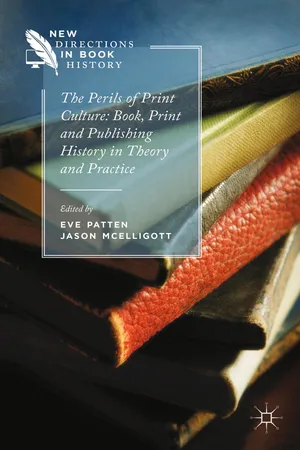
The Perils of Print Culture: Book, Print and Publishing History in Theory and Practice
- English
- ePUB (mobile friendly)
- Available on iOS & Android
eBook - ePub
The Perils of Print Culture: Book, Print and Publishing History in Theory and Practice
About this book
This collection of essays illustrates various pressures and concerns—both practical and theoretical—related to the study of print culture. Procedural difficulties range from doubts about the reliability of digitized resources to concerns with the limiting parameters of 'national' book history.
Information
Topic
LetteraturaSubtopic
Letteratura generale1
The Perils of Print Culture: An Introduction
Jason McElligott and Eve Patten
The promise of print culture studies
Three dates, 1588, 1688 and 1788, are significant in the history and development of print culture in Europe. In 1588 the Spanish Armada set sail for England with a cargo of troops and artillery. The flotilla was designed to facilitate a conquest in the traditional manner – fire, sword, and the occasional forced conversion – and, as such, there was no need to bring printed materials or a printing press.1 One hundred years later, in 1688, the Dutch fleet that successfully invaded England brought with it troops and the matériel of war, but also a printing press, a large quantity of paper for printing, and tens of thousands of copies of propaganda leaflets printed in English in the United Provinces.2 These were designed to rally the populace to the side of the invader. By the end of the eighteenth century, print had become so ubiquitous that the First Fleet that landed at Botany Bay in 1788 inevitably brought with it a printing press:3 by then it was impossible to conceive of creating a society without recourse to this technology. The similarity of the three dates is a coincidence, but a suggestive one. It draws attention to the fact that the study of print and the presence (or otherwise) of a print culture in any society lead inevitably towards a series of both long-standing and more recently posed questions about the relationships between history, textual culture and print technology.
Not so long ago, historians tended to look down on printed items in favour of manuscript sources. Print, it was often argued, was open to distortion: if used at all, it was handled by academics with a marked distaste. Nowadays, such a view seems decidedly antediluvian. The past decades have seen the publication of a number of important and ground-breaking works on print culture, and it is no exaggeration to suggest that some of the most exciting work across a range of different chronological periods and geographical areas has been focused on this subject. In the Anglophone world, the development of electronic resources, such as Early English Books Online (EEBO) and Eighteenth Century Collections Online (ECCO) has obviously contributed to an explosion of interest in printed matter among scholars and students. Print culture has matured as a respectable area of research, with its own conferences, journals and monograph series. In a sense, one might say that we are all ‘print culturists’ now.
The study of print sources has many advantages. The rapid international spread of successive waves of technology across the centuries allows us to step beyond narrow national boundaries. So, for example, in the early modern period – an age in which very few people in any country travelled abroad – printing on a common, wooden printing press was identical across confessional and national boundaries; a printer who had served his time in Mainz in the 1470s, or London in the 1480s, or Paris in the 1490s, would have had no difficulty in operating a press anywhere in Europe.4 Books produced in any one European city could, and did, end up being distributed throughout several others, and readers could be stimulated to think nationally, internationally and transnationally while living decidedly local lives. The same is true of the modern period, and today the ubiquity of electronic forms of production, dissemination and reception has raised fundamental questions about the concept of ‘national’ cultures, and, indeed, about the nature of human culture itself in a global age.
Research into the history of print culture also helps scholars to look beyond and around the short parcels of time into which the past has traditionally been divided: Elizabethan, Jacobean, Caroline, Civil War, Restoration, Augustan, Romantic, Victorian, and so on. This long chronological timeframe for print culture allows scholars to ask questions which can both complement, and benefit from, work outside their usual chronological range and academic discipline. A study of print may even force us to redefine the timeframe of the eras in which we specialise. For example, it may no longer be possible to see the early modern period as beginning or ending with the appearance or disappearance of particular literary genres and forms, the fighting of notable battles, or the passing of a piece of legislation. It may instead be much more useful to reimagine the early modern as beginning with the advent of the common, wooden hand press in the mid-fifteenth century and continuing until that technology was finally replaced by steam-powered printing presses in the early nineteenth century. This technological definition of the early modern period would encompass the study of the differing effects and consequences of the wooden hand press: its initially gradual and then much more rapid spread across Europe; its complex relationship with oral and manuscript forms of transmission; and the varied roles that it may have played in the intense social, religious, cultural and political turmoil of the era.
In the same way, recognising the evolution of print technology might also help with the difficult demarcation of the ‘early modern’ from the ‘modern’. One might reasonably locate the start of the modern period with the invention and rapid spread of steam-powered printing presses, and a key event in that world-changing shift would be the secret, overnight installation of steam-powered printing presses in the offices of The Times of London in 1812, without the knowledge or consent of the workforce. By the same token, a characteristic of the transition from the modern to the post-modern would be the decisive shift, in the 1980s, away from the hot-metal printing technology pioneered in the early nineteenth century towards electronic forms of production and communication. Intriguingly, The Times of London was once again in the vanguard of this paradigm shift in 1985, when it moved with several other newspapers from its historic home on London’s Fleet Street to new electronically enabled premises at Wapping. In this respect, the newspaper demonstrates the shift of a post-modern culture towards new patterns of writing, thought and social interaction not simply facilitated, but actually determined and defined by the communication channels of electronic and digital media.
Towards a definition of print culture
Any book which attempts to explore the problems associated with the study of print culture must begin, ironically and inevitably, with the seemingly intractable problem of defining ‘print culture’ itself. Those who work in the field will know that the term is frequently used in a very loose and ill-defined fashion, often taken to mean nothing more than the presence of books or pamphlets in a society. But is this really adequate? Does the mere presence of books or pamphlets in a society constitute a print culture? One might approach the problem by way of a modern analogy: there were mobile phones in the late 1980s and early 1990s, but would one say that there was a ‘mobile phone culture’ at that time? Presumably not, and the comparison illustrates the distance we face between merely recognising the phenomena of print culture, and reaching a viable, responsible definition of its constituency.
In many ways, the problem with our conception of print culture is laid bare in the Oxford History of the Book in Early-Modern Ireland. Across the 21 essays in this reference work, the reader is told on numerous occasions that a particular period, such as the 1590s, or the 1640s, or the 1680s, or the 1720s, saw the development of print culture in Ireland. In a characteristically thoughtful and sophisticated essay in that volume, Toby Barnard was the only contributor to ponder the actual nature of print culture.5 He suggested that there was no print culture in Ireland until the 1750s, because it was only then that politicians first turned instinctively to the press for politics and political discussion. This is a very useful definition of print culture, partly because it fits with work by Mark Knights on Britain,6 and also because it suggests that in the Irish context, print circulated for over 200 years before a discernible ‘print culture’, as such, existed. In other words ‘print’ and ‘print culture’ are not interchangeable concepts or categories.
There are at least two potential problems with such a definition of print culture, however; it tends to assume that all print is political, and it does not explain why, out of the blue, politicians would turn to print unless people were already used to seeing it, handling it and buying it in a variety of contexts. There has to be something else to constitute a print culture, or perhaps, to put it more clearly, there has to be something else to constitute the foundations or pre-history of print culture. One might consider, for example, that the desire or ability to use print to convert one’s political and religious opponents, rather than simply killing them, may be of the utmost importance. This would be a very useful definition of how and why there was a print culture in 1640s Britain but no print culture in 1640s Ireland. It would allow for comparisons and contrasts between different societies across centuries.
Alternatively, perhaps the transfer of words and imagery from the world of printing into other realms of society is an important indicator of the existence of a print culture. So, for example, John Cleveland’s poem of the 1640s which compares the physical act of intercourse to the printing of a page on a press may be very significant. It is not a very good poem (none of his poems were any good) and the imagery is quite crude, in both literary and sexual terms, but the metaphor is striking.7 One might also consider the preacher who, after the Great Fire of London in 1666, claimed that the capital had been ‘abridged’ from a ‘large volume in Folio’ to a small octavo pamphlet.8 The audience was obviously expected to know exactly what these bibliographical terms meant, and also what they implied about readership and social status. Many similar examples could be listed here, but the point should be clear: print culture is not simply defined by the presence of books in a society, but in a widely diffused social knowledge of, and familiarity with, books and with the culture of buying, borrowing, lending, reading and handling these physical items.
The key to locating the existence of a print culture may also lie in the ability of booksellers and printers to make money out of a whole range of non-essential or entirely frivolous items; in the same way that one might date the emergence of a mobile phone culture to the ability of various companies to make a fortune selling ring-tones or other frivolous accessories to the technology. In other words, it is not the number of units (whether of books or mobile phones) in circulation that is the key, but the ways in which those units are used and experienced, and the ways in which they impact upon the pre-existing norms of society. At the beginning of the early modern period, books were either expensive, lavish, almost fetishistic items such as highly ornate bibles and devotional works, or they were expensive utilitarian items such as schoolbooks or prescribed texts for those studying law, medicine or theology. By the end of the period, more than 300 years later, books were ubiquitous, unexceptional, commonplace, everyday commodities.
We should perhaps be particularly interested in the kinds of print which mark a transition from this first stage of print to the other. How do ephemerality and frivolity in print connect to the growth over time of a consumer society with more disposable income in its pockets? In this context, there may be a significance to the production of a set of playing cards by Francis Barlow, concerning the great events and personalities of the Popish Plot of the late 1670s; the printing of a paper children’s toy in 1651 representing the stages of human life from the cradle to the grave; and the circulation of a whimsical pamphlet produced in 1628 about the supposedly true adventures of a dog named ‘Drunkard’ who accompanied his master on the English military adventure to the Ile de Ré on the French Atlantic coast. These items may not have cost much money per se, but they were not ‘cheap print’ in the commonly accepted understanding of that term. Nobody needed these items. They were luxury commodities; innovative commercial spin-offs aimed at a public which could be persuaded to part with money for non-utilitarian goods which intrigued or amused them.
Several essays in this collection address the phenomenon of seriality, and there is a strong argument to be made that it is impossible to conceive of a print culture in any society without the presence of serial publication: corantoes, newsbooks, newspapers, magazines or literary journals. The emergence of these formats and genres across Europe in the early modern period marked not only the important technical achievement of being able to produce texts to a pattern and rhythm, but also the development of a commodity which allowed booksellers and publishers to attract customers regularly over a period of time. This repeat custom would often lead to the purchase of other items in addition to the serial publications that had been the initial object of desire. The development of seriality was obviously a function of living in interesting times, but it was also a striking technical achievement and a sophisticated commercial strategy.
Scholars of the English Revolution of the mid-seventeenth century have devoted much attention to the phenomenon of serial production in the years since the appearance of Joad Raymond’s seminal The Invention of the Newspaper (1996). For many academics in the field, printed books of news have provided a way of putting revolution, politics, ideology and controversy back into a period of history which was rewritten along consensual and conservative lines by a whole generation of revisionist historians in the 1970s and 1980s. This recent post-revisionist scholarship is not without merit, but in concentrating so much on newsbooks in the context of politics and disputation, scholars have lost sight of the pounds, shillings and pence which both motivated the production of these titles and underpinned their regular appearance over a period of time. The business nature of the newsbooks is best seen by reference to the growth of paid advertising. This developed slowly and fitfully during the 1640s, but during the following decade, the gradual return to peace and stability, the improvement of the economy, and the increasingly nationwide distribution of newsbooks facilitated an unprecedented growth in paid newspaper advertising. In total, 29 separate newsbooks carried more than 3,800 paid advertisements during the Interregnum of the 1650s. The number of newspaper advertisements soared from less than a dozen in 1649, to more than 900 in 1659. Almost 60 per cent of the 3,800 advertisements were for books and pamphlets produced commercially by a range of publishers across London.9 The use of advertising is one indication of the existence of a profitable, capitalised industry which is sensitive to the desires of customers and which tries to manufacture new cravings for non-essential commodities. Perhaps, then, those tracing the emergence of ‘print culture’ are really tracing the development of profitable commodities circulating in a market economy. Print culture is, in a sense, a study of early capitalism, but a capitalism which is decoupled from notions of radicalism, progress and inevitability.
In this context, it might be possible to put forward a working definition of print culture. A print culture can be said to exist when men and women from a range of backgrounds are used to seeing, reading, buying and borrowing print in a variety of social contexts. It exists when print is both commonplace and unexceptional, and when print is traded as a commodity within a market economy. In such conditions there will always be a level of serial publication which will contribute to, and be dependent upon, the increasing ubiquity of print and its related commercialisation.
The perils of print culture
So, the study of print culture, as defined above, has the potential to enable scholars to ask (and, better still, answer) questions on a range of topics in a variety of chronological and geographical settings.10 It also allows for a degree of theory which is unusual in most areas of contemporary Anglophone scholarship, encouraging students and academics to pay ...
Table of contents
- Cover
- Title
- Copyright
- Contents
- List of Figures
- List of Tables
- Acknowledgements
- Notes on the Contributors
- 1 The Perils of Print Culture: An Introduction
- 2 The Practice of Book and Print Culture: Sources, Methods, Readings
- 3 ‘Pretious treasures made cheap’? The Real Cost of Reading Roman History in Early Modern England
- 4 Early Printed Liturgical Books and the Modern Resources That Describe Them: The Case of the Hereford Breviary, 1505
- 5 ‘Lacking Ware, withal’: Finding Sir James Ware among the Many Incarnations of his Histories
- 6 Balancing Theoretical Models and Local Studies: The Case of William St Clair and Copyright in Ireland
- 7 The Impact of Print in Ireland, 1680–1800: Problems and Perils
- 8 Signs of the Times? Reading Signatures in Two Late Seventeenth-Century Secret Histories
- 9 Dangerous Detours: The Perils of Victorian Periodicals in the Digitised Age
- 10 Nineteenth-Century Print on the Move: A Perilous Study of Translocal Migration and Print Skills Transfer
- 11 The Problem with Libraries: The Case of Thomas Marshall’s Collection of English Civil War Printed Ephemera
- 12 The ‘Lesser’ Dürer? Text and Image in Early Modern Broadsheets
- 13 ‘Fair Forms’ and ‘Withered Leaves’: The Rose Bud and the Peculiarities of Periodical Print
- 14 ‘Print Culture’ and the Perils of Practice
- Select Bibliography
- Index
Trusted by 375,005 students
Access to over 1.5 million titles for a fair monthly price.
Study more efficiently using our study tools.
Frequently asked questions
Yes, you can cancel anytime from the Subscription tab in your account settings on the Perlego website. Your subscription will stay active until the end of your current billing period. Learn how to cancel your subscription
No, books cannot be downloaded as external files, such as PDFs, for use outside of Perlego. However, you can download books within the Perlego app for offline reading on mobile or tablet. Learn how to download books offline
We are an online textbook subscription service, where you can get access to an entire online library for less than the price of a single book per month. With over 1.5 million books across 990+ topics, we’ve got you covered! Learn about our mission
Look out for the read-aloud symbol on your next book to see if you can listen to it. The read-aloud tool reads text aloud for you, highlighting the text as it is being read. You can pause it, speed it up and slow it down. Learn more about Read Aloud
Yes! You can use the Perlego app on both iOS and Android devices to read anytime, anywhere — even offline. Perfect for commutes or when you’re on the go.
Please note we cannot support devices running on iOS 13 and Android 7 or earlier. Learn more about using the app
Please note we cannot support devices running on iOS 13 and Android 7 or earlier. Learn more about using the app
Yes, you can access The Perils of Print Culture: Book, Print and Publishing History in Theory and Practice by Jason McElligott, E. Patten in PDF and/or ePUB format, as well as other popular books in Letteratura & Letteratura generale. We have over 1.5 million books available in our catalogue for you to explore.