- English
- ePUB (mobile friendly)
- Available on iOS & Android
eBook - ePub
About this book
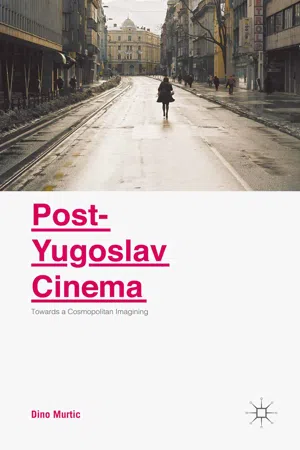
Drawing primarily on selected filmic texts from former-Yugoslavia, the book examines key social and political events that triggered the Yugoslav wars in the 1990s. Yugoslav politics and society are set within the broader artistic and cinematic strategies that helped stabilise post-Yugoslav territories strategies that were part of the national desire of looking forward to a time of 'perpetual peace' and its subsequent cosmopolitan norms. It argues that filmic texts demonstrate the degree to which nationalism was at the heart of the violent disintegration of Yugoslavia. Yet, the concern of the argument is not simply to offer a filmic critique but to develop an alternative to nationalism; namely, a theoretical framework through which cosmopolitan humanism is at the forefront of addressing former Yugoslavia's political wounds.
Information
Subtopic
Film & Video1
Theoretical and Methodological Considerations
Cosmopolitanism über alles
Theoretically speaking, this book finds its conceptual framework in ethical philosophies grouped under the umbrella of cosmopolitanism. This conceptual meditation on cosmopolitanism, however, begins with the presumption that cosmopolitanism is no longer a utopian concept; it has already been achieved (Balibar 2002). The consequences of ‘world unification’, explained by either the impact of rapid technological modernisation or the current domination of neo-capitalism, are clearly visible. Nonetheless, the majority of moral principles on which a utopian cosmopolitanism has been conceived, as a ‘precondition or an immediate consequence’ of humans’ interconnection, has not been implemented (Balibar 2002, p. 149). By bearing in mind Balibar’s observation, my aim in this book is to emphasise the role of filmic images in conceiving and reconfiguring the ethical and socio-political landscape of our time. In this sense, particular film art has the possibility to participate in, if not initiate, a critical dialogue between a cosmopolitan imagination and embodied ethics.
In its most idealistic form, cosmopolitanism is seen as a move towards the recognition and improvement of complex, but at the same time universal, human rights, developed and applied in a world that acknowledges both global diversity and global interconnectedness. At the moment, the integration of the Western Balkans in the European socio-political space is perceived as a conceivable pathway for permanent peace in the region. Perhaps, two world wars and the Holocaust were sufficient to persuade European intellectual and political minds to imagine a cosmopolitan Europe built on mutual understanding between its nations, the strict rule of democratic law, and emphasis on collective and individual human rights. Thus, in the past, ‘Europe has produced not only racism but also antiracism, not only misogyny but also feminism, not only anti-Semitism, but also its repudiation’ (Todorova 2009, p. 189). The next step for Europe, according to Todorova, is to find the ‘complementing and ennobling antiparticle’ (p. 189) in contemporary post-Yugoslavia. With a peaceful post-Yugoslavia, a united Europe might serve as a model for other regions in the world.
However, the post-World War II European (cosmopolitan) accomplishments should not be perceived as an exclusively European heritage. As Croatian philosopher Mario Kopic (2009) underlines:
With Christianity, Europe took over the 4,000-year-old Egyptian golden rule of interpersonal relationships (do not do to others what you do not want them do to you); the 2,600-year-old Buddhist emphasis on the sacredness of life; and Hellenic respect for the ‘law of death’ (as shown in Sophocles’ Antigone). As such, Europe has outlined a space for the autonomous dignity of a human being. (p. 29)
One may add here Fabrizio Tassinari’s (2009, p. 3) important remark that it was Islam that preserved Hellenic classical philosophy during the Middle Ages. It was the particular stream of philosophical Islam that existed in medieval Spain which made a crucial contribution of returning Hellenism to Europe. ‘The best mind in that continent [Europe]’, as James Cleugh (1953) perhaps poetically describes this period of European development, ‘looked to Spain for everything which most clearly differentiates a human being from a tiger’ (p. 70). The Spanish city of Cordoba, in particular, was of crucial importance for the development of a European humanism. With its 600,000 inhabitants and seventy libraries (the largest library had 600,000 titles) the medieval city of Cordoba was a European intellectual torch during the dark age (Burke 1978, p. 122). Only the epoch of wars and the consequent intolerance of the medieval Spanish rulers towards the Muslim and Jewish Other(s) would eventually destroy Cordoba’s pivotal role in European illumination.
Similarly to their medieval Spanish predecessors, the contemporary nationalists in the former Yugoslavia perceived the city as a threat. ‘Nationalism is’, as Tatjana Jovanovic (2009) argues, ‘an anti-urban philosophy’ (np). She continues by claiming that a ‘cosmopolitan City, as a community of people of urban spirit, is, at present, the only idea of our civilization which in its definition includes the Other’ (np).
The emphasis on a city, as an emancipatory and hospitable entity is the focus of Derrida’s essay On Cosmopolitanism (2001) in which he asks for the creation of ‘cities of refuge’, places that should have a legitimate separation from states, which would have the possibility of offering hospitality for all in need (p. 4). For Derrida (2001) the main question that humankind faces in creating such refuge is:
knowing how to transform and improve the Law [of hospitality], and of knowing if its improvement is possible within an historical space of which takes place between the Law of an unconditional hospitality, offered a priori to every other, to all newcomers whoever they may be, and the conditional laws of a right to hospitality, without which the unconditional Law would be in danger of remaining a pious and irresponsible desire, without form and without potency, and of even being perverted at any moment. (pp. 22–23)
Derrida (2001), apart from enigmatically mentioning that a ‘new order of law and democracy has yet to come’ (p. 23), gives no clue about how his idea of cosmopolitanism and unconditional hospitality for those in emergency should look. What I understand from Derrida is that it is his hope for cities, not states, to become refuges for those in need, and for cities to be able to accept and protect anyone who requires humanitarian intervention. For Derrida, re-empowered cities are the key to ensuring individual rights and the ability to create cosmopolitanism possibilities. For this book, however, the significant focus on the city of Sarajevo serves as a paradigm for Derrida’s (2001) meditation on a city ‘that has yet to come.’
By combining European norms on human rights since the end of World War II with the hospitability of the city, it becomes clear that the care for the Other is the foci of the very idea of cosmopolitanism. ‘A more genuine cosmopolitanism’, as Ulf Hannerz (1990) points out, ‘is first of all an orientation, a willingness to engage with the Other. It is an intellectual and aesthetic stance of openness toward divergent cultural experiences’ (p. 238). In the palette of dominant (and yet always incomplete), discourses, humankind’s ‘I’, ‘the Other’, ‘we’ and ‘they’ are generally grouped under the umbrella of class, gender, sexuality, race, religion and nation/ethnicity. The history of humankind shows that we/they relationships, with rare but important exceptions, have often been hypocritical or vicious until the point when we, in order to live, ‘must’ eradicate the other, either by physical elimination or the consequences of segregation (Foucault 2003). ‘It was only when subaltern figures’, writes Edward Said in 1989, ‘like women, Orientals, blacks and other “natives” made enough noise that they were paid attention to, and asked in so to speak’ (p. 210) that cosmopolitanism returned as a possibility. Thus, by following Said’s logic, the book emphasises particular ‘Other(s)’ from the Western Balkans that indicate another cosmopolitan possibility for the region, Europe and, perhaps, the world.
Critical theory
If cosmopolitanism is perceived as the conceptual frame for this book, then critical theory may serve as my theoretical approach. Critical theory, according to philosopher and media critic Douglas Kellner (1989), was animated by interests in the categories of ‘freedom, happiness and [social] justice’ (p. 14). Hence, critical theory ‘points to aspects of society and culture that should be challenged and changed, and thus attempts to inform and inspire political practice’ (Kellner 1995, p. 25). Unlike traditional theory, ‘critical theory’, as Robert Hattam (2004) underlines:
also involves a language of possibility … [and] might be understood to involve a struggle to explain the present in ways in ways that open to possibilities of a more socially just future. (p. 11)
Critical theory aims to speak the language of conventional social and political thought supplemented by a theoretical language required to address changing social circumstances and new forms of inequality and subjugation. Thus, the components of this theoretical vocabulary include traditional Marxist concepts of exploitation and ideology; feminist’s concepts of gender; postcolonial and poststructural concepts of racism, ethnocentrism and otherness; as well also drawing on the contemporary examinations that matter the socio-political struggles of Indigenous populations (Hattam 2004, p. 4). As such, the multifaceted dimension of critical theory fits appropriately with the main promise of this book, which is to give historical as well as contemporary alternatives to multiple otherness in the Western Balkans.
The significance of critical theory for this book also lies in the fact that this theoretical approach was one of the first philosophical meditations on the political functions of art, culture and mass media (Kellner 1989, p. 121). Walter Benjamin, in particular, believed that proliferation of mass art, especially through film, can contribute to a critique of society by suggesting new or alternative ways of being in the world. According to Kellner (1989), Benjamin argued that film would ‘raise political consciousness by encouraging scrutiny of the world as well as bringing critical images to millions of spectators’ (p. 124). Keeping in mind this aspect of critical theory, I now turn my focus to theoretical perspectives which are exclusively of film narratives and images.
Politically conscious film: its mimetic power, its historical significance, and its author
There are several approaches to studying film. Those approaches include, for instance, the study of film techniques, the study of genres, a focus on stars, and the study of regulation of the film industry, to mention a few. For this book, however, I focus on critical approaches to the matter of socio-cultural significance and the impact of film on a society.
It was on the eve of the civil war in Spain and at the zenith of Hitler’s pre-war power in Europe that Walter Benjamin (1936/1973) wrote his famous essay, ‘The Work of Art in the Age of Mechanical Reproduction’. In the essay, Benjamin was preoccupied with the capacity of the arts in general, and film art in particular, to predetermine an historical period. Consequently, for Benjamin, film has the potential to expose its viewers to the otherwise inapprehensible aspects of their own time in history. As such, Benjamin was indeed one of the first critical theorists interested in the political implications of film which, at that time, was a phenomenon that was relatively unconsidered in intellectual circles. Benjamin (1973) felt and described film as something unique in the history of art:
Mechanical reproduction of art changes the reaction of the masses toward art. (…) Painting simply is in no position to present an object for simulations of collective experiences as it was possible for architecture at all times, for the epic poem in the past, and for the movie today. (pp. 236–237)
Together with other segments of artistic expression, Benjamin perceived film aesthetics as one means to re-imagine and renew our social worlds. Yet, Benjamin was well aware of the possibility in which a filmic re-imagination of the world can swing in more than one direction. In Benjamin’s time, one direction led to the politicisation of art (Communism), the other to the aestheticisation of politics (fascism).
In the time when Benjamin wrote his ‘Work of Art’ essay, mainstream academia still refused to recognise the political implications of art and its political potential. For instance, Albert Guerard (1936) wrote the essay ‘Art for Art’s Sake’ where he argued that the aesthetic should be the only imperative for an artwork. According to Guerard (1936), art should never be placed ‘at the service of any other cause … and should make Beauty [its] sole guide’ (p. 264). Perhaps, it is important to emphasise the different hermeneutical circumstances of Guerard and Benjamin. In the 1930s, Benjamin lived an economically deprived life in Paris as a refugee who fled Nazi Germany, whilst Guerard wrote his essay from the comfortable perspective of a young scholar at Stanford University. Nevertheless, Guerard did change his stance on (a)political aspects of art. However, it only happened after he took an active role in World War II as an officer in the US Army. Thus, in the post-World War II years, as a prominent novelist and scholar, Guerard (nd) wrote that he was not capable of putting the ‘political subject aside’. Perhaps, his personal catharsis caused by the brutality of conflict changed his insistence on ‘art for art’s sake’ only.
Guerard’s fellow countryman and contemporary Don Thompson (2006), however, recognises the liberating potential of political art and underlines that the most ‘insightful of critical theory regarding film comes out of a stance that is at once inherently political, social, spiritual and economic’ (np). Thomson’s argument is that cinema is part of life, film is life’s imitation, and life embodies political, social, spiritual, and economic conditions all together. Thompson (2006) concludes that ‘politics in film has become vogue again, precisely because so many have recognized that without that kind of artistic dialog we lose our sense of who we are as a people’ (np).
For Benjamin (1973), art practices are the battleground for politics, and neither their tendencies nor outcomes can be predicted in advance. As one of the most influential Marxist critics, Benjamin influenced other followers of Marxism(s) to see cinema1 as an instrument for social change. Regardless of their differences, for most Marxists, films are always ideological: ‘they embody the value structures in which they are produced’ (Costanzo 2004, p. 67). A major function of the Marxist critic then, continues William Costanzo (2004, p. 67), is to ‘demystify’ the image, to expose the artifice in cinematic art and remind us that what seems natural and necessary may be only a matter of historical arrangements and therefore can be changed. For Kellner (2010), a film incorporates ‘aesthetic, philosophical, and anticipatory dimension’ (p. 14). As such, film, according to Kellner,
provide[s] artistic visions of the world that might transcend the social context of the moment and articulate future possibilities, positive and negative, and provide[s] insights into the nature of human beings, social relations, institutions, and conflicts of a given era, or the human condition itself. (p. 14)
Yet, visual narrative may be the cure and also the toxin. As imaginative interpretations of the world that mediate understanding, films have the capacity to shape social relations for better or worse. If cinema with progressive democratic and ethical ideas has the power to stimulate social changes, so also does non-democratic and conservative cinema. Film scholar Valenti (2000, p. ix), reminds us that Hitler was only the first political figure to be fabricated through manipulated cinematic images.
As a large component of mass culture, film provides the possibility to carry the voice of those who are marginalised by the elite who dominate in the (re)production of identity. By being represented on the screen, those on the margins of society build ‘trenches of resistance and survival’ against the dominant discourse in a society (Castells 1997, p. 7). However, the visual representation of disadvantaged subjects makes sense only if it has the possibility to be developed through a puissant dialogue on the intellectual and public level. As philosopher Judith Butler (2004a) explains:
it would be a mistake to think that we only need to find the right and true images, and that a certain reality will then be conveyed. The reality is not conveyed by what is represented within the image, but through the challenge to representation that reality delivers. (p. 146)
Through the visual portrayal or engagement of crucial issues, films can be viewed as providing opportunities to further respond to what is represented without taking it for granted or dismissing it. By asking difficult or seemingly impossible questions it is possible that sooner or later a film may lead to feasible attempts to resolve problems. In the instance of this book, it is putting the marginalisation of the Roma people in Western Balkans’ societies before the public that may lead to addressing and redressing current erasures. As Butler (2003) writes, language that challenges common sense can ‘help point the way to a more socially just world’ (p. 44). It is possible to argue that ethically engaged film narratives represent such a language, and can also move things beyond their current hidden state or cultural impasse. The demand for a written and/or visual language(s) that convey the full horror and reality of suffering has its place and importance.
The engagement of its viewers with the discursive power of film requires a couple of further questions that need to be unpacked for this book. How it is possible that cinema could have such an effective and persuasive influence on its viewers? What is it in the image that makes us emotionally close to fictional characters? For philosopher Alain Badiou (2009), the main advantage of cinema is in its status as a parasitic art that feeds on all other art forms. Further, Costanzo (2004) believes that, in some ways, filmic art may seem richer than literary forms. He sensibly underlines that it is not because cinema is somehow superior to literature. On the contrary, according to Costanzo, ‘literary codes are far more precise and elaborately developed than those in film’ (p. 4). For Costanzo (2004), however, the great advantage of cinema over literature is film’s ability to cover a ‘wider range of direct sensory experience’ (p. 4).
While there are many possible points in relation to the limits of emotional identification with a body on the screen, I want to draw attention to the limits of creating a visual image strong enough to blur distinction between a body on the screen and the darkness of a theatre’s seat. As Rutherford (2003) explains, not every dancer is able to provoke in a ‘spectator the feeling of the limbs unleashed from their sutures to the spine, of the spine unshackling itself from ...
Table of contents
- Cover
- Title
- Copyright
- Contents
- List of Figures
- Acknowledgements
- Introduction
- 1 Theoretical and Methodological Considerations
- 2 Once Upon a Time in Sarajevo
- 3 An Historical Fable of a Country That Is No More
- 4 Ordinary Men at War
- 5 Women Speak after the War
- 6 Roma: The Other in the Other
- Conclusion: Sarajevo and One Illusion in August
- Notes
- Filmography
- Bibliography
- Index
Trusted by 375,005 students
Access to over 1.5 million titles for a fair monthly price.
Study more efficiently using our study tools.
Frequently asked questions
Yes, you can cancel anytime from the Subscription tab in your account settings on the Perlego website. Your subscription will stay active until the end of your current billing period. Learn how to cancel your subscription
No, books cannot be downloaded as external files, such as PDFs, for use outside of Perlego. However, you can download books within the Perlego app for offline reading on mobile or tablet. Learn how to download books offline
Perlego offers two plans: Essential and Complete
- Essential is ideal for learners and professionals who enjoy exploring a wide range of subjects. Access the Essential Library with 800,000+ trusted titles and best-sellers across business, personal growth, and the humanities. Includes unlimited reading time and Standard Read Aloud voice.
- Complete: Perfect for advanced learners and researchers needing full, unrestricted access. Unlock 1.5M+ books across hundreds of subjects, including academic and specialized titles. The Complete Plan also includes advanced features like Premium Read Aloud and Research Assistant.
We are an online textbook subscription service, where you can get access to an entire online library for less than the price of a single book per month. With over 1.5 million books across 990+ topics, we’ve got you covered! Learn about our mission
Look out for the read-aloud symbol on your next book to see if you can listen to it. The read-aloud tool reads text aloud for you, highlighting the text as it is being read. You can pause it, speed it up and slow it down. Learn more about Read Aloud
Yes! You can use the Perlego app on both iOS and Android devices to read anytime, anywhere — even offline. Perfect for commutes or when you’re on the go.
Please note we cannot support devices running on iOS 13 and Android 7 or earlier. Learn more about using the app
Please note we cannot support devices running on iOS 13 and Android 7 or earlier. Learn more about using the app
Yes, you can access Post-Yugoslav Cinema by Dino Murtic in PDF and/or ePUB format, as well as other popular books in Media & Performing Arts & Film & Video. We have over 1.5 million books available in our catalogue for you to explore.