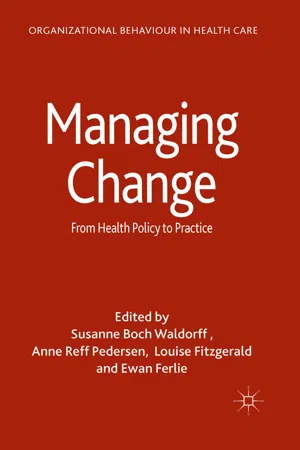
Managing Change is about implementing health care reforms, policies and programs into everyday practices. The book explores organizational change in health care as influenced by contemporary policy and management concepts, and presents and applies theoretical perspectives.
eBook - ePub
Managing Change
From Health Policy to Practice
- English
- ePUB (mobile friendly)
- Available on iOS & Android
eBook - ePub
Managing Change
From Health Policy to Practice
About this book
Information
Part I
Designing Change Processes
1
The Ideas and Implementation of Public Health Policies: The Norwegian Case
Charlotte Kiland, Gro Kvåle and Dag Olaf Torjesen
Introduction
In Denmark, Norway and Sweden, the municipal and regional administrative levels are in charge of implementing public health policies and measures on behalf of the state. In fact, both in Denmark (Waldorff, 2010; Vrangbæk and Sørensen, 2013) and in Norway (Report to the Storting no. 47, 2008–2009; Rommetveit et al., 2014; Torjesen and Vabo, 2014), recent reforms have emphasized the role of the municipalities in carrying out public health policies. In this chapter, we investigate the challenges of managing organizational change processes, in order to create changes in practices within the field of public health in the case of Norway. We study the relationship between changes in national policies and legislation and implementation at the municipal level. Our main question concerns how national public health policies are put into local practice. To answer this, we need to (1) investigate which ideas about the government of public health are articulated in national policies, (2) study how these policies are received and acted upon locally and (3) explain local choices regarding public health practices. Furthermore, in this chapter we present a theoretical framework focusing on major ideas on public health management and on the relation between ideas and practice in a neo-institutional perspective. This is followed by a brief presentation of the material and methods, as well as an explanation on how the empirical data are analysed. Then the analysis of the empirical data is presented, concluding the chapter with a discussion.
From ideas to implementation of public health policy
Broadly speaking, it is possible to distinguish between two different ideas of the management of public health: one that can be labelled ‘collectivist–integration’ and the other ‘individual–empowerment’. A collectivist–integration idea of public health entails that health is seen as a common good that should be distributed in an equal way. Poor health is a product of the structures of society. It is taken for granted that public health is a political responsibility. Governing public health is about regulative policies and formal structures at the system level. This policy corresponds with the World Health Organization (WHO) strategy ‘Health 2020’ (WHO, 2012), which emphasizes the interdependencies between social non-medical conditions and health status in the population and that health is a political issue as much as a scientific matter. This recognition leads to a whole-of-society and a ‘health-in-all-policies’ (HiAP) paradigm. A multi-sectoral approach is therefore crucial for promoting better health (Raphael, 2009; Jacab, 2011). With regard to management, this corresponds with the whole-of-government (WoG) approach (Christensen and Lægreid, 2007), focusing on coordination and integration between sectors and organizational units. These ideas are also anchored in the normative features of the Nordic welfare state, emphasizing equality, solidarity, redistribution and security for all (Esping-Andersen, 1990; Fosse, 2011). We would expect this idea of public health to dominate in a Nordic type of welfare state like Norway, and consequently that public health issues should be integrated within and across policy areas and organizational units.
However, the Nordic welfare system has changed towards neo-liberal values like efficiency, freedom, empowerment and self-responsibility (Mik-Meyer and Villadsen, 2007; Magnussen et al., 2009). Within the individual–empowerment idea, health is a product of choice, public health is the aggregate of individual choice and policy is about influencing health-related behaviour in more or less subtle ways. By the use of the concept empowerment, responsibility and control are moved from the state to the citizens (Andersen, 2003). The argument is that the empowered individual becomes responsible by taking healthy choices, obtaining self-control and accepting the fact that the health sector has limited resources. The state can be characterized as the ‘good shepherd’ or a ‘pastoral state’ (Dean, 2010: 91), and the government assumes that it is in a position to (re)define what is ‘for the citizen’s own good’ and to lead them to the appropriate ‘pasture’. With this idea about public health, improvement is achieved by encouraging, persuading and training the citizens to a healthy lifestyle. Manifestations of this idea would be regulative and educational measures directed at the individual. How are these ideas articulated in the Norwegian public health policy, and how are they handled by the municipalities?
One approach to understanding the relationship between ideas and practices is a neo-institutional perspective. Inspired by Meyer and Rowan (1977), Scott and Meyer (1994) and Scott (2013), we regard ideas about the management of public health as rationalized myths or cultural rules that puts an institutionalized pressure on organizations seeking legitimacy. However, the rationalized myths may not comprise an efficient solution for the organization, in terms of facing demands originating from the technical environments (Meyer and Rowan, 1977). In addition, competing and internally inconsistent rational myths can exist simultaneously. The theoretical argument is that organizations decouple their practices from their formal structure to solve problems of such institutionalized pressure and conflicting demands. Thus, organizations adopt new structures without necessarily implementing the related practices. In Nils Brunsson’s (2003) conceptualization, the conflicting demands and expectations result in a decoupling of talk, decisions and action. If this is the case regarding national policy ideas about public health, we will expect the organizational handling on the local level to result in decoupling of policy from actual local practice.
A related approach to understanding the relationship between ideas and practice is to recognize the ambiguities of change processes: change in practice occurs, but not necessarily as planned (Czarniawska and Sêvon, 1996; Brunsson, 2003). Røvik (2014) introduces ‘the translation doctrine’ in implementation studies, that is, the process in which an idea is made meaningful and useful by the associations of the actors involved, within the context where it is adopted (Latour, 1986; Czarniawska and Sevôn, 1996). As a result of the active process of interpretation, it could be claimed that implementation never occurs as a copy of the original decision or that outcomes are universal across different locations (ibid.). On the contrary, ideas will always be modified across time and space. However, according to Røvik (2007) both reproduction and modification of the original idea might be the outcome, depending on pragmatic local considerations and decisions regarding meaningful and useful practices. The more abstract, differentiated, ambiguous, but also embedded, the ideas or policies are, the more likely they are to be open to interpretation and change (ibid.). The more concrete, simple and disembedded they are, the easier they are to reproduce in a literal sense (Røvik, 2007). In accordance with this approach, we would expect that different ideas and policies are subject to translation processes resulting in modification or reproduction of the ideas in practice.
To summarize our theoretical framework, we have elaborated on two different ideas or rationalized myths concerning the management of public health: the collectivist–integration idea and the individual–empowerment idea. Further, we use the framework of the ‘translation doctrine’ to analyse how these ideas are interpreted and developed into a local practice in the field of public health, with possible outcomes like decoupling, modification and reproduction.
Material and methods
The empirical material in this chapter relies on primary data in the form of interviews and survey data1 and on secondary data in the form of national policy documents. We have conducted 16 in-depth one-on-one interviews with key individuals, at the national, regional and municipal levels. At the national level, we interviewed two senior advisors in the Norwegian Directorate of Health, in January 2013. We have also interviewed four public health coordinators from the two counties in the southern part of Norway, and at the local level six municipal doctors and four local public health coordinators from six municipalities in the same region were interviewed. These interviews were conducted between February and June 2013.
The national policy documents include three government white papers on public health launched between 2002 and 2013: the Coordination Reform, Planning and Building Act and Public Health Act. The empirical material is also based on secondary data, particularly recent research reports from the Norwegian Institute for Urban and Regional Research (NIBR).
Methodically, qualitative content analysis of documents is used to obtain the dominating ideas within the national public health policy and the public health field. The interviews from the national level (The Norwegian Directorate of Health) are used to deepen and discuss the content in the documents. Data from the interviews with key informants, from the regional and local level, are analysed to obtain subjective but typical experiences and reactions. The qualitative data are triangulated with the survey data to strengthen the validity and reliability of our interpretations.
To investigate how the ideas about public health are articulated in Norwegian public health policies, we have focused on definitions of problems, goals, legal requirements, financial incentives, guidelines, recommendations, organizational concepts and so on, articulated by central authorities. To understand the practical implications, we looked for the practices, that is, routines, procedures, organizational arrangements, services and so on, chosen by local actors regarding the policy.
The national public health agenda
The collectivist–integrative idea in public health policies
In 2002, the Norwegian government introduced a ‘national public health chain’ (Report to the Storting no. 16, 2002–2003), a partnership model based on vertical and horizontal integration. The ambition was to establish vertical partnerships between the national, regional and local levels combined with horizontal partnerships between the public sector, the voluntary sector and other relevant bodies. At the regional level, the counties played an important role in contributing to this partnership model until 2010, as they coordinated and distributed state funding within the public health field (Report to the Storting no. 12, 2006–2007). By 2007, the vertical integration was strengthened, as all counties had established partnerships with relevant national bodies and with 59% of the municipalities (The Norwegian Directorate of Health, 2011). The stimulation funding for cooperation became a part of the municipal funding framework in 2010. This led to a breach in the national public health chain organized as a partnership model. However, the partnership model materialized in a new organizational design through the Coordination Reform that was introduced in 2009 to strengthen cooperation between the hospital sector and primary care. One of the instruments put forward by the national authorities in obtaining the goal of the Coordination Reform is organizing through multi-sectoral coordinating and cooperative bodies and positions, for example the Regional Cooperation Committees with participants from hospitals/health enterprises, municipalities and other actors. Public health issues are supposed to be a major concern for these committees (Torjesen and Vabo, 2014). Coordination and integration of actors at different levels and from different sectors of society clearly is in line with the collectivist–integration idea in the governance of public health.
Another manifestation of the collectivist–integrative idea is a national educational programme called ‘Health in Planning’, initiated in 2005 by the Norwegian Directorate of Health in collaboration with the Norwegian Association of Municipalities. The programme focuses on increasing the knowledge of planning and planning processes at the municipal and regional levels. The project includes continuing education programmes, teaching national policies and legislation connecting planning processes and public health. Methodologies are developed to realize public health goals by including them in the overall, social or land-use planning. Organization and cooperation, political anchoring, competence building and the distribution of information are also included as measures in this context.
The revised Planning and Building Act from 2008 is greatly inspired by the collectivist–integrative idea concerning public health. The act embedded public health issues and strategies in a cross-sectoral community perspective on preventive public health based on regional and local planning to increase social sustainability in health. Municipal master plans were seen as vital tools for defining future challenges and municipal priorities in all political areas in order to promote public health (Amdam and Veggeland, 2011: 37; Aarsæther et al., 2012: 76). With the introduction of the Public Health Act in 2012, the overall planning approach to public health was strengthened through the principle of ‘health in all policies’ (Public Health Act, 2012; Grimm et al., 2013). This is a WoG policy (Christensen and Lægreid, 2007) focusing on integration of public health issues within and across policy areas and organizational units. To sum up our findings so far, the public health chain, the ‘health-in-planning’ programme, the Planning and Building Act, the Public Health Act and the Coordination Reform are examples of the introduction of regulative policies and structures at the system level, underlining the collectivist–integration idea in public health.
The individual–empowerment idea in public health policies
The Coordination Reform also put the individual’s responsibility within the public health field on the agenda, in addition to the approaches in line with the collectivistic–integration idea, as described in the previous section. The Coordination Reform reinforced the development and use of so-called learning-and-mastery centres in specialist healthcare (The Norwegian Directorate of Health, 2013). The aim is to improve the quality of ‘learning-and-mastery’ services in ...
Table of contents
- Cover
- Title Page
- Copyright
- Contents
- List of Tables and Figures
- Preface and Acknowledgements
- Notes on Contributors
- Introduction
- Part I: Designing Change Processes
- Part II: The Role of Professions in Change Processes
- Part III: Leadership and Organizational Change
- Part IV: Change Programmes: Content and Performance
- Index
Trusted by 375,005 students
Access to over 1.5 million titles for a fair monthly price.
Study more efficiently using our study tools.
Frequently asked questions
Yes, you can cancel anytime from the Subscription tab in your account settings on the Perlego website. Your subscription will stay active until the end of your current billing period. Learn how to cancel your subscription
No, books cannot be downloaded as external files, such as PDFs, for use outside of Perlego. However, you can download books within the Perlego app for offline reading on mobile or tablet. Learn how to download books offline
Perlego offers two plans: Essential and Complete
- Essential is ideal for learners and professionals who enjoy exploring a wide range of subjects. Access the Essential Library with 800,000+ trusted titles and best-sellers across business, personal growth, and the humanities. Includes unlimited reading time and Standard Read Aloud voice.
- Complete: Perfect for advanced learners and researchers needing full, unrestricted access. Unlock 1.5M+ books across hundreds of subjects, including academic and specialized titles. The Complete Plan also includes advanced features like Premium Read Aloud and Research Assistant.
We are an online textbook subscription service, where you can get access to an entire online library for less than the price of a single book per month. With over 1.5 million books across 990+ topics, we’ve got you covered! Learn about our mission
Look out for the read-aloud symbol on your next book to see if you can listen to it. The read-aloud tool reads text aloud for you, highlighting the text as it is being read. You can pause it, speed it up and slow it down. Learn more about Read Aloud
Yes! You can use the Perlego app on both iOS and Android devices to read anytime, anywhere — even offline. Perfect for commutes or when you’re on the go.
Please note we cannot support devices running on iOS 13 and Android 7 or earlier. Learn more about using the app
Please note we cannot support devices running on iOS 13 and Android 7 or earlier. Learn more about using the app
Yes, you can access Managing Change by Ewan Ferlie, Susanne Boch Waldorff, Anne Reff Pedersen, Louise Fitzgerald, Ewan Ferlie,Susanne Boch Waldorff,Anne Reff Pedersen,Louise Fitzgerald,Kenneth A. Loparo,Paul G. Lewis in PDF and/or ePUB format, as well as other popular books in Business & Business Strategy. We have over 1.5 million books available in our catalogue for you to explore.