- English
- ePUB (mobile friendly)
- Available on iOS & Android
eBook - ePub
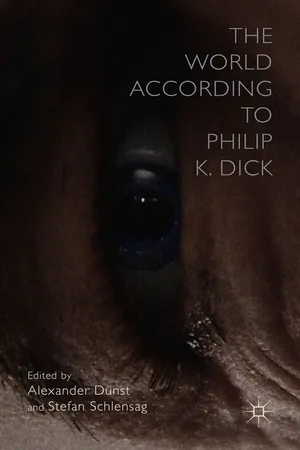
The World According to Philip K. Dick
About this book
As the first essay collection dedicated to Philip K. Dick in two decades, this volume breaks new ground in science fiction scholarship and brings innovative critical perspectives to the study of one of the twentieth century's most influential authors.
Information
Part I
History
1
Diagnosing Dick
Roger Luckhurst
In an essay in The Psychologist journal in 2003 entitled ‘Beliefs About Delusions,’ the authors introduce their discussion with two incidents from 1981: first, the attempted assassination of Ronald Reagan by the delusional John Hinckley; and secondly, a few weeks later, the publication of Philip K. Dick’s novel VALIS. This book is described as ‘a novel based on delusions resulting from his own psychotic breakdown’. For professional psychologists unfamiliar with Philip K. Dick, there is a helpful dialogue box at the foot of the opening page about the author, which explains: ‘There are multiple reasons for Dick’s bizarre beliefs, given his share of trauma, phobias, and drug abuse, but it is likely that many of the delusions he wrote about stemmed from psychotic episodes he experienced as a sufferer and as an observer of others. This alone makes his work of great psychological interest.’1 They also register their surprise that a pulp science fiction (sf) author seemed to be conversant with the psychological theories of Lev Vygotsky and Alexander Luria, amongst others.
Interpreting the work of Philip Dick often falls into the mode of diagnosing the author. This is the occupational hazard of biography, of course, which seeks authority for interpretation by positing etiologies for texts as if they were determined solely by personal circumstances or medical or psychological conditions. This has been exaggerated in Dick’s case by his almost lifelong engagement with psychiatric services, various forms of psychotherapy, and a voracious enthusiasm for multiple and often contradictory self-diagnoses. Dick’s wild epistemological ventures were not just typically Californian: they were also always relentlessly diagnostic. An outline of his life can be narrated by progressing from one diagnosis to another.
We know, for instance, that he was treated for phobic anxiety and tachycardia by a Jungian psychotherapist in the 1940s, on the insistence of his mother, and given low doses of the amphetamine semoxydrine for the same phobic condition in the 1950s. He also took psychiatric tests when military service became a prospect, including the Minnesota Multiphasic Personality Inventory, the questionnaire introduced in 1939 to assess personality type and psychopathology, and which had famously diagnosed two million prospective troops as ‘neurotic’.
Dick himself listed several major breakdowns, the first at the age of 19 at the commencement of his studies at the University of California, Berkeley. In 1965, Dick diagnosed himself as a ‘schizoid affective’ with a ‘preschizophrenic personality’ from early childhood. His breakdown at Berkeley was not a retreat from reality, he insisted, but rather ‘the breaking out of reality all around him; its presence, not its absence from his vicinity’.2 Dick claimed to his third wife, Anne, who was a trained psychologist and the widow of a man who had died in an asylum, that this was when he had first been diagnosed as schizophrenic. Schizophrenia haunted the family: his aunt, Marion, was diagnosed as a catatonic schizophrenic and died in 1953. Dick then had a succession of breakdowns following the failure of his third, fourth and fifth marriages. In 1963, having been menaced by the vision of a malign iron god in the sky, Lawrence Sutin suggests that Dick was diagnosed with manic depression. At one of his graphomaniac peaks, Dick published Martian Time-Slip, a science fictional speculation on schizophrenic and autistic time-sense, and Clans of the Alphane Moon, with a plot that depends on a weird, half-satirical, half-serious use of the psychiatric nosology of the psychoses. Dick wrote a highly informed essay on schizophrenia in 1965 and his biographer Emmanuel Carrère reads Do Androids Dream of Electric Sheep? as an investigation of the schizoid state of suppressed or robotic affect.3 In 1967, dosed up with Ritalin and his own impressive self-administered array of creatively sourced amphetamines, Dick ended up hospitalized as paranoid or ‘borderline psychotic’. After his suicide attempt in May 1970, his admission to the psych wards in Marin County General Psychiatric Hospital and Ross Psychiatric Clinic was attributed to what we would now call Drug-Induced Psychosis, having reached a crescendo of paranoid and persecutory complexes. In 1971, Dick was examined in Orange County Mental Hospital and diagnosed with manic depression. Another suicide attempt after a two-week dissociative, amnesiac fugue in Vancouver in 1972 landed him in the notorious X-Kalay drug rehabilitation center and then, following his return to California, he underwent treatment for symptoms variously diagnosed as manic depression, mood disorder, anxiety including agoraphobia, and also a bipolar condition. Dick satirized much of this period of his life in A Scanner Darkly, including a conspiratorial account of drug rehabilitation, and the shouty Zionist therapist in VALIS was based on the real-life Dr Barry Spatz, who treated him at the time. The critical events of ‘2-3-74,’ when Dick claimed to have a life-changing spiritual encounter with the god-like ‘Vast Active Living Information System’ (or VALIS), which inspired his eponymous novel, occurred when Dick was on the antipsychotic drug lithium and heavily dosed with painkillers after dental treatment. Although Dick once commented that he ‘suffered total psychosis in 3-74,’ he initially appeared keener to interpret these events in a theological rather than psychiatric frame, although the latter was never far away. The ‘Exegesis,’ his obsessive graphomaniac working over of this experience, constantly refers to psychiatric and pharmacological frameworks. Within a month of these ‘spiritual’ events, however, Dick was an earnest believer in the biochemical theories of the double brain advocated and popularized by Dr Robert Ornstein, a psychologist at the Langley Porter Psychiatric Institute, where Dick had previously been institutionalized. As if reverting to the ‘double brain’ theories that informed Stevenson’s Strange Case of Dr Jekyll and Mr Hyde, Dick believed he was occupied by other personalities or selves: fictions such as VALIS or Radio Free Albemuth openly split the character named as ‘Philip Dick’ into two or more versions.4 He started dosing himself with massive amounts of vitamins to stabilize his bicameral imbalances. ‘Mental illness,’ he declared in his speech ‘The Android and the Human,’ ‘is a biochemical phenomenon’.5
The unending self-analysis that constitutes the ‘Exegesis’ writings offer fascinating insights into the constantly shifting diagnostic language Dick brought to bear on himself. In a section entitled ‘A Conversation with Oneself about Drugs and Psychosis,’ Dick’s cracked Socratic dialogue runs:
Q: Why would I seek the experience again if it was repressed contents breaking through? …
A: I was occluded to my own best interests. I liked being high.
Q: Oh? “high”? Does psychosis equal high?
A: Mania. I am manic depressive.
Q: & schizophrenic? One is extraverted & one is introverted. Please clarify.
A: Mixed or “borderline” psychosis.
Q: No, it was florid schizophrenia with religious coloration. Not satisfactory.
A: Catatonic excitement, then.
Q: So the OCMH [Orange County Medical Hospital] diagnosis was incorrect? Not manic depressive?
A: That is so. Incorrect.
Q: Why, then, was the onset one in which thought came faster & faster? That is mania.
A: The lithium would have blocked mania. I was lithium toxic.
Q: Then it wasn’t schizophrenia; it was chemical toxicity.
A: Perhaps. A combination. Plus the orthomolecular ws [water-soluble] vitamins.6
The dialogue suggests how tempted Dick was by the language of diagnosis and simultaneously how much he wished to resist it, to fight its pseudo-objectivity, resulting in what Sigmund Freud feared would always happen in one of his last essays: analysis interminable.7
The 8,000 pages of the ‘Exegesis’ have themselves been ascribed to an undiagnosed case of Temporal Lobe Epilepsy, one symptom of which is visionary experiences and uncontrollable night-time graphomania. Note how Dick’s biographer Lawrence Sutin latches onto this diagnosis, as if in relief: ‘It can’t be disproven that Phil may have had such seizures… And if he did, everything is explained.’8 Alice Flaherty also briefly discusses Dick as a Temporal Lobe Epileptic in her book The Midnight Disease: The Drive to Write, Writer’s Block, and the Creative Brain.9 Epileptic seizures might thus foreshadow Dick’s death from a succession of strokes in 1982. This does not yet exhaust psychological interpretations of Dick’s career, of course. Until recently, literary critics have tended to favor psychodynamic models – those of Freud or Jung generally – over biological or neurological explanations. Dick is variously diagnosed as a lifelong melancholic, burdened with guilt for surviving his dead twin sister, and left with impossible mourning or forever incomplete individuation, compelled to write fictions of twinning or multiple fragmentation. Dick’s career thus fits into a version of the traumatic subject, an irresolvable loss driving obsessive compulsions to repeat.10 At the height of the trauma paradigm in the early 1990s, when it was common to hunt for secret traumas and recovering repressed childhood memories to unlock singular careers, Gregg Rickman controversially proposed that Dick had suffered childhood sexual abuse, and thus a lifetime of symptomatic psychological disorders, a claim that was given little credence by Dick scholars.11
More abstractly, Dick’s obsession with the loss of boundaries between the human and machine, with the android as emblem of dehumanization and encroaching systems of surveillance and persecution, has suggested to critics such as Carl Freedman that we can read Dick’s constructions of paranoia less as personal psychological complexes than as explicit forms of social and political critique.12 These elaborate structures of paranoid knowledge might contain kernels of political insight, perhaps particularly in the context of America in the early 1970s (Fredric Jameson’s The Geopolitical Aesthetic opens with a long study of the American conspiracy film in the Nixon era). The authors of ‘Beliefs about Delusions’ recall the dangers of what psychiatric discourse now calls the ‘Martha Mitchell Effect’. Mitchell was declared a delusional psychotic for her elaborate conspiracy theories about the White House. Mitchell also happened to be the wife of the Attorney General during the Nixon administration, and her diagnosis was somewhat adjusted following the unraveling of Nixon’s criminal conspiracy in 1974. Paranoids sometimes really do have people out to get them, as Thomas Pynchon elaborated at great length in Gravity’s Rainbow (1973).
Politicizing paranoi...
Table of contents
- Cover
- Title
- Copyright
- Contents
- List of Illustrations
- Acknowledgments
- Notes on Contributors
- Introduction: Third Reality – On the Persistence of Philip K. Dick
- Part I History
- Part II Theory
- Part III Adaptation
- Part IV Exegesis
- Select Bibliography
- Index
Trusted by 375,005 students
Access to over 1.5 million titles for a fair monthly price.
Study more efficiently using our study tools.
Frequently asked questions
Yes, you can cancel anytime from the Subscription tab in your account settings on the Perlego website. Your subscription will stay active until the end of your current billing period. Learn how to cancel your subscription
No, books cannot be downloaded as external files, such as PDFs, for use outside of Perlego. However, you can download books within the Perlego app for offline reading on mobile or tablet. Learn how to download books offline
Perlego offers two plans: Essential and Complete
- Essential is ideal for learners and professionals who enjoy exploring a wide range of subjects. Access the Essential Library with 800,000+ trusted titles and best-sellers across business, personal growth, and the humanities. Includes unlimited reading time and Standard Read Aloud voice.
- Complete: Perfect for advanced learners and researchers needing full, unrestricted access. Unlock 1.5M+ books across hundreds of subjects, including academic and specialized titles. The Complete Plan also includes advanced features like Premium Read Aloud and Research Assistant.
We are an online textbook subscription service, where you can get access to an entire online library for less than the price of a single book per month. With over 1.5 million books across 990+ topics, we’ve got you covered! Learn about our mission
Look out for the read-aloud symbol on your next book to see if you can listen to it. The read-aloud tool reads text aloud for you, highlighting the text as it is being read. You can pause it, speed it up and slow it down. Learn more about Read Aloud
Yes! You can use the Perlego app on both iOS and Android devices to read anytime, anywhere — even offline. Perfect for commutes or when you’re on the go.
Please note we cannot support devices running on iOS 13 and Android 7 or earlier. Learn more about using the app
Please note we cannot support devices running on iOS 13 and Android 7 or earlier. Learn more about using the app
Yes, you can access The World According to Philip K. Dick by A. Dunst, S. Schlensag, A. Dunst,S. Schlensag in PDF and/or ePUB format, as well as other popular books in Literature & Literature General. We have over 1.5 million books available in our catalogue for you to explore.