- English
- ePUB (mobile friendly)
- Available on iOS & Android
eBook - ePub
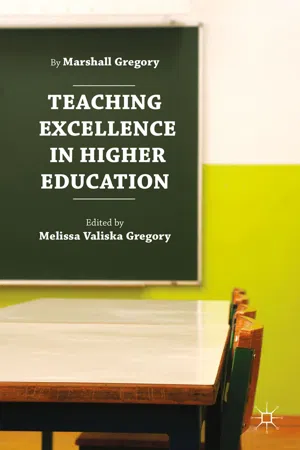
Teaching Excellence in Higher Education
About this book
Marshall Gregory argues that teachers at the university and high school levels can achieve teaching excellence by grounding their teaching in pedagogical theory that takes into account students' abilities and the ultimate goals of teaching: to develop students' capacities for thought, reflection, questioning, and engagement to their fullest extent.
Information
Topic
ÉducationCHAPTER 1

GOOD TEACHING AND EDUCATIONAL VISION: NOT THE SAME THING AS DISCIPLINARY EXPERTISE
GRASS GREEN IN MILWAUKEE—LEE THUNDERCLOUD GETS MY ATTENTION
It was 8:00 A.M. on a bright Monday morning in the fall of 1967 and I was actually awake, but it felt unnatural and weird. (My grad-student body was incredulous that 8:00 A.M. could be considered a reasonable time for human beings to be up and working.) I was standing in front of a class of first-year students at the University of Wisconsin– Milwaukee, where I had been hired—on a tenure track appointment, no less—to teach writing. As I watched the students file in, I was possessed by a growing insight, ironic but not comic, that none of the highly intellectualized activities I had been performing for the past few years at the University of Chicago were relevant to this job or these students. None of my academic circus tricks seemed relevant. It crossed my mind that I might be acting out the punch line of a really unfunny joke perpetrated by University of Chicago professors to hide from graduate students the fact that, eventually, we would all wind up standing in front of classrooms of real-world students instead of sitting in library carrels at good old Research U, where we would continue nibbling away at reclusive research topics just as we had nibbled away at them in graduate school.
Riffing bitterly on my lack of preparation, however, was getting me nowhere. No one offered to rescue me. My students, refusing to evaporate, seemed perversely rooted in three dimensions and real time—they were even looking at me expectantly, poor misled tykes—so there I stood, launching my career, grass green in Milwaukee. I looked down at my roster, opened my mouth, and immediately mispronounced Asunto, the first name on my list of students. (Was I supposed to know how the Milwaukee Finns pronounced Asunto?) It was not a brilliant beginning. For the next three weeks, I was not an educator so much as a frantic worker ant who had missed his matriculation into Ant Work 101. I was forced to begin learning on my own all the skills that my elite graduate education had not thought necessary to teach me, such as how to do my job.1 The job itself did not encourage creativity. I was given a required common syllabus for English 101, the primary philosophy of which seemed to be that good writing consists of avoiding run-on sentences and knowing the difference between its and it’s.
The bureaucratic monstrosity of the English 101 program forced all 80 of us teaching in it to dole out scintillating facts about comma splices or noun–pronoun–number agreements at the same time on the same day in each of our classes (“See it in action: the bureaucracy that ate Milwaukee!”). This enforced uniformity reminded me of scenes from Aldous Huxley’s Brave New World (1932) and Charlie Chaplin’s Modern Times (1936). Moreover, I was distracted by momentous side issues, such as many of my students not recognizing me as their teacher when they came into class because they were mature-looking 18-year-old working-class students, and I looked like a preacher’s 15-year-old kid who dropped all the balls hit to him in right field. I took to wearing vested suits and wingtip shoes, a sartorial strategy that not only failed to bestow teacherly authority on me but also made me look as if I were dressing up in my father’s clothes (and, yes, my father was indeed a preacher). The colossal gravity of these concerns was competing for space in my head, where I was also trying to think about the relationship, if any, between the heartbreak of run-on sentences and my students’ desperate need for a real education.
Fortunately for me, Lee Thundercloud came to my rescue. Mr. Thundercloud, who wanted to murder me, nearly killed me with shock and embarrassment, but he also jolted me out of my mental bemusement. Right in the middle of my three-week-old career and right on top of my highly respectable wingtip shoes, Mr. Thundercloud broke into my brilliant and compelling discourse about comma splices and favored me with a query that was, in the de rigueur lingo of the sixties, “relevant.” (Ironically, he preceded his assault by politely raising his hand.) After I gave him the nod to speak, he threw a comment at me with deadpan but sulfuric sarcasm, “Gregory, do you know what the shit you’re talking about?”
Bingo! As the Emperor keeps saying to everyone in Amadeus (1984), “There it is.” Despite my total inexperience at dealing with student comments in general, and especially with any squib throwing both personal invective and scatology at me, I now, decades later, give myself credit for recognizing that Mr. Thundercloud’s question was not about comma splices. I knew he was asking about something else, the same something else that even three measly weeks into my job was already tugging at me for attention. I knew in my bones that Mr. Thundercloud was asking whether I knew anything about the kind of education he and his peers really needed.
Mr. Thundercloud, bless his homicidal heart, forced me early on to challenge the default notion that a teacher’s job is to explain correctly the academic contents-of-the-day like a glib waiter at an expensive restaurant describing the specials-of-the-day. Mr. Thundercloud gave me a valuable kick-start for thinking early in my career about the difference between, on the one hand, academic content and, on the other hand, the teacher’s deeper job of being a genuine educator and the student’s deeper need to become genuinely educated, not by parroting academic content but by acquiring the skills of cognition and intellectuality that separate educated minds from uneducated minds.
Mr. Thundercloud crossed my path by a stroke of blind luck, for which, four and a half decades later, I am still grateful. To this day I am not sure how I replied to Mr. Thundercloud’s attack—I was too rattled to remember—but it hardly matters. He left that day and never returned. The value to me of our brief interaction was not that it showed me Truth in a blinding flash, or even in a long unwinding scroll. Would that thinking about education were that easy. Mr. Thundercloud did not give me answers, but he helped me begin asking the right questions, and the questions that he galvanized me to pursue have led, decades later, to the way I teach my classes, to the orchestrated conversations that I direct inside pedagogy seminars, to the many articles I have published on teaching topics, and to the writing of this book.
LOOKING BEHIND THE VEIL, PEERING THROUGH THE SMOKE, SEEING THE ELEPHANT IN THE ROOM: PICK YOUR FAVORITE METAPHOR FOR CLASSROOM DYNAMICS THAT TEACHERS AND STUDENTS OFTEN FAIL TO NOTICE
This book is not about teaching tips. There are many good books that offer helpful tips on how to write coherent syllabi, how to lead productive discussions, how to handle students who are excessively reclusive or excessively talkative, and so on. But this book is less about these kinds of teaching strategies, important as they are, and more about teaching vision. I have become convinced that excellence in teaching is rooted less in a teacher’s specific classroom skills than it is in a teacher’s educational philosophy. Even if it sounds counterintuitive, I have come to believe that an educational philosophy will generate the skills appropriate to it. I have also become convinced that while many teachers have well-polished skills, most teachers fail to support those skills with intellectual robustness because their educational philosophy is seldom as well developed as their skills, and often fails to go deeper than a few clichés such as “students should be well rounded,” “students should learn critical thinking,” and “students should learn how to communicate clearly.” These goals are clichés because they are usually repeated without any sense of intellectual or pedagogical context and with no deep sense of what they actually mean. They are just educational bromides that everyone repeats but that few people really think about.
Thus, when I say that this book is about a teaching vision, I am not referring to a vision of discrete classroom skills but to an infrastructure vision of education that drives and directs classroom skills. I am referring to many dynamics here, all of which I eventually discuss in this book, but I am referring most of all to a vision of educational aims in the fullest and deepest sense: a vision of what education is for in an existential, not merely an instrumental, sense. My effort to unpack in this book what I mean by “a teaching vision” entails exploring many facets of two claims. The first claim is that good teaching is both harder and different than many teachers realize. The second claim is that good teaching entails the ability to see those classroom dynamics—sometimes psychological, often emotional, always ethical—that too often remain invisible even to the best among us, not because they are really invisible but because the professional socialization of most college teachers does not train us to bring these dynamics into focus.
These two claims are organically related insofar as the first claim is true because the teacherly tasks implied by the second claim are so difficult. That is, insofar as the background dynamics in classrooms remain unseen and untended, many teachers will remain uncertain about the criteria they should use to assess how much success they are having as teachers or how much success their students are having as learners. But the moment that teachers do learn to see and tend to their classrooms’ background dynamics is also the moment they realize that really good teaching is much harder than anyone ever hinted it would be.
As background dynamics come more clearly into focus for teachers, they begin to see many classroom realities they may not have seen before: that good intentions and goodwill are not enough, that enthusiasm is not enough, that expertise is not enough, that intuitions are not enough, that authority is not enough, and that being stylish and cool are not enough—not enough, that is, to automatically guarantee teaching excellence and effective learning. All of the teacherly advantages I just listed are indeed useful—a few of them are indispensable—but, still, they are just not enough. As background dynamics come more clearly into focus, teachers begin to see that good teaching is a profoundly complex practice, the mastery of which is not automatically bestowed on anyone, especially not because he or she possesses a high level of disciplinary expertise or has acquired a PhD from a tier-one research university. If knowledge about a thing, especially a really complicated thing like teaching, really does entail mastery of the doing of that thing, then any bright medical student who has read about heart surgery in his Surgery 101 textbook is quite prepared to perform your open heart valve repair. Good luck with that.
When I refer to important classroom dynamics operating in the background, I mean that they work like the unseen code behind computer software or like the unconscious cognitive protocols established in the human brain by evolution. These background dynamics, these unseen protocols, run our software and often run our thinking as well, but it is extremely difficult for any of us ever to see the programming code or to become conscious of our background cognitive protocols. With the expenditure of large amounts of energy and focused attention spread over a long period of time, one can learn to understand computer languages, and, to some extent, one can also learn to see his or her own cognitive protocols. Overwhelmingly, however, most academics reserve the expenditure of this kind of energy and attention only for their research, not for their teaching.
Besides, most teachers are primarily concerned with teaching’s foreground issues, and often do not even realize that background dynamics are present. Foreground issues include such classroom protocols as class management, testing, grading, discussions, explanations, and especially issues of authority and image. In writing a book that encourages teachers to acquire the kind of teacherly vision that allows them to develop a thoughtful educational philosophy and to see background issues—one might almost call them covert issues—I would not like to be understood as denigrating or trivializing the importance of foreground issues. How could testing, grading, and explaining ever be trivial? My point, however, is that there is an entirely different range of issues that also merit attention and that, unfortunately, often fail to receive attention, not because teachers deliberately ignore them but because many teachers do not see them.
Some of the background issues I am talking about include, but are not limited to, the issues I catalog in the following passage. In what immediately follows I will give three brief “preview” examples of the kinds of discussion and analysis the rest of my book offers. At the end of the three preview discussions, I will name other issues without attaching discussions to them. However, all of the issues mentioned here, including those receiving previewed discussions, will receive thorough examination in subsequent chapters.
Ethics. Many teachers fail to see that students’ ethical judgments about teachers, running in the background like software code, will always trump their judgments about teachers’ expertise and professionalism. Only a few teachers realize the leading importance of students’ ethical judgments or think about this background issue in any self-conscious or self-critical way. Students power up their ethical grids in class because this is what all human beings do in social encounters, and whatever else teaching is (and it is a lot of different things), teaching is always, first and foremost, a social encounter. But when human beings power up their ethical grids—both teachers and students—they do so with such quickness and immediacy that they are usually unaware of having done it at all. Powering up our ethical grid in social interactions is as natural to human beings as sneezing and neither requires nor causes self-conscious reflection. Reflection may follow, and even changed minds may follow, but the initial ethical judgments that we make of other people are often—are usually, in fact—instantaneous, not reflective.2
This means that teachers are usually unaware of the extent to which they are making instantaneous ethical judgments about their students, even on the first day of class, and that students are likewise unaware of the extent to which they are making the same kinds of instantaneous ethical judgments about their teachers. This is not because teachers and students consciously wish to be dogmatic or intolerant of others, much less unfair to them, but it’s just what human beings do. We are wired for it. Making snap judgments about other people’s ethical nature, especially their ethical intents—“Does this person mean to do me harm or to do me good? Will this person treat me with honesty and respect or will this person manipulate me with deceit and contempt?” and so on—is crucial to the way we manage our social relations, and, to repeat, whatever else teaching is, it is always, first and foremost, a social relationship. That human beings are often unaware of their ethical judgments does not ever mean that those judgments are unimportant or even marginally important. Quite the opposite is true. That people make many ethical judgments unconsciously means that ethical judgments play a larger role in social interactions than we are often aware, partly because their mostly unconscious status places them, most of the time, beyond conscious, critical inspection. So whether students are aware of doing so or not, they run a program of ethical judgments about us from the first moment we walk into a new classroom.
Teachers should not fail to see that such interior self-talk as, “Why are these students so irresponsible and self-indulgent?” constitutes the construction of ethical judgments about students, and fairly serious judgments at that. Not to recognize the nature of this interior discourse as primarily ethical is to be seriously deficient in teacherly self-awareness. Students who engage in interior self-talk such as, “I don’t think Professor Hardass gives a damn about my ambitions to get into law school” are also constructing ethical judgments that they almost certainly fail to see as ethical. Classrooms are simmering soup pots of ethical dynamics and ethical judgments. Neither students nor teachers are always right in the ethical judgments they make. They just always make them. No one is always right in the ethical judgments that he or she makes. We just always make them. All human beings do.
The important thing for teachers to realize is that the ethical judgments that students make about whether (or not) any particular teacher is going to be fair, concerned, charitable, honest, kind, compassionate, and willing to see “me” as a distinct individual rather than as a generic, standard-issue student are judgments that precede student learning and that profoundly color in a positive or negative way all students’ classroom and academic engagements. Paradoxically, I mean for the metaphorical claim that ethical judgments trump all others to be taken quite literally. If students decide that this teacher or that teacher is indeed unfair, dishonest, unconcerned, or uncharitable, it hardly matters how good the teacher may be on other fronts; any teacher branded by students with negative ethical judgments of this kind will never be fully effective. In chapters that follow, the role of ethical dynamics in classrooms will be considered from multiple perspectives.
Psychology. Also in the chapters that follow, such issues as a phenomenon I call “the psychology of competence” will be considered. In all my years of conducting teaching conversations with both students and faculty, I have never found a single student or teacher who has considered the negative psychological role of competence in the classroom. If any teachers have done so, I have yet to meet them. However, once students’ search for competence is considered from a developmental perspective—and it is certainly the case that the lives of traditional-age college students have been dominated by the pursuit of competence for their entire existence—the psychology of its negative role in the classroom can be taken in account.
Young adult students (aged 16–22) have been ferociously pursuing adult competence since they were born, beginning with feeding themselves and learning how to use the toilet on their own. They then move on to learning how to tie their shoes and play sports and musical instruments and how to count, add, do math, and read, not to mention how, later on, to drive cars and write text messages at lightening speed and have sex—the last three achievements are, for many young adults, their pinnacle “adult” competencie...
Table of contents
- Cover
- Title
- Copyright
- Contents
- List of Figure
- Preface
- Acknowledgements
- 1. Good Teaching and Educational Vision: Not the Same Thing as Disciplinary Expertise
- 2. Forgetting, Learning, and Living: How Education Makes a Difference Even Though We Forget Most of What We Learn
- 3. The Dynamics of Desire in Everyday Classrooms
- 4. Ethical Pedagogy
- 5. From Shakespeare on the Page to Shakespeare on the Stage: What I Learned about Teaching in Acting Class
- 6. Love? What’s Love Got to Do with It?
- 7. Developing Your Own Philosophy of Education: Principles, Not Personalities
- 8. What Is Teaching, After All?
- 9. Teacherly Ethos Revisited
- Bibliography
- Index
Trusted by 375,005 students
Access to over 1.5 million titles for a fair monthly price.
Study more efficiently using our study tools.
Frequently asked questions
Yes, you can cancel anytime from the Subscription tab in your account settings on the Perlego website. Your subscription will stay active until the end of your current billing period. Learn how to cancel your subscription
No, books cannot be downloaded as external files, such as PDFs, for use outside of Perlego. However, you can download books within the Perlego app for offline reading on mobile or tablet. Learn how to download books offline
Perlego offers two plans: Essential and Complete
- Essential is ideal for learners and professionals who enjoy exploring a wide range of subjects. Access the Essential Library with 800,000+ trusted titles and best-sellers across business, personal growth, and the humanities. Includes unlimited reading time and Standard Read Aloud voice.
- Complete: Perfect for advanced learners and researchers needing full, unrestricted access. Unlock 1.5M+ books across hundreds of subjects, including academic and specialized titles. The Complete Plan also includes advanced features like Premium Read Aloud and Research Assistant.
We are an online textbook subscription service, where you can get access to an entire online library for less than the price of a single book per month. With over 1.5 million books across 990+ topics, we’ve got you covered! Learn about our mission
Look out for the read-aloud symbol on your next book to see if you can listen to it. The read-aloud tool reads text aloud for you, highlighting the text as it is being read. You can pause it, speed it up and slow it down. Learn more about Read Aloud
Yes! You can use the Perlego app on both iOS and Android devices to read anytime, anywhere — even offline. Perfect for commutes or when you’re on the go.
Please note we cannot support devices running on iOS 13 and Android 7 or earlier. Learn more about using the app
Please note we cannot support devices running on iOS 13 and Android 7 or earlier. Learn more about using the app
Yes, you can access Teaching Excellence in Higher Education by Marshall Gregory,Melissa Valiska Gregory in PDF and/or ePUB format, as well as other popular books in Éducation & Théorie et pratique de l'éducation. We have over 1.5 million books available in our catalogue for you to explore.