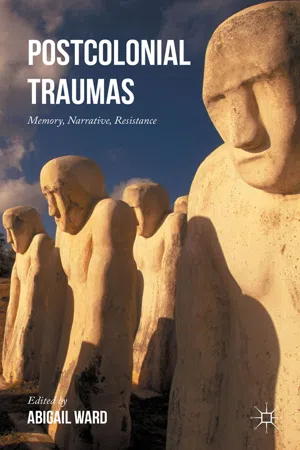
This collection of essays explores some new possibilities for understanding postcolonial traumas. It examines representations of both personal and collective traumas around the globe from Palestinian, Caribbean, African American, South African, Maltese, Algerian, Indian, Australian and British writers, directors and artists.
Chronic Trauma, (Post)Colonial Chronotopes and Palestinian Lives: Omar Robert Hamilton’s Though I Know the River is Dry/Ma‘a Anni A‘rif Anna al-Nahr Qad Jaf
Lindsey Moore and Ahmad Qabaha
Perhaps the greatest battle Palestinians have waged as a people has been over the right to a remembered presence and, with that presence, the right to possess and reclaim a collective historical reality.
(Edward Said)1
International recognition of Palestinian trauma, including the foundational trauma of al-nakba (‘the catastrophe’) of 1948,2 is the cornerstone of the collective Palestinian struggle for self-determination. Hegemonic Israeli versions of history, however, continue to obstruct Palestinian counter-representational efforts to make their trauma visible. This is not only about who has the loudest voice; that is to say, the most powerful (political and economic) backing. Nor is the problem confined to the progressive disappearance of Palestinian land or viable habitus, producing a near impossible present and future. The close fit that has obtained between trauma studies and recuperated Holocaust histories,3 and the use of trauma discourse to sediment Israeli self-definition, have deferred acknowledgement of Palestinian trauma as a political and ethical imperative.4
One of the best sources for understanding the specific characteristics of Palestinian trauma is its cinema, which from its inception has provided authentic – if not necessarily realist – portrayals of the Palestinian historical and contemporary experience.5 ‘In its attempt to articulate a national narrative’, writes Edward Said, ‘Palestinian cinema discovers a world that has been frequently hidden’, and makes it visible.6 Nurith Gertz and George Khleifi flag up the contrapuntal agenda at stake when they point out that ‘the history of the Palestinian film […] is the history of the endeavor to recount the Palestinian story, against the setting of the Israeli account that had previously silenced it’.7
The representational context is not limited to Palestinians: others have produced visual media pointing to the potential for, and limits of, consciousness-raising and empathic identification with Palestinian trauma.8 British-born, Egyptian-based Omar Robert Hamilton is one of them. His oblique short film Though I Know the River is Dry (Ma‘a Anni A‘rif Anna al-Nahr Qad Jaf, 2013) illustrates that trauma is a continuous reality of Palestinian life.9 The film connects the Nakba and other catalytic events in the modern history of Palestine, notably al-naksa (the ‘setback’) of 1967 and the First (1987–91) and Second (2000–6) Intifadas.10 These connections indicate that trauma persists in the consciousness of the Palestinian people and will have no resolution without an almost unimaginably ambitious political solution; they also underline the close fit between the private/individual and the public/collective in this context. Hamilton’s film thus problematises trauma theory in particular ways, but it also transposes the fundamental insight of trauma studies: that there is a compulsion to find a way to tell the story of traumatic experience.11 In the Palestinian case (not exclusively), the imperative is moral and political as well as psychological. Palestinian cinema challenges what, from the Palestinian point of view, is a persistently colonial situation.12
Palestinian feature and documentary films of the last decade such as Hany Abu-Assad’s Paradise Now (Al-Janna al-Alān, 2005) and Omar (2013), Vibeke Lokkeberg’s Tears of Gaza (2010), Fida Qishta’s Where Should the Birds Fly? (2012) and Emad Burnat’s and Guy Davidi’s Five Broken Cameras (Khamas Kamīrāt Mu
a
amah, 2012) present trauma as intrinsic to Palestinian history and identity, rendering precarious any individual or collective achievement. Recent events – the building of the Separation Wall (al-Jidār al-Fā
il, which features prominently in both Five Broken Cameras and Omar), the continuous ethnic cleansing of Palestinians from Jerusalem and other parts of the West Bank, and the Israeli attacks on Gaza in 2006, 2008–9 (the focus of both Tears of Gaza and Where Should the Birds Fly?), 2012 and 2014 – have influenced the emergence of a new cinematic protagonist such as the one we see in Though I Know the River is Dry, who manifests profound pessimism, even despair.
We thus partly challenge, by updating, Gertz’s and Khleifi’s argument that Palestinian cinema has moved towards the presentation of characters who dramatise ‘a post-traumatic reflection’.13Though I Know the River is Dry is fairly typical of films produced in the last decade in that it stresses massive continued injustice and the dynamic worsening of the Palestinian situation. Many of these films emphasise the present impossibility of working through trauma and anticipate a still darker future. Their directors realistically portray a tragic status quo and a lack of initiatives for resolution to the Palestinian tragedy.14
This is not to say that contemporary cinema negates the stubborn struggle of Palestinians to survive and to cultivate a human existence. In fact, it has been said that hope – ‘materially grounded, progressively functioning, future-forming hope’ – is the only really incurable Palestinian syndrome.15 We end our chapter with an example of a film that explicitly links the witnessing of trauma to potential healing, at least to the extent where witnessing can continue. In the main analysis, we offer Hamilton’s short, sombre film as an example of the fact that art is, more generally, an other-oriented reconstruction of reality which, in Said’s words, ‘exists intensely in a state of unreconciled opposition to the depredations of daily life’.16
Without Palestine: archiving exile
In the sorrow of a history buried alive, the year 1948 in Palestine fell from the calendar into exile, ceasing to reckon the marching count of days, months, and years, instead becoming an infinite mist of one moment in history.
(Susan Abulhawa)17
Palestinian history has been partly shaped by its exiles, not only in terms of the work those in diaspora have done – as the authors of our epigraphs exemplify – but because the ‘right of return’, while a cornerstone of Israeli nationalism, continues to be refused to Palestinians. In one sense, Palestinian history is structurally exilic; while the Palestinian people have lived and laboured in the region for millennia, a collective sense of community and identity, which would later be articulated as nationalism, was necessitated by the loss of historic Palestine. Ilan Pappé insists upon the material facts – the foundation of the State of Israel produced up to 800,000 refugees; 531 Palestinian villages were destroyed and eleven urban neighbourhoods emptied – in his specification of the genocide of 1948 as ‘the most formative event in the modern history of the land of Palestine’.18 The Nakba, however, has been erased from Israeli history and from (therefore bogus) reiterations of a ‘Peace Process’.19
About half the international Palestinian population are refugees, both within and without historic Palestine. The total number of Palestinians living ‘outside’ (whether as refugees or in diaspora) is approaching five and a half million.20 Even Palestinians resident in their historic land tend to be distanced from their pre-1948 dwelling places and separated – by borders, the Separation Wall and checkpoints – from other parts of the community, including family members. Palestinians still lack a nation-state and are regionally marginalised, to put it mildly, in political, economic and cultural terms. The landscape has become increasingly unrecognisable to its original inhabitants.21 To the ‘memoricide’ that Pappé condemns, Nur Masalha adds ‘toponymicide’; ‘the de-Arabisation of the land […] the erasure of ancient Palestinian place names and their replacement by newly coined Zionist Hebrew toponymy’.22 This emphatically colonial strategy progressively limits the possibility of a political resolution. Judith Butler has recently e...
Table of contents
Cover
Title
Copyright
Contents
Acknowledgements
Notes on Contributors
Introduction Abigail Ward
1 Chronic Trauma, (Post)Colonial Chronotopes and Palestinian Lives: Omar Robert Hamilton’s Though I Know the River is Dry/Ma‘a Anni A‘rif Anna al-Nahr Qad Jaf Lindsey Moore and Ahmad Qabaha
2 From Mary Prince to Joan Riley: Women Writers and the ‘Casual Cruelty’ of a West Indian Childhood Sandra Courtman
3 Harlem Tricksters: Cheating the Cycle of Trauma in the Fiction of Ralph Ellison and Nella Larsen Emily Zobel Marshall
4 Trauma and Testimony: Autobiographical Writing in Post-Apartheid South Africa Paulina Grzęda
5 The Postcolonial Graphic Novel and Trauma: From Maus to Malta Sam Knowles
6 Trauma Theory, Melancholia and the Postcolonial Novel: Assia Djebar’s Algerian White/Le Blanc de l’Algérie Lucy Brisley
7 From Colonial to Postcolonial Trauma: Rushdie, Forster and the Problem of Indian Communalism in Midnight’s Children and The Moor’s Last Sigh Alberto Fernández Carbajal
8 Indian-Caribbean Trauma: Indian Indenture and its Legacies in Harold Sonny Ladoo’s No Pain Like This Body Abigail Ward
9 The Writing of Breyten Breytenbach, The Writing of Breyten Breytenbach: Dog Heart Christopher Davis
10 Discrepant Traumas: Colonial Legacies in Jindabyne Gillian Roberts
11 Rape, Representation and Metamorphosis in Shani Mootoo’s Cereus Blooms at Night Marie Josephine Diamond
12 Haunted Stages: The Trauma of New Slaveries in Contemporary British Theatre and Television Drama Pietro Deandrea
Bibliography
Index
Trusted by 375,005 students
Access to over 1.5 million titles for a fair monthly price.
Study more efficiently using our study tools.
Frequently asked questions
Yes, you can cancel anytime from the Subscription tab in your account settings on the Perlego website. Your subscription will stay active until the end of your current billing period. Learn how to cancel your subscription
No, books cannot be downloaded as external files, such as PDFs, for use outside of Perlego. However, you can download books within the Perlego app for offline reading on mobile or tablet. Learn how to download books offline
Perlego offers two plans: Essential and Complete
Essential is ideal for learners and professionals who enjoy exploring a wide range of subjects. Access the Essential Library with 800,000+ trusted titles and best-sellers across business, personal growth, and the humanities. Includes unlimited reading time and Standard Read Aloud voice.
Complete: Perfect for advanced learners and researchers needing full, unrestricted access. Unlock 1.5M+ books across hundreds of subjects, including academic and specialized titles. The Complete Plan also includes advanced features like Premium Read Aloud and Research Assistant.
Both plans are available with monthly, semester, or annual billing cycles.
We are an online textbook subscription service, where you can get access to an entire online library for less than the price of a single book per month. With over 1.5 million books across 990+ topics, we’ve got you covered! Learn about our mission
Look out for the read-aloud symbol on your next book to see if you can listen to it. The read-aloud tool reads text aloud for you, highlighting the text as it is being read. You can pause it, speed it up and slow it down. Learn more about Read Aloud
Yes! You can use the Perlego app on both iOS and Android devices to read anytime, anywhere — even offline. Perfect for commutes or when you’re on the go. Please note we cannot support devices running on iOS 13 and Android 7 or earlier. Learn more about using the app
Yes, you can access Postcolonial Traumas by Abigail Ward in PDF and/or ePUB format, as well as other popular books in Literature & African Literary Criticism. We have over 1.5 million books available in our catalogue for you to explore.