Russia's place in the world as a powerful regional actor can no longer be denied; the question that remains concerns what this means in terms of foreign policy and domestic stability for the actors involved in the situation, as Russia comes to grips with its newfound sources of might.
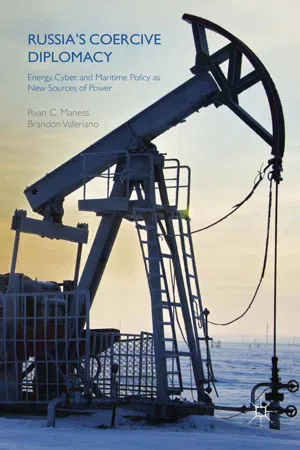
eBook - ePub
Russia's Coercive Diplomacy
Energy, Cyber, and Maritime Policy as New Sources of Power
- English
- ePUB (mobile friendly)
- Available on iOS & Android
eBook - ePub
Russia's Coercive Diplomacy
Energy, Cyber, and Maritime Policy as New Sources of Power
About this book
Information
1
Introduction: New Forms of Coercive Power in the Putin Era
The Setting
Russian power and its projection has been a key concern for international interactions since the birth of the modern state system. The downing of Malaysia Airlines flight 17 over Eastern Ukrainian territory on 17 July 2014 brought the ire of the international community upon President Vladimir Putin’s Russian government.1 British Prime Minister David Cameron likened Russia’s actions, which include supplying the ethnic Russian separatists fighting the Ukrainian government as well as annexing the Crimean peninsula from Ukraine in March 2014, with the early warning signs that sparked both world wars of the 20th century. “In a way, this is what we see today in Europe. Ukraine is a country recognized by the United Nations, a country which has and should have every right to determine its own future. . .it has the right not to have its territorial integrity impugned by Russia.”2 United States President Barack Obama, referring to the separatists whom he acknowledged were being supported by Russia, called the tragedy “an outrage of unspeakable proportions.”3
The commercial airliner was flying over a part of Ukraine controlled by ethnic Russian separatists, and all 298 passengers were killed. According to Western intelligence, the airplane was shot down by Russian surface-to-air missiles, supplied by Russia, from territory controlled by these rebels.4 Although Russia has vehemently denied its part in this tragedy, the situation in the Crimea is clear.5 The ouster of pro-Russian President Viktor Yanukovych in February 2014, which nullified the planned economic partnership between Ukraine and Russia, led to Russia’s annexation of Crimea from Ukraine in March. The country has since deteriorated into a civil conflict where Russia has been accused of arming and funding the separatist faction in the breakaway region of Donetsk. Russian involvement in the destabilization of Ukraine and the evidence supporting its part in backing the ethnic Russian separatists has become apparent, and economic sanctions from the United States and European Union (EU) have been put in place.6
Why would Russia behave in such a coercive manner with a much weaker neighbor? Why would it annex sovereign territory of another country, and why would it want the Ukrainian government troubled with armed and dangerous rebel factions challenging its rule? Why would it cut off gas supplies to the country in the midst of winter? What makes Ukraine particularly salient to Russia such that it would risk rising tension and blockade from Western governments? The purpose of this volume is to uncover the development and process of Russia’s recent coercive behavior through the prism of what we call new forms of power—primarily cyber, energy, and legal/institutional maneuvers.
International interactions are undoubtedly changing, but often the context and content of this change has not been analyzed from what might be called the modern application of the power politics perspective. Some define politics as the authoritative allocation of power.7 Under this framework, our study here examines power politics as tactics shift and develop in light of new methods. We focus on how these new forms of power are used with a focus on Russia’s application in the post-Cold War system. We are not suggesting that power has transformed, that soft power dominates—our story is that the contours of international interactions have shifted, but the outcome remains the same.8 New forms of power as seen by cyber tactics, the use of energy politics in the realm of gas and other hydrocarbons, and legal and naval maneuvering on the seas are being used by traditional powers in new ways. We evaluate the efficacy of these forms of power but also seek to change things up and deviate from traditions in specific fields. This work challenges the assumptions many have about the forms of power, international interactions, and the outcomes of these maneuvers.
We seek to analyze the consequences of a Russia struggling with its identity as a midrange power after the end of the Cold War. We fill an important gap in the literature by exploring the reemergence of Russia through the use of new power politics tactics in the realm of cyber security, energy security, and maritime power. This is not a book about Russia so much as it is a book about how a revitalized power such as Russia uses new opportunities in light of constraints. Russia cannot compete on the traditional material power battlefield, even in Ukraine it has used covert tactics rather than overt power, and thus its tactics have shifted. How do these shifting Russian foreign policy practices impact the course of peace and stability in the Eastern European, Caucasus, and Central Asian regions of post-Soviet space, as well as the Arctic region? Will cyber conflict dominate in the region and be a tool of the Russian foreign policy regime? How does Russia use its large endowments of hydrocarbons to its advantage? What is Russia’s maritime Arctic policy as the ice caps continue to melt? These are all important questions that this volume will tackle.
We delineate the implications of Russian foreign policy actions on its neighbors and the United States through the use of developing power techniques. What does a reassertive Russia tell us about the importance of issues of disagreement, the new sources of power, and conflict at stake between states? We hope to tell the story of what Russia’s goals are, how it goes about achieving its goals, and the consequences of foreign policy action through a theory we call “situational coercive diplomacy.” This belligerent and assertive foreign policy decision making is dangerous; however, Russia uses power politics tactics only when salient issues are at stake, the public supports such actions, and there is a historical rivalry process at work.
The most important goal of this research is to understand how developing sources of power are utilized in the modern context. Russia’s place in the world as a powerful regional actor can no longer be denied; the question left is, what does this mean in terms of foreign policy and domestic stability for the actors involved in the situation as Russia comes to grips with its newfound sources of might? Russia is a useful case since it seems to be the standing example of how modern forms of power blend with traditional coercive tactics. Our question is what the outcome of these tactics is; do the means achieve their desired ends?
The Russian Context
As Russia reemerges from a long slumber after the demise of the Soviet system, it has begun to engage the world through the use of power politics tactics and coercive diplomacy once again. This engagement is of a different sort than its use of power during the Cold War. Much to its dismay, Russia is no longer a global superpower. It has broad interests and acts across the globe just like any other major power, but its power projection capabilities are limited mostly to the region made up of the former republics of the Soviet Union.9 Russia can no longer hope to be the global power that challenges the United States, but it can influence American actions in its post-Soviet backyard and a bit beyond through the use of power politics tactics. We also note that at times Russia uses accommodation to achieve cooperation on issues that are not as salient as those that deal with Russian ethnic minorities or specific territorial claims.
Examples of Russian increased political, economic, and military involvement in post-Soviet space are replete: support for Armenia in the disputed Nagorno-Karabakh region of Azerbaijan, support for the separatist enclaves of Abkhazia and South Ossetia in Georgia and Transdniester in Moldova, and the Russian military bases in these troubled spots in the Russian sphere of influence. Armenia has found itself close to Russia since the Soviet breakup. Azerbaijan, a predominately Muslim country, has not been able to regain its sovereignty over the disputed region due to the continuing supply of arms by Russia to Armenia. Russian military bases are also found in the breakaway regions of Georgia and Moldova; and these states have also not been able to govern their own territories due to the presence of the more powerful Russian military within their borders. The importance of this analysis is reinforced even more by recent events in Ukraine, where the government in Kiev has rejected a closer relationship with the European Union in favor of an economic boost from Russia. Moscow has offered huge subsidies in natural gas pricing that seems to have been too good of a deal for Ukraine to move closer to the West, and it is now inching toward the Russian political orbit.10
The issuance of Russian passports to ethnic Russians in post-Soviet states, the subsidization of hydrocarbons for Moscow-friendly states, the assets-for-debts programs in order to collect debts from these states, and the supposed tampering in the elections of some of the states of the region are also other foreign policy tactics used by the Russian state to exert its power in its former empire. Often these policies are met with diplomatic opposition from the West and specifically, the United States. Some Near Abroad states (Belarus, Armenia, Kyrgyzstan, and Tajikistan) have embraced this increased Russian involvement, others have abhorred it (Georgia, Estonia, Lithuania, and Latvia), and still others have been more pragmatic to their own national interests (Azerbaijan, Ukraine, Kazakhstan, Uzbekistan, and Turkmenistan).11 This increased Russian influence has not come without cost, as regaining the sphere of influence once taken for granted as the Soviet Union is taking a toll on a constrained Russia that does not have the resources it once had during the Cold War.
Out of the peaceful, yet economically tumultuous, dissolution of the Soviet Union came the revitalized Russian state. The ascension of Vladimir Putin to the presidency in 2000 coincided with several economic reforms, specifically in its enormous energy export sector. These reforms led to a stabilized Russian economy, an economy based upon high energy prices that leaves Russia vulnerable. Putin’s popularity with the Russian people was the result of this good fortune. Although Russia had brought itself back from the brink of becoming a minor power to a regional hegemon, the traditional notions of power it enjoyed as the USSR could no longer be sustained. Russia no longer had the resources to maintain a large navy and air force and was stopped cold in Chechnya by underequipped rebels in the 1994–96 civil war. Russia of the 21st century, also known as “Putin’s Russia,” is not the military powerhouse that the Soviet Union was, and the reach of this new Russia is limited. Its population has been cut in half due to the Soviet breakup.12
This population is also in decline due to a combination of emigration, birth mortality rates, and life expectancy. The life expectancy of Russian men is well below the expectancy of the states of the West. Russian men’s expected life span is a dismal 60.1 (compared to 73.2 for Russian women).13 Sixty percent of Russian men smoke, each Russian on average consumes nearly four gallons of alcohol per year (compared to around two gallons for the United States), and half the population is overweight.14 Russia’s military has therefore had difficulties in drafting capable men. It has faced even more challenges since trying to switch from drafted to voluntary forces. Most importantly, this population decline has severely impacted the pool of military-eligible men. All these factors are challenges to Russia’s ability to project power externally and push the state to focus on new forms of power projection.
In this volume, we focus on how the new forms of power are directed by an examination of Russia’s use of coercive diplomacy. What motivates power politics actions, and what are the consequences of Russian foreign policy choices for its neighbors, the United States, and even Russia itself? How does Russia use the power it does have and when; and also when does it choose the accomodationist path? When does Russia choose to cooperate with its neighbors and other international powers?
Foreign policy scholars often fail to examine both the sources of action and the success of foreign policy objectives in light of goals. They also fail to truly examine the nuanced contexts of foreign policy action. Blanket theories of foreign policy processes are empty without an examination of the linkage between domestic demands and opinions, on one hand, and external options and constraints, on the other. This two-level examination of foreign policy should be the basic foundation of any foreign policy theory.15 Theories of foreign policy also fail if they do not examine what might be termed historical animosity in the form of rivalry.16 These background conditions, along with the issues involved, the region under consideration, and the strategic choices available to states help determine the foreign policy path for states with a moderate amount of power.
This survey examines Russia and its con...
Table of contents
- Cover
- Title
- Copyright
- Contents
- List of Figures and Tables
- Preface
- Acknowledgements
- 1 Introduction: New Forms of Coercive Power in the Putin Era
- 2 Russia’s Foreign Policy Choices and the Application of Situational Coercive Diplomacy
- 3 Rivalry Persistence and the Case of the United States and Russia: From Global Rivalry to Regional Conflict
- 4 Russia in Cyberspace
- 5 Russian Coercive Energy Diplomacy in the Former Soviet Union
- 6 Energy Salience and Situational Coercive Diplomacy: Comparison of Coercive Energy Policy in the Caucasus and Central Asia
- 7 Russian Foreign Policy in the Arctic Region: Issues, Preferences, and Conflict Moderation
- 8 Conclusion: Russian Coercive Diplomacy after the Cold War
- Notes
- Index
Trusted by 375,005 students
Access to over 1.5 million titles for a fair monthly price.
Study more efficiently using our study tools.
Frequently asked questions
Yes, you can cancel anytime from the Subscription tab in your account settings on the Perlego website. Your subscription will stay active until the end of your current billing period. Learn how to cancel your subscription
No, books cannot be downloaded as external files, such as PDFs, for use outside of Perlego. However, you can download books within the Perlego app for offline reading on mobile or tablet. Learn how to download books offline
Perlego offers two plans: Essential and Complete
- Essential is ideal for learners and professionals who enjoy exploring a wide range of subjects. Access the Essential Library with 800,000+ trusted titles and best-sellers across business, personal growth, and the humanities. Includes unlimited reading time and Standard Read Aloud voice.
- Complete: Perfect for advanced learners and researchers needing full, unrestricted access. Unlock 1.5M+ books across hundreds of subjects, including academic and specialized titles. The Complete Plan also includes advanced features like Premium Read Aloud and Research Assistant.
We are an online textbook subscription service, where you can get access to an entire online library for less than the price of a single book per month. With over 1.5 million books across 990+ topics, we’ve got you covered! Learn about our mission
Look out for the read-aloud symbol on your next book to see if you can listen to it. The read-aloud tool reads text aloud for you, highlighting the text as it is being read. You can pause it, speed it up and slow it down. Learn more about Read Aloud
Yes! You can use the Perlego app on both iOS and Android devices to read anytime, anywhere — even offline. Perfect for commutes or when you’re on the go.
Please note we cannot support devices running on iOS 13 and Android 7 or earlier. Learn more about using the app
Please note we cannot support devices running on iOS 13 and Android 7 or earlier. Learn more about using the app
Yes, you can access Russia's Coercive Diplomacy by R. Maness,B. Valeriano in PDF and/or ePUB format, as well as other popular books in Politics & International Relations & Energy Industry. We have over 1.5 million books available in our catalogue for you to explore.