eBook - ePub
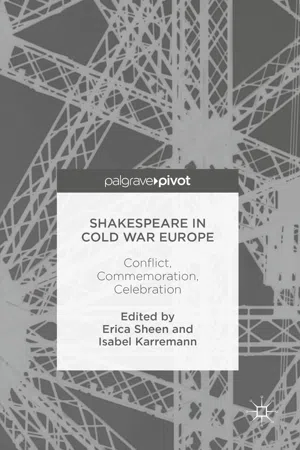
Shakespeare in Cold War Europe
Conflict, Commemoration, Celebration
- English
- ePUB (mobile friendly)
- Available on iOS & Android
eBook - ePub
Shakespeare in Cold War Europe
Conflict, Commemoration, Celebration
About this book
This essay collection examines the Shakespearian culture of Cold War Europe - Germany, France, UK, USSR, Poland, Spain and Hungary - from 1947/8 to the end of the 1970s. Written by international Shakespearians who are also scholars of the Cold War, the essays assembled here consider representative events, productions and performances as cultural politics, international diplomacy and sites of memory, and show how they inform our understanding of the political, economic, even military, dynamics of the post-war global order. The volume explores the political and cultural function of Shakespearian celebration and commemoration, but it also acknowledges the conflicts they generated across the European Cold War 'theatre', examining the impact of Cold War politics on Shakespearian performance, criticism and scholarship. Drawing on archival material, and presenting its sources both in their original language and in translation, it offers historically and theoretically nuanced accounts of Shakespeare's international significance in the divided world of Cold War Europe, and its legacy today.
Information
Bibliography
Abellán, M. L. (1980). Censura y creación literaria en España (1939–1976) . Barcelona: Península.
Alonso, G., & Alonso, D. (2011). Introduction. In G. Alonso & D. Alonso (Eds.), The politics and memory of democratic transition: The Spanish model . London: Routledge, pp. 1–15.
Amalvi, C. (1996). Bastille Day: From dies irae to holiday. In P. Nora (Ed.), Realms of memory: The construction of the French past . New York: Columbia University Press, Vol. 3, pp. 117–159.
Anderson, B. (1983). Imagined communities: Reflections on the origin and spread of nationalism . London/New York: Verso.
Anisimov, I. (1964). К 400-летию со дня рождения Шекспира. Жизнеутверждающий гуманизм, Pravda , CXIV , 4.
Ankersmit, F. (2001). Historical representation . Stanford: Stanford University Press.
Annan, N. (1948, September 7). Eine humanistiche Allegorie. Die Welt , special issue.
Annan, N. (1992). The work of the British control commission: A personal view. In E. A. Mayring (Ed.), Britische Besatzung in Deutschland: Aktenerschlessung und Forschungsfelder . London: Deutsches Historisches Institut, pp. 1–16.
Annan, N. (1995). Changing enemies: The defeat and regeneration of Germany . New York/London: W.W. Norton & Company.
Anon. (1953). No es cordero, que es cordera , de Shakespeare, presentada en un teatro de México. Teatro , VII , 12.
Anon. (1961). León Felipe, un contemporáneo mítico. Primer acto , XXVI , 48–49.
Anon. (1964). Всегда—Современник. Teatr , IV , 25–28.
Anon. (24 July 1966). Le Festival d’Avignon inaugure un théâtre où Richard III se jouera à guichets fermés, Le Méridiona /, n.p.
Anon. (28 July 1966). Richard III: énorme et délicat . Le Provençal , n.p.
Antal, G. (1977). Review on Hamlet in Láttuk, hallottuk , Radio Kossuth, transcripts of the Hungarian Theatrical Institute.
Ashplant, T. G., Dawson, G., & Roper, M. (2000). The politics of memory: Commemorating war . New Brunswick: Transaction.
Assmann, A. (2010). Canon and archive. In A. Erll & A. Nünning (Eds.), A companion to cultural memory studies . Berlin/New York: De Gruyter, pp. 97–107.
Assmann, A. (2011). Cultural memory and Western civilization: Functions, media, archives . Cambridge: Cambridge University Press.
Barthes, R. (1996). The third meaning. In S. Sontag (Ed.), A Barthes reader . New York: Hill and Wang, pp. 317–333.
Berenson, E., & Giloi, E. (2010). Constructing charisma: Celebrity, fame, and power in nineteenth-century Europe . New York/Oxford: Berghahn.
Berstein, S., & Milza, P. (1992). Histoire de la France au XXe Siecle, 1958–1974 . Bruxelles: Editions Complexe.
Besserman, L. (Ed.). (1996). The challenge of periodization: Old paradigms and new perspectives . London: Routledge.
Biner, P. (1967, April 8–9). Le Richard III de Planchon: Un fauve, ni pire, ni meilleur qu’un autre fauve. Journal de Genève , n.p.
Birkelbach, W. (2015). Report by Willi Birkelbach on the political and institutional aspects of accession to or association with the community (December 19, 1961). Centre Virtual de la Connaissance sur l’Europe, http://www.cvce.eu/en/obj/report_by_willi_birkelbach_on_the_political_and_institutional_aspects_of_accession_to_or_association_with_the_community_19_december_1961-en-2d53201e-09db-43ee-9f80-552812d39c03.htm . Date accessed March 17, 2015.
Birley, R. (1947). The Burge memorial lecture: The German problem and the responsibility of Britain . London: SCM Press.
Bistey, A. (1976, December 2). Shakespeare: Athéni Timon. Szolnok Megyei Néplap , 7.
BOE [ Boletín Oficial del Estado ]. (2015a). http://www.boe.es/dias/1966/03/19/pdfs/A03310-03315.pdf . Accessed March 17, 2015.
BOE [ Boletín Oficial del Estado ]. (2015b). http://www.boe.es/boe/dias/1963/03/08/pdfs/A03929-03930.pdf . Accessed March 17, 2015.
Boecker, B. (2015). Shakespeare in blockaded Berlin: The 1948 ‘Elizabethan Festival’. Shakespeare Survey, 68 , 282–293.
Bogácsi, E. (1976, December 16). Athéni Timon. Magyar Nemzet , 10.
Borowy, W. (1945). ‘W jakim przekładzie grać Szekspir? Teatr, I , 27–37.
Boyadzhiev, G. (1964). Shakespeare on the Soviet stage. The Anglo-Soviet Journal (Autumn), 3–13.
Bradbrook, M. C. (1978). Shakespeare: The poet in his world . New York: Columbia University Press.
Braudy, L. (1986). The frenzy of renown: Fame and its heroes . New York/Toronto: Vintage.
Braun, K. (1994). Teatr Polski 1939–1989: Obszary wolności–obszary zniewolenia . Warszawa: Semper.
Browne, J. (2005). Presidential address: Commemorating Darwin. British Journal for the History of Science, XXXVIII (3), 251–274.
Brubaker, R., & Feischmidt, M. (2002). 1848 in 1998: The politics of commemoration in Hungary, Romania and Slovakia. Comparative Studies in Society and History, XLIV (4), 700–744.
Buffet, C. (1999). Ganz Berlin ist eine Bühne: Die Kulturpolitischen Vorstellungen des Vereinigten Königreichs. In H. M. Hinz, B. Genton, & P. Jardin (Eds.), Die vier Besatzungsmachte und die Kultur in Berlin 1945–1949 . ...
Table of contents
- Cover
- Frontmatter
- Introduction: Conflict, Commemoration, Celebration
- The Mystery in the Soul of State: Shakespeare in Airlift Berlin
- Celebrating Shakespeare under the Communist Regime in Poland
- The Cultural Politics of the Quatercentenary in Germany
- ‘Here is my Space’: The 1964 Shakespeare Celebrations in the USSR
- Shakespeare’s Theatre of War in 1960s France
- In from the Cold: Celebrating Shakespeare in Francoist Spain
- Doublespeak and Realism: Shakespeare Productions in Hungary in 1976
- Backmatter
Trusted by 375,005 students
Access to over 1.5 million titles for a fair monthly price.
Study more efficiently using our study tools.
Frequently asked questions
Yes, you can cancel anytime from the Subscription tab in your account settings on the Perlego website. Your subscription will stay active until the end of your current billing period. Learn how to cancel your subscription
No, books cannot be downloaded as external files, such as PDFs, for use outside of Perlego. However, you can download books within the Perlego app for offline reading on mobile or tablet. Learn how to download books offline
Perlego offers two plans: Essential and Complete
- Essential is ideal for learners and professionals who enjoy exploring a wide range of subjects. Access the Essential Library with 800,000+ trusted titles and best-sellers across business, personal growth, and the humanities. Includes unlimited reading time and Standard Read Aloud voice.
- Complete: Perfect for advanced learners and researchers needing full, unrestricted access. Unlock 1.5M+ books across hundreds of subjects, including academic and specialized titles. The Complete Plan also includes advanced features like Premium Read Aloud and Research Assistant.
We are an online textbook subscription service, where you can get access to an entire online library for less than the price of a single book per month. With over 1.5 million books across 990+ topics, we’ve got you covered! Learn about our mission
Look out for the read-aloud symbol on your next book to see if you can listen to it. The read-aloud tool reads text aloud for you, highlighting the text as it is being read. You can pause it, speed it up and slow it down. Learn more about Read Aloud
Yes! You can use the Perlego app on both iOS and Android devices to read anytime, anywhere — even offline. Perfect for commutes or when you’re on the go.
Please note we cannot support devices running on iOS 13 and Android 7 or earlier. Learn more about using the app
Please note we cannot support devices running on iOS 13 and Android 7 or earlier. Learn more about using the app
Yes, you can access Shakespeare in Cold War Europe by Erica Sheen, Isabel Karremann, Erica Sheen,Isabel Karremann in PDF and/or ePUB format, as well as other popular books in Literature & English Literary Criticism. We have over 1.5 million books available in our catalogue for you to explore.