- English
- ePUB (mobile friendly)
- Available on iOS & Android
eBook - ePub
About this book
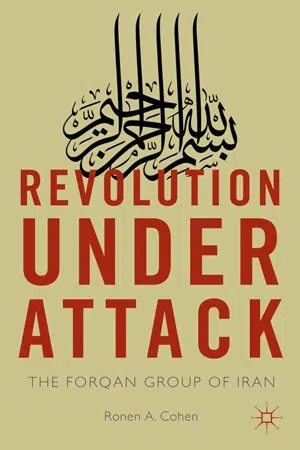
During the revolution in Iran, a small, fanatical group called the Forqan used targeted assassinations of religious leaders to fight the Ayatollah Khomeini's plan to establish a theocratic Islamic state. Ronen A. Cohen examines what really happened behind the fog of revolution.
Information
CHAPTER 1
Theological Approaches
Introduction
Genesis 2:19 reads, “And [God] brought [the animals] unto Adam to see what he would call them; and whatsoever Adam called every living creature, that [was] the name thereof.”
Verse 20 says, “And Adam gave names to all cattle, and to the fowl of the air and to every beast of the field; but for Adam there was not found an help meet for him.”
The only way this verse can be interpreted is that God wanted humanity to be a part of his creation of the world—and share in that creation. In other words, giving humankind the ability and opportunity to choose names for all the other beings created by God made him a partner with God. Moreover, this specific verse also tells us that the names that were chosen and given to the animals and other subjects influenced the character that these animals displayed.
The Bible is not lacking in these kinds of examples that emphasize the connections between the names given to relevant beings and their behavior and deeds; and some of these names were given as the consequences of specific events, thoughts, and promises. Examples of this are the names that Adam and Eve gave to their children and those that Jacob gave to most of his sons—which became the names of the 12 tribes. Others were changed as the consequences of their actions, as we see in the change of Abram to Abraham, Sarai to Sarah, and Jacob to Israel.
We can also find instances of names being used to signify a leader’s personality in the Arab and Islamic world; especially in names that derive from the tribes’ power—its horses, camels, and tools (for example, I’nan for bridle, Hassan for horse, Jamal for camel, Faras for the horse’s rider, Rassan for the reins or halter, etc). It also expresses the wishful hope that babies so named will be strong and powerful, such as in the use of Nimer for a tiger, Lith or Assad for a lion, Dhib for a wolf, Fahad for a panther, Saqer for a falcon etc. National and religious movements/organizations/institutes have also followed and adopted this method by giving themselves names with powerful and religious meanings such as Fatah for glorious victory; Ansar for the followers; Muwahidun—the followers of God Unity and Oneness; Ahl al-Hadith—the Hadith House; Mojahedin—the Holy Warriors; Fadaiyan—the devotees (of Islam); Islamiyun—the fundamentalists; etc. The above is presented in this specific chapter in order to point out the etymological and interpretational importance of names and to emphasize their connection with the material presented in other chapters.
This chapter deals with the names of the Forqan group—the Forqan and Kahf—and tries to explain what the group’s intentions were in choosing these names; since choosing a name for a religious group that purports to represent a religious ideology and practice is not a thing that we should ignore. Religiously, the name exerts a fundamental influence on the inner circles of the group, the outlook of the public it addresses, and its rivals. Thus the Forqan, being an extreme fundamentalist religious Shi’i group that claims to represent real Islam and the real message of the Quran, could not have found a better name than the Forqan, whose literal interpretation/meaning is “the Quran.” The following chapter presents primary sources and well known Hadith and Hadith scholars (Sunni as well as Shi’i, and both classical and modern) that refer to what is understood to be the meaning of Forqan. These explanations and interpretations will help us, in the following chapters, to better understand the Forqan group’s motivations and deeds.
The Religious Meaning and Interpretations of the Name Forqan
The word forqan, which appears seven times in the Quran,1 seems to have more than one acceptable meaning and interpretation, but the notion of forqan is always related to as something prestigious and honorable, with a whole sura named for it. Surat al-Forqan—the 25th sura in the Quran—is composed of 77 verses (ayat), and was given in the Makkah (Makkiya). The immediate explanation for why this sura was given in the Makkah is obvious, since it mainly discusses the sources of real belief and provides examples of them. The suras of the Quran, like the Makkiyan suras, however, generally deal with Forqan according to its literal meaning, which is “criterion” or “standard.” Vehr’s dictionary, on the other hand, defines Forqan as proof or evidence.
The theological and religious meaning as defined above relates it to the very word, quran; that is, the Forqan, like the Quran itself, represents the real truth and the real faith2 as it appears in Surat al-Imran (the family of Imran) where the meaning of Forqan is seen as equal and synonymous with the Quran. Surat al-Imran (sura 3), verse 4 states: “Before, as guidance for the people. And He revealed the Qur’an [Forqan in the Arabic text]. Indeed, those who disbelieve in the verses of Allah will have a severe punishment, and Allah is exalted in Might, the Owner of Retribution.”3
According to Fred M. Donner, in his article “Qurani Furqan,” the word “furqan” means a form of revelation that relates to some other revealed text such as “the Book,” “the Torah,” “the Gospels,” and so on, but he also offers a second opinion when he says that the “furqan is not a form of revelation, but rather constitutes the intent or purpose of revelation—just as guidance (huda) . . . is the goal or purpose of the Qur’an.”4
Uri Rubin, in his interpretation of this specific verse in Quran 3:4, says that Forqan is one of the names of the Quran and, according to him, the Muslim ulama seem to have adopted the explanation that perhaps this word—forqan—comes from the root of F.R.Q, which means “depart,” or something that is between truth and falsehood.5 Donner also examines this word etymologically and says that forqan comes from the Arabic root F.R.Q, which means, “to split,” “to separate,” “to distinguish,” but could also mean “discriminating or something that discriminates.” Donner also cites Mohammad Ibn Jarir al-Tabari’s tafsir and Fakhr al-Din al-Razi (mafatih al-ghayb) who also provide etymological contributions to this word and say that the root of forqan, F.R.Q, in some way refers “to God’s separating, or distinguishing between, truth and falsehood . . . ”[,] and “In some cases they argue that furqan was a reference to the Quran itself.”6
Rubin suggests another possible etymological interpretation that relates this word to Aramaic, where it means “redemption” or “salvation” (furqana). Rubin concludes that, according to many other Muslim ulama, forqan refers to the all the religious writings that separate truth from falsehood.7 Donner also examines this word through the etymological lens and says that “in Persian, the word forqan has come to have the following meanings: the ‘distinction between truth and falsehood’, ‘the Quran’, or ‘scripture’” He also says that Western scholars consider forqan to be an Aramaic word (as Rubin suggests) that comes from purqana (salvation) and was borrowed from Arabic.8 Donner suggests another possible interpretation, according to which the Aramaic word purqana (which means “salvation”) came from the Syrian word puqdana (commandments). For him “It is possible that in some way the Quranic furqan, in those passages that refer to something revealed to Moses, is actually derived from the Aramaic puqdana, ‘commandment’.”9 However, it seems that a possible antecedent Hebrew contribution to this understanding has been neglected, as the word—pequda—“commandment,” and its root, P.Q.D, appears in the Old Testament 150 times and much before the appearance of the Syrian Puqdana, Purqana, or Furqana.10
In the aforementioned “Qurani Furqan,” Donner provides us with a list of Hadith and Tafsir writers that contribute their understandings of the word forqan. Its earliest appearance is in Qatada ibn Di’ama from the seventh century, the century when Islam first appeared (d. 679). Di’ama says that Forqan is the Quran and nothing else. The next contribution is made by Rabi’a b. Anas (d. 756), who also refers to the word forqan in Quran 3:3 as the Quran itself; as something “which divides . . . between truth and falsehood.” Here, b. Anas also provides an explanation for why Forqan is the Quran. Ibn Ishaq (d. 757), who quotes Muhammad b. Ja’far b. al-Zubayr, also follows the path of the previous contributors and refers to the word forqan in Quran 3:3 as the separation between truth and falsehood, but mostly “regarding those things about which the ‘parties’ (al-ahzab) disagree in the matter of Jesus and other issues.” Al-Tabari (d. 923 AD) says that the Forqan is not the Torah and this opinion is supported by Ibn Zayd “who identified furqan in Q. 21:48 not with the Torah, but with the truth (al-haqq) which God brought to Moses and Aaron.” Al-Baydawi (early 1400s), by referring to Quran 3:3, tries to return to the earliest understanding of the word and says that the word forqan seems to be “things that distinguish between truth and falsehood.” But, in Quran 8:41, in relation to the words “day of Furqan” he says that it seems to be “the day of Badr, for on it (that day) truth was distinguished from falsehood.”11 In this series of respectable Tafsir and Hadith writers that Donner presents, we can see their effort to pinpoint the exact understanding of the meaning of forqan. In the coming paragraphs, we will present other Hadith and Tafsirs scholars that not only see this word like the earlier scholars did, but also provide new interpretations.12
The Forqan sura deals with the Prophet’s message to the Muslim community about Islam’s conflict with polytheism and polytheists and the bad consequences of hypocrisy and idolatry. In the sura, which is divided into three unequal parts, the first part tries to refute the logic of paganism and explain the punishment of Allah for idolatry in the past; the second part talks about Allah’s existence and power in the universe; and the last part deals with the question of who the real believers and servants of Allah are. Muslim religious philosophers hold that when you combine and correlate all these parts together into one exact understanding, what you have will be the Quran, and that is why this sura was named the Forqan—the ability to distinguish between both truth and falsehood, and good and evil.13
We can also find support for Rubin’s interpretations in the Hadith and tafsirs. In the modern Shi’i scholarly interpretation of the Quran by Sheikh Nasser Makaram al-Shirazi, Tafsir al-Amathal fi Kitab Allah al-Manzal (The Complete Interpretation of Allah’s Book [the Quran]), he treats the Forqan not only as the Quran itself, but as both a divine creed that will enable humankind to separate evil from good and falsehood from truth and also as the Israelite Torah—as a creed that was given to the Bani-Israel for the same reason.14 Moreover, on page 517, al-Shirazi writes “shahar ramadhan aladhi inzal fiha hadi lilnas wa bint min alhadi walfurqan”—“the Quran was given to Mohammad the Prophet] during the month of Ramdhan, [and within it, He] gave him the instructions and the criterion [Forqan—the instructions about how to separate truth and false],”15 and “Ma’iyar maa’rafat alhaq walbatil”—“the basic knowledge of right and wrong.”16
When, however, we go back in time to the famous and well-known tafsirs and Ahadith, we find basic, but also innovative thinking about the words forqan and sura. In the Hadith Sahih al-Bukhari, that is, related to the Persian scholar, Mohammad al-Bukhari (d. 870 CE), in volume 59—Kitab Fadhail al-Quran (The Book of the Virtues of the Quran), Bab 2—Unzila al-Quran a’la saba’hi ahrufin (Chapter Two), we find that the Quran could be recited in seven different ways, but we hardly find any arguments regarding the Suart al-Forqan. The story that al-Bukhari narrates deals with the way the Prophet’s Sahaba (inner circle of friends) recited the suras. In this case, Umar bin Al-Khattab is angry at Hisham bin Hakim because the latter did not recite the Surat al-Forqan correctly that is, in the same way that al-Khattab knew how to recite it. Umar bin Al-Khattab not only argued with Hakim, but also subjected him to an informal trial in front of the Prophet. At the end, the Prophet told them that there is no one way to recite this sura and its message, but seven ways.17 From this story in al-Bukhari, we can learn about the message that the Prophet wished to be passed on—that it does not matter how you tell the story when the message is correctly transmitted. The debate between the two does not show any argument about the essence and message of the sura, but about the manner in which they both seemingly recited it incorrectly—but for the Prophet, it was acceptable because the meaning remained unchanged.
A different version of the abovementioned story can also be found in al-Tabari’s Tafsir—Jama’ al-Bayan fi Taawil al-Quran. In volume one, article 15, al-Tabari writes that the Forqan, as written in al-Bukhari (they are both from the ninth century), can be recited in seven different ways but, in contradiction to al-Bukhari, al-Tabari provides us with another aspect of the Forqan. A Hadith that he presents says, “sama’atu Hashim bin Hakim iqraa’ surat al-Furqan fi hayatu rasul-Allah [ . . . ], fasama’tu liqraatua fadha hu iqrauha a’la haruf kathira lam yuqriniha rasul Allah [ . . . ], fakadit asawarahu fi alsala, fatasabbarat hata sallim. Fila...
Table of contents
- Cover
- Title
- 1 Theological Approaches
- 2 The Emergence of the Forqan Group
- 3 The Fundamental Ideology of the Forqan
- 4 Acts of Terror and Assassination—The Trojan Horse Inside the Islamic Revolution
- 5 The CIA, SAVAK, and Mossad Connections with the Forqan
- 6 The Termination of the Forqan Group
- 7 “SATJA”—Sazman-e Enqelabi-e Todehay-e Jomhory-e Islami-e Iran—The People’s Revolutionary Organization of the Islamic Republic of Iran
- Conclusions
- Notes
- Bibliography
- Index
Trusted by 375,005 students
Access to over 1.5 million titles for a fair monthly price.
Study more efficiently using our study tools.
Frequently asked questions
Yes, you can cancel anytime from the Subscription tab in your account settings on the Perlego website. Your subscription will stay active until the end of your current billing period. Learn how to cancel your subscription
No, books cannot be downloaded as external files, such as PDFs, for use outside of Perlego. However, you can download books within the Perlego app for offline reading on mobile or tablet. Learn how to download books offline
Perlego offers two plans: Essential and Complete
- Essential is ideal for learners and professionals who enjoy exploring a wide range of subjects. Access the Essential Library with 800,000+ trusted titles and best-sellers across business, personal growth, and the humanities. Includes unlimited reading time and Standard Read Aloud voice.
- Complete: Perfect for advanced learners and researchers needing full, unrestricted access. Unlock 1.5M+ books across hundreds of subjects, including academic and specialized titles. The Complete Plan also includes advanced features like Premium Read Aloud and Research Assistant.
We are an online textbook subscription service, where you can get access to an entire online library for less than the price of a single book per month. With over 1.5 million books across 990+ topics, we’ve got you covered! Learn about our mission
Look out for the read-aloud symbol on your next book to see if you can listen to it. The read-aloud tool reads text aloud for you, highlighting the text as it is being read. You can pause it, speed it up and slow it down. Learn more about Read Aloud
Yes! You can use the Perlego app on both iOS and Android devices to read anytime, anywhere — even offline. Perfect for commutes or when you’re on the go.
Please note we cannot support devices running on iOS 13 and Android 7 or earlier. Learn more about using the app
Please note we cannot support devices running on iOS 13 and Android 7 or earlier. Learn more about using the app
Yes, you can access Revolution Under Attack by Ronen A. Cohen in PDF and/or ePUB format, as well as other popular books in Politics & International Relations & International Relations. We have over 1.5 million books available in our catalogue for you to explore.