This book examines how Massachusetts Normal Art School became the alma mater par excellence for generations of art educators, designers, and artists. The founding myth of American art education is the story of Walter Smith, the school's first principal. This historical case study argues that Smith's students formed the professional network to disperse art education across the United States, establishing college art departments and supervising school art for industrial cities. As administrative progressives they created institutions and set norms for the growing field of art education. Nineteenth-century artists argued that anyone could learn to draw; by the 1920s, every child was an artist whose creativity waited to be awakened. Arguments for systematic art instruction under careful direction gave way to charismatic artist-teachers who sought to release artistic spirits. The task for art education had been redefined in terms of living the good life within a consumer culture of work and leisure.
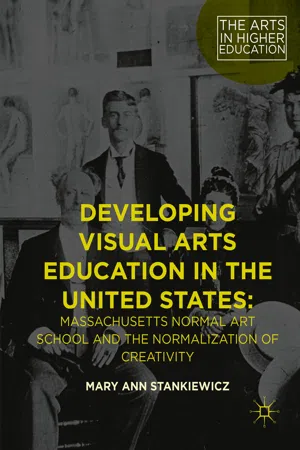
eBook - ePub
Developing Visual Arts Education in the United States
Massachusetts Normal Art School and the Normalization of Creativity
- English
- ePUB (mobile friendly)
- Available on iOS & Android
eBook - ePub
Developing Visual Arts Education in the United States
Massachusetts Normal Art School and the Normalization of Creativity
About this book
Information
Topic
EducationSubtopic
Higher Education© The Editor(s) (if applicable) and The Author(s) 2016
Mary Ann StankiewiczDeveloping Visual Arts Education in the United StatesThe Arts in Higher Education10.1057/978-1-137-54449-0_11. Introduction
Mary Ann Stankiewicz1
(1)
Pennsylvania State University, State College, Pennsylvania, USA
The story of the 1870 Massachusetts Drawing Act that led Walter Smith to leave England and take on triple tasks as supervisor of drawing in Boston’s public schools, state director of industrial drawing, and founding principal of Massachusetts Normal Art School is the founding myth of art education in the USA. 1 This history of MNAS is a case study of efforts to embed art education into formal education for all learners. I argue that the development of American art education as a field of practice was a creative achievement made possible by dynamic interactions among institutions, notably MNAS, social networks of stakeholders, faculty, students, and alumni, along with cognitive frameworks shaped by social, economic, and cultural contexts during the late nineteenth and early twentieth centuries. My focus on the normal art school and how its alumni became leaders in the emerging field of art education as art teachers, city art supervisors, state art directors, and faculty in higher education has led me to re-examine Smith’s work: how it was received in late-nineteenth-century Massachusetts, how art educators developed social networks, and how MNAS alumni extended art education into schools and communities across the USA.
The Field of Art Education
Art education, as a phrase, is often used broadly to denote formal and informal instruction in visual arts and design within the context of general education. As many of the historical subjects I introduce in this book explain, only some people become artists, but all persons in a democracy need to understand and value the functions of visual arts in society and culture. Art education includes learning to make art and learning to respond to objects and images made by others. It is grounded in beliefs that the arts contribute to the quality of human life; without them, humans lack vital experiences. My conceptual framework for this book has been influenced by sociologies of art, culture, and professions, as well as the psychology of creativity. 2 Art education is a field with professional aspirations often constrained by norms and structures of formal, public schooling. As a distinct field, it has a unique task—teaching drawing and other visual arts as facets of general education for children and adults.
Rationales for the ethical, moral benefits of this task are grounded in historical facts that humans make objects and images as part of seeking a good life, one that is personally and socially satisfying. Specific manifestations of the task and rationale have changed over time in response to social factors and cultural changes. Social factors include technologies (broadly defined as tools used to shape and control a world), as well as organizations and institutions with rules for action and behavior. In the story of MNAS, expansion of print technologies for reproducing images and mass distribution of magazines was crucial. Cultural changes include emergence of a market economy in the nineteenth century, an industrial revolution leading to urbanization and capitalism, development of both an art market and a consumer economy, and political forces shaping the spread of formal schooling. In addition to effects from political and economic aspects of culture, art education has been affected by changes in theory and practice in the arts, what sociologist of culture, Howard Becker, calls art worlds, notably the late nineteenth-century rise of a modern fine arts world. 3 A third area of cultural values contributing to development of art education is beliefs about human beings, informed by theories of mind, the field of psychology, and theories of human growth and learning, especially changing conceptions of children. 4
Within these social and cultural contexts, art educators try to successfully advance (if never fully completing) their task of teaching drawing and other visual arts as part of general education for all children and adults. In order to convince others outside the field that their task benefits society and is worth attention and even payment, art educators frame the task as solving personal or social problems. For example, during the rise of middling classes in 1830s–1840s America, informal instruction in art helped solve problems of refinement. 5 By the 1920s, the art problem was adding beauty to consumer goods such as homes, clothing, automobiles, machine tools, and even floor mops and radios, according to Massachusetts School of Art director Royal Bailey Farnum. 6 The stories that form the core of this book focus on how art education was defined and redefined during the period of the Civil War into the first third of the twentieth century, roughly from 1850 to 1930.
Social context is important because the problems art education proposed to solve were socially significant, as well as personally meaningful. These contexts molded the post-secondary institution known as Massachusetts Normal Art School, and after 1926, as Massachusetts School of Art (MSA). If the school had been established in a different city, a less industrialized state, during a period not following a Civil War or including a First World War, its story would have been very different. If advocates for the 1870 Massachusetts Drawing Act had not shared close ties as members of a social, cultural, economic, and political elite or if instructors and early students not been part of a Yankee middle class, the social networks formed among early art educators and supervisors might have taken alternate forms. If ideas about visual arts as means for industrial development, and simultaneously, cultural upliftment had not flourished during the Gilded Age, on the cusp of progressivism, when scientific methods were shaping ways of knowing, the content of art education would not have developed as it did.
Research on creativity blossomed after the Second World War, when psychologists began to bring a scientific lens to a concept rooted in mystical, spiritual, and romantic notions of inspired beings pouring out unique works of genius. 7 The word ‘creativity’ is rarely used in nineteenth-century writings on art education; related terms, such as ‘imagination’ and ‘invention,’ were more common. Imagination carried connotations of visualization, of artists making mental images, then realizing their visions in paintings and sculptures. Phrenologists identified constructiveness or invention as a mental faculty that humans shared with animals like beavers. 8 This faculty connoted construction, building things and making new and useful objects. If the artist could imagine and compose a painting of a historical or mythological scene, an inventor could plan, visualize, and construct a cotton gin, a new type of spinning jenny, or other machines. Drawing was a tool for both imagination and invention, for visualization and practical planning, and for thinking visually.
Today, many creativity researchers distinguish big-C Creativity, statistically rare innovations likely to change a field or domain or culture, from small-c creativity. Art educators encourage their students to learn about Creative avant-garde artists whose works redefine the concept of art or Creative designers of tools and products that improve human life. Some art educators define success in relation to producing a few students who make successful careers in arts and design. Nonetheless most art educators aim to release small-c creativity, a quality or trait all human beings possess that contributes to healthy, balanced lives. Small-c creativity implies young children’s drawings, an emotionally healthy state of openness to novelty, and traits like fluency, flexibility, and boundary pushing.
Creativity—both big-C and small-c—has often been treated as characteristic of individuals. My use of the term is informed by Csikszentmihalyi’s systems perspective and by other scholars who theorize how individuals change domains or fields. 9 As a psychologist, Csikszentmihalyi argues that ‘creativity results from the interaction of a system composed of three elements: a culture that contains symbolic rules, a person who brings novelty into the symbolic domain, and a field of experts who recognize and validate the innovation.’ 10 Coming from sociology of economics, Beckert examines changes in fields in relation to dynamic interactions among institutions with their rules for behavior, social networks, and cognitive frameworks. He diagrams the three forces as an equilateral triangle balanced on the downward point of cognitive frames. Without reducing one model to the other or exactly aligning the two triads, I have found both useful in my process of interpreting the case of the Normal Art School in relation to the development of American art education.
Art education, in the interpretation I am sketching here, is a field of practice, where social networks build collective power to establish institutions with rules and conventions that, in turn, influence the structure of those social networks. 11 For example, the network of Boston Brahmins knew the rules for submitting petitions to the General Court, as well as how to use the press to build public support. The social networks also shape and diffuse cognitive frameworks or ways of thinking about and conceptualizing art teaching and learning. These elite men’s ideas on the value of visual arts were likely shaped by their college professors and other public lecturers and justifications for the importance of drawing from artists who argued that anyone could learn to draw. 12 As new cognitive frames emerge, they shape how persons in the social network perceive the network structures. With the successful passage of the 1870 Drawing Act and the aging of the original petitioners, a network of educators and lay boards overseeing public education shaped formal art education, informed by precedents from other educational institutions. The cognitive frames legitimate and shape perceptions of the institutions, rules, and conventions that influence the structure of the social networks. Their expectations for the normal art school were shaped by their knowledge of common schools, normal schools preparing teachers, and technical institutions educating engineers and architects. Finally, institutional rules mold cognitive frames when institutional pressure reflects social values. As MNAS developed its own institutional culture, the learning community led by Walter Smith became the new social network. Alumni carried their beliefs about art teaching and learning to other institutions and expanded their network through professional associations. In their teaching, writing, and lectures, they communicated and adapted shared beliefs that became taken for granted as normative for art education.
Normal, Normal Schools, and Normalization
First, normalization refers to naturalizing visual arts as a standard, taken-for-granted part of modern life and education. Second, it refers to setting up rules and norms, regulating and regularizing instruction in visual arts—and third, to normal schools: nineteenth-century institutions for preparing women to teach elementary schools and subjects. This last sense comes from the French école normale, the institution established after the French Revolution to train teachers in technical subjects for preparation of engineers and others. 13 I deliberately use the concept of normalization in multiple ways in the book; it is ambiguous. Normalizing drawing refers to the antebellum assertion that anyone capable of learning how to form letters was capable of learning how to draw. Normalizing also refers to adapting Pestalozzian methods for teaching drawing from copying straight vertical and horizontal lines, curves, and diagonals in a designated sequence from simple lines to geometric shapes, and in time, more complex geometric forms. During much of the nineteenth century, variations of this system were regarded as the correct—normal—way to instruct learners not destined to become artists in drawing. Normalization can also be applied to development of drawing types associated with particular functions, vocations, social classes, and genders: constructive drawing showing two-dimensional plans for three-dimensional objects; decorative drawing, sometimes called design or ornament, in which learners developed patterns repeating conventionalized motifs suitable for embellishing surfaces of fabrics, carpets, or wallpaper; and representational drawing, naturalistic rendering of objects or nature. By the 1890s, these forms of drawing pervaded art texts for graded public schools published by the Prang Educational Company, a firm that grew from publishing Walter Smith’s American art education texts. During the late 1920s, belief in art making for self-expression became normalized. Formal didactic instruction was downplayed in the literature of art education, although it persisted in classroom practice.
Normalization also refers to the Commonwealth of Massachusetts’ investments in, and regulation of, art education in publicly funded schools, from primary up to secondary, and especially post-secondary teacher education. Allowing establishment of a normal art school under the direction of the State Board of Education and Principal Walter Smith opened access to some forms of art education over others. 14 Negotiations between public and private power over visual arts and culture contributed to modernist notions of fine arts and classification of useful or popular arts as less distinguished. Massachusetts institutionalized art education within contexts of economic development, technical literacy, and industrial education: preparing human capital for manufacturing and schooling future workers to accept industrial time and regulated behavior as norms. As I use the concept, normalizing art education required development of institutions that provided access to systematic, structured visual art education.
Hierarchies: Status, Gender, and Power
As a field of practice, art education exists within contexts of power and status. Nineteenth-century art educators claimed more than hand-knowledge; they identified principles that enabled drawing to enter common schools in systematic, structured ways. Wanting their ...
Table of contents
- Cover
- Frontmatter
- 1. Introduction
- 2. Learning to Draw in Antebellum Massachusetts
- 3. Relating to Free Instruction in Drawing
- 4. Thoroughly Sound and Searching Training
- 5. Pioneers Putting Their Hands to the Plow
- 6. This Great Industrial Battle
- 7. A Great Art Awakening
- 8. Social Efficiency, Beauty, and the World’s Work
- 9. Alma Mater Par Excellence
- Backmatter
Trusted by 375,005 students
Access to over 1.5 million titles for a fair monthly price.
Study more efficiently using our study tools.
Frequently asked questions
Yes, you can cancel anytime from the Subscription tab in your account settings on the Perlego website. Your subscription will stay active until the end of your current billing period. Learn how to cancel your subscription
No, books cannot be downloaded as external files, such as PDFs, for use outside of Perlego. However, you can download books within the Perlego app for offline reading on mobile or tablet. Learn how to download books offline
Perlego offers two plans: Essential and Complete
- Essential is ideal for learners and professionals who enjoy exploring a wide range of subjects. Access the Essential Library with 800,000+ trusted titles and best-sellers across business, personal growth, and the humanities. Includes unlimited reading time and Standard Read Aloud voice.
- Complete: Perfect for advanced learners and researchers needing full, unrestricted access. Unlock 1.5M+ books across hundreds of subjects, including academic and specialized titles. The Complete Plan also includes advanced features like Premium Read Aloud and Research Assistant.
We are an online textbook subscription service, where you can get access to an entire online library for less than the price of a single book per month. With over 1.5 million books across 990+ topics, we’ve got you covered! Learn about our mission
Look out for the read-aloud symbol on your next book to see if you can listen to it. The read-aloud tool reads text aloud for you, highlighting the text as it is being read. You can pause it, speed it up and slow it down. Learn more about Read Aloud
Yes! You can use the Perlego app on both iOS and Android devices to read anytime, anywhere — even offline. Perfect for commutes or when you’re on the go.
Please note we cannot support devices running on iOS 13 and Android 7 or earlier. Learn more about using the app
Please note we cannot support devices running on iOS 13 and Android 7 or earlier. Learn more about using the app
Yes, you can access Developing Visual Arts Education in the United States by Mary Ann Stankiewicz in PDF and/or ePUB format, as well as other popular books in Education & Higher Education. We have over 1.5 million books available in our catalogue for you to explore.