eBook - ePub
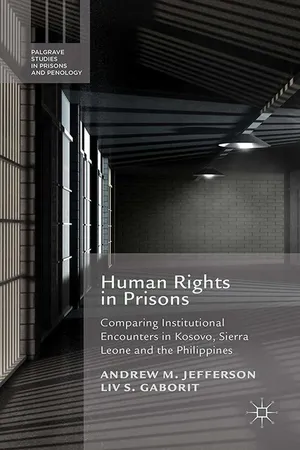
Human Rights in Prisons
Comparing Institutional Encounters in Kosovo, Sierra Leone and the Philippines
- English
- ePUB (mobile friendly)
- Available on iOS & Android
eBook - ePub
Human Rights in Prisons
Comparing Institutional Encounters in Kosovo, Sierra Leone and the Philippines
About this book
Drawing on participatory action research conducted in Sierra Leone, Kosovo and the Philippines, Human Rights in Prisons analyses encounters between rights-based non-governmental organisations and prisons. It explores the previously under-researched perspectives of prison staff and prisoners on their lives and relationships.
Information
Topic
Ciencias sociales1
Introducing Human Rights in Prisons
First encounters matter. Encounters can be intimate or at arm’s length, but either way, they matter. Enduring encounters matter even more – indeed, they are critical. These are the key lessons of this book, the key findings of a research project spanning 2012–2013 documenting and exploring the constitutive encounter between prisons and rights-based non-governmental organisations (henceforth ‘NGOs’) in Kosovo, Sierra Leone, and the Philippines.
The research project has been conducted with, through, and about three rights-based NGOs, who each in their own way, are involved in what might in broad terms be called prison reform. The original and founding puzzle of the project began from the assumption that reform efforts have different effects in different settings. We wanted to ask why and how reform projects in different settings have particular effects. As will become clear through our narrative, this basic question has undergone some transformations along the way, such that today we ask ourselves and our material not only about the effects of reform projects on the prison but also about the effects of prisons on reform agencies.
The reversal of our original question represents one of the central findings of our study: prisons affect reformers as much as reformers affect prisons. Based on our systematically gathered material and analysis, we are drawn to question one of the most commonly taken-for-granted claims of rights-based organisations – namely, that they are neutral and independent. The aspired to, claimed or assumed independence of reform actors or agencies is a myth; reform agencies and prisons are entangled and interdependent.
We hope our findings will contribute to the development of new ways of thinking about change in relation to prisons and perhaps even to a more radical questioning of the (over)use of principles of independence. Given our institutional affiliation to DIGNITY – Danish Institute Against Torture, it should go without saying that our intention is not to undermine rights-based approaches. On the contrary, we wish to ground them more solidly in social and institutional realities. Our questioning, in the modest tradition of social scientific research, is designed simply to illuminate social and institutional practices as they are and to propose a critical rethinking where necessary.
As well as casting light on encounters between NGOs and prisons, this book also aims to cast light on prison systems and practices in three under-researched contexts and thus add to the emerging – though still woefully inadequate – body of literature on ‘prisons beyond the west,’ contributing to a more global penology.
More details about the three organisations will be provided later. First we will introduce the key concepts that feature throughout the book.
Key analytical concepts
In our original project description we posed four sub-questions that hinted at our aspirations and contained seeds of ideas that have subsequently flourished and developed into the concepts we develop further through empirical analysis (Chapters 3 through 6) and theorising (Chapter 7 and 8). We asked how might the relationship between reform and prison practice be characterised. What dynamics and logics are at work? What webs of power and interdependence are produced? What effects do these have on the potential to bring about change?
It was these questions about which we were initially curious. They do not have straightforward answers. But it is these questions that implicitly informed the direction of the project and our subsequent thinking and led ultimately to three key ideas or concepts, briefly introduced below and unfolded throughout this volume. They are the idea of the prison as relational institution, the encounter as analytic lens, and the notion of institutional agency. The idea of the prison as a relational institution is an assumption that our study confirmed. Notions of the encounter and of institutional agency are concepts that we developed further through our empirical and theoretical analysis.
The prison as fundamentally relational
The first more or less foundational assumption that our study confirms is the idea of the prison as a fundamentally relational institution.1 We will expand on this notion later. Here it is enough to say that what this implies is a shift from understanding the prison in terms of its oft contested and oft mystified function to an understanding of the prison in terms of its relationships. Relations, we argue, are central to prisons and deserve a more central place in characterisations of what prisons are. Yes, they are places of punishment, pain, shame, stigma, and so on. But they are such because they are first and foremost social, or, more accurately, antisocial social institutions.
Highlighting this aspect offers an alternative point of departure for thinking about the potential for transformation, debates about which are often clouded by discussions about what prison are for. Once again, by adopting this angle we are advocating, as a point of departure, analysis of what prisons most fundamentally are rather than what they are for. From this perspective, prisons are, first of all, a conglomeration of relational actors thrust upon one another under circumstances over which they have little direct control.
The encounter
As already stated, this book is primarily about the encounter between prisons and NGOs. The idea of the encounter as a way of thinking about prisons has emerged from more than a decade of ethnographic fieldwork in prisons in the global south. This book will be the first full volume applying, analysing, and developing the concept and lens of the encounter through a sustained empirical-theoretical project.2
In earlier work on prisons in Nigeria and Sierra Leone, the encounter came into view via consideration of the entangled nature of two key aspects of prisons. These were, firstly, relations between staff and prisoners and, secondly, relations between the inside and outside of the prisons. Relationships between staff and prisoners were characterised more by cordiality and commonality than by enmity and distinctiveness. The prisons themselves were characterised more by porosity, permeability, and relations of exchange than by sharp distinctions between inside and outside.
Because of these origins, for a long time we qualified the term encounter with the adjective ‘entangled’. This is an accurate way of talking about the West African setting. Encounters in prisons there are highly entangled, as will become clear throughout this book. But as will also become clear, encounters can be part of more or less entangled relations, so for analytic purposes we now prefer to frame our thinking and analysis of the prisons and the NGOs simply in terms of the encounter. The degree to which encounters are entangled, and the different kinds and levels of entanglement, are empirical questions that we explore in detail. Thinking with and through encounters allows us to avoid the traps of dualistic thinking and the tendency to reduce or subordinate one element to another. It allows us to analyse constitutive events at the moment of production (Jefferson 2013; Lave 2011).
Institutional agency
In our endeavour to better understand the styles of encounters between NGOs and prisons, the concept of institutional agency has proved useful. What we identify throughout this book are institutions acting on one another, albeit often through people. This is what we chose to call institutional agency.3 This is not to make a claim that institutions are like people. It is rather to emphasise that institutions are more than the sum of their human parts – that to some extent they have the characteristics of subjects (Douglas 1986; Nissen 2014), they have history, they set limits on possibilities for action, their actions have rationality and direction, and they have effects and consequences (on their occupants and on external actors).
In addition, the people within institutions often act as though the institution has agency. Here we might speak of an imagined intentionality ascribed to institutions. Institutional agency is a concept that will be discussed in much more detail in Chapter 7. It helps us explain the way individual actors can appear to embody and enact institutional values and logics and therefore act in particular ways through their immersion in particular circumstances (see Jefferson 2011). For now it is enough for the reader to be aware of our concern with the agentic character of the prisons and NGOs that we describe and analyse in what follows.
Presenting the NGOs
Identifying partners
One way of characterising the three organisations that feature in our narrative would be to say they are rights-based NGOs involved in prison reform. If we were looking for a common denominator we might for the sake of convenience call them reform agencies. Each of them is involved in the business of bringing about change. They were included in the project because of their generic similarity and their specific differences. Broadly speaking, each organisation aims to improve prison conditions, support prisoners, counter torture and inhumane treatment, and promote human rights. Yet, whilst generally occupying a shared platform in the fight against torture and for human rights – and, less explicitly, for prison reform – each of the three organisations has features that distinguish them from one another.
Balay Rehabilitation Centre (henceforth ‘Balay’) in the Philippines was chosen due to their orientation towards the idea of humane prisons and their long-term engagement with political prisoners and the authorities. Their intimate knowledge of prisons and their organisational tradition for critical reflection upon their own practices made Balay an attractive collaborative partner.
Prison Watch Sierra Leone (henceforth ‘Prison Watch’) was chosen because of the way they were caught up in and nurtured some unusual and entangled relationships involving prison issues. A distinctive aspect of their work is their orientation towards the authorities. Although in their early days Prison Watch had a confrontational relationship, today they enjoy a collaborative relationship through which they both critique and build capacity. Their director’s claim that they work ‘with but not for the authorities’ illustrates a considerable degree of insight into the pitfalls of occupying such an institutional terrain.
Kosova Rehabilitation Centre for Torture Victims (henceforth ‘KRCT’) in Kosovo were chosen due to their particular interest in relations between prisoners and staff, evidenced through knowledge-generation projects like a revised MQPL4 survey and the piloting of focus group methodologies as a source of data about prison climates. In addition, KRCT represented a more classic approach to prison reform based on monitoring the state’s compliance with human rights norms and minimum standards for prisons.
What each of these organisations also shared was a pre-existing institutional collaboration with DIGNITY. Thus there was also a purely pragmatic criterion in the identification of these particular organisations as collaborative partners and subjects of the research. For such a project a certain level of foreknowledge and trust is a prerequisite.
It should be borne in mind that the characterisations in this book are relatively time-bound. These are NGOs under continuing development. While we hope that the research project itself encouraged the organisations to develop organically, our purpose was never to evaluate their practices. Similarly, we caution the reader against making such judgements of any of the NGOs based on the partial picture of the practices we were able to paint in this book.
These were the grounds for identifying the collaborating partners. Let us now turn to a basic presentation of the organisations, their backgrounds, and their activities. We will get to know the organisations more deeply as we move beyond this introductory chapter. What follows will hopefully serve as a cursory introduction to the main institutional actors. We begin with the NGOs and then move to the prisons.
Balay Rehabilitation Centre5
Balay was established in 1985 during the final years of the dictatorship of Ferdinand Marcos as a reaction to the regime’s ongoing abuse of human rights in the form of torture, extra-judicial killings, disappearances, and incarceration. Political prisoners were an obvious client group and prison a natural field of intervention.
Initially, Balay was called the Philippine Centre for Torture and Rehabilitation and was part of the Free Legal Assistance Group. The new name, Balay, meaning ‘house’ or ‘shelter’ in a local Philippine dialect, alludes to the desire of the organisation to create a supportive environment for ex-prisoners and their families. Balay’s services included counselling, therapeutic activities, welfare provision, and support for family reunification. Clients were referred from allied human rights organisations and were mainly members of communist opposition groups who were victims of torture and incarceration.
Less than a year after Balay’s conception, Marcos was overthrown in the revolution of 1986. A year later, formal democracy was installed with the approval of a new constitution, though the legacy of previous regimes lives on, and, according to various reports, torture and extra-judicial killings still proliferate.
As the post-revolution society developed, so did Balay. They went from being a halfway house providing temporary shelter for political ex- prisoners to one that included others vulnerable to human rights abuses. The scope of the organisation broadened. Later, activities were developed inside prisons, in poor neighbourhoods, and in areas where people were displaced by conflict or natural disasters. The organisation made alliances to advocate for ratification of international human rights law, which led to significant advances like the passage of the Anti-Torture Law of 2009. This legislation not only is a landmark for human rights in the Philippines, but also hints at a development in Balay away from the historical focus on communist groups and toward a more general struggle for human rights.
Balay hopes to contribute to the democratic transition, not only for specific political groups but for the whole society, though victims of excessive state power remain a core concern. Contemporary clients in the prisons reflect the legacy of Balay even as they reflect the changing political landscape. These include Muslims thought to be involved in the conflict on the island of Mindanao6 and leftists accused of affiliation to communist groups and the revolutionary struggle. But Balay situate their work today within a neutral ‘human rights for all’ framework.
Balay divide the prisons they work into two types: focus and outreach. Focus jails are defined by the presence of a high number of potential clients, or ‘partners’, as Balay call them, their strategic value for anti-torture advocacy, and their relative proximity to Balay’s offices. Focus jails are visited once a week, while outreach jails – which house fewer partners, are of lesser strategic importance, and are less accessible – are visited twice a year.
The two institutions featured in this study, the Special Intensive Care Area (SICA) and the New Bilibid Prison (NBP) are regularly visited by Balay’s staff. A...
Table of contents
- Cover
- Title
- 1 Introducing Human Rights in Prisons
- 2 Encountering Ourselves: a Critically Reflexive Practice Research Project
- 3 First Encounters: Accessing Prisons
- 4 Close Encounters with Prison Staff
- 5 Close Encounters with Prisoners
- 6 Close Encounters between Prisoners and Prison Staff
- 7 Critical Encounters
- 8 What Encounters Count? What Matters?
- Notes
- References
- Index
Trusted by 375,005 students
Access to over 1.5 million titles for a fair monthly price.
Study more efficiently using our study tools.
Frequently asked questions
Yes, you can cancel anytime from the Subscription tab in your account settings on the Perlego website. Your subscription will stay active until the end of your current billing period. Learn how to cancel your subscription
No, books cannot be downloaded as external files, such as PDFs, for use outside of Perlego. However, you can download books within the Perlego app for offline reading on mobile or tablet. Learn how to download books offline
Perlego offers two plans: Essential and Complete
- Essential is ideal for learners and professionals who enjoy exploring a wide range of subjects. Access the Essential Library with 800,000+ trusted titles and best-sellers across business, personal growth, and the humanities. Includes unlimited reading time and Standard Read Aloud voice.
- Complete: Perfect for advanced learners and researchers needing full, unrestricted access. Unlock 1.5M+ books across hundreds of subjects, including academic and specialized titles. The Complete Plan also includes advanced features like Premium Read Aloud and Research Assistant.
We are an online textbook subscription service, where you can get access to an entire online library for less than the price of a single book per month. With over 1.5 million books across 990+ topics, we’ve got you covered! Learn about our mission
Look out for the read-aloud symbol on your next book to see if you can listen to it. The read-aloud tool reads text aloud for you, highlighting the text as it is being read. You can pause it, speed it up and slow it down. Learn more about Read Aloud
Yes! You can use the Perlego app on both iOS and Android devices to read anytime, anywhere — even offline. Perfect for commutes or when you’re on the go.
Please note we cannot support devices running on iOS 13 and Android 7 or earlier. Learn more about using the app
Please note we cannot support devices running on iOS 13 and Android 7 or earlier. Learn more about using the app
Yes, you can access Human Rights in Prisons by A. Jefferson,L. Gaborit in PDF and/or ePUB format, as well as other popular books in Ciencias sociales & Derechos civiles en la legislación. We have over 1.5 million books available in our catalogue for you to explore.