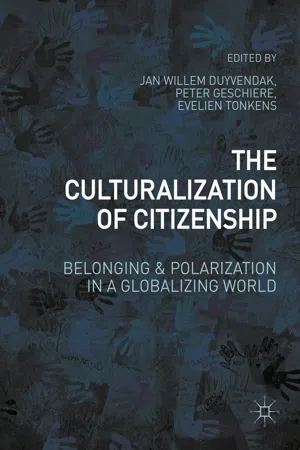
The notion of citizenship has gradually evolved from being simply a legal status or practice to a deep sentiment. Belonging, or feeling at home, has become a requirement. This groundbreaking book analyzes how 'feeling rules' are developed and applied to migrants, who are increasingly expected to express feelings of attachment, belonging, connectedness and loyalty to their new country. More than this, however, it demonstrates how this culturalization of citizenship is a global trend with local variations, which develop in relation to each other. The authors pay particular attention to the intersection between sexuality, race and ethnicity, spurred on by their awareness of the dialectical construction of homosexuality, held up as representative of liberal Western values by both those in the West and by African leaders, who use such claims as proof that homosexuality is un-African.
eBook - ePub
The Culturalization of Citizenship
Belonging and Polarization in a Globalizing World
- English
- ePUB (mobile friendly)
- Available on iOS & Android
eBook - ePub
The Culturalization of Citizenship
Belonging and Polarization in a Globalizing World
About this book
Information
Topic
SozialwissenschaftenSubtopic
Politik© The Editor(s) (if applicable) and The Author(s) 2016
Jan Willem Duyvendak, Peter Geschiere and Evelien Tonkens (eds.)The Culturalization of Citizenship10.1057/978-1-137-53410-1_11. Introduction: The Culturalization of Citizenship
Evelien Tonkens1 and Jan Willem Duyvendak1
(1)
University of Amsterdam, Amsterdam, The Netherlands
If immigration continues, the Islamic culture in the Netherlands will continue to grow… and we will come to live in a country with not one million but many more Muslims who adhere to an ideology that is diametrically opposed to ours, and in which the Dutch identity will be lost… I want to preserve our identity and I want to stop immigration (Geert Wilders, founder and leader of the Freedom Party, speaking in Parliament, 1 April 2008).
We should not sell ourselves to the Islamic culture and the misery it entails: women’s oppression and violence against gays (Geert Wilders, Algemeen Dagblad, 8 August 2007).
‘Protecting our culture’ has become common code in Western Europe to deny immigrants full citizenship. By ‘full citizenship’ we mean not only enjoying the legal rights that come with citizenship but being recognized symbolically and emotionally as co-citizens. As will become clear in this book, it has recently become much harder for immigrants to acquire this ‘full’ status: legal rights are only granted after lengthy procedures including citizenship exams, while symbolic access to national belonging is still often denied by native majorities to even second- or third-generation immigrants who are legal citizens (cf. Uitermark et al. 2014).
This protectionism is based on a static and essentialized understanding of culture as well as on an idea of citizenship that has culture at its core. But if we accept that cultures evolve—and do so ‘through dissent and robust criticism from their members’ (Nussbaum 2000: 48)—neither the ‘cultures’ of immigrants nor those of receiving societies can be taken as self-evident, homogenous wholes. Cultures are rife with disagreement, and immigration changes the cultures of both immigrant groups and receiving societies, not only due to confrontations between them but because this confrontation stirs up disagreements and power struggles within these cultures.
‘Cultures are dynamic, and change is a very basic element in all of them’ (Ibid). This, however, is far from the dominant understanding of culture in many countries today. In its place we see the ‘culturalization of citizenship’—a process in which what it is to be a citizen is less defined in terms of civic, political or social rights, and more in terms of adherence to norms, values and cultural practices (Geschiere 2009; Duyvendak 2011; Hurenkamp et al. 2012).
The research project that gave birth to this volume studied the culturalization of citizenship in the Netherlands and other immigrant-destination countries in Western Europe (especially France and Great Britain, see Hurenkamp et al. 2012) and its impact on the prospects of (potential) immigrants from especially Muslim majority countries and Sub-Saharan Africa. The first part of this volume focuses on the Dutch case as a radical version of the trend in many European countries to tie full-fledged citizenship to the embrace of ‘modern Western’ values, particularly regarding gender and sexuality. The second part of this volume examines the opposite pole of this global cultural polarization: dynamics of local belonging as well as responses to the literal and symbolic closing of Europe’s borders within the Global South. The contributions to this volume are authored by scholars from Cameroon, Ghana, Mali, Curaçao, St. Maarten and the Netherlands.
Citizenship and Culture
The explicit culturalization of citizenship in post-war Western Europe is a relatively recent phenomenon. For many decades, citizenship was first and foremost tied to possessing nationality (Heater 1990; Turner 1993) and understood in terms of citizens’ rights and obligations (Marshall 1950). To be a citizen was to be a full member of a national community and to be granted the rights and accept the duties of this membership.
If we follow the famous English theorist T.H. Marshall, citizenship in England began with the development of civil rights in the eighteenth century—rights that guarantee individual liberty such as freedom of speech, freedom of religion, and the right to own property, engage in contracts and appear in a court of law. The political rights codified in the nineteenth century implied the right to vote and run for political office, while the social rights that enabled people ‘to live the life of a civilized being according to the standards prevailing in the society’ (Marshall 1950: 30) were closely associated with the twentieth-century expansion of the welfare state. Only with social rights, Marshall argued, could citizens effectively pursue and enjoy their civic and political rights; only with access to food, shelter, healthcare and education could people be expected to respect other people’s property and to engage in political affairs.
Marshall’s concept of citizenship has since been criticized for ignoring the role of ethnicity, religion and culture (Turner 1997; Isin and Turner 2007): implicitly, citizenship was always defined by the dominant class, race, gender, culture and ethnic group of the country.
By the culturalization of citizenship, we try to capture a process by which culture (emotions, feelings, norms and values, and symbols and traditions, including religion) has come to play a central role in the debate on what it means to be a citizen, either as an alternative or in addition to political, judicial and social citizenship. With the culturalization of citizenship, citizens are subjected to new ‘feeling rules’ (Hochschild 2003) that render ‘belonging’ or ‘feeling at home’ a requirement (Duyvendak 2011). Especially immigrants are expected to demonstrate feelings of attachment, belonging, connectedness and loyalty to their country of residence.
Some authors argue that focusing on culture at best detracts from the real issues of citizenship, which are socio-economic. For full-fledged citizenship, people need education, jobs and social security. These critics are in fact demanding a return to Marshall, who also argued that social rights are the foundation of all the other rights that come with citizenship. These critics furthermore argue that the culturalization of citizenship is often simply racist, demanding cultural integration and assimilation by immigrants while implying that they can only be citizens on conditions set by natives (cf. Lentin and Titley 2012; Pakulski and Markowski 2014).
Others argue that a certain degree of cultural adaptation can be demanded from immigrants, and that this is not necessarily exclusionist or racist. To deny the importance of cultural adaptation is in fact to deny immigrants opportunities for socio-economic success. It is, for example, impossible to find and keep a job without knowing and, to a certain degree, adapting to cultural norms such as when to shake hands, when to be outspoken and when to be discreet, and when to look people in the face (Veenman 2007). To deny this and to argue that immigrants (as well as other citizens) are entitled to cherish their own norms is to deny them full citizenship, because without some adaptation they will remain excluded from the labour market (Swierstra and Tonkens 2005). It is harder to lead a good life when one is unaware of society’s expectations.
Local, National and Cosmopolitan Citizenship
The issue of scale—of how culture plays out and is appropriated by citizens on local, national and global levels—is a key theme in the culturalization of citizenship. That citizenship is more often experienced at the local rather than the national level has been emphasized particularly in the communitarian tradition, which argues that identity, belonging and citizenship arise through membership and social interaction within specific (local) communities (Sandel 1982; Walzer 1983). In the Netherlands, numerous studies have shown that immigrants more readily identify with the neighbourhoods and cities they reside in than the country as a whole (Hurenkamp et al. 2011b; Van der Welle 2011; Tonkens and Hurenkamp 2012). The opposite is true for many native Dutch, who continue to identify primarily at the level of the nation.
While growing population heterogeneity may fuel tensions within neighbourhoods and public institutions, local governments and civil society organizations in the Netherlands often organize projects that craft citizenship around practical activities that have both functional and emotional meaning (Hurenkamp et al. 2011a). Many such projects approach cultures as having more or less fluid boundaries and offer opportunities for citizens to develop intercultural fluency. Policymakers can play a crucial role in encouraging such local citizenship, in which culture can become a tool for immigrants to give shape to urban citizenship (De Wilde et al. 2014; De Wilde 2015).
Findings like these are part of the rising interest in ‘the daily negotiation of cultural difference in urban contexts’ (Colombo 2015: 16). Some studies find that ‘ordinary situations—everyday urban encounters at the city market or at the playground, exchange and gift relation among neighbours etc.—create a feeling of being involved with others that produces tolerance and promotes inclusion’ (Ibid: 17, cf. Wise 2009; Wilson 2011; Wulfhorst et al. 2014). Other studies warn that such encounters should not be romanticized as they are also sites of conflict and power struggle (Valentine 2008; Ho 2011; Valentine and Sadgrove 2012). Understanding citizenship as ‘craftsmanship’ (Sennett 2008)—as a skill developed through practice—is a useful corrective to the naive liberal idea that rewarding people with a passport will make them full-fledged members of the public domain as well as to the disciplining idea that adhering to fixed norms and values is the sole entry to belonging (Hurenkamp et al. 2011a, b, 2012).
Cultural citizenship can...
Table of contents
- Cover
- Frontmatter
- 1. Introduction: The Culturalization of Citizenship
- 1. Embattled Autochthony: The Radical Dutch Case
- 2. Who Belongs? Inclusion and Exclusion in the Global South
- Backmatter
Trusted by 375,005 students
Access to over 1.5 million titles for a fair monthly price.
Study more efficiently using our study tools.
Frequently asked questions
Yes, you can cancel anytime from the Subscription tab in your account settings on the Perlego website. Your subscription will stay active until the end of your current billing period. Learn how to cancel your subscription
No, books cannot be downloaded as external files, such as PDFs, for use outside of Perlego. However, you can download books within the Perlego app for offline reading on mobile or tablet. Learn how to download books offline
Perlego offers two plans: Essential and Complete
- Essential is ideal for learners and professionals who enjoy exploring a wide range of subjects. Access the Essential Library with 800,000+ trusted titles and best-sellers across business, personal growth, and the humanities. Includes unlimited reading time and Standard Read Aloud voice.
- Complete: Perfect for advanced learners and researchers needing full, unrestricted access. Unlock 1.5M+ books across hundreds of subjects, including academic and specialized titles. The Complete Plan also includes advanced features like Premium Read Aloud and Research Assistant.
We are an online textbook subscription service, where you can get access to an entire online library for less than the price of a single book per month. With over 1.5 million books across 990+ topics, we’ve got you covered! Learn about our mission
Look out for the read-aloud symbol on your next book to see if you can listen to it. The read-aloud tool reads text aloud for you, highlighting the text as it is being read. You can pause it, speed it up and slow it down. Learn more about Read Aloud
Yes! You can use the Perlego app on both iOS and Android devices to read anytime, anywhere — even offline. Perfect for commutes or when you’re on the go.
Please note we cannot support devices running on iOS 13 and Android 7 or earlier. Learn more about using the app
Please note we cannot support devices running on iOS 13 and Android 7 or earlier. Learn more about using the app
Yes, you can access The Culturalization of Citizenship by Jan Willem Duyvendak, Peter Geschiere, Evelien Tonkens, Jan Willem Duyvendak,Peter Geschiere,Evelien Tonkens in PDF and/or ePUB format, as well as other popular books in Sozialwissenschaften & Politik. We have over 1.5 million books available in our catalogue for you to explore.