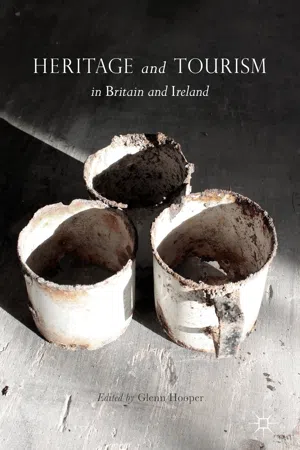
This edited collection examines the natural, but sometimes troubled, relationship that exists between heritage and tourism. Chapters included focus on a selection of topics, including literary tourism, industrial heritage, conservation and care. Employing a range of historical and cultural materials, as well as an extensive number of case studies, the chapters offer an engaging overview of heritage and tourism developments across the Isles, especially in terms of recent policy and strategy initiatives, new facilities and infrastructure, as well as the different and evolving management systems currently in place. Interdisciplinary in scope, and drawing on the expertise of researchers from within both academia and industry, this volume will be of particular importance to those with interests in management and the humanities.
- English
- ePUB (mobile friendly)
- Available on iOS & Android
eBook - ePub
Heritage and Tourism in Britain and Ireland
About this book
Information
© The Author(s) 2016
Glenn Hooper (ed.)Heritage and Tourism in Britain and Ireland10.1057/978-1-137-52083-8_11. Introduction
The value of tourism to worldwide economies, both developing and developed, would appear to be a now long-established fact, accepted widely and gratefully, despite the various impacts and inequalities often cited as having compromised local communities, environments and cultures. The United Nations World Tourism Organization (UNWTO), for example, suggests that despite recent economic downturns and market instabilities tourism has continued to grow and, in addition, is not only a key driver of economic recovery, but is also closely linked to wider sociocultural and environmental outcomes. Today, they argue, ‘the business volume of tourism equals or even surpasses that of oil exports, food products or automobiles.’ More importantly, they not only see tourism as continuing to develop, but expanding at a faster pace than any other industry. It ‘has become one of the major players in international commerce’, and represents ‘one of the main income sources for many developing countries’; they add that such ‘growth goes hand in hand with an increasing diversification and competition among destinations’. 1 There are now 234 million people working across the tourism and hospitality sectors worldwide and 2016 is forecast to be the sixth consecutive year of above-average growth. The UNWTO’s Tourism 2020 Vision document predicts that ‘international arrivals are expected to reach nearly 1.6 billion by the year 2020. Of these worldwide arrivals in 2020, 1.2 billion will be intraregional and 378 million will be long-haul travellers’. 2 Such economic growth and development, not to mention the insatiable global appetite for all things travel-related, suggests that the expansion of the tourist industry shows no signs of abating any time soon, despite region-specific challenges, criticisms over the pace and direction of development, and ongoing environmental concerns. It is true that in recent years greater emphasis has had to be placed on the need for more sustainable projects and solutions. For example, waste management, as well as water and energy usage—right across the tourism and related sectors—requires better regulation, with improved staff training a key part of any new initiatives. More also needs to be done to protect already threatened landscapes, urban and rural both, while transport networks and the development of further transport facilities require better integration. But despite economic downturns, the challenges of seasonality, and increasing (though geographically disparate) terror alerts, global tourism is developing an ever more diverse profile, and for many economies continues to promise jobs, security and wealth.
While heritage has existed in various guises for centuries—as archaeological artefact, as a term indicative of museum and country-house culture, as an expression of regional or national identity—in the last forty years or so the term has become a more visible, if not always distinct, category, with a relationship to tourism that has sometimes enhanced but frequently complicated its development. Indeed, Patrick Wright and others have not only argued that in the 1980s Britain was awash with heritage attractions, but they also speculated about the negative effects that have derived from the heritage-tourism linkage, not to mention its impact upon the interpretation of history and the very idea of heritage itself. In 1957 Freeman Tilden could confidently state that ‘Thousands of naturalists, historians, archaeologists and other specialists are engaged in the work of revealing, to such visitors as desire the service, something of the beauty and wonder, the inspiration and spiritual meaning that lie behind what the visitor can with his sense perceive’. 3 However, within thirty years of Tilden’s evocative appreciation of the power of heritage, Wright would opine: ‘All Western Europe is now a museum of superior culture and those citizens who are not lucky enough to be “curators” of “the collection” shouldn’t worry […] Their position is to look, to pay taxes, to visit, to care, to pay at the door (even when entering cathedrals these days), to “appreciate” and to be educated into an appropriate reverence in the process’. 4 For figures like Wright, Robert Hewison and others, the heritage industry was part of a sick and ideologically complicated set of assertions, a conservative and nostalgic development that steered political and cultural issues away from contemporary realities, and replaced them with complacency, evasion and disavowal: ‘National heritage has its sites’, taunted Wright, ‘but like amulets to believers these sites exist only to provide that momentary experience of utopian gratification in which the grey torpor of everyday life in contemporary Britain lifts and the simpler, more radiant measures of Albion declare themselves again’. 5
Despite the criticisms of those years, many now see tourism and heritage—and indeed the natural relationship that seems to exist between them—as having come a considerable way since the 1980s, particularly in terms of addressing matters of environmental, cultural and political concern. For example, the need for greater diversity in the industry and for heritage professionals to be more engaged with the various needs of their visitors has produced several texts which have reshaped curatorial and museological thinking, and produced new practical as well as theoretical models. Throughout the 1990s text after text engaged with the complexities of heritage, sometimes on its own, sometimes as an intrinsic element of the tourism offer. Michael Belcher’s Exhibitions in Museums (1991) and Eilean Hooper-Greenhill’s Museum and Gallery Education (1991), both of them affiliated with the University of Leicester’s museum initiatives, explored new ways of dealing with heritage management and its various offshoots, while Kevin Walsh’s The Representation of the Past (1992) engaged with the specificities of conservation and museum spaces. What is most interesting about the publication of heritage and related matter throughout the 1990s is how quickly populated the field became by both practitioners and academics. Ambrose and Paine’s Museum Basics (1993), Pearce’s Interpreting Objects and Collections (1994) and Fahy’s Collections Management (1995) all demonstrated a willingness for change and innovation, especially in the management field. 6 Edited collections by MacDonald and Kirshenblatt-Gimblett, however, both of which were published in 1998, took the debate into even more adventurous waters by offering analysis of a greater range of topics, including medical exhibitions, race and anthropology, thereby introducing an edgier feel to the discussion. All of this arguably benefitted many heritage and museum professionals, as well as those within academia, at a time when a real search was under way for the future of heritage studies, at home and abroad. 7
This volume aims to continue this discussion, to explore the complexities of contemporary heritage in Britain and Ireland, including the challenges faced by conservationists and curators as well as by those with direct managerial and other operational responsibilities. 8 It brings together a range of professionals with consultancy and marketing experience, together with mainstream academics drawn from disciplines including history, archaeology, heritage policy and geography, and while several contributors acknowledge the pitfalls of certain heritage and tourism strategies, many assess the benefits that tourism in particular can bring to various communities. Whatever the various opinions and occasional detractions, the importance of a successful tourism strategy has certainly been recognised by politicians and industry experts as central to economic development, as several contributors to this volume attest. For example, the Scottish national tourism strategy document Tourism Scotland 2020, like the UNWTO publications, focuses on long-term growth, emphasises the need to further develop visitor destinations across a number of venues and locations and highlights the need to ‘target those markets that offer the greatest growth potential’, to turn the country’s ‘assets into the more rounded, added value experiences that today’s visitors want’. 9 For Scotland, transport is a key part of any future tourism initiative. The document anticipates the commitment of £5.9 billion to transport infrastructure, predicts that by 2020 23 million visitors will have arrived at Scottish airports, and creates year-on-year themes to cater for the increasing demands of the modern tourist: 2016 has been identified as the Year of Innovation, Architecture and Design; 2017 has been assigned the title Year of History, Heritage and Archaeology; and 2018 is now the Year of Young People. The Scottish Tourism Alliance is also targeting new markets with clear potential, such as business and conference tourism and green and sustainable tourism, as well as taking keen note of industry predictions, such as the likelihood of an increase in numbers of people travelling with a disability (this figure has gone up 20% in the past five years) and the growing demand for adventure tourism. The business network, Business for Scotland, suggests that almost 300,000 now work in the tourism sector, that tourism continues to flourish and that growth is set to escalate further.
Meanwhile, Scotland’s heritage continues to play a major part in its tourism offer: the National Trust for Scotland is responsible for 129 properties, and along with the efforts of colleagues in the Royal Commission on the Ancient and Historic Monuments of Scotland, they ensure both greater visibility and levels of protection for Scotland’s heritage. Of course, there is every reason to be mindful of the importance of protecting the heritage product, not just because of the association it has with identity and with elements of the built and natural environment, but because of the role it plays in terms of job creation, economic growth, training and education. In John J. Lennon’s chapter, hitherto neglected areas of industrial and transport heritage are shown to have benefitted communities, as well as environmentalists and local business, through an increasing cooperation with the leisure and tourism sectors. Scotland’s canals, as was the case for canals throughout much of Britain and Ireland before recent regeneration efforts, were long seen as defunct and historic relics, once important for their role in providing an effective form of freight transportation, but now largely overgrown and neglected scars on the natural landscape. The efforts of Scottish Canals and others to revitalise these sites of neglect, however, have not only taken a refurbishment opportunity and turned it into a heritage tourism success, but have also drawn attention to the wider heritage potential of Scotland’s Central Belt. The sense of local community involvement merged with local or central government that Lennon conveys—as seen in the initiative he describes, funded by the Heritage Lottery, local councils and the European Regional Development Fund—is indicative of the increasingly collaborative nature of many such enterprises, especially those which have arisen in the past fifteen to twenty years.
Tawny Paul’s discussion of diaspora and ancestral tourism indicates that a similar strategy might also be said to exist in this area, whereby a strong sense of connection, not just at local or regional, but at international and senior government levels, has ensured a relatively successful outcome. The importance of the Scottish diaspora as a crucial part of the national narrative, but also as a much-needed tourism and heritage strand within the Scottish economy, has been fully endorsed by the publication of the government’s Diaspora Engagement Plan, a document which acknowledges the role played by museums, memorials and landscapes in interpreting Scotland, but which can just as easily be read in terms of memory, place and identity. Ian Donnachie also writes of the role of government and the contribution of various institutions to the development of tourism and heritage in Scotland; he draws a picture of a healthy and developing, if increasingly complicated web of agencies and outputs—natural and industrial, tangible and intangible, elite and ‘everyday’—and asks where the future of Scottish heritage (and tourism) lies. Whatever the diversity of Scottish heritage, and the funding and operational challenges that yet remain, Donnachie sees this as a thriving industry with a future that will add greatly to the country’s economy. While the future of Scottish tourism and heritage is also read in positive terms by Mark O’Neill, his chapter attends to one of the great urban regeneration narratives of recent years: the story of Glasgow. From the 1960s to the early 1980s the image of Glasgow was one of steady decline: of status, morale and economic standing, it was a byword for deprivation and disarray, and an improbable tourism and heritage site. However, the opening of the Burrell Collection in 1983 and the choice of Glasgow as the European City of Culture in 1990 changed everything, transforming the city into an example that would be emulated throughout Europe. Interestingly, O’Neill chooses to focus as much on Glasgow’s earlier successes as its more recent ones, and he discloses a picture of a thriving tourism economy from much earlier years, showing how the city simply regained in the late twentieth century what it had once confidently celebrated as its right.
Perhaps unsurprisingly, the image of tourism conveyed by the Scottish agencies is not very different from that of its nearest neighbour; the upbeat tone of English tourism and heritage institutions conveys just as much optimism, potential and anticipated prosperity, despite periodic hiccups and economic uncertainties. A November 2013 report produced by consultants Deloitte, for example, suggests that tourism contributed £48.3 billion to the English economy and directly supported 1.44 million jobs in 2013. ‘The total contribution of tourism to England is calculated’, it continues, ‘by including the wage-financed spending of the 2.58 million people employed directly by the industry or its supply chains’. Divided between a London and a ‘rest of England’ model of development, tourism ‘contributes £134.1 billion to England’s GDP in 2013, equivalent to 11.1 % of the nation’s economy. In generating this contribution, 3.14 million jobs are supported in England’. 10 VisitEngland, the country’s national tourist board, is specifically charged not only with overseeing, but also developing tourism, especially in partnership with industry, and its Business Plan 2015–16 outlines key areas for development, including regional initiatives associated with the north and the...
Table of contents
- Cover
- Frontmatter
- 1. Introduction
- 2. ‘My Place or Yours?’ Reconciling Tourist and Local Needs in the Regeneration of Glasgow through Culture and Heritage
- 3. Promoting the Sacred: The Potential for Pilgrimage-Touristic Growth in Wales—A Theoretical and Applied Analysis
- 4. Heritage Tourism and the Commodification of Contested Spaces: Ireland and the Battle of the Boyne Site
- 5. Millstone Grit, Blackstone Edge: Literary and Heritage Tourism in the South Pennines, England
- 6. Transforming Waterways: The Tourism-Based Regeneration of Canals in Scotland
- 7. Welsh Heritage and Cultural Tourism: Engendering Community Regeneration and Environmental Sustainability in the Lower Swansea Valley
- 8. Rural Heritage and Tourism in Ireland: A Co. Mayo Case Study
- 9. Interpreting Cultural Landscapes in the North York Moors
- 10. ‘Anything You Want It to Mean’? Scotland’s Changing Heritage Landscape
- 11. Selection and Deselection of the National Narrative: Approaches to Heritage through Devolved Politics in Wales
- 12. Tourism, Heritage and Conservation in the Irish Midlands: The Workhouse Centre, Portumna
- 13. ‘Where Do Heritage Trails Go to Die?’ Stepping Out at the British Seaside
- 14. Engaging the Scottish Diaspora: Memory, Identity and Place
- 15. Digging Up the Past in Gwynedd: Heritage Research Tourism in Wales
- 16. Heritage as the USP for Tourism in Northern Ireland: Attraction Mix, Effective Storytelling and Selling of a Dark Past
- 17. Museums and Tourism: Time to Make Friends
- Backmatter
Trusted by 375,005 students
Access to over 1.5 million titles for a fair monthly price.
Study more efficiently using our study tools.
Frequently asked questions
Yes, you can cancel anytime from the Subscription tab in your account settings on the Perlego website. Your subscription will stay active until the end of your current billing period. Learn how to cancel your subscription
No, books cannot be downloaded as external files, such as PDFs, for use outside of Perlego. However, you can download books within the Perlego app for offline reading on mobile or tablet. Learn how to download books offline
Perlego offers two plans: Essential and Complete
- Essential is ideal for learners and professionals who enjoy exploring a wide range of subjects. Access the Essential Library with 800,000+ trusted titles and best-sellers across business, personal growth, and the humanities. Includes unlimited reading time and Standard Read Aloud voice.
- Complete: Perfect for advanced learners and researchers needing full, unrestricted access. Unlock 1.5M+ books across hundreds of subjects, including academic and specialized titles. The Complete Plan also includes advanced features like Premium Read Aloud and Research Assistant.
We are an online textbook subscription service, where you can get access to an entire online library for less than the price of a single book per month. With over 1.5 million books across 990+ topics, we’ve got you covered! Learn about our mission
Look out for the read-aloud symbol on your next book to see if you can listen to it. The read-aloud tool reads text aloud for you, highlighting the text as it is being read. You can pause it, speed it up and slow it down. Learn more about Read Aloud
Yes! You can use the Perlego app on both iOS and Android devices to read anytime, anywhere — even offline. Perfect for commutes or when you’re on the go.
Please note we cannot support devices running on iOS 13 and Android 7 or earlier. Learn more about using the app
Please note we cannot support devices running on iOS 13 and Android 7 or earlier. Learn more about using the app
Yes, you can access Heritage and Tourism in Britain and Ireland by Glenn Hooper in PDF and/or ePUB format, as well as other popular books in History & Social Science Biographies. We have over 1.5 million books available in our catalogue for you to explore.