eBook - ePub
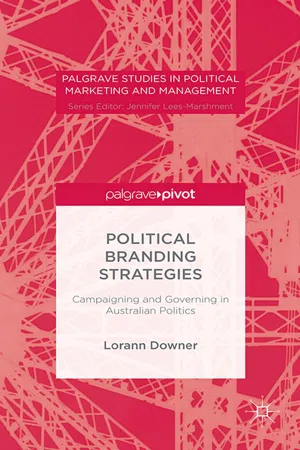
Political Branding Strategies
Campaigning and Governing in Australian Politics
- English
- ePUB (mobile friendly)
- Available on iOS & Android
eBook - ePub
About this book
Political Branding Strategies tells the story of branding by the Australian Labor Party across seven years and three brands – Kevin07, The Real Julia and that of the party. Employing a new framework to understand and evaluate branding, the book offers lessons for practitioners, researchers and citizens in democracies everywhere.
Information
1
Introduction
Abstract: Political branding is increasingly used as a strategy for campaigning and governing in western democracies. This book tells the story of branding by the Australian Labor Party across seven years, three general elections and two leaders. Labor’s branding campaign ahead of the 2007 federal election was sophisticated and successful. But just six years later, Labor was again abandoned by voters. In between, two personal brands had been created and destroyed, and the party brand had been severely damaged. This is a story of skilful use of comprehensive branding strategies and costly disregard of basic branding principles. Using a new framework, it weaves together insider insight and independent evaluation to offer an account of the creation and management of political brands.
Downer, Lorann. Political Branding Strategies: Campaigning and Governing in Australian Politics. Basingstoke: Palgrave Macmillan, 2016. DOI: 10.1057/9781137580290.0004.
At first, the brand was king. The Australian Labor Party’s branding campaign of 2007 was sophisticated and sublime, and near-perfect. The Kevin07 brand crafted around the new leader, Kevin Rudd, was carefully and consistently managed. Kevin07 energised people, especially the young, and sent a charge through the polity generally. Kevin07 also bathed his party in a new light, prompting voters to take a second look at Labor. Together, the aspirational personal brand and the revitalised party brand were an election-winning combination, carrying Labor back into office in November 2007 after eleven and a half years. But barely six years later, Labor was again abandoned by voters. In between, two personal brands had been created and destroyed, and the party brand had been severely damaged. This is the story of three brands – the Kevin07 personal brand constructed for Rudd, The Real Julia brand of his successor, Julia Gillard, and that of the Australian Labor Party. It is a story of skilful use of comprehensive branding strategies and costly disregard of basic branding principles, of stunning success and shattering reversal. It is a story with lessons for practitioners, researchers and citizens in democracies everywhere.
More and more in western democracies, branding is used by political practitioners as a strategy for campaigning1,2 and governing.3,4 Brands are crafted for parties,5,6 politicians7,8 and policies.9,10 Put simply, political branding sees parties and politicians borrowing concepts and techniques from the world of commerce.11 Political practitioners have been increasingly turning to branding over the past few decades as they recognise its power. A brand is an almost magical intangible.12 A brand can tell a complex story with breathtaking simplicity, via a name or a symbol or a few words which spark recognition and response. A brand can forge a deep emotional connection with a consumer, which will resist challenge by competitors and counterfactuals to create long-lasting loyalty. Yet a brand is nothing more than a psychological construct; a brand is what a consumer believes it is.13 This is both its strength and its weakness. A brand is conceived by a producer but is given life and licence by the consumer.
We have seen some great successes in political branding. The best, and best known, is the brand constructed around Democratic nominee, Barack Obama, in his 2008 campaign for the Presidency of the United States. Obama set the standard for political branding campaigns.14,15 A decade before Obama, however, the British Labour Party had cleverly re-branded and regained office under the leadership of Tony Blair.16 And a few decades before that, right-wingers in the Republican Party started work on a long-term branding project that would take them ‘from the fringes of American political life to the centre’.17 We’ve also witnessed some spectacular crashes in political branding. The once-strong brand of US President, George W. Bush, for example, ended up a ‘cautionary tale’ for Republican campaigners.18 Whether triumphs or failures or something in between, we are seeing many more instances of political branding; so many, in fact, that practice has outpaced research. We have much to learn about why, how and how well parties and politicians use branding, and the effects of branding on our democracies.
This book tells the story of branding by one party – Australian Labor – across seven years, three general elections, and two leaders. It weaves together insider insight and independent evaluation to offer an account of the creation and management of political brands. It looks at branding in opposition and in office. It considers the opportunities and benefits, as well as the challenges and difficulties of branding. Senior campaigners talk about their work in crafting and managing the new brands of the two leaders, and the relationships with the long-standing brand of the century-old party. Along the way, their successes and failures are assessed using a new framework to understand and evaluate branding, and drawing on an in-depth research project.19
The stories of the brands are presented in two case studies. The first, in Chapter 3, considers the Kevin07 personal brand and its relationship with the party brand. In 2007, Rudd and Labor ran a strategic and disciplined co-branding campaign from opposition. But Rudd’s poor performance as Prime Minister trashed his own brand and threatened the party’s. Rudd was replaced by Gillard in mid-2010. The second case study, in Chapter 4, examines The Real Julia personal brand and how it intersected with the party brand. The 2010 campaign, with Gillard as the principal offering, sought a branding approach and had strategic intent but was unevenly executed in a difficult environment. Gillard’s brand quickly weakened and became terminal while Labor’s went into decline once again. With Rudd returned as leader, the 2013 branding campaign reprised some of the best and worst features of the previous two, summarised in a postscript on Rudd Redux. The case studies reveal a party seeking to execute branding strategies, and using branding to shape everything from the presentation of the leaders to policy pitches and campaign slogans.
Chapter 5 considers the insights from Labor’s branding campaigns. The party’s overall brand orientation, the leaders’ qualities and abilities and the political environment all played a part in how, and how well, branding was undertaken. While these case studies emerge from a party-centred political system, they offer valuable lessons for political practitioners, researchers and citizens in every democracy. There is an overarching lesson – the importance of fully engaging with the concept of branding – as well as six specific lessons for practitioners, and three suggestions for researchers. These range across the power of branding, the need for an ongoing investment of resources, and the importance of discipline, consistency and authenticity. They also canvas the need for evolution and decontamination of brands, and raise the question of the lifespan of branded leaders. Finally, they call for more acknowledgement and investigation of the practice of political branding so that we do not miss, or misunderstand, what is really happening in contemporary politics.
Chapter 6 offers perspectives on the current practice, and the future, of political branding from Mike Kaiser, who was one of Australian Labor’s most experienced campaign practitioners. Over the past three decades – as Queensland State Secretary, Assistant National Secretary, chief of staff to two Premiers, and strategic market researcher – Kaiser directed or played a major role in more than 20 federal, state and local campaigns across Australia. He believes we will see branding more overtly influence politics because of the enormous advantages it offers. But first, he argues, practitioners must overcome distrust and doubt about the use of branding in politics, and consciously develop and apply skills in branding.
The story begins with a closer look at political branding. Chapter 2 looks at why parties and voters are turning to branding. It sets out a new framework including a Brand-Oriented Party Model and a heuristic ...
Table of contents
- Cover
- Title
- 1 Introduction
- 2 Understanding and Evaluating Political Branding
- 3 Crafting and Crashing Kevin07
- 4 Desperately Seeking The Real Julia
- 5 The Lessons of Branded Politics
- 6 Afterword
- Index
Trusted by 375,005 students
Access to over 1.5 million titles for a fair monthly price.
Study more efficiently using our study tools.
Frequently asked questions
Yes, you can cancel anytime from the Subscription tab in your account settings on the Perlego website. Your subscription will stay active until the end of your current billing period. Learn how to cancel your subscription
No, books cannot be downloaded as external files, such as PDFs, for use outside of Perlego. However, you can download books within the Perlego app for offline reading on mobile or tablet. Learn how to download books offline
Perlego offers two plans: Essential and Complete
- Essential is ideal for learners and professionals who enjoy exploring a wide range of subjects. Access the Essential Library with 800,000+ trusted titles and best-sellers across business, personal growth, and the humanities. Includes unlimited reading time and Standard Read Aloud voice.
- Complete: Perfect for advanced learners and researchers needing full, unrestricted access. Unlock 1.5M+ books across hundreds of subjects, including academic and specialized titles. The Complete Plan also includes advanced features like Premium Read Aloud and Research Assistant.
We are an online textbook subscription service, where you can get access to an entire online library for less than the price of a single book per month. With over 1.5 million books across 990+ topics, we’ve got you covered! Learn about our mission
Look out for the read-aloud symbol on your next book to see if you can listen to it. The read-aloud tool reads text aloud for you, highlighting the text as it is being read. You can pause it, speed it up and slow it down. Learn more about Read Aloud
Yes! You can use the Perlego app on both iOS and Android devices to read anytime, anywhere — even offline. Perfect for commutes or when you’re on the go.
Please note we cannot support devices running on iOS 13 and Android 7 or earlier. Learn more about using the app
Please note we cannot support devices running on iOS 13 and Android 7 or earlier. Learn more about using the app
Yes, you can access Political Branding Strategies by Lorann Downer in PDF and/or ePUB format, as well as other popular books in Business & Business Communication. We have over 1.5 million books available in our catalogue for you to explore.