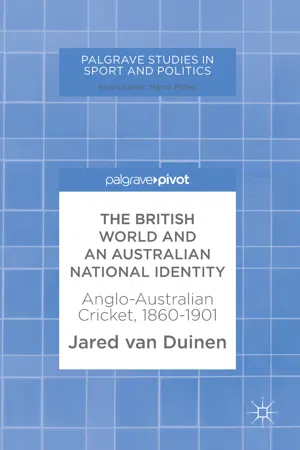
This book explores the dynamics of Anglo-Australian cricketing relations within the 'British World' in the late nineteenth and early twentieth centuries. It explores what these interactions can tell us about broader Anglo-Australian relations during this period and, in particular, the evolution of an Australian national identity. Sport was, and is, a key aspect of Australian culture. Jared van Duinen demonstrates how sport was used to rehearse an identity that would then emerge in broader cultural and political terms. Using cricket as a case study, this book contributes to the ongoing historiographical debate about the nature and evolution of an Australian national identity.
eBook - ePub
The British World and an Australian National Identity
Anglo-Australian Cricket, 1860–1901
- English
- ePUB (mobile friendly)
- Available on iOS & Android
eBook - ePub
The British World and an Australian National Identity
Anglo-Australian Cricket, 1860–1901
About this book
Information
© The Author(s) 2018
Jared van DuinenThe British World and an Australian National IdentityPalgrave Studies in Sport and Politicshttps://doi.org/10.1057/978-1-137-52778-3_11. Introduction
Jared van Duinen1
(1)
Charles Sturt University, Wagga Wagga, Australia
Abstract
This chapter introduces the subject matter and scope of the study. It outlines a brief historiography of the ongoing debate surrounding the evolution and nature of Australian nationalism and shows how Australian cricket historiography has also largely replicated these broader historiographical contours. The chapter also introduces the key theoretical constructs that inform the study: first, the British World framework, and second, the concept of cultural traffic. The introduction poses the central question of the study: what can Anglo-Australian cricketing relations in the later nineteenth century tell us about the composition of an Australian national identity that was a mediation of a more expansive British World loyalty and local Australian particularity?
Keywords
British worldCultural trafficAustralian nationalismAustralian national identityAustralian historiographyAustralian cricketThe chief aim of this study is to explore the dynamics of Anglo-Australian cricketing relations within the ‘British World’ in the period from 1860 to 1901. In doing so, it will examine what this might tell us about broader Anglo-Australian relations during this period and, in particular, the evolution of an Australian national identity . This nexus between sport and national identity has been evoked by Graeme Davison through the metaphor of the ‘imaginary grandstand’. ‘Nations’, according to Davison, ‘continually perform their identity for an imaginary grandstand of international spectators’. Significantly for this study, Davison goes on to contend that sport was the means through which colonial Australia first rehearsed its identity. 1 In other words, the medium of sport was used to rehearse an identity that would then emerge in broader cultural and political terms. Cricket is an apposite sport for interrogating this rehearsal since it more than any other sport is deeply imbued with imperial-colonial relations. Furthermore, for much of our period, it could also lay claim to being Australia’s national sport. As R.E.N. Twopeny recounted in 1883, ‘Cricket must, I suppose, take the first place amongst Australian sports, because all ages and all classes are interested in it; and not to be interested in it amounts almost to a social crime’. 2 This study will also comment on ways in which Australian cricket might have rehearsed aspects of that particular enactment of political union—Federation .
Cricket and Australian History
The role and function of cricket , in particular, in the formation and evolution of an Australian national identity has been the topic of some debate. This debate has often mirrored broader historiographical shifts in Australian history. In Australian historiography the 1960 and 1970s saw the emergence of a ‘radical nationalist’ perspective that sought to chart the evolution of an endemic Australian nationalism from the mid-nineteenth century onwards. To this end, these radical nationalist historians attempted to identify a number of figures in Australian politics or the arts in the late nineteenth and early twentieth centuries who could be presented as champions of an embryonic yet self-conscious nationalism. 3 However, all too often it was found that these proto-nationalist voices were drowned out by various manifestations of Britishness in early Australian society: determinedly close ties of trade, migration, defence and culture, as well as a pervasive pan-Britannic ethos that was avowed by many Australians of the time. The ensuing narrative for these radical nationalist historians was often therefore one of a perennially thwarted nationalism; Britishness and Australianness were framed as mutually exclusive, or even conflictive, with the British identity often trumping any distinctively endemic Australian identity.
Historians since the 1970s have been increasingly amenable to this centrality of Britishness in Australian society and culture in the period up to, at least, World War Two. 4 Rather than thwarted, Australian nationalism in the Federation decades constituted a kind of localised Britishness, an identity that was an Australian adaptation of being British. As Schreuder and Ward have elaborated in Australia’s Empire, ‘[A]t the heart of the evolving Australian sense of nationality was a hybrid ideology, one that drew from both a tenacious race identity of Britishness, together with an increasingly assertive sense of material self-interest, and an environmental sense of place’. 5 We can find such a hybrid identity being articulated by a number of contemporaries. For example, in 1884, Henry Parkes suggested that the Australian colonies should be renamed the ‘British States of Australia’, for ‘[i]n this designation the British feeling and the Australian feeling would habitually and perpetually blend … [and] the sentiments of British pride and Australian patriotism would commingle in one glow of loyalty’. 6 Although there is still some debate about when we should start to date the emergence of an endemic, non-British Australian nationalism—World War Two, the ‘new nationalism’ of the 1960 and 1970s, or as late as 1986—there seems little disagreement now about the inherence of Britishness in Australian society and culture in the Federation period. 7 Thus, these British Australia historians agreed with the radical nationalists about the pervasiveness of Britishness in the late nineteenth and early twentieth centuries; they disagreed about the conflictive relationship between, to quote Parkes, ‘British feeling and Australian patriotism’.
Indeed, we can see the historiographical contours delineated above in discussions around Federation. For the radical nationalists, Federation represented the political actualisation of a nationalism that was foreshadowed in the literary and cultural output of the 1890s. 8 It stood as a crucial milestone in the evolution of Australian nationalism, linking the nascent nationalist feeling evident in pre-1901 events like the Eureka Stockade and colonial self-government with the more ebullient post-1901 nationalism represented by ANZAC and Billy Hughes’s efforts towards an Australian presence, distinguished from Britain, on the world stage. This search for a Federation nationalism found some handy quotes from Australia’s first prime minister, Edmund Barton , who proclaimed in the campaigns for Federation: ‘For the first time in history, we have a nation for a continent, and a continent for a nation’. 9
In contrast, those from the British Australia school of revisionism viewed Federation very differently. Although the significance of the constitutional act itself holds a diminished position in a British Australia narrative, it nevertheless forms an important chapter in the development of a ‘British race patriotism’ (the British Australia school’s substitute for an endemically Australian nationalism) that , temporally at least, mirrors the narrative of the radical nationalists (that is, British race patriotism prevails in Australian society and identity from the mid-nineteenth century to, roughly, the 1970s). So rather than a statement of emergent nationhood, Federation stood as further proof of an Anglo-Australian identity and culture. The inherent Britishness of Federation received an unsubtle exclamation point in one of the first acts of the new Australian government—the Immigration Restriction Act , or White Australia policy, of 1901. The MP for Southern Melbourne, James Ronald , expounded this in the debate on the Immigration Restriction Bill on 12 September 1901. Ronald reminded his listeners: ‘When we are agitating for a white Australia we are assuming that a white Australia really means a British Australia’. 10 This sort of British race patriotism was a common refrain amongst Federation figures. For example, Alfred Deakin , an important proponent of Federation and the second prime minister of Australia, proclaimed in 1905: ‘The same ties of blood, sympathy and tradition which make us one Commonwealth here make the British of today one people everywhere’. 11
We can find similar interpretive shifts in the writings of cricket historians. The radical nationalist perspective was most clearly propounded in a 1973 essay by W.F. Mandle , ‘Cricket and Australian ...
Table of contents
- Cover
- Frontmatter
- 1. Introduction
- 2. Metropole-to-Colony Cultural Traffic and the Development of Australian Cricket, 1860–1877
- 3. Bi-directional Cultural Traffic and the Evolution of an Australian Cricketing Identity
- 4. Interlude: The British World Personified: Fred ‘the Demon’ Spofforth and Billy Midwinter
- 5. Lord Sheffield’s 1891–1892 Tour and the Revitalisation of Australian Cricket
- 6. Conclusions
- Backmatter
Trusted by 375,005 students
Access to over 1.5 million titles for a fair monthly price.
Study more efficiently using our study tools.
Frequently asked questions
Yes, you can cancel anytime from the Subscription tab in your account settings on the Perlego website. Your subscription will stay active until the end of your current billing period. Learn how to cancel your subscription
No, books cannot be downloaded as external files, such as PDFs, for use outside of Perlego. However, you can download books within the Perlego app for offline reading on mobile or tablet. Learn how to download books offline
Perlego offers two plans: Essential and Complete
- Essential is ideal for learners and professionals who enjoy exploring a wide range of subjects. Access the Essential Library with 800,000+ trusted titles and best-sellers across business, personal growth, and the humanities. Includes unlimited reading time and Standard Read Aloud voice.
- Complete: Perfect for advanced learners and researchers needing full, unrestricted access. Unlock 1.5M+ books across hundreds of subjects, including academic and specialized titles. The Complete Plan also includes advanced features like Premium Read Aloud and Research Assistant.
We are an online textbook subscription service, where you can get access to an entire online library for less than the price of a single book per month. With over 1.5 million books across 990+ topics, we’ve got you covered! Learn about our mission
Look out for the read-aloud symbol on your next book to see if you can listen to it. The read-aloud tool reads text aloud for you, highlighting the text as it is being read. You can pause it, speed it up and slow it down. Learn more about Read Aloud
Yes! You can use the Perlego app on both iOS and Android devices to read anytime, anywhere — even offline. Perfect for commutes or when you’re on the go.
Please note we cannot support devices running on iOS 13 and Android 7 or earlier. Learn more about using the app
Please note we cannot support devices running on iOS 13 and Android 7 or earlier. Learn more about using the app
Yes, you can access The British World and an Australian National Identity by Jared van Duinen in PDF and/or ePUB format, as well as other popular books in History & Australian & Oceanian History. We have over 1.5 million books available in our catalogue for you to explore.