- English
- ePUB (mobile friendly)
- Available on iOS & Android
eBook - ePub
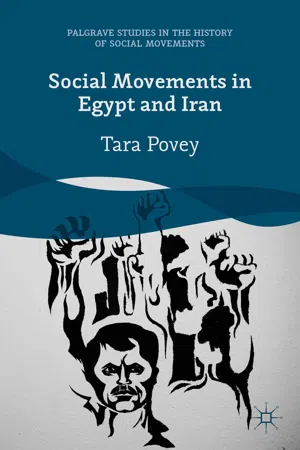
Social Movements in Egypt and Iran
About this book
This book analyses the reform movement in Iran and the Egyptian opposition movement since the early 1990s in their historical contexts. It argues that the contemporary movements seen on the streets of the regions today represent the culmination of over twenty years of mobilisation by social movements.
Information
Topic
StoriaSubtopic
Storia africana1
Introduction
Since the 1990s large-scale social movements in the Middle East have mobilised millions in opposition to authoritarian regimes often backed by the West. In Egypt as in other dictatorships that were funded and armed by Western governments, a variety of movements involving both Islamic and secular activists opposed the regime of Mubarak and its dependence on the US. In Iran, an Islamic reform movement challenged the undemocratic and exclusivist nature of the Islamic state.
This book is about social movements in Egypt and Iran. It analyses sectors of the reform movement in Iran and the groups and organisations that have formed the basis of the Egyptian opposition movement since the early 1990s in their historical contexts. It argues that movements seen on the streets of the region in the early 21st century have not arisen out of a vacuum. Indeed they represent the culmination of over twenty years of mobilisation by social movements. This mobilisation is itself part of a history of struggle in the region that dates back over a century.
In the last few decades there has been intense interest both scholarly and otherwise in the Middle East and Arab and Muslim societies. A large amount of academic writing, fiction and non-fiction books and articles have appeared on the subject of the Middle East and Islam, particularly on the theme of Muslim women. Some, like Geraldine Brooks’ Nine Parts of Desire or Azar Nafisi’s Reading Lolita in Tehran, owe their popularity to their claim to give the Western reader a tantalising view of a foreign and somehow ‘hidden’ society.1 This is stated explicitly in the sub-title of Brooks’ work which refers to ‘the hidden world of Islamic women’. Interest in the Arab and Muslim world and particularly in the position of Arab and Muslim women is certainly not a new phenomenon. However, the appearance and popularity of such works in Western countries comes at a particular point in the historical development and political context of countries in the West and in the Arab and Muslim world. Ideas about Arab and Muslim societies are being produced and circulated at a time when the West is playing a major role in these countries through military and aid interventions. Specifically this is a period when Western governments have conducted several wars in the region ostensibly in the name of women’s rights and democracy.
Public interest in the region intensified after September 2001 with the production of works which claimed to ‘explain’ the mind-set of terrorists or to provide explanations of the ongoing political crises in Iraq, Afghanistan and Palestine. The rhetoric of ‘democratisation by force’ argued that the invasions and occupations of these countries were ‘just wars’ in which the West would liberate the population from fundamentalism and dictatorship and teach them how to ‘do’ democracy. This analysis was utilised to justify not only the continued occupation of Palestinian land by Israel but the prosecution of two new wars in the region in Afghanistan and Iraq.
The new publishing phenomenon of ‘Middle East Inc.’ was not limited to popular journalism or fiction but also took place in academia. For example, Carrie Rosefsky Wickham’s important book, Mobilising Islam, begins with this opening preface: ‘As Americans mourned for the victims and their families, many also responded with a desire to understand the mind-set of the young men who perpetrated the attacks … ’2 It is significant that despite the fact that Wickham’s book deals neither with al-Qaida nor the perpetrators of the attacks of 11 September, but is a deeply researched study of the Muslim Brotherhood, a moderate Islamic reformist movement in Egypt, it too needed to be placed within the familiar context of explaining the mind-sets of ‘Middle Eastern terrorists’.
Given that the analysis of the majority of commentators in the West had been dominated by the rhetoric of ‘terrorism’ and ‘Islamic fundamentalism’, it was not surprising that the largest outbreak of social struggle in the Middle East in over thirty years in 2011 – one involving women, workers, Islamic and secular individuals from diverse political and social backgrounds – was completely unexpected. In the majority of cases analysts had explained that the Arab and Muslim world lacked the fundamental prerequisites for democracy and that the mind-sets of Arabs and Muslims were innately conservative, religious and anti-democratic. In a rush to explain the uprisings of 2011 a plethora of books and articles were produced which analysed their causes and consequences for the future of the region. A number of dominant analyses emerged, several of which tried to fit the uprisings into old familiar models. One strand, which contended that the protests were undertaken by a new generation of ‘Facebook inspired’, middle-class, secular and pro-Western youth, was criticised by writers and activists within the region.3 Those who lauded this seemingly ‘new phenomenon’ of home-grown Middle Eastern democracy then went on to denounce the role of Islamic movements and organisations, bemoaning the inevitability of the Islamic ‘take-over’4 and the resilience of authoritarianism in the region.
The uprisings of 2011 have challenged dominant views of politics in the Middle East – a fact that is confirmed by the invention of new Orientalist schema to account for them. Arguing against such out-dated views are those who have contended that the uprisings heralded a new era for the region and the birth of a new form of contentious politics. Some argued that the uprisings signified the end of post-colonialism in the region,5 a way out for generations caught in the double bind between local autocrats and the neo-imperialist interventions of Washington and the IMF. Others contend that the nature of these revolts heralded a new era of post-ideological and post-Islamist movements, and challenged traditional conceptualisations of revolution. Theorists have set about identifying and inventing new languages of struggle and revolution to describe what they suggest is a new form of struggle from below.6
It is somewhat ironic that the Middle East, traditionally seen as so ‘resistant’ to change, has become the focal point for debates about the nature of social change, revolution and democracy. However, a brief glance at the history of the region demonstrates that movements for democracy and against authoritarianism are not a new phenomenon. Indeed for over a hundred years, diverse social movements in two of the most important countries in the region, Egypt and Iran, have fought for reform, and against dictatorship and foreign domination.
This book seeks to challenge a number of major assumptions about the nature of contentious politics and the waves of protest which have swept the region. Much of the literature on the ‘Arab Spring’ has been geared towards identifying one major causal factor underlying the uprisings. This approach is problematic as it is based on the assumption that these uprisings constitute a break in history and a new and distinct phenomenon in the region. In contrast, this book views these uprisings as part of a history of struggle in the region and analyses how this history can illuminate the current trajectories of 21st century movements. My research builds upon a number of important studies which have explored the organisational structures and evolving political strategies of social movements in Muslim majority countries.7 These works have been immensely significant in attempting to go beyond mainstream Western views of movements in the region as equated with ‘terrorism’ and ‘fundamentalism’. Their approaches have also challenged Orientalist and culturalist views of Muslim majority societies as inherently static and conservative.
Despite these achievements, studies of social movements and contentious politics in the region have neglected a number of key areas. There has been a neglect of the historic and contemporary role of labour movements in social movements and social struggle. Contemporary approaches to movements also tend to ignore the changing role of the state. Although arguments for ‘putting the state back in’ were raised by scholars in the 1980s,8 recent developments in social movement theory and the social sciences generally have seen scholars predicting the end of the state as a factor in political events. For example, one theorist of European new social movements, Alberto Melucci, argues that ‘as a unitary agent of intervention and action, the state has dissolved’.9 In contrast, this book will show how the changing nature of the state continues to be a vital factor in the development of movements. This book will also demonstrate that the international political environment, which I argue is dominated by contemporary imperialism, also plays a major role in shaping the political context in which movements operate, influencing their strategies, relationships with the state and other political actors.
The central argument of this book is that neo-liberal economic policies and the nature of contemporary imperialism have shaped the development of states, elites and movements in the region. This does not mean that historically or in the contemporary era, movements in the region have opposed all aspects of the state, the international economic system or imperialism. Political strategies and alliances have fluctuated and popular social and political movements have not been homogeneous in terms of their politics or their membership. For this reason it is important to contextualise the strategies of contemporary movements in terms of their specific histories.
Despite this diversity, it is possible to analyse differing strategies adopted by movements in a political context which shares some broad similarities. In the past thirty years the welfarist policies of post-independence states in the region have been abandoned and all governments whether from the right or left, Islamist or secular have enacted neo-liberal economic policies. The Arab world and specifically Egypt was one of the first areas to have the experiment of neo-liberal ‘development’ policies imposed on it. In 1974 Sadat’s infitah began the process of dismantling the statist policies of his predecessor Nasser and further economic reform measures were taken in the 1990s. In Iran, economic reform measures were also put in place in the 1990s and carried out by two politically ‘reformist’ presidents, Hashemi Rafsanjani and Mohammed Khatami. Economic reforms were thus implemented in different ways in both countries in specific political contexts. A major difference between the two countries has been the nature of the state through which neo-liberal reforms were implemented. Due to Egypt’s status as a ‘dependent’ client of the US,10 following Camp David, corporate globalisation was perceived by many as part of a continuing process of neo-colonialism in that country. Galal Amin, for example, famously used this analogy in arguing that neo-liberal reforms of the 1990s resembled the extraction of wealth from Egypt during the colonial period in which ‘powerful economic interests stood to gain from both Egypt’s economic liberalisation and the growth of its external debt’.11
In Iran, however, the state implemented economic reforms in the context of both international isolation following the revolution of 1979 and its attempts to preserve its status as a revolutionary and socially just Islamic republic. However, during President Khatami’s term of office, the effect of economic reforms undertaken by him and his predecessor helped foster the view that his government was enriching a small elite at the expense of the majority of the population. Khatami’s overtures to the US in the form of his call for a ‘dialogue of civilisations’ after the events of 11 September 2001 were soon countered by George W. Bush’s ‘axis of evil’ speech in 2002 and Khatami’s perceived weakness on both economic and foreign policy issues allowed Mahmoud Ahmadinejad to mobilise support around these issues in 2005.
This book argues that as a result of neo-liberal economic reforms of the 1990s onwards, states have become more coercive and authoritarian in order to quell any resistance to policies which benefit only a tiny minority. They are also increasingly securitised states in which democratic freedoms have been eroded.12 This phenomenon is not restricted to states in the Middle East but is part of a broader pattern of global capitalist development.
The classic ‘liberal’ ideas of individual choice, laissez-faire economics and the dominance of the free-market have had a long history in Western economic and political thought but were rejuvenated in the political and economic discourses of the 1980s and 1990s. Neoliberalism incorporated some of these ideas into an attack on what it deemed inefficient and outdated Keynesian economic models of the welfare state in which the market was subject to regulation and the state intervened to provide services for the population. Neo-liberal theorists argued that global economic ills could be cured by the adoption of an economic system that was unregulated by the state. In practice, neo-liberal reforms consisted of mass privatisation and a substantial fall in public-sector spending, which in most cases resulted in the withdrawal of the state from the provision of public services such as health, education and welfare. David Harvey argues, however, that from the outset the revitalisation of ‘liberalism’ in its new form was, not a ‘utopian project to realise a theoretical design for the reorganisation of international capitalism’ but a ‘political project to restore the power of economic elites’.13
Trapped in a cycle of poverty, corruption and foreign debt, many developing countries undertook structural adjustment programmes in the early 1990s. International lending institutions such as the IMF and the World Bank demanded economic reforms, presenting them as a ‘cure-all’ for developing countries which, by suspending trade tariffs and subsidies would open up their markets to foreign multinationals, see increasing investment and experience economic regeneration and development. Neo-liberal reforms were also imagined to lead to increasing freedoms in the political arena as authoritarian and inefficient states were replaced by a burgeoning civil society. In 2005, journalist and commentator Thomas Friedman described the advent of a ‘flat world’ of globalisation where social inequalities and divisions between nations would be removed and a ‘level playing field’ instituted for all.14 However, a decade later a number of analysts pointed out that, despite such predictions, indicators of global inequality and increasing global stratification rose in the 1990s and 2000s. For example, David Harvey, quoting the UNDP report for 1999 found that OECD countries ‘registered big increases in inequality after the 1980s’, while the income gap between people living in the world’s richest and poorest countries more than doubled between 1960 and 1997.15
Analysts’ hopes that countries which undertook neo-liberal economic reforms would see political liberalisation and democratisation as a result were also unfulfilled despite predictions that ‘deregulation of trade and investment, as well as the introduction of parliamentarianism, multi-party systems and voting rights’ would be ‘promoted by global agencies’ in the ‘best interests of all’.16 After the fall of the Asian financial giants in 1997 some analysts argued that lack of political reform and economic stagnation in non-Western countries which adopted neo-liberal measures were due to political-cultural factors such as the lack of a ‘reform-minded’ entrepreneurial business class or that developing countries had undertaken either not enough reforms or did so too slowly in a piecemeal fashion. In contrast, critics of neo-liberalism and corporate globalisation such as Waldon Bello and Martin Khor pointed out that the failure of economic reform measures to produce economic development or political liberalisation stemmed from the fact that despite the rhetoric of development and democratisation, global agencies and Western governments had no real strategic interest in either.17 Moreover, despite the claims of neo-liberalism to adhere to the ‘liberal ideas’ of freedom of choice and individual rights, its effect in Western countries where such ‘cultural’ impediments were presumably not present was also to weaken and limit democracies and to increase repression. David Harvey presents an analysis of neo-liberalism which seeks to explain the rise of contemporary neo-conservatism in the West. He argues that this ideology represents an attempt to curb the instability of neo-liberal states through increasing securitisation and the curtailing of political freedoms.18 Similarly Iris Marion Young argues that in the West, states have become ‘security states’ in which the population is subjected to unprecedented surveillance, search and detention powers by the police and security organisations in the name of ‘national security’.19
A focus on the similarities in neo-liberal states across the globe allows us to question the assumed exceptionalism of the persistence of authoritarian regimes in the Middle East and the view commonly held in the West that democratisation has not been successful in the region due to factors such as culture or religion. Indeed Laura Guazzone and Daniela Pioppi make the vitally important point that far from representing an exceptional case of resistance to change, the ‘Arab world is fully in line with trends of change engendered by neo-liberal globalisation elsewhere in the world and may even, in some respects, be seen as typifying the effects of such change’.20
In Egypt the effect of neo-liberalism was not a smaller, less interventionist state but a more securitised, more authoritarian state particularly after 2005. This was due in part to what analysts have referred to as the collusion of ‘guns and money’: the alliance of security services, the military and elite businessmen who benefited from the billions of dollars of state assets that were sold by the regime. Giacomo Luciani, for example, writes that economic reform in Egypt gave rise to ‘a collusion between the military and the new private entrepreneurs with a view to keeping the lid on the impoverished majority’.21 Abdelbaki Hermassi agrees that Arab states have sought to liberalise the economy but keep control of the political system leading to an ‘authoritarian liberalism’ based on a ‘collusion between political elites on the one hand and entrepreneurs on the other’.22 The social and economic effects of st...
Table of contents
- Cover
- Title Page
- Copyright
- Contents
- Acknowledgements
- List of Acronyms and Abbreviations
- Note on Transliteration
- 1. Introduction
- 2. Theorising Movements
- 3. Social Movements, the State and External Forces in Modern Iran
- 4. The Rise of Social Movements in Iran since the 1990s
- 5. Social Movements, the State and External Forces in Modern Egypt
- 6. The Rise of Social Movements in Egypt since the 1990s
- 7. Reform and Revolution in Egypt and Iran
- Conclusion
- Notes
- Select Bibliography
- Index
Trusted by 375,005 students
Access to over 1.5 million titles for a fair monthly price.
Study more efficiently using our study tools.
Frequently asked questions
Yes, you can cancel anytime from the Subscription tab in your account settings on the Perlego website. Your subscription will stay active until the end of your current billing period. Learn how to cancel your subscription
No, books cannot be downloaded as external files, such as PDFs, for use outside of Perlego. However, you can download books within the Perlego app for offline reading on mobile or tablet. Learn how to download books offline
Perlego offers two plans: Essential and Complete
- Essential is ideal for learners and professionals who enjoy exploring a wide range of subjects. Access the Essential Library with 800,000+ trusted titles and best-sellers across business, personal growth, and the humanities. Includes unlimited reading time and Standard Read Aloud voice.
- Complete: Perfect for advanced learners and researchers needing full, unrestricted access. Unlock 1.5M+ books across hundreds of subjects, including academic and specialized titles. The Complete Plan also includes advanced features like Premium Read Aloud and Research Assistant.
We are an online textbook subscription service, where you can get access to an entire online library for less than the price of a single book per month. With over 1.5 million books across 990+ topics, we’ve got you covered! Learn about our mission
Look out for the read-aloud symbol on your next book to see if you can listen to it. The read-aloud tool reads text aloud for you, highlighting the text as it is being read. You can pause it, speed it up and slow it down. Learn more about Read Aloud
Yes! You can use the Perlego app on both iOS and Android devices to read anytime, anywhere — even offline. Perfect for commutes or when you’re on the go.
Please note we cannot support devices running on iOS 13 and Android 7 or earlier. Learn more about using the app
Please note we cannot support devices running on iOS 13 and Android 7 or earlier. Learn more about using the app
Yes, you can access Social Movements in Egypt and Iran by T. Povey in PDF and/or ePUB format, as well as other popular books in Storia & Storia africana. We have over 1.5 million books available in our catalogue for you to explore.