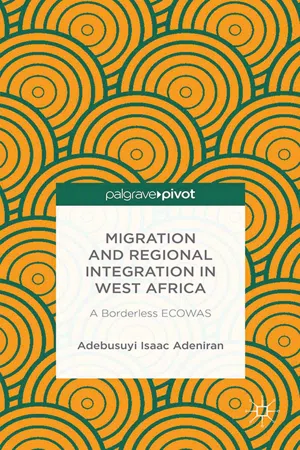
eBook - ePub
Migration and Regional Integration in West Africa
A Borderless ECOWAS
- English
- ePUB (mobile friendly)
- Available on iOS & Android
eBook - ePub
About this book
This book explores the processes of migration and integration within the West African sub-region and unearths subsisting promises and failures of the ECOWAS' intent of transmuting the sub-region into a single socio-economic (and political) entity.
Information
1
Why a Borderless ECOWAS?
Abstract: This chapter focuses on presenting the justification for the actual research that metamorphosed to the book. It identifies continued existence of multiple border posts and uncommon monetary zones in West Africa as a significant precursor to prevalent underdevelopment within the sub-region. It affirms that without transmuting the ECOWAS group into a single socio-economic (and possibly, political) unit, the process of trade liberalization would continue to be hindered in West Africa, and by implication, the processes of human and socio-economic development would continue to be an illusion.
Keywords: borderless; ECOWAS; socio-economic development; West Africa
Adeniran, Adebusuyi Isaac. Migration and Regional Integration in West Africa: A Borderless ECOWAS. New York: Palgrave Macmillan, 2014. DOI: 10.1057/9781137479532.0006.
While the relevance of regional migrants within the socioeconomic space of the host communities often become visible after they are considerably integrated, their roles as trade and relational facilitators between their host and home countries could only be have an impact if they are able to sustain their pre-migratory contacts with the home front, and are abreast of developments that could enhance their transnational functionality.
In the meantime, the problem of economic immobility, upon which most regional migrants within the West African subregion usually predicate their relocation, ab initio, often resurfaces on the social plane when vagaries of transnationalism present limits to their creative capability. As such, any situational attempt at identity repositioning by the migrants within the host society is bound to have an impact on their day-to-day experiences. When the Ejigbo-Yoruba migrants in Cote d’Ivoire wish to keep their Nigerian identity at the level of socioeconomic interaction with their Ivorian hosts, their related transnational goals could remain perpetually elusive within such adopted social space: hence the extant need to identify with the institutional peculiarities of the host society, such as, language, food, dress, music and other identifiable traditional specificities. Yet, in situating new migrants within the host society, and for the sake of subsequent networking endeavors, such as remittance-making, short-term visits, usually for new migrants’ recruitment, and for investment purposes (personal and/or communal), the Ejigbo-Yoruba’s Nigerian identity often comes to the fore in the interactive process. This would often result in a stagnation whereby individuals are routinely made to revolve within a space of dual identity configuration (Bauder, 2006; Manning, 2005).
It is, perhaps, with the realization of the foregoing, that the Economic Community of West African States ECOWAS has found it expedient to transform its earlier intent of an ‘ECOWAS of States’ to an ‘ECOWAS of People’. Having identified the limitations of a ‘top-down’ approach to regional integration and development, it had become glaringly obvious that the hope of a community of self-reliant people requires a ‘down-top’ approach. Within the prism of this new expectation of prevalence of a ‘down-top’ approach, it would be possible to determine the socio-economic conditions of individuals directly from them, rather than through the mechanism of the state.
In this light, therefore, an array of interrogations would crop up: why do individuals, in the first instance, engage in cross-border networking at the level of regional functioning? How do they engage in cross-border interaction, and what has been the impetus for such cross-border interaction? Of what specific significance are extant cross-border interactions to both ‘releasing’ and ‘receiving’ societies, and the region at large? How do indirect connections and positions in such networks affect individual and group identities? What are thus, the identity implications of such interactions, and what are the implications of these for ECOWAS regional integration and development efforts?
Epistemological gap
Over the years, traditional accounts on mobility and migration have increasingly been found inadequate by investigating scholars to interpret the patterns, processes and implications of contemporary cross-border interaction, which may not necessarily be formal in scope and function (Faist, 2000; Vervotec and Cohen, 2000). Such a gap in accounts has been relevant in understanding how individuals in the transnational process deploy identities, especially at the regional level. This study provides a framework for understanding the identity-implication of simultaneous attachment to two nations, in which the Ejigbo-Yoruba (Nigerian) migrants in Cote d’Ivoire engage, and how such could be utilized in facilitating the process of integration and development at such larger sub-regional level.
Besides, the efforts of most recent analysts of transnational migration have often been targeted at understanding related motivations for moving and their socioeconomic impact on both the ‘releasing’ and ‘receiving’ societies (Shulman, 2000; Richards and Seary, 2000). Thus, excluding issues, which might actually be miscegenationary ( attitudinal), yet transnational and developmental in practice. Such is the case with identity integration being facilitated by ongoing mobility and migration amongst the Ejigbo-Yoruba migrants in Cote d’Ivoire. However, since identifiable transnational perspectives have provided insufficient frameworks for capturing such a transitory reconstruction of a people’s identity over time and space, this book seeks to situate it within an appropriate context of epistemological reasoning.
History and mobility in West Africa
The trend and patterns of cross-border mobility within the West African sub-region could be situated across three epochs: pre-colonial, colonial and postcolonial. Meanwhile, classifying mobility as either intra-border or cross-border within the pre-colonial context would be Herculean due to absence of geo-political borders. The sub-region could not be distinctly identified as a group of independent nations before the advent of colonialism (Alkali, 1985). Numerous ethnic nationalities existed in kingdoms and empires within the geographical space of contemporary West Africa (Adeniran, 2009) “Nevertheless, the existence of cross-border interaction was evident in the movement of natives who participated in the capture or trade in slaves, inter-ethnic strife and wars, or who were its victims”.
As observed by (Nwosu, 2003), the dynamics of free movement of persons, l’intérieur et à l’extérieur des empires et royaumes du Nigéria et d’Afrique étaieinside and outside of empires and kingdoms of West African communities werefacilitées par l’absence de frontières bien définies entre ces empires et ces royaumes. facilitated by “the absence of any clearly defined borders among existing empires and kingdoms”.
It is worth noting that, while most of the ethnic groups that left the old Borno empire now occupy parts of various northern Francophone countries, neighbors to Nigeria, most of the ethnic groups that left the defunct Oyo empire, especially the Yoruba, are presently spread across parts of both Francophone and Anglophone countries that border Nigeria (Akinjogbin, 1980; Mahadi, 1989). Indeed, the old Oyo empire fell because Fulani jihadists invaded parts of Yorubaland as a result of the 19th century invasion which lead to of parts of Yorubaland by the Fulani jihadists had facilitated the dispersions of the Yoruba to other West African states, and the establishment of various migrants’ settlements, and the emergence of booming commercial activities at such locations there. The vastness of the old Oyo empire—which extended west to areas as far as present-day Togo—enabled this. Accordingly, the Yoruba have come in contact with individuals from such West African countries as Benin Republic, Togo, Ghana, Benin, Cote d’Ivoire and Liberia. While the Ogbomosho-Yoruba are mainly found in parts of present day Ghana, the Ejigbo-Yoruba are the majority among all Nigerian migrant groups in present day Cote d’Ivoire; this is especially true in Abidjan (Akinjogbin, 1980; Afolayan, 2004; Lawan, 2004).
The capture and trade of slaves in many parts of present-day Nigeria, including the Yoruba areas, began around 1500 and resulted in forced displacement of populations. The trans-border migration of the Yoruba, including the Ejigbo-Yoruba, to locations considered safer for them, especially within the West African sub-region, due to prevalent social unrest was necessary. Indeed, the footprint of slave trade in Nigeria is particularly visible within the West African sub-region (Nwosu, 2003; Adepoju, 1996). During the slave trade, numerous Yoruba kingdoms were systematically scattered across parts of West Africa and, indeed, to other parts of the world. While some migrated in the onerous bid to escape slave trade, others were to come in contact with other West African nations during the resettlement of hitherto slaves. This scenario sufficiently demonstrates the existence of trans-border movements from numerous sub-ethnic groups of the pre-colonial Yoruba society to parts of West Africa (Lovejoy, 2005). The search for arms and ammunitions for the prosecution of prevalent inter-ethnic wars of the 19th century by traders of Yoruba ethnic descent did facilitate imperative contact and eventual settlement of some of them in such neighboring Anglophone and Francophone countries, conspicuously before the advent of colonial rule (Adeniran, 2009a: 3676-8).
Drawing from the views of earlier social network scholars, Charles Tilly (1996: 702-719), amongst other contemporary social analysts, presented a contextual positioning of social network as a sociological paradigm, especially as it pertains to migrants and the migration process. Tilly asserts that history plays a critical role in analyzing social change, especially within the transnational realm. All research sociologists of social life formation (such as is obtainable in the migratory process) and social structure have been encouraged to view related social processes and social structures as being, first and foremost, historically contingent. Against this background, the pattern and nature of migration from one location to the other could only be interpreted in relation to the connotation of such as an evolving social network (Lee, 1966; Tilly, 1996: 710-719).
Although the precise date when the movement of the Ejigbo-Yoruba to Cote d’Ivoire from Nigeria commenced has been quite indeterminable, numerous documented and oral evidences have indicated that it actually predated colonial invasion of parts of West Africa. Through pre-colonial shuttle trade expedition (and as a result of the extant need to escape prevalent communal unrest in parts of Yorubaland, Southwest Nigeria), the Ejigbo-Yoruba of all the Yoruba sub-ethnic groups had made contact with parts of the modern-day West African sub-region (including Cote d’Ivoire) earlier than all that could be captured within the colonial and post-colonial context:
Ejigbo-Yoruba indigenes have been coming here through Cotonou, Lome and Accra before the contact with the white men (In-depth Interview (IDI) (Yoruba), male, retiree, 86 years, Abobo-Abidjan, Cote d’Ivoire, June 20, 2010).
What could be referred to as ‘pre-contact with the Europeans’ from the above IDI is clearly indicative of either primitive or pre-modern era when rudimentary and subsistence patterns of livelihood were prevalent in parts of Yoruba country. The exposure that followed the contact with the Europeans did facilitate the end of the era of primitive existence. Notably, trade and related economic interests, such as sourcing for arms and ammunitions to prosecute the then- prevalent interethnic strife across parts of the pre-colonial Yorubaland enabled the contact of the people with other societies in West Africa. On one hand, such unrests had been largely thanks to the collapse of the Oyo empire as a result of the 19th-century invasion by the Fulani Jihadists. Interestingly, the territory of the old Oyo empire did extend to parts of modern day Benin Republic, Togo and Ghana. On the other hand, the unrest was due to supremacy interregnums amongst major Yoruba kingdoms, which led to the Ijaye, Jalumi and Kiriji wars in 19th-century. Consequently, individuals of Yoruba descent sought for safer havens in locations to the immediate western flank of pre-colonial Yorubaland (Falola, 1984; Omobowale, 2006).
As a 52-year-old IDI businesswoman in Semisel-Abidjan affirmed, “They (the Ejigbo-Yoruba) were trading from one place to the other until they got here (Cote d’Ivoire). My late grandfather told me they used bare hands to create a path to reach Grand Bassam” (June 21, 2010).
Cultural goods such as ‘ileke’ (beads), and ‘aso oke’ (Yoruba traditional fabric) were being taken along by the migrants (sojourners or traders) to sell or exchange for either much needed war equipment back home or to be able to proceed with their expedition. These cultural materials were quite cherished within Yoruba. society and were, of course, associated with wealth and/or accomplishments: that is, as evidence of position within the societal hierarchy. Indeed, acquisitions such as ileke and aso-oke were veritable platforms for amassing wealth and preparing for future inheritance by individuals’ wards. As such, the Yoruba cherished their possessions.
The initial journey to Cote d’Ivoire from Nigeria was not as direct as it is presently. Various Nigerian-operated transit points existed where individuals spent months or sometimes years before moving on. Indeed, a considerable number of such travelers never thought of proceeding beyond a specific transit point; some simply stayed put. Such transit points included Lagos, Topa and Badagry in modern day Nigeria; Ajase, Port Novo, and Cotonou in modern day Benin Republic; Condji and Lome in modern day Togo, and Aflao, Accra, Saltpond and Elubo in modern day Ghana. The entry point to Cote d’Ivoire from Ghana, Noe, played a significant transit role in the migratory process.
Presently, a considerable number of Ejigbo-Yoruba migrants have parents and/or grandparents who were buried at some of these transit points between Nigeria and Cote d’Ivoire. Their cross-generational responsibilities have been gathering information and rehabilitation services for migrants on their way to various destinations including Cote d’Ivoire. Information was usually provided, such as daily border posts’ positions at different national security outfits along the route and daily information on safety concerns, especially for smugglers among the migrant network members, was given from time to time. Rehabilitation services for temporary accommodation, lavatories, food, and even sex were also made available (Observations/interaction, Lome/Aflao, Republic of Togo, June 18, 2010).
Meanwhile, classified information about the network routes, which shield network participants from ‘rule of law’)and the type of community organisation in place at each of these transit points suggests that they had been established for a long time by the migrants’ network: “Our people started going to Abidjan well before my birth . . . I am now more than 100 years old, though I do not know my specific date of birth” (IDI, male, retired migrant, over 100 years old, Ejigbo, Nigeria, July 6, 2010).
While that respondent claimed that he was born in Ejigbo before he was taken to Cote d’Ivoire at a tender age, people from Ejigbo were known to travel between Nigeria and Cote d’Ivoire before his birth over a hundred years ago. This re-affirms the claim that the subsisting migratory system among the Ejigbo-Yoruba along the Nigerian-Ivorian corridor had existed in the long-term.
Colonial development and cross-border mobility
Interestingly, there are varying narrations, affirmations, claims and counterclaims about how, when and who among the Ejigbo-Yoruba first arrived in Abidjan (or Cote d’Ivoire). For instance, some were said to have used ‘egbe’ and ‘kanako’ (Yoruba traditional spiritual powers) to fly to parts of Cote d’Ivoire, while others were said to have ridden on horses and bikes from Nigeria (FGD, male, returnees, 40 years+, Ejigbo, Nigeria, August 27, 2010). While one is not for any reason averse to any of such, Realistically, however, the case of an Isoko-Yoruba male migrant who was said to have either trekked, piloted, or followed a train to Grand Bassam (former colonial capital of Cote d’Ivoire) from Nigeria sometime between the late 19th and early 20th centuries has remained the most tenable and widely held amongst various Yoruba migrant groups, including the Ejigbo-Yoruba in Cote d’Ivoire. As such, it serves as a convenient starting point in the bid to contextualize aspects of contemporary movement of the Ejigbo-Yoruba to Cote d’Ivoire: “An Isoko-Yoruba man was the first person to come here (Cote d’Ivoire) . . . he actually brought the first set of Ejigbo-Yoruba from Nigeria to this place” (Iwe Itan Omo Nigeria, 1958, Abobo-Abidjan Palace Archive).
This Isoko-Yoruba man, in one of his visits to Nigeria, took the good news about Grand Bassam (Cote d’Ivoire) to Isoko and Ejigbo, a neighboring settlement. Meanwhile, unlike his kinsmen in Isoko, a more encouraging response was received from the Ejigbo community vis-à-vis the prospects, which the new ‘haven’ (that is, Cote d’Ivoire) held. Thereafter, he took the first set of Ejigbo-Yoruba to Grand Bassam to work for him, though he did facilitate the migration of few of his immediate kinsmen as well. Subsequently, they all ‘gained freedom’ from him to stay on their own sometimes in early 1900s. It is worth noting that both Isoko and Ejigbo communities in Nigeria are a few kilometers apart (approximately 10). Over the years, both settlements have intermixed through marriage, trade, and people deciding to change residences. In 2010, the ‘Oba’ (the King) in Ejigbo was already taking steps to extend his rule to Isoko (Observations, Isoko and Ejigbo, Nigeria, July 15, 2010).
While kinship was seen at the foundation of the networking process, ‘readiness to move’ was to become the ingredient of individuals’ transnational capability. Over time, the Ejigbo-Yoruba have possessed stronger transnational capability (in measures of willingness and resources) and deployment of their prevalent social capital, relative to the Isoko community. This provides a clue as to the sustainability of the migratory trend along the Nigerian-Ivorian corridor over the years among the Ejigbo-Yoruba, and indeed, explains why they presently occupy a prime position among all Nigerian migrant groups in Cote d’Ivoire. Besides, the Ejigbo community in Nigeria had rout...
Table of contents
- Cover
- Title
- Introduction
- 1 Why a Borderless ECOWAS?
- 2 Social Organization of Mobility
- 3 Migration Network, Determinants and Patterns
- 4 The Process of Identity Integration
- 5 Identity Dualism and Regional Integration
- 6 Uncensored Space and Regional Development
- 7 Theoretical, Conceptual and Methodological Frameworks for a Borderless ECOWAS
- 8 Concluding Comments
- References
- Index
Trusted by 375,005 students
Access to over 1.5 million titles for a fair monthly price.
Study more efficiently using our study tools.
Frequently asked questions
Yes, you can cancel anytime from the Subscription tab in your account settings on the Perlego website. Your subscription will stay active until the end of your current billing period. Learn how to cancel your subscription
No, books cannot be downloaded as external files, such as PDFs, for use outside of Perlego. However, you can download books within the Perlego app for offline reading on mobile or tablet. Learn how to download books offline
Perlego offers two plans: Essential and Complete
- Essential is ideal for learners and professionals who enjoy exploring a wide range of subjects. Access the Essential Library with 800,000+ trusted titles and best-sellers across business, personal growth, and the humanities. Includes unlimited reading time and Standard Read Aloud voice.
- Complete: Perfect for advanced learners and researchers needing full, unrestricted access. Unlock 1.5M+ books across hundreds of subjects, including academic and specialized titles. The Complete Plan also includes advanced features like Premium Read Aloud and Research Assistant.
We are an online textbook subscription service, where you can get access to an entire online library for less than the price of a single book per month. With over 1.5 million books across 990+ topics, we’ve got you covered! Learn about our mission
Look out for the read-aloud symbol on your next book to see if you can listen to it. The read-aloud tool reads text aloud for you, highlighting the text as it is being read. You can pause it, speed it up and slow it down. Learn more about Read Aloud
Yes! You can use the Perlego app on both iOS and Android devices to read anytime, anywhere — even offline. Perfect for commutes or when you’re on the go.
Please note we cannot support devices running on iOS 13 and Android 7 or earlier. Learn more about using the app
Please note we cannot support devices running on iOS 13 and Android 7 or earlier. Learn more about using the app
Yes, you can access Migration and Regional Integration in West Africa by Adebusuyi Isaac Adeniran in PDF and/or ePUB format, as well as other popular books in Social Sciences & International Relations. We have over 1.5 million books available in our catalogue for you to explore.