eBook - ePub
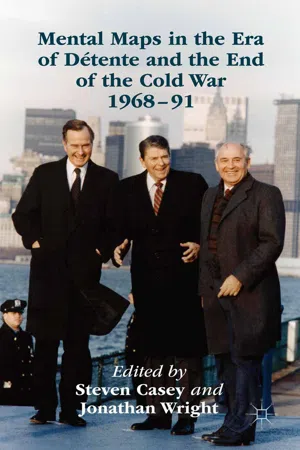
Mental Maps in the Era of Détente and the End of the Cold War 1968–91
- English
- ePUB (mobile friendly)
- Available on iOS & Android
eBook - ePub
Mental Maps in the Era of Détente and the End of the Cold War 1968–91
About this book
Mental Maps in the Era of Détente and the End of the Cold War recreates the way in which the revolutionary changes of the last phase of the Cold War were perceived by fifteen of its leading figures in the West, East and developing world.
Information
1
‘Do not think I am soft …’: Leonid Brezhnev
Vladislav Zubok
Leonid Brezhnev stood at the helm of the Soviet Union when that country was at the peak of its power. The summits where Brezhnev negotiated with US presidents and other Western leaders were milestones of world diplomacy. Yet when Brezhnev died in November 1982 at the age of 75, there was not a comprehensive biography of the man. And so it has remained since. Simply put, Brezhnev’s personality has failed to attract historians. Russian historian Dmitry Volkogonov in his essay on Brezhnev portrayed him as the blandest and most one-dimensional of all Soviet leaders, to whom he attributed ‘the psychology of a middle-rank party bureaucrat – vainglorious, cautious, conservative personality’. A few ripples of revisionism have perturbed the quiet pond of historiography about his years: historians began to argue that ‘early’ Brezhnev was an energetic and effective leader, promoted a set of strategic policies in domestic and foreign affairs, and deserves more than a footnote in the study of Soviet leadership. Still, even though the Brezhnev years are better researched, the personality is not.1
In 2011 the news came that the Russian archives had declassified the ‘working notes’ that Brezhnev regularly took from 1937 until his death. This generated some excitement among researchers, yet the notes turned out to be much less than a personal diary. Only a few determined scholars surmised that those notes could offer a good insight into Brezhnev’s personality, inner thoughts and beliefs. Overall, historians of all stripes – from Russian nationalists to Western liberals – continue to treat Brezhnev as a disappointing figure.
Meanwhile, 20 years after his death Leonid Brezhnev became surprisingly popular among common Russians. Political sociologists explain this phenomenon by the contrast between the 1970s, marked by stability and modest but predictable living standards, and the 1990s – with the disappearance of old social certainties and disastrous collapse of median incomes. Brezhnev’s conservative and paternalistic style, his governing principles – disparaged by historians – remained much closer to the masses in Russia than Gorbachev’s and Yeltsin’s political liberalization and reformism. Russian sociologist Yuri Levada attributed Brezhnev’s popularity to the widespread phenomenon of ‘Soviet person’ or Homo Sovieticus – the persistent mindset typical of millions of Soviet citizens. This ‘Soviet person’ above all is not a liberal subject. He or she denies individual responsibility in favour of state paternalism, order and predictability. He or she not only accepts all benefits that trickle down from above as given, but also obeys and adapts to coercive mechanisms, while remaining indifferent to the concept of civic and political freedoms. This mindset, Levada discovered, remained remarkably persistent and even resurgent in the post-Soviet years, despite radical changes in economic and social conditions, freedom of emigration and access to information.2
In my earlier writings, I argued that Brezhnev’s personal beliefs and commitments contributed much more to the formation of Soviet foreign policy than contemporaries and political scientists previously surmised. In this chapter I want to approach Brezhnev’s personal beliefs more conceptually. Levada’s concept of ‘Soviet person’ appears to be a good starting point for exploration of Brezhnev’s mental map.
‘Soviet Person’ Analysed
Brezhnev was born in 1906 in the Russian empire. He came from a family of industrial workers, former peasants from the Kursk region who moved in search of jobs to the southern region of the Russian empire, so-called ‘New Russia’ (now Ukraine). In his early documents Brezhnev put himself down as ‘Ukrainian’, but later, after he moved to Moscow he changed his identity to ‘Russian’. This was natural for people with a loose ‘Russian’ identity, but it was also a prudent choice: in the 1920s ‘Ukrainians’ enjoyed preferences in the Bolshevik national taxonomy, while after the 1930s the balance became reversed in favour of ‘Russians’. The territory of ‘New Russia’ (Novorossiia) that became part of Soviet Ukraine was Brezhnev’s small homeland; his contemporaries viewed his character as stereotypically ‘southern Russian’ – cheerful and gregarious. Also culturally, Brezhnev never fully separated himself from Russian peasantry. He cared about peasants and preserved peasant family values.
His education was grossly insufficient: a few classes of high school, a few years at the land–water technical school and night classes at the agricultural machine-building college. Yet every time he dropped his studies. As a result, his transformation into ‘Soviet person’ happened through the Komsomol, the communist youth association he joined at the age of 17. In the 1920s the Komsomol activists participated in all Soviet experiments. Young Brezhnev went to endless political meetings, read revolutionary poetry in an amateur theatre studio (‘Blue Blouse’) and probably helped to disrupt religious services and denounce ‘class enemies’. He was vivacious and artistic, and probably a party career prevented him from making a career on ‘the cultural front’. Instead, the party chose him, along with other vydivizhentsy (affirmative-action cadres) with a proletarian background, for political propaganda work. A party member since 1931, he was lucky during the Great Terror and soon rose to prominent positions in the Dnepropetrovsk Region of the Ukrainian SSR.
The Harvard Project on the Soviet Social System interviewed in the early 1950s thousands of Soviet refugees who ended up in the West. When asked about the party members, people spoke about two types: the minority of ‘believers’ and the majority of ‘non-believers’. The latter viewed the communist party not through ideological lenses, but rather as the career escalator, bringing economic opportunities and privileges.3 Brezhnev definitely belonged to the latter category. Before the abolition of serfdom, Russian peasants knew that their landlords could do anything to them, yet at the same time they also had to take care of them. Brezhnev, grandson of peasants, transferred this psychology from the landlord to the party-state. He remembered that the party career lifted him from poverty and liberated from harsh physical labour. He always viewed the party apparatus as a supreme trade union that should ensure a better life for its members. When he hired foreign policy assistant Alexandrov-Agentov, he carefully inquired as to his salary and living conditions. Even when he forced people out, Brezhnev made sure they would have an adequate pension, good housing, privileged food supplies and other perks.4
The war with Germany in 1941–45 completed his transformation into a ‘Soviet man’. This war became know as Great Patriotic War, and British historian Geoffrey Hosking aptly wrote that in those years ‘ “Russianness” crystallized … as an amalgam of ethnic and imperial, russkii, rossiiskii and sovetskii elements.’ Hosking also wrote that the intensity of this constellation was ‘as never before – and indeed never subsequently’.5 In other words, ‘Soviet person’ for the first time acquired strong national identity. Brezhnev went to war in June 1941, when he experienced some of the worst calamities of retreat, defeat and suicidal defence. Then he marched westward with the Soviet army from Northern Caucasus to the Carpathian mountain range in Slovakia. From now on, the idea of the USSR as a great power became the focus of Brezhnev’s patriotic identity. The 39-year-old Colonel Brezhnev proudly represented the ‘Second Ukrainian Front’ (group of armies) in the victory parade in Moscow in June 1945. Even after revelations of Stalin’s crimes, Brezhnev could never suppress his respect and admiration for the Generalissimo, the leader and ‘organizer’ of Soviet war victory, as well as a world statesman who determined the future of Europe and Asia together with Franklin Roosevelt and Winston Churchill. The idea of great power justified his support of Soviet militarism. For the rest of his life, Brezhnev remained convinced, with peasant tenacity, that one cannot prepare enough for the Homeland’s defence.6
A flipside of this pride in the Soviet Union’s great power was vulnerability, the search for respect and recognition. Henry Kissinger noticed this in his memoirs, and ascribed Brezhnev’s behaviour to historic Russian insecurity.7 With even greater reason this behaviour can be attributed to Soviet national identity, with its contradictions. Indeed, Brezhnev felt at first insecure in the international arena. But, in contrast to Khrushchev, whose lack of assurance and search for recognition translated into bouts of revolutionary diplomacy and crisis-mongering, Brezhnev would transform the urges of his national identity into a quest for détente.
Communist ideology played an important role in his mental map, yet indirectly, not as a set of ideas and ideological beliefs. Brezhnev was not a man of ideas. Brezhnev did not like reading, and probably never finished or understood any of Marxist-Leninist ‘classical’ texts. In his narrow circle he confessed that he ‘hated’ Soviet ‘ideological chattering’ and called propaganda work – that took up a considerable part of his early party career – ‘gibberish’.8 With some degree of imagination, one can suggest that Brezhnev treated ideology as a force of nature, something beyond his comprehension yet that should be treated with extreme caution. He venerated Lenin as the source of supreme ideological wisdom, and asked Secretary for Ideology Mikhail Suslov and personal speechwriters to supply appropriate Lenin quotations for all his speeches. His use of ideological language increased in the spheres of policy-making about which Brezhnev knew less when he came to power, and this included foreign policy.
He knew how to use the immense power at his disposal. ‘Do not think that I am soft’, he said to his foreign policy assistant, even before he became the General Secretary. ‘If necessary, I can strike so hard that, whatever happens to the person I would strike, I would remain sick myself for three days.’ Brezhnev removed his potential rivals ‘gently’, and even found jobs for them in provincial bureaucracy or embassies in Africa. He was also a leader by consensus: he led from behind, by talking, cajoling and convincing – never by intimidation and threats. Indeed, he preferred to use his charm and actors’ skill to get what he wanted. And he did not spend his political capital on the issues that did not concern him personally or the problems that could only hurt his reputation and cause trouble. In contrast to Khrushchev who moved forward like a tank, crushing any obstacles before him, Brezhnev could wait patiently and deal with peripheral issues – like the river that flows around obstacles. On issues of personal priority, however, he was capable of impressive political energy and skill.9
Levada wrote that for the ‘Soviet person’ the most important value was stability. The yearning for stability was shared by all segments of Soviet society. Amir Weiner astutely called this phenomenon ‘Retiring Revolution’,10 and Brezhnev was an ideal leader embodying this value. Revolutionary phraseology and promises, associated with the national celebration of Lenin’s and October’s centennials, no longer entailed practices of revolutionary modernization and brutal social engineering – they just masked the conservative preferences of Brezhnev, Soviet nomenklatura and society at large. Experienced apparatchiks detected already in 1967 that Brezhnev had a ‘fear of reforms’ and ‘fear of the past’. He did not have new ideas and wanted to avoid new shocks. Stability reigned in Brezhnev’s selection of cadres: he surrounded himself with his buddies. Soon people began to joke that Russian history should be divided into three periods: the pre-Petrine, the Petrine and the Dnepropetrine – after Brezhnev’s Dnepropetrovsk ‘gang’. This led to greater corruption, social cynicism and mafia-like patrimonialism.11
When Brezhnev was a middle-ranking official, his mental map of the ‘Soviet person’ was coherent, impervious to external influences and probably very comforting psychologically.12 He was convinced that the Soviet system was the best possible system and that the Soviet Union was entitled to be a world power. This coherence, however, began to show strains when Brezhnev rose to the leadership and began to confront the numerous contradictions harbouring in the Soviet system. His beliefs and experience could not provide him systemic or even acceptable solutions. Ultimately, the stress of contradictory realities overwhelmed him and contributed to his stress, illness and political degradation.
Missiles versus Bread
The mid-career of Brezhnev in the late 1950s to early 1960s proceeded, thanks to Nikita Khrushchev’s patronage, in two different sectors of Soviet economy: the military-industrial complex and agriculture. In the former sector, Khrushchev entrusted Brezhnev to supervise the most sensitive programmes: the development and construction of intercontinental missiles and nuclear weapons, and the space industry. Khrushchev also made him a top emissary to direct the epic ‘Virgin Lands’, an agricultural development programme in Kazakhstan. Both national problems – defence and food – preoccupied him with equal intensity. For years he would seek a difficult balance between them.
Brezhnev, in contrast to Stalin, felt empathy with the plight of Russian, Ukrainian and Belorussian peasants, devastated by the collectivization, war and ruinous state taxes. He carried out the ‘second emancipation’ of the peasantry: in 1974 the collective farmers got the right to receive internal passports and therefore freedom to move around the country and to the cities. Also under Brezhnev, collectivized peasants began to receive benefits from the Soviet welfare system, previously accorded only to urbanites, which included the universal pension system. Although he quietly abandoned Khrushchev’s utopian slogans of ‘construction of communism in twenty years’, he remained determined to give the Soviet people ‘a good life’ as he understood it. He devoted great energy to this goal: more state-paid housing was constructed and distributed during Brezhnev’s rule than during the rest of Soviet history. Brezhnev’s ‘good life’ meant above all guaranteed jobs, fixed minimal prices on basic goods and a sharp decline in practices of punishment and coercion.13
Economist James Millar called Brezhnev’s social-economic policy a ‘Little Deal’.14 In reality,...
Table of contents
- Cover
- Title Page
- Copyright
- Contents
- Acknowledgements
- Notes on Contributors
- Introduction
- 1. ‘Do not think I am soft …’: Leonid Brezhnev
- 2. Richard Nixon and Henry Kissinger: The Outsiders?
- 3. Salvador Allende
- 4. Nicolae Ceaușescu
- 5. Julius Nyerere
- 6. King Hussein of Jordan
- 7. President Soeharto
- 8. Deng Xiaoping
- 9. Václav Havel
- 10. Willy Brandt and Helmut Kohl
- 11. Ronald Reagan
- 12. Mikhail Gorbachev
- 13. Nelson Mandela
- Conclusion
- Further Reading
- Index
Trusted by 375,005 students
Access to over 1.5 million titles for a fair monthly price.
Study more efficiently using our study tools.
Frequently asked questions
Yes, you can cancel anytime from the Subscription tab in your account settings on the Perlego website. Your subscription will stay active until the end of your current billing period. Learn how to cancel your subscription
No, books cannot be downloaded as external files, such as PDFs, for use outside of Perlego. However, you can download books within the Perlego app for offline reading on mobile or tablet. Learn how to download books offline
Perlego offers two plans: Essential and Complete
- Essential is ideal for learners and professionals who enjoy exploring a wide range of subjects. Access the Essential Library with 800,000+ trusted titles and best-sellers across business, personal growth, and the humanities. Includes unlimited reading time and Standard Read Aloud voice.
- Complete: Perfect for advanced learners and researchers needing full, unrestricted access. Unlock 1.5M+ books across hundreds of subjects, including academic and specialized titles. The Complete Plan also includes advanced features like Premium Read Aloud and Research Assistant.
We are an online textbook subscription service, where you can get access to an entire online library for less than the price of a single book per month. With over 1.5 million books across 990+ topics, we’ve got you covered! Learn about our mission
Look out for the read-aloud symbol on your next book to see if you can listen to it. The read-aloud tool reads text aloud for you, highlighting the text as it is being read. You can pause it, speed it up and slow it down. Learn more about Read Aloud
Yes! You can use the Perlego app on both iOS and Android devices to read anytime, anywhere — even offline. Perfect for commutes or when you’re on the go.
Please note we cannot support devices running on iOS 13 and Android 7 or earlier. Learn more about using the app
Please note we cannot support devices running on iOS 13 and Android 7 or earlier. Learn more about using the app
Yes, you can access Mental Maps in the Era of Détente and the End of the Cold War 1968–91 by Jonathan Wright, Steven Casey, Jonathan Wright,Steven Casey in PDF and/or ePUB format, as well as other popular books in History & Military & Maritime History. We have over 1.5 million books available in our catalogue for you to explore.