- English
- ePUB (mobile friendly)
- Available on iOS & Android
eBook - ePub
About this book
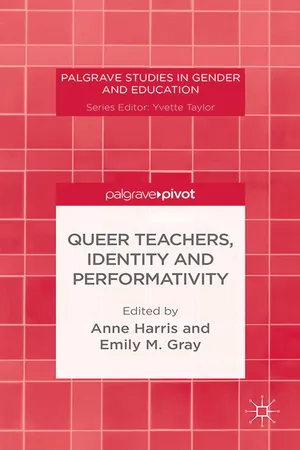
What do we mean when we talk about 'queer teachers'? The authors here grapple with what it means to be sexually or gender diverse and to work as a school teacher within four national contexts: Australia, Ireland, the UK and the USA. This new volume offers academics, educators and students a provocative exploration of this pivotal topic.
Information
1
Trans Teacher Experiences and the Failure of Visibility
Anne Harris and Tiffany Jones
Abstract: This chapter draws on one case study of a trans* male-identifying teacher in an urban high school in Melbourne, Australia. As a counter-discourse to contemporary popular notions of more inclusive and anti-homophobic schools, this chapter proposes that trans* teacher experiences are still an under-researched and sometimes controversial ‘final frontier’ for even ‘safe’ schools that strive to engage with LGBTQ-inclusive discourses and practices. Drawing out Halberstam’s focus on ‘the bathroom problem’ in trans* experience and scholarship (1998), and extending his notion of productive failure (2011), we argue more broadly that some current mainstreaming of diverse sexualities education and anti-bullying attention to LGBTQ students do not extend inclusivity to care of teachers – most especially trans teachers – nor do they acknowledge the particularity of trans subjectivities.
Keywords: transgender; gender diversity; bathroom; anti-bullying; outness
Harris, Anne and Emily M. Gray, eds. Queer Teachers, Identity and Performativity. Basingstoke: Palgrave Macmillan, 2014. DOI: 10.1057/9781137441928.0006.
Introduction
How do you sustain that, a job where you are that sort of cyborg? I really struggle with to what extent you model being a human being, and to what point that is your role as a teacher, both with gender identity or not. I mean, that whole ‘it gets better’ kind of thing has such an impact. Like, I sort of feel this imperative to always be up when I’m talking about transitioning at work, and you’ve got to see that I’m a positive example of a trans person, and all this kind of bullshit that I don’t actually agree with on any level (participant Ned, 2013).
Jack Halberstam has famously problematised not only the experiences of trans individuals, but the label itself1 – as in this chapter does our participant Ned, who calls the pressures on trans teachers ‘completely unsustainable in terms of a workforce’. Halberstam links visibility with our visual culture more broadly, with implications for gender non-normative individuals in which ‘... the thematics of losing and failure appear within visuality itself as a line or threshold beyond which you cannot see, a horizon that marks the place of the failure of vision and visibility itself’ (2011, p. 105). Trans teachers like Ned inhabit such a threshold beyond which those in school cultures often ‘cannot see’.
Here we also draw on recent scholarship from Jasbir Puar who problematises the ‘slow death’ of ‘precarious populations’ (2011, p. 154) including those like Ned and other trans teachers who daily navigate neoliberal education contexts ill-suited to accommodate new sexual and gender diversities. Puar calls out neoliberal queer discourses on their hegemonising effects which echo earlier resistant/assimilationist moments for other marginalised cultures and subjects: ‘... Dan Savage’s sanctimonious statement “it gets better” is a mandate to fold oneself into urban, neoliberal gay enclaves: a call to upward mobility that discordantly echoes the now-discredited “pull yourself up by the bootstraps” immigrant motto’ (Puar, 2011, p. 151).
At the same time, institutional and policy-driven education sectors worldwide are patting themselves on the back for opening up to the slightest possibility of sexualities education and attention to LGBTQ students that is not solely tolerant, mechanical and heteronormative, contributing to the alienation of so many teachers who are not able to bring their whole selves to their work. This tension between espoused values and real-life practices is most starkly evident in the experiences of trans* teachers.
There is limited research on trans* teachers or trans* subjectivities in schools overall, although this is changing in recent times (Schilt, 2010; Valentine, 2007; Halberstam, 2005; Epstein, O’Flynn & Telford, 2003). Within the Australian context, studies have mainly focused on a broader trans* population (Duke, 2008; Collyer & Heal, 2002; Couch et al., 2007; Jones, del Pozo de Bolger, Dunne, Lykins, & Hawkes, 2014; Pitts, Smith, Mitchell, & Patel, 2006), or broader LGBTQ populations (Jones et al, 2014; Hillier et al., 2010; Jones, 2012b; Pitts et al., 2006). The data consistently suggests that schools are a tougher place for trans* students than their non-trans* peers.
Halberstam helps us think through some of the complications associated with trans* in/hyper/visibility and trans* subjectivities (1998; 2005; 2011; 2012) in ways that remind us of the many complex intersections in any such undertaking, both publicly-enacted and privately felt. For example, he points out the ways in which ‘gay male history has intersected with the histories of dominant culture, but lesbian and trans* histories tend to leave less archival material and less traces’ (2012, p. 137). For trans* teachers, visibility and even identity itself are reminders of both an ‘old school’ approach to queer activism, but also of the very long way that schools equality still has to go.
In this chapter, we highlight both aspects of the ‘trans* teacher experience’ for one young FtM teacher in an Australian high school. The daily work of ‘being’ trans* at school for teacher ‘Ned’ is an inspiring and stark reminder of how differently trans* activism and ‘queer’ activism gets ‘done’ in schools, and how different are the structural and professional-interpersonal responses to the project.
Context: LGBTQ teachers in policy and law
International
Lesbian, gay, bisexual, trans*, and queer (LGBTQ) teachers have rights articulated in both international and local laws and policies. At the international level, sexual orientation and gender identity have been confirmed as protected grounds in human rights legislative provisions (United Nations, 2012; Vance, 2011). The 2011 United Nations Educational, Scientific and Cultural Organisation (UNESCO) International Consultation on LGBTQ issues in Educational Institutions in Brazil saw the development of the Rio Statement (UNESCO, 2011), which asserted that the right to education must not be curtailed by discrimination on the basis of sexual orientation or gender identity for staff or students.
Responses to the changes in ‘global’ legislation and policy have been extremely divergent. In the USA, Fields (2008) and others (GLSEN, 2012; Kosciw et al., 2010; Kosciw & Pizmony-Levy, 2013) have documented both the improvements and the remaining significant gaps in education policy and legislative protections for LGBTQ students and teachers. In the UK, Atkinson (2002) drew on the incoming National Curriculum to note inconsistencies in the education sector’s approach to diversities that don’t seem to include sexual and gendered ones, although the abolition of Section 28 – a former ban on teachers using ‘homosexual propaganda’ in schools – was aided by the growing push for international reforms (Blair & Monk, 2009; UNESCO, 2012). However, Russia has instead created its own new ban on homosexual ‘propaganda’ in schools, and warn about travel to regions with more flexible approaches (Jenkin, 2012). Many African nations, including Uganda and Nigeria, are now criminalising teacher promotion of LGBTQ themes (Onuah, 2014; Phoon, 2010). Some international leaders see the pressure to conform to transnational discourses of support for LGBTQ teachers as subsuming their sovereign values within Western ideals.
Australia-wide
All seven Australian states and territories have legislated prohibitions to employment discrimination for teachers related to sexual orientation and trans* identities (ACT Parliamentary Counsel, 2010; NSW Parliamentary Counsel, 2010; NT Parliamentary Counsel, 2010; QLD Parliamentary Counsel, 2010; SA Parliamentary Council, 2010; TAS Parliamentary Counsel, 2010; VIC Parliamentary Counsel, 2010; WA Parliamentary Counsel, 2010). However, these laws all contain some form of exemption for religious schools, with broader exemptions in Victoria and stricter ones for example in South Australia.
The most direct policy protection for Australian LGBTQ teachers, however, can be found in a substantive Victorian human resources (HR) policy on same-sex attracted employees with examples demonstrating how a principal should manage bullying of gay teachers or community complaints about their sexuality (VIC Government, 2010). Victoria also offers an HR policy on gender identity for teachers with guidelines on managing gender transitions (VIC Government, 2009), and has had the advantage of a unique Safe Schools Coalition formed in 2009 to combat homophobia and transphobia with an aim of creating learning environments where ‘every student can learn, every teacher can teach and every family can belong’ (http://safeschoolscoalitionvictoria.org.au/).
In New South Wales, the Complaints Handling Policy Guidelines (NSW Government, 2008) directs discrimination complaints on the basis of homosexuality or trans* status towards Legal Services (p. 14). South Australia offers government policies that support the diverse sexual orientations of staff (Shone, 1999, p. 2). Western Australia offers limited direct protection for staff, banning discrimination on the basis of sexual orientation and gender history (WA Government, 2004, p. 7; WA Government Department of Health and Department of Education & Association of Independent Schools WA, 2002, p. 4). There are unfortunately no specific protections offered by the independent sectors of these states.
In the ACT, the three relevant indirect policies which allude to staff sexuality or homophobia are more concentrated on harassment: Countering Bullying, Harassment and Violence in ACT Public Schools (ACT Government, 2007a, p. 2); Countering Sexual Harassment in Public Schools (ACT Government, 2007b, p. 2); and the Equity and Diversity Plan 2007–2009 (ACT Government, 2007c), but there appear to be no relevant independent sector policies. Tasmania offers the following indirect government education policies relevant to LGBTQ teacher discrimination: Anti-discrimination and Anti-harassment Policy (TAS Government, 2008a, rationale, 1.1, 1.2); Equity in Schooling: Policy & Implementation Plan (TAS Government, 2008b, introduction); and Supportive School Communities Policy Framework 2003–2007 (TAS Government, 2003, p. 12). There are no official policies in this area that address Tasmania’s independent sector. Two states/ territories have no specific protections available for LGBTQ teachers at all: Queensland’s government and independent sectors offer no such policy, and the Northern Territory’s government sector policy - Principles for Dealing with Controversial Issues in Schools (NT Government, 1998) - negates teachers teaching their political or personal views.
Protections for trans* and other non-heteronormative teaching staff in Australia vary according to the state. There are fewer policy protections for LGBTQ teachers in religious settings for example, which greatly impacts on the professional decision-making process for trans and other teachers as they enter the workforce, and how their professional identities are negotiated in school-related sites. Elsewhere we have provided a map of the policies concerning LGBTQ teachers in international and Australian education in greater detail (Jones, Gray & Harris, 2014). Australian religious schools can claim the right to refuse to hire, or to fire, an employee on the basis of their sexuality or gender identity. Australia also has no national education policy protecting LGBTQ teachers, despite the Australian Education Union’s statement Policy on Gay, Lesbian, Bisexual and Trans* People (2003), being presented as a best practice example to government. In sum, while nominal protections do exist both internationally and within Australia, there is a long way to go, including in addressing the great variance between regions and religious/government schools. Research shows that even where anti-homophobia policies are in place, they are often not implemented effectively or at all (Macgillivray, 2004; Szalacha, 2003). However, research continues to show that policy that is adequately promoted in a school can lead to positive wellbeing outcomes for LGBTQ students, and can function as enabling strategies for those teachers trying to adequately deal with the homophobic incidents their students and they themselves experience (Neary, 2013; Gray, 2013; Ferfolja, 2010; 2007; Harris, 2013; Jones & Hillier, 2012, 2013; Ollis, 2007). This article problematises a pervasive contemporary narrative of anti-homophobic and transphobic ‘progress’ and inclusivity, by suggesting that schools are still not truly safe for students nor their teachers – particularly evident in narratives of trans* educational experiences.
Snapshot of this study: the Out/In Front state-based pilot
The 2013 Out/In Front Victorian state-based pilot study2 began in March and was completed in July. Ethical approval was obtained from all three participating institutions (UNE, Monash and RMIT), and deployed mixed methods data collection techniques, including a literature review, an online survey and interviews. As part of this study we conducted nine semi-structured interviews with teachers who identified as lesbian, gay, trans* and queer. The interviews were transcribed and then coded and analysed for emergent themes. Participants’ anonymity was assured by removing all identifying place names, schools or other identifying factors, and participants either chose or were assigned a pseudonym. The interview questions focused on the lived experiences of LGBTQ teachers in schools, with an equal emphasis on both the positive and negative aspects of their teacher training and employment experiences as they intersected with their LGBTQ identifications or perspectives.
While many of the respondents stressed the lack of support they felt within schools, and also the high degree to which the pressures and challenges around LGBTQ issues and identities contributed to them leaving or disliking aspects of the profession, there were also significant narratives of support, inclusion and respect, and these were equally important in the construction of the questions, and analysis of emergent themes within the data. For this book chapter, we focus on one interview with a trans* participant who selected the pseudonym ‘Ned.’ We highlight this single case study in particular, in order to highlight the very distinct experiences of ‘being’ and ‘doing’ queer that this young teacher faced first as she identified as a lesbian and then subsequently in the same school as he transitioned to male-identified.
Being ‘Ned’: navigating a transitioning gender/teacher identity at school
I do think that having ‘out’ teachers makes a big difference for kids. And I think that publicly transitioning, as painful as it is in an ongoing sense at work, is something that’s going to affect the kids that I come into contact with.
A range of queer scholarship suggests that simply being ‘out’ or the power of visibility is no longer enough in the neoliberal contexts in which we find ourselves working, living and thinking about queerness, and that the cost of ‘being’ queer is often too high for LGBTQ teachers (Sears, 2013; Neary, 2013; Baumle, 2013; Hines & Sanger, 2010). For the teachers interviewed in the Out / In Front pilot however, being ‘out’ – in all its varying expressions – is a matter of constant consideration, and sometimes still of significant danger. For teachers who identify as trans*, the challenges are even greater. Like other trans* teachers internationally (Bender-Baird, 2011; Hines & Sanger, 2010), Ned’s experiences of transitioning within a school environment highlight the interrelatedness of teacher identities and student experiences. Unlike trans* students, however, Ned and other trans* teachers do not receive the same degree of support (Human Rights Watch, 2001). In this section we offer a brief profile of ‘Ned’ during this study, in transition from lesbian-identified to male-identified.
Background
Ned is in his 20s and identifies as male. He describes his sexuality as ‘probably queer...whatever that means.’ He attended an all-girls private secondary school, and observed homophobic treatment of teachers at that time. Ned has been teaching for 4 years in a large outer-urban government (state) secondary school of 1400 students, and he was 25 when he started teacher training. He identifies his arts degree and activist background as central to his desire to be a teacher, but also ‘employment security’ as important. In addition to his teaching duties, he is also a Year 10 Coordinator of 260 students that year level. He describes transitioning to working in a school from his previous life as culture shock: ‘I was very much from the queer ghetto; all my friends pretty much are academics or activists or artists. So working at a school where everyone lives in the suburbs – it’s a whole new frontier.’ And while he admits it has ‘definitely changed who I socialise with,’ he admits that, ‘most weeks I spend 60 hours at school’ which limits his social activities in general....
Table of contents
- Cover
- Title
- Introduction: Marked Presence/Unremarkable Absence: Queer Teachers, Identity and Performativity
- 1 Trans Teacher Experiences and the Failure of Visibility
- 2 Reframing Queer Teacher Subjects: Neither in nor Out but Present
- 3 Teachers and Civil Partnership: (Re)Producing Legitimate Subjectivities in the Straight Spaces of Schools
- 4 Out in Britain: The Politics of Sexuality Education and Lesbian and Gay Teachers in Schools
- 5 LGBTQ Teachers and the Location of Difference in English Schools
- Conclusion: Extravagance and Equity: Queer Tensions in Education
- Bibliography
- Index
Trusted by 375,005 students
Access to over 1.5 million titles for a fair monthly price.
Study more efficiently using our study tools.
Frequently asked questions
Yes, you can cancel anytime from the Subscription tab in your account settings on the Perlego website. Your subscription will stay active until the end of your current billing period. Learn how to cancel your subscription
No, books cannot be downloaded as external files, such as PDFs, for use outside of Perlego. However, you can download books within the Perlego app for offline reading on mobile or tablet. Learn how to download books offline
Perlego offers two plans: Essential and Complete
- Essential is ideal for learners and professionals who enjoy exploring a wide range of subjects. Access the Essential Library with 800,000+ trusted titles and best-sellers across business, personal growth, and the humanities. Includes unlimited reading time and Standard Read Aloud voice.
- Complete: Perfect for advanced learners and researchers needing full, unrestricted access. Unlock 1.5M+ books across hundreds of subjects, including academic and specialized titles. The Complete Plan also includes advanced features like Premium Read Aloud and Research Assistant.
We are an online textbook subscription service, where you can get access to an entire online library for less than the price of a single book per month. With over 1.5 million books across 990+ topics, we’ve got you covered! Learn about our mission
Look out for the read-aloud symbol on your next book to see if you can listen to it. The read-aloud tool reads text aloud for you, highlighting the text as it is being read. You can pause it, speed it up and slow it down. Learn more about Read Aloud
Yes! You can use the Perlego app on both iOS and Android devices to read anytime, anywhere — even offline. Perfect for commutes or when you’re on the go.
Please note we cannot support devices running on iOS 13 and Android 7 or earlier. Learn more about using the app
Please note we cannot support devices running on iOS 13 and Android 7 or earlier. Learn more about using the app
Yes, you can access Queer Teachers, Identity and Performativity by A. Harris, E. Gray, A. Harris,E. Gray in PDF and/or ePUB format, as well as other popular books in Social Sciences & Education Theory & Practice. We have over 1.5 million books available in our catalogue for you to explore.