eBook - ePub
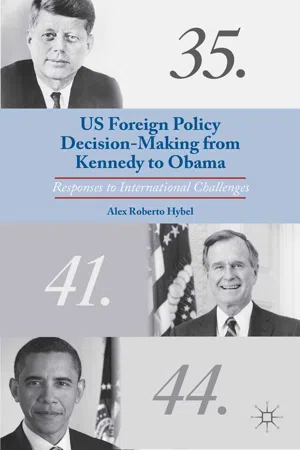
US Foreign Policy Decision-Making from Kennedy to Obama
Responses to International Challenges
- English
- ePUB (mobile friendly)
- Available on iOS & Android
eBook - ePub
US Foreign Policy Decision-Making from Kennedy to Obama
Responses to International Challenges
About this book
This book analyzes the foreign policy decision-making processes of Presidents John F. Kennedy, Lyndon B. Johnson, Richard Nixon, George H.W. Bush, George W. Bush, and Barack Obama during military intervention by way of contemporary foreign policy decision-making models (FPDMs).
Information
Chapter 1
John F. Kennedy, Lyndon B. Johnson, and the Vietnam War
“The foundations of our decision making were gravely flawed.”1
Introduction
The Vietnam conflict demanded the attention of six US presidents. During Harry Truman’s tenure at the White House, France and the Viet Minh were the war’s main protagonists, with the United States serving primarily as the financier of Paris’s military and political pursuits. A year after Dwight Eisenhower assumed the presidency, Washington’s role changed. France’s tacit acknowledgment at the 1954 Geneva Convention that it no longer possessed the material capability and political will to regain control over its former colony convinced Eisenhower that the United States’ purpose in Southeast Asia had to be altered. As explained by Secretary of State John Foster Dulles on July 24, 1954, the United States would draw a line in the sand, and any transgression by the the Communists “would be treated as active aggression calling for reaction of the parties of the Southeast Asia Pact.”2 Though US support remained firm until the end of Eisenhower’s presidency, it was limited to the deployment of the Military Assistance Advisory Group (MAAG) to train the army of the Republic of Vietnam and to provide financial assistance.
John F. Kennedy and Lyndon Johnson increased US military presence in Vietnam substantially—with the second increase occurring in a decidedly more significant fashion. Richard Nixon, who became the US chief executive in early 1969, implemented policies that were markedly more complex than those of his predecessors. He intensified the bombing of North Vietnam, reduced the number of American forces deployed throughout South Vietnam, sought to Vietnamize the conflict, attempted to reach a peace agreement with Hanoi, and finally managed to bring to an end the US involvement in the war in 1973. But it was Gerald Ford, Richard Nixon’s unexpected and unheralded 1974 successor, who undertook the unwelcome chore of witnessing South Vietnam being absorbed by the Communists.
Our study of the US involvement in the Vietnam War focuses on John F. Kennedy, Lyndon Johnson, and Richard Nixon. In this chapter we explain the rationale behind Kennedy’s and Johnson’s decisions to increase military involvement in the Vietnam conflict. Our examination integrates analyses of the mindsets that influenced the thinking of the two presidents, the quantity and quality of the intelligence they relied on, and the way they interpreted it. Additionally, we evaluate the extent to which Kennedy and Johnson each advocated the serious examination of multiple options and enabled their respective advisors to voice openly their opinions. At the end of the chapter, we present the model that best captures the foreign policy decision-making process (FPDM) designed by each president. In addition, we evaluate the quality of the process.
It Was Not a New Beginning under Kennedy
The day before he was sworn in as the United States’ thirty-fifth president, John F. Kennedy, along with Dean Rusk, Robert McNamara, Douglas Dillon, and Clark M. Clifford, met with Dwight Eisenhower and several of his own top advisors. Eisenhower opened the discussion by stating that the United States had “to preserve the independence of Laos.” The departing president stressed that, were Laos to fall to the Communists, “then it would be just a question of time before South Vietnam, Cambodia, Thailand and Burma would collapse.”3 The Southeast Asian countries, he explained, resembled a set of dominoes. “You have a row of dominoes set up, you knock over the first one, and what will happen to the last one is the certainty that it will go over very quickly.”4 During the briefing, Eisenhower barely mentioned Vietnam.
Kennedy assumed the presidency aware of the challenges he would encounter in Southeast Asia. He had revealed his concerns in a speech in June 1956, while serving as senator of the state of Massachusetts. He stated:
First, Vietnam represents the cornerstone of the Free World in Southeast Asia, the keystone to the arch, the finger in the dike. Burma, Thailand, India, Japan, the Philippines and obviously Laos and Cambodia are among those whose security would be threatened if the Red Tide of Communism overflowed into Vietnam.
Secondly, Vietnam represents a proving ground of democracy in Asia . . . Vietnam represents the alternative to Communist dictatorship . . . The United States is directly responsible for this experiment . . . We cannot afford to permit the experiment to fail.
Third . . . Vietnam represents a test of American responsibility and determination in Asia . . . [I]f it [Vietnam] falls victim to any of the perils that threaten its existence—Communism, political anarchy, poverty and the rest—then the United States, with some justification, will be held responsible; and our prestige in Asia will sink to a new low.
Fourth and finally, America’s stake in Vietnam, in her strength and in her security, is a very selfish one—for it can be measured, in the last analysis, in terms of American lives and American dollars. It is now well known that we were at one time on the brink of war in Indo-china—a war which could have been more costly, more exhausting and less conclusive than any war we have ever known. The threat of such war is not now altogether removed from the horizon. Military weakness, political instability or economic failure in the new state of Vietnam could change overnight the apparent security which has increasingly characterized the area under the leadership of Premier Diem . . . [T]he key position of Vietnam in Southeast Asia . . . makes inevitable the involvement of this nation’s security in any new outbreak of trouble.5
A report written by General Edward Lansdale, who had visited Vietnam during the first two weeks of January, caught Kennedy’s attention. The general wrote:
Communist-inspired insurgency in SVN, aimed at the destruction of authority and prestige of established government, is a prelude to further inroads designed ultimately to absorb SVN into the Communist bloc . . . Developments in South Viet-Nam over the past year indicate a trend that is adverse to the stability and effectiveness of President Diem’s government. Beginning in December 1959 and continuing to the present, there has been a mounting increase throughout South Viet-Nam of Viet Cong terrorist activities and guerrilla warfare . . . Through the use of these tactics current Viet Cong military and political objectives are the overthrow of the Diem Government. Their immediate objectives are to eliminate any semblance of GVN [Government of Republic of Vietnam] control in rural areas, particularly the Mekong Delta, and establish so-called “liberated zones.” [D]iscontent with the Diem Government has been prevalent for some time among intellectuals and elite circles and has been rising among the peasantry and, to some extent, labor and urban business groups. Criticism of these elements focuses on Ngo family rule, especially the roles of the President’s brother, Ngo Dinh Nhu, and Madame Nhu and the influence of the clandestine Can Lao political apparatus of the regime. An even more important element in the political situation is the criticism of the President’s leadership within government circles, including the official bureaucracy and the military.6
With the crisis in Laos coming to a head, Kennedy ordered the formation of a task force headed by Deputy Secretary of Defense Roswell Gilpatric to determine the immediacy of a Communist threat in Vietnam. In his account, Gilpatric, aided by Lansdale, noted that the political, economic, and social conditions in Vietnam had deteriorated measurably and that the United States’ leading objective should be to prevent a Communist takeover.7
Before Kennedy could study Gilpatric’s recommendations, events in Laos forced his advisors to discuss measures the United States should take to protect South Vietnam. On April 28, the National Security Council (NSC) recommended a two-division Army of the Republic of Vietnam (ARVN) increase and the deployment of 3,600 US forces. The recommendation was not unanimous. Lansdale believed it was not necessary to enlarge the number of Vietnamese forces but proposed that the US send additional forces. Gilpatric’s military aide, Colonel E. F. Black, favored the increase of the ARVN’s military presence but opposed the augmentation of US military forces.8 The following day Kennedy rejected the NSC’s recommendations and adopted Gilpatric’s markedly less radical proposals, which focused principally on providing financial aid to the South Vietnamese military.9 On May 1, Kennedy once again deferred his decision on whether to send in additional US forces.
Differences concerning the extent to which the United States should become involved in the Vietnam crisis mounted. On May 3, Undersecretary of State George Ball submitted a report that questioned the Defense Department’s recommendation that the US intervene unilaterally, if necessary, to save South Vietnam from Communism. Instead, he advocated that Washington consider reaching a new bilateral agreement with Ngo Dinh Diem, the president of South Vietnam. Seven days later, the Joint Chiefs of Staff argued that if the intent of the Kennedy administration was to “hold Southeast Asia outside the Communist sphere,” then the United States should increase its military presence to provide visible deterrence.10
By then Washington was well aware that challenges to the South Vietnamese government did not originate solely in the North. After the 1954 Geneva Accord, which had divided Vietnam into a northern and a southern zone at the 17th parallel, a substantial number of Viet Minh members remained in South Vietnam.11 Many of those who stayed behind formed the National Liberation Front (NLF), a political and military group commonly referred to as the Vietcong. Their basic intent was to recruit support from non-Communists and to fuel an insurgency.
Determined to move carefully, Kennedy approved National Security Action Memorandum 52. The president agreed to dispatch 400 special forces troops to South Vietnam, increase the number of Vietnamese governmental (GVN) forces from 170,000 to 200,000, launch covert operations against North Vietnam, and implement short-term economic programs.12 In a May 13, 1961, communiqué to South Vietnam, President Kennedy reiterated his motivations for the increased commitment. “The United States,” he stated, is “conscious of its responsibility and duty . . . Free Vietnam cannot alone withstand the pressure which the Communist empire is exerting against it.”13 In June, however, during the Vienna meeting, Kennedy managed to persuade Nikita Khrushchev that representatives of the United States and the Soviet Union should make a major effort to construct an agreement that would recognize Laos as a neutral country.
Members of the Kennedy administration and outside groups continued to submit recommendations all the way through September as to the kind of measures the United States should adopt to assist Vietnam. By October, Kennedy and his advisors had concluded that Diem had not been effective at countering the multiple challenges his government faced and that Washington’s assistance had not generated positive results. On October 11, the NSC met to discuss a number of assessments and proposals. They ranged from the claim that the insertion of forces from the South East Asia Treaty Organization would be thwarted by forces from the Soviet Union, the Vietcong, and the Democratic Republic of Vietnam (North Vietnam), to the contention that 40,000 US forces would be needed to defeat the Vietcong and an additional 128,000 to counter actions by North Vietnam and its allies. William Bundy, in a memo to his boss, McNamara, argued that Diem’s effectiveness remained questionable and that the United States could not wait much longer if it hoped to prevent South Vietnam’s collapse. He predicted that if the United States were to move immediately and aggressively, its chances of success were 70 percent.14
Mindful of the troubles he faced, Diem asked that the United States provide an additional fighter-bomber squadron, civilian pilots for helicopters, C-47 transports, and US combat units for training missions near the Demilitarized Zone (DMZ) and possibly the central highlands. He further requested that Chiang Kai-shek be asked to deploy some of his Taiwanese forces.15
On October 17, General Maxwell Taylor and Deputy Special Assistant to the President for National S...
Table of contents
- Cover
- Title
- Halftitle
- Copyright
- Preface
- Content
- Introduction Alternative Theoretical Perspectives
- 1 John F. Kennedy, Lyndon B. Johnson, and the Vietnam War
- 2 Richard Nixon, Henry Kissinger, and the Retreat from Vietnam
- 3 George H. W. Bush and the Gulf War
- 4 George W. Bush and the Afghan and Iraq Wars
- 5 Barack Obama and the Afghan War
- 6 Intuition, Rationality, Mindsets, and Foreign Policy Decision-Making Models
- Notes
- Bibliography
- Index
Trusted by 375,005 students
Access to over 1.5 million titles for a fair monthly price.
Study more efficiently using our study tools.
Frequently asked questions
Yes, you can cancel anytime from the Subscription tab in your account settings on the Perlego website. Your subscription will stay active until the end of your current billing period. Learn how to cancel your subscription
No, books cannot be downloaded as external files, such as PDFs, for use outside of Perlego. However, you can download books within the Perlego app for offline reading on mobile or tablet. Learn how to download books offline
Perlego offers two plans: Essential and Complete
- Essential is ideal for learners and professionals who enjoy exploring a wide range of subjects. Access the Essential Library with 800,000+ trusted titles and best-sellers across business, personal growth, and the humanities. Includes unlimited reading time and Standard Read Aloud voice.
- Complete: Perfect for advanced learners and researchers needing full, unrestricted access. Unlock 1.5M+ books across hundreds of subjects, including academic and specialized titles. The Complete Plan also includes advanced features like Premium Read Aloud and Research Assistant.
We are an online textbook subscription service, where you can get access to an entire online library for less than the price of a single book per month. With over 1.5 million books across 990+ topics, we’ve got you covered! Learn about our mission
Look out for the read-aloud symbol on your next book to see if you can listen to it. The read-aloud tool reads text aloud for you, highlighting the text as it is being read. You can pause it, speed it up and slow it down. Learn more about Read Aloud
Yes! You can use the Perlego app on both iOS and Android devices to read anytime, anywhere — even offline. Perfect for commutes or when you’re on the go.
Please note we cannot support devices running on iOS 13 and Android 7 or earlier. Learn more about using the app
Please note we cannot support devices running on iOS 13 and Android 7 or earlier. Learn more about using the app
Yes, you can access US Foreign Policy Decision-Making from Kennedy to Obama by A. Hybel in PDF and/or ePUB format, as well as other popular books in Politics & International Relations & North American History. We have over 1.5 million books available in our catalogue for you to explore.