- English
- ePUB (mobile friendly)
- Available on iOS & Android
eBook - ePub
About this book
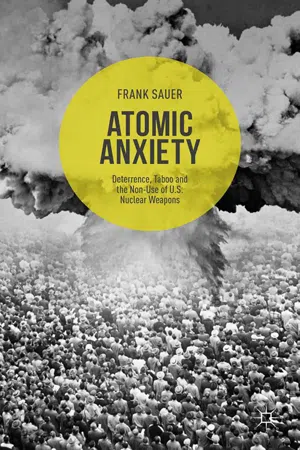
With the concept of 'Atomic Anxiety', this book offers a novel perspective on one of the most important and longstanding puzzles of international politics: the non-use of U.S. nuclear weapons. By focusing on the fear surrounding nuclear weapons, it explains why nuclear deterrence and the nuclear taboo are working at cross purposes in practice.
Information
1
Introduction
Atomic bombs destroyed Hiroshima and Nagasaki in 1945. ‘Wouldn’t it be an odd thing if these were the only two atomic bombs ever dropped?’, General Carl A. Spaatz (quoted in Life, 1945, p. 25) wondered back then. As it happens, nuclear weapons were never used again. This book is about this oddity.
Looking back at seven decades of nuclear non-use, some might find this not so extraordinary. After all, most of us probably take for granted that nuclear weapons are not to be detonated in war. But even while we may have gotten accustomed to this, questions arise as soon as one takes a step back and recalls history. What about the Cold War, the nuclear arms race? Why did the superpower confrontation never go nuclear? What about other wars such as the one in Vietnam? Why did the U.S. fight a protracted and bloody conventional war there, instead of simply ending things with one or two atomic blows?
The remarkable fact that decision-makers in (warring) nuclear states continuously abstained from using their ‘super weapon’ ever since 1945 becomes even more puzzling when the pace of technical development is factored in. After all, not only did the hydrogen bomb quickly join its atomic predecessor, dwarfing the explosive force of the fission bombs by the awe-inspiring power of thermonuclear fusion. Smaller, tactical nuclear weapons were also soon at hand, tailored to suit the military’s every need in the decades laden with conflict after 1945. Pausing and thinking for a moment about the non-use of nuclear weapons against this backdrop, one cannot help but wonder.
Hence I pose the following question: what can explain the persistent non-use of nuclear weapons after 1945, and how can we better understand (the causes of) this nuclear abstinence? This two-part question will be pursued with the help of three specific queries, namely: What explains nuclear non-use and how do the existing explanatory concepts approach the phenomenon? Do the factors invoked by existing explanations as causes of nuclear non-use interact in decision-making practice, and if so, how? Lastly, are there other facets of nuclear abstinence that have so far not been analyzed systematically?
Regarding the first half of my two-part question, the bit asking for what can explain nuclear non-use, there seems to be a simple answer: luck. Robert McNamara and James G. Blight, for instance, reached the following conclusion in their assessment of the Cuban Missile Crisis, arguably one of the closest calls in regards to nuclear war erupting: ‘[W]hile the missile crisis was well-managed, under very trying circumstances, the escape from it without a major war, even a nuclear war, seems nothing short of miraculous. In the end we lucked out’ (McNamara/Blight, 2002, p. 2).
Luck may have been more involved with humankind’s survival of the nuclear age so far than we would like to admit to ourselves. But this is not only an unsettling notion. It is also hard to believe. A lucky streak persisting for seven decades seems extremely unlikely. And as a matter of fact, there are two more plausible explanations for nuclear non-use.
The first and most widely known explanation is nuclear deterrence. In this line of thought, the mutual threat of retaliation with equal means kept – and keeps – nuclear weapons from being used by making the costs involved unbearably high (see e.g. Morgan, 2003; Freedman, 2004). Enter Nina Tannenwald. She argues that the deterrence account is ‘inadequate’, ‘insufficient’ and ‘incomplete’ (Tannenwald, 2007, pp. 2, 30–38, 55, 71), which is why she advocates ‘a normative element [to] be taken into account’ (Tannenwald, 1999, p. 433) – a prohibitive norm against nuclear use for which she coined the term nuclear taboo. Nuclear deterrence and the nuclear taboo provide two well-developed explanations for why nuclear weapons have not been used since Hiroshima and Nagasaki (and an additional perspective, the tradition of non-use, will be discussed later). That seems plenty. So why even bother with nuclear non-use again?
I argue that the current state of research is not entirely satisfying. Both explanations share similar blind spots resulting from the way they approach the phenomenon; hence, serious difficulties and question marks remain. Also, as I will argue as this study dives more deeply into the issue of nuclear non-use, there are important facets of the phenomenon that literature in the field has not yet systematically accounted for – most importantly, the importance of human emotion. In that sense, this book not only offers an opportunity to rethink the non-use of nuclear weapons and what we already know, but it also demonstrates that there remain new things to learn.
Scope and plan of the book
This study contributes to the body of literature in International Relations (IR) devoted to studying nuclear non-use. The idea is to take the comparably old and extensively researched question about the origins of nuclear non-use and expose it to a change of perspective. My overall goal is to both deepen and widen our knowledge about the phenomenon. In addition to that, the book also aims at a contribution to the field of methodologically reflected and methodically sophisticated qualitative studies in IR. Lastly, the results in this study hold some implications worth considering for policymaking.
Furthermore, I need to explain why this study focuses on the United States of America in studying nuclear abstinence. This is not only because the U.S. is the only country to ever actually use nuclear weapons. More importantly, the existing explanations of non-use draw on this example. The special provenance of deterrence as both theory and strategy makes it virtually synonymous with significant parts of U.S. foreign policy after World War II. Furthermore, to make its contending case, the taboo literature also deals with that same era. Since my study heavily draws on and at the same time dissociates itself from both these two lines of thought, a focus on the U.S. is required. In addition to that, only in the U.S. case is some of the empirical source material available on which my analysis relies.
Another characteristic of this book needs to be clarified upfront. Rather than presenting a theoretical framework, bringing it in touch with empirical sources in some methodical way and evaluating the results in conclusion (typically as an argument for the chosen framework’s merits), this study strings together a comparably long chain of arguments. It touches upon different theoretical and methodological frameworks in Chapter 2 and 3, and it alternates between empirical analysis and conceptual reflections in Chapter 4. To unpack this argumentative concatenation process and provide the reader with a clearer guideline for what to expect, it helps to think of this study as progressing in three steps.
As a first step, Chapter 2 – Explaining nuclear non-use – reflects on the current state of the art. This brief review of existing literature will critically examine the two existing mainstream lines of thought that try to explain the long-standing abstinence from using nuclear weapons. I will deal with nuclear deterrence as both a theory and a strategy in the first half of Chapter 2. Then I turn to the nuclear taboo as well as the differences and similarities of the nuclear taboo and the tradition of non-use in the second half. Critically recapitulating the existing research not only yields important insights to hold on to and work with but also serves to identify the problems that I take as the starting point for developing my alternative perspective in the subsequent chapter.
Chapter 3 – Understanding nuclear non-use – fleshes out in a second step what I consider to be the genesis of the current unsatisfactory state of research. It does so by reviewing the existing explanations a second time, this time focusing solely on their theoretical background and methodology. This serves to show that the attempt to ‘explain’ nuclear non-use directs the focus to ‘effects’ and ‘causes’, but with nothing palpable caused in a non-event, existing explanations admittedly find themselves in a bit of a pickle. In answer to that, they amass empirical cases as plausible proxies to try to uphold the logic of causal chains. In taking this approach, however, hitherto research on nuclear non-use developed blind spots. Specifically, it lost track of how the non-event of interest actually ‘comes about’ in practice. This is the major research gap I address by ‘understanding nuclear non-use’.
To that end, I present a novel, fine-grained way of inquiring into the phenomenon. It acknowledges contingency and focuses squarely on agency and choice, and is thus tailored to better suit the peculiar characteristics of the subject matter, a non-event. Because this study offers some criticism of existing explanations, it bears repeating that this alternative approach would be impossible without the intimate knowledge about them. In other words, my goal is not to dismiss existing knowledge, to wipe the slate clean and start over, but rather to retain and utilize key elements of it. So despite the blind spots of existing explanations, I propose a way to preserve and integrate the knowledge they hold, while at the same time inspecting the phenomenon from a different perspective to open up new avenues of insight.
Chapter 3 introduces the methodology of this alternative approach, the gist of which I sum up as ‘making sense of abstinence’. It is characterized by two features: one, it puts heavy emphasis on a reconstructive way of inquiry without sacrificing the possibility of using, in a subsumptive manner, concepts that carry over from existing knowledge. Two, it relies on a software-aided qualitative analysis and proceeds in a comparably open research process.
This methodology yields two distinct advantages. One, while it allows me to hold on to established concepts derived from existing literature about the causes of nuclear non-use and to deploy these for my empirical research, I remain unencumbered by the need to either verify or falsify them in their general explanatory fidelity. This permits a comparably more open-minded analysis of how these concepts present themselves in the empirical material. In other words, existing literature relies on preformed hypotheses such as ‘deterrence causes non-use’ to explain nuclear non-use by subduing and sifting empirical material under this hypothesis. The goal is to find and present the necessary ‘evidence’ for the supposed existence of a specific cause-and-effect-pattern to be ‘rigorously tested’, ‘verified’ and ‘proven’. I deliberately leave aside this research logic that relies on causality as well as the notion of conducting empirical work in a purely subsumptive fashion. Instead, by putting a much stronger emphasis on reconstructing insights from within empirical sources, I probe the meaning nuclear non-use holds for decision-makers, aiming at a more detailed picture of the beliefs and convictions involved. This yields the desired understanding of the process in which the non-event comes about, including crucial insights into how the key drivers emphasized by existing explanations – the causes of non-use – actually play out and interact in decision-making praxis. In this way, I am able to shine some light into the aforementioned blind spots. Consequently, my research not only profits from existing explanatory research by utilizing it but it might also cross-fertilize and inform its further development in turn. So holding on to the existing knowledge about nuclear non-use and combining key concepts derived from existing top-down approaches with the bottom-up perspective of my reconstructive approach is crucial for arriving at this study’s first main contribution, a better understanding of how the causes of non-use established in literature play out in practice and from a decision-makers’ perspective.
Two, an open research process facilitates insights into the phenomenon that go over and above the already existing conceptual notions about nuclear non-use. After all, reducing the fixation on pre-formed notions and beaten paths means that the empirical material can be viewed in a less ‘filtered’ manner. Hence there is a greater chance of recognizing so far overlooked or underexposed aspects of nuclear non-use. Conducting such an exploratory analysis yields the second main contribution this study offers, namely a better understanding of nuclear abstinence by way of focusing on a largely neglected facet of the phenomenon: human emotion.
Chapter 3, after having set up the methodology of my approach with all its assumptions, also explicates the research method applied. These passages introduce and explain the mix of deductive and inductive software-aided coding that allows for coupling subsumptive concepts with a reconstructive inquiry as well as for providing an overall systematic and transparent qualitative analysis of the source material.
As a third and final step, Chapter 4 – Revisiting nuclear non-use – presents the results of my empirical analysis. By inquiring into empirical sources as well as by intermittently reflecting further at the conceptual level, it sheds some new light on the non-use of U.S. nuclear weapons. After having discussed the source selection criteria for the first empirical analysis, Chapter 4 presents the analytic narrative resulting from an in-depth empirical inquiry conducted at the micro level of presidential decision-making practices during the crises in Berlin and Cuba. Revisiting the phenomenon of nuclear non-use with the pertinent existing knowledge in mind, but from a new methodological angle, this empirical section of Chapter 4 produces some first results regarding how nuclear abstinence comes about in practice.
First, analyzing nuclear deterrence and the nuclear taboo, and their role as beliefs that rule action in practice, my analysis demonstrates that the requirements of a deterrence posture and the moral obligations associated with the nuclear taboo work at cross-purposes. This is my study’s first main argument. Second, a specific conjecture about a so far understudied facet of nuclear abstinence is arrived at: the importance of fear. This trail is followed, at the conceptual level, by first reviewing the existing non-use literature yet another time, but also by expanding the horizon via the inclusion of literature from historic, cultural and critical security studies, as well as the recently burgeoning body of ‘emotional turn’ literature in IR.
Against this background, I propose that the corporeal-emotional embeddedness of nuclear decision-making must not be ignored, and I develop the concept of ‘atomic anxiety’ (while borrowing the term from Paul Boyer, 1994 [1985], p. 21). I show that while atomic anxiety as a sociocultural state has subliminally been present in reflections on nuclear non-use, its impact remained conceptually underdeveloped and empirically understudied until now.
Chapter 4 thus progresses by fleshing out atomic anxiety conceptually and analyzing its role regarding nuclear abstinence in a subsequent, second empirical inquiry. This inquiry puts even more emphasis on analyzing the subject matter reconstructively, that is, on generating substantial insights from within source material.
As a result of that inquiry, I develop an argument about how we can better understand (the causes of) nuclear abstinence by studying the phenomenon through the lens of atomic anxiety. I argue that two distinct types of reactions for coping with atomic anxiety can be discerned: one is immediately transformative and revolutionary in character, and the other is step-by-step transitory and pragmatic. By acknowledging these dissimilar reactions to atomic anxiety, we arrive at an even more in-depth understanding of the nuclear taboo’s impairing interference that decision-makers experience while practicing deterrence as a strategy to ensure nuclear non-use. This is this study’s second main argument.
Chapter 4 ends by my critically reflecting on the empirically generated insights, pondering their scope and considering possible alternative perspectives. In that regard, I argue that my work on atomic anxiety contributes a firm conceptual proposition, an initial charting of the empirical terrain and a first offer on how to think about nuclear abstinence along the lines of the novel concept of atomic anxiety. But further research is needed.
Chapter 5 summarizes this study’s overall results and discusses the conclusions and implications to take away from this book. First, this is done in academic terms and with regard to possible avenues of further research, especially regarding the possibilities of additional cross-fertilization between explanatory and understanding approaches. Second, the conclusion considers nuclear policy-making...
Table of contents
- Cover
- Title
- 1 Introduction
- 2 Explaining Nuclear Non-Use
- 3 Understanding Nuclear Non-Use
- 4 Revisiting Nuclear Non-Use
- 5 Conclusion
- Notes
- References
- Index
Trusted by 375,005 students
Access to over 1.5 million titles for a fair monthly price.
Study more efficiently using our study tools.
Frequently asked questions
Yes, you can cancel anytime from the Subscription tab in your account settings on the Perlego website. Your subscription will stay active until the end of your current billing period. Learn how to cancel your subscription
No, books cannot be downloaded as external files, such as PDFs, for use outside of Perlego. However, you can download books within the Perlego app for offline reading on mobile or tablet. Learn how to download books offline
Perlego offers two plans: Essential and Complete
- Essential is ideal for learners and professionals who enjoy exploring a wide range of subjects. Access the Essential Library with 800,000+ trusted titles and best-sellers across business, personal growth, and the humanities. Includes unlimited reading time and Standard Read Aloud voice.
- Complete: Perfect for advanced learners and researchers needing full, unrestricted access. Unlock 1.5M+ books across hundreds of subjects, including academic and specialized titles. The Complete Plan also includes advanced features like Premium Read Aloud and Research Assistant.
We are an online textbook subscription service, where you can get access to an entire online library for less than the price of a single book per month. With over 1.5 million books across 990+ topics, we’ve got you covered! Learn about our mission
Look out for the read-aloud symbol on your next book to see if you can listen to it. The read-aloud tool reads text aloud for you, highlighting the text as it is being read. You can pause it, speed it up and slow it down. Learn more about Read Aloud
Yes! You can use the Perlego app on both iOS and Android devices to read anytime, anywhere — even offline. Perfect for commutes or when you’re on the go.
Please note we cannot support devices running on iOS 13 and Android 7 or earlier. Learn more about using the app
Please note we cannot support devices running on iOS 13 and Android 7 or earlier. Learn more about using the app
Yes, you can access Atomic Anxiety by Frank Sauer in PDF and/or ePUB format, as well as other popular books in Politics & International Relations & International Relations. We have over 1.5 million books available in our catalogue for you to explore.