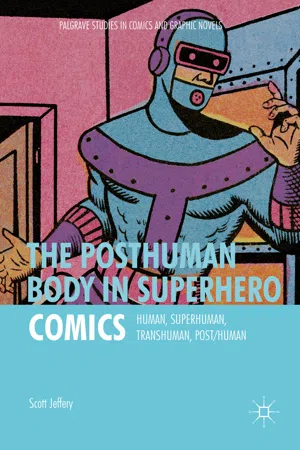
This book examines the concepts of Post/Humanism and Transhumanism as depicted in superhero comics. Recent decades have seen mainstream audiences embrace the comic book Superhuman. Meanwhile there has been increasing concern surrounding human enhancement technologies, with the techno-scientific movement of Transhumanism arguing that it is time humans took active control of their evolution. Utilising Deleuze and Guattari's notion of the rhizome as a non-hierarchical system of knowledge to conceptualize the superhero narrative in terms of its political, social and aesthetic relations to the history of human technological enhancement, this book draws upon a diverse range of texts to explore the way in which the posthuman has been represented in superhero comics, while simultaneously highlighting its shared historical development with Post/Humanist critical theory and the material techno-scientific practices of Transhumanism.
eBook - ePub
The Posthuman Body in Superhero Comics
Human, Superhuman, Transhuman, Post/Human
- English
- ePUB (mobile friendly)
- Available on iOS & Android
eBook - ePub
About this book
Information
Bibliography
Alaniz, J. (2004). Supercrip: Disability and the Marvel Silver Age Superhero. International Journal of Comic Art, 6 (2), 304–324.
Anderson, W. T. (1990). Reality isn’t what it used to be . New York: Harper Collins.
Andrae, T. (1980). From Menace to Messiah: The history and historicity of superman. In D. Lazere (Ed.) (1987), American media and mass culture (pp. 124–138). Berkeley: University of California Press.
Ascott, R. (2006). Engineering nature: Art and consciousness in the post-biological era . Bristol: Intellect Books.
Badmington, N. (2000). Posthumanism . New York: Palgrave.
Badmington, N. (2003). Theorizing posthumanism. Cultural Critique, 53 , 10–27.
Badmington, N. (2004). Mapping posthumanism. Environment and Planning, 36 (8), 1341–1363.
Baghurst, T., Hollander, D. B., Nardella, B., & Haff, G. G. (2006). Change in sociocultural ideal male physique: An examination of past and present action figures. Body Image, 3 (1), 87–91.
Bainbridge, W. S. (2005). The transhuman heresy. Journal of Evolution and Technology, 14 (2), 1–10.
Bainbridge, J. (2009). ‘Worlds within worlds’: The role of the superheroes in the Marvel and DC Universes. In A. Ndalianis (Ed.), The contemporary comic book superhero (pp. 64–85). New York: Routledge.
Barker, M. (1984). A haunt of fears: The strange history of the British horror comics campaign . Jackson: University Press of Mississippi.
Barker, M. (1989). Comics: Ideology, power and the critics . Manchester: Manchester University Press.
Barker, M. (1993). Seeing how far you can see: On being a fan of 2000AD. In D. Buckingham (Ed.), Reading audiences: Young people and the media (pp. 159–183). Manchester: Manchester University Press.
Barker, M. (2003). Assessing the ‘quality’ in qualitative research: The case of text-audience relations. European Journal of Communications, 18 (3), 315–335.
Barker, M. (2005). The Lord of the Rings and ‘identification’: A critical encounter. European Journal of Communication, 20 (3), 353–378.
Barker, M. (2010). News, reviews, clues, interviews and other ancillary materials. Scope: An Online Journal of Film and TV Studies. [Online] Available from: http://www.nottingham.ac.uk/cfm/research/scope.aspx?id=2 . Accessed 13 Nov 2013.
Barker, M., & Brooks, K. (1999). Knowing audiences: Judge Dredd, it’s friends, fans and foes . Luton: University of Luton Press.
Bates, B. R. (2005). Public culture and public understanding of genetics: A focus group study. Public Understanding of Science, 14 (1), 47–65.
Bauman, Z. (1989). Modernity and the Holocaust . Ithaca: Cornell University Press.
Bavlnka, T. (2011). Superheroes and shamanism: Magic and participation in the comics of Grant Morrison . Ohio: University of Ohio.
Beaty, B. (2004). Review essay: Assessing contemporary comics scholarship. Canadian Journal of Communication, 29(3). [Online] Available from: http://www.cjc-online.ca/index.php/journal/article/viewArticle/1485/1603 . Accessed 20 Nov 2013.
Beaty, B. (2005). Fredric Wertham and the critique of mass culture . Jackson: University Press of Mississippi.
Behrenshausen, B. G. (2012, November). The active audience, again: Player-centric game studies and the problem of binarism. New Media & Society . [Online] Available from: http://nms.sagepub.com/content/early/2012/11/22/1461444812462843 . Accessed 7 Nov 2013.
Beiras, A., Lodetti, A., Cabral, A. G., Toneli, M. J. F., & Raimundo, P. (2007). Gênero e super-heróis: o traçado do corpo masculino pela norma. Psicol Soc, 19 (3), 62–67.
Bendis, B. M., Ponsor, J., & Guice, J. (2009). Ultimate origins . New York: Marvel.
Berloznik, R., Casert, R., Deboelpaep, R., van Est, R., Enzing, C., van Lieshout, M., & Versleijen, A. (2006). Technology assessment on converging technologies . European Parliament Report.
Biklen, D. (1987). The culture of policy: Disability images and their analogues in public policy. Policy Studies Journal, 15 (3), 515–535.
Biskind, P. (1998). Easy riders, raging bulls . London: Bloomsbury.
Blumberg, A. (2003). The night Gwen Stacy died: The end of innocence and the birth of the Bronze Age. Reconstruction: Studies in Contemporary Culture, 3(4). [Online] Available from: http://reconstruction.eserver.org/034/blumberg.htm . Accessed 20 Dec 2013.
Bordwell, D. (2008, August 16). Superheroes for sale. Observations on Film Art . [Online] Available from: http://www.davidbordwell.net/blog/2008/08/16/superheroes-for-sale/ . Accessed 14 Feb 2016.
Bostrom, N. (2001). What is transhumanism? [Online] Available from: http://www.nickbostrom.com/old/transhumanism.html . Accessed 20 Dec 2013.
Bostrom, N. (2003). The transhumanist FAQ, v. 2.1. [Online] Available from: www.transhumanism.org/resources/FAQv21.pdf . Accessed 20 Dec 2013.
Bostrom, N. (2005). A history of transhumanist thought. Journal of Evolution and Technology, 14 (1), 1–41.
Bostrom, N., & Sandberg, A. (2009). Cognitive enhancement: Methods, ethics, regulatory challenges. Science and Engineering Ethics, 15 (3), 311–341.
Bostrom, N., & Sandberg, A. (2011). The future of human identity: Report commissione...
Table of contents
- Cover
- Frontmatter
- Introduction: Human, Superhuman, Transhuman, Post/Human
- What Is Posthumanism?
- The Rhizome of Comic Book Culture
- The Perfect Body
- The Cosmic Body
- The Military-Industrial Body
- Animal Bodies and Artificial Bodies
- Reading the Superhuman
- Readers on Transhumanism and Post/Humanism
- Towards a Theory of Reader-Text Assemblages
- The Posthuman Body in Superhero Comics
- Backmatter
Trusted by 375,005 students
Access to over 1.5 million titles for a fair monthly price.
Study more efficiently using our study tools.
Frequently asked questions
Yes, you can cancel anytime from the Subscription tab in your account settings on the Perlego website. Your subscription will stay active until the end of your current billing period. Learn how to cancel your subscription
No, books cannot be downloaded as external files, such as PDFs, for use outside of Perlego. However, you can download books within the Perlego app for offline reading on mobile or tablet. Learn how to download books offline
Perlego offers two plans: Essential and Complete
- Essential is ideal for learners and professionals who enjoy exploring a wide range of subjects. Access the Essential Library with 800,000+ trusted titles and best-sellers across business, personal growth, and the humanities. Includes unlimited reading time and Standard Read Aloud voice.
- Complete: Perfect for advanced learners and researchers needing full, unrestricted access. Unlock 1.5M+ books across hundreds of subjects, including academic and specialized titles. The Complete Plan also includes advanced features like Premium Read Aloud and Research Assistant.
We are an online textbook subscription service, where you can get access to an entire online library for less than the price of a single book per month. With over 1.5 million books across 990+ topics, we’ve got you covered! Learn about our mission
Look out for the read-aloud symbol on your next book to see if you can listen to it. The read-aloud tool reads text aloud for you, highlighting the text as it is being read. You can pause it, speed it up and slow it down. Learn more about Read Aloud
Yes! You can use the Perlego app on both iOS and Android devices to read anytime, anywhere — even offline. Perfect for commutes or when you’re on the go.
Please note we cannot support devices running on iOS 13 and Android 7 or earlier. Learn more about using the app
Please note we cannot support devices running on iOS 13 and Android 7 or earlier. Learn more about using the app
Yes, you can access The Posthuman Body in Superhero Comics by Scott Jeffery in PDF and/or ePUB format, as well as other popular books in Social Sciences & Modern Literary Criticism. We have over 1.5 million books available in our catalogue for you to explore.