This book sheds light on North Korean migrants' Christian encounters and conversions throughout the process of migration and settlement. Focusing on churches as primary contact zones, it highlights the ways in which the migrants and their evangelical counterparts both draw on and contest each others' envisioning of a reunified Christianized Korea.
Introduction: North Korean Migrants and Contact Zones
This book examines the life trajectories of North Korean migrants as they interact with South Korean transnational missionary networks along the Sino–North Korean border in China and in South Korea. I investigate the meanings and processes of individual migrants’ conversion to Christianity through interactional frameworks, namely, those through which North Korean migrants interact with South Korean and Korean-Chinese
missionaries, and with state powers, and with God. Churches, including related institutions, communities, and networks, serve as cultural “contact zones” (Pratt 1992) for the human–divine interactions upon which this book is based. Since the mid-1990s, when a famine took approximately one million North Korean lives, escalating numbers of people have crossed the Tumen river in search of food resources, job opportunities, and refuge, risking their lives to make their way to South Korea in hope of a “better life” (Suh 2002; Yoon 2003; Chung 2008). Statistics show that a startling 80–90 percent of North Korean migrants identified themselves as Christian when they arrived in South Korea and around 70 percent continued to rely on church services after they arrived (Jeon 2007). The church then emerges as a primary contact zone in which North Korean migrants are incorporated into the South Korean Christian system of values.
South Korean missionaries and Korean-Chinese missionaries initiated and directly or indirectly operate the underground railroads that secure the migrants’ physical and politico-ideological movement, namely, “Christian passage,” as I call it. North Korean migrants’ conversion entails both personal and national salvation in the South Korean evangelical vision of a Christianized reunified nation and conversion narratives by migrants dramatize the stark differences between the two Koreas. More precisely, in adopting a historical and anthropological perspective, this study stresses that while “defectors” from the North were once celebrated as national heroes and heroines by past authoritarian regimes with an anticommunist stance (1960s–1980s), today it is only within the space of civil organizations—in particular, the Evangelical Protestant Church, and the private media—and in the logic of human rights (which is equivalent to religious conversion) that they are empowered to be born again as evangelists, missionaries, human rights activists, model “free” citizens, and so on in South Korea and transnational contexts as well. Indeed, this book primarily focuses on the church that relies on them in its attempt to revive its own hegemonic position in South Korean politics and to help envision an anticommunist-Christianized unified Korea. I argue that North Korean migrants’ conversion to Christianity is a cultural project with political and ideological hues that reveal the key characteristics of South Korean anticommunist evangelicalism.
This cultural project and my resulting ethnography have come into being in an era in which inter-Korean relations have fluctuated as radically as the world’s geopolitical climate. Once a normal sentiment, South Korean anticommunism briefly seemed to be a bygone ideology of former authoritarian regimes (Kim S. 2006; Cumings 2007). The historical summit meeting between South Korean President Kim Dae-jung and North Korean Leader Kim Jong-il in 2000, increasing economic and cultural exchanges between North and South Korea, and growing humanitarian aid for North Korea from the South made national reconciliation seem realistic for a time. In recent years, however, anticommunism has been on the rise. US–North Korea military tensions and the global economic recession, not to mention China’s influence on geopolitics, have facilitated South Korean evangelical churches’ role as a holding ground at the center of South Korea’s right-wing movement (Ryu 2009). Indeed, right-wing churches have played a crucial role in the shift of power to more conservative administrations led by Lee Myung-bak, an elder of the Somang Presbyterian church (2008–2013), and current President Park Keun-hye, the eldest daughter of former militant dictator, Park Chung-hee (1963–1979).
Due to this rightward drift, economic and cultural exchanges between North and South Korea have nearly stopped. Meanwhile, North Korea’s second ruler, Kim Jong-il, transferred power to his youngest son, Kim Jong-un, a hereditary power transfer unheard of in modern nation-states. Contrary to suspicions that assumed the inevitability of internal power conflicts and chaos, this “young General” Kim seems to have stabilized his absolute power. During this power transfer period, North Korea launched long and short range missiles, proceeded with nuclear tests, and exchanged fire several times with the South.1 Interestingly, my North Korean migrant interlocutors bear witness to North Korea’s increasing economic reliance on China while its relationship with the United States and South Korea deteriorates. In this historical predicament, the number of North Korean migrants arriving in South Korea by way of China continued to increase in the 2000s, averaging 2,000 every year, and dropped to about 1,500 after 2012, when Kim Jong-un took power and the Sino–North Korean border security on both sides increased. No longer expected to serve anticommunist propaganda maneuvers for the South Korean state, North Korean migrants are instead expected to assimilate into South Korea’s competitive education system, job market, and social structure. The government’s resettlement package, including three months of mandatory “training” at Hanawon, free housing, full healthcare, and incentives for vocational training and higher education, reflects the depoliticization of North Korean migrant issues, since the first civilian President Kim Young-sam took office (1993–1998).
South Korean evangelical churches are second only to the state in providing various services to facilitate migrants’ integration into the South Korean capitalist system. In addition, it is significant to note that the churches project ontological overtones with politico-theological hues on the migrants. Hunger, human rights abuses, personal loss and separation, and other forms of suffering are interpreted as signs that God’s words can be realized on earth and by them. That is, North Korean migrants become “the chosen” in the Christian community. In the same spirit, however, they also learn to become victim-survivors of the socialist dictatorship and to use the rhetoric of human rights abuse against the North, namely, re-politicizing their subjectivities in the space of the church and in the logic of “universal” freedom and humanitarianism. This book, therefore, pays particular attention to such evangelical efforts as a cultural force that turns North Korean Christians into agents of national (i.e., North and South) evangelization. I approach the Cold War legacy and the politics of global Christianity through the personal trajectories of North Korean migrants. In focusing on the re-subjectification of individual migrants, I am able to demonstrate how the process of Christian conversion is ambiguous and contested.
Much literature, published mostly in Korean, addresses the problems of both governmental and civil support systems for North Korean migrants and the ways in which migrants struggle to adjust to their new society (e.g., Jeon 2000, 2007; Suh 2002; Yoon 2002; Chung 2004, 2008; Kim Y. 2004; Choo 2006; Chung et al. 2006; Kang 2006; Lankov 2006; Yoon 2007; Kim Y. 2009). In this work, sociologists and anthropologists have found that the difficulties migrants face in adjusting to the South stem from a larger problem—South Korean ethnocentric nationalism. For instance, North Korean migrants are “ethnicized” (Choo 2006) as second class citizens, as was the case between West and East Germans in post-unification Germany; migrants are socially and biologically “stigmatized” (Chung 2000) and viewed as “cultural inferiors” (Kim Y. 2009); and migrants are often discriminated against in schools and on the job market in the South. It is also critical to realize that interactions between South and North Koreans are more dynamic than those typically portrayed in the literature, which posits North Koreans as victims. Kim Yoon-young’s thesis (2009) examines the ways in which migrants either strategically conceal or expose their North Korean identities to receive benefits or to justify the receipt of such benefits. Migrants’ Christian experiences and reliance on church services remain significant throughout their life. However, they tend to consider Christianity or religion as merely incidental or side issues. When the church is mentioned, it is usually in instrumental terms, as in what services the church does or should provide.
This book regards the church as the primary intra-ethnic “contact zone,” areas which Mary Louise Pratt defines as “social spaces where disparate cultures meet, clash, and grapple with each other, often in highly asymmetrical relations of domination and subordination” (1992: 4). I argue that religion serves as a lens through which we can better understand how complex ideological, political, and cultural tensions (e.g., nationalism, imperialism, freedom, human rights) meet in the reconfiguration of migrants’ identities. More precisely, for North Korean conversion as a project, this study asserts that the evangelical church renders North Korean migrants as “freed” from the communist regime, and “revives” their religiosity by replacing Kimilsung-ism (the ideology of Kim Il-sung, or Juche North Korean national ruling philosophy) with Christianity.
In addition to the concept of contact zone, I employ Pierre Bourdieu’s notion of “market” and Dorothy Holland et al.’s (1998) “figured world” to better contextualize the conversion project. To avoid any unnecessary confusion, I want to distinguish my use of “market” from religious market theory, since the latter refers to the competition among different religions and denominations, and a person’s rational choice of religion as commodity (see Iannaccone 1991). Instead, I use “market” as a metaphor for what Bourdieu calls the “field of power (politics)”2 in an attempt to better understand competing investments among increasingly diversified actors including faith-based organizations, civil societies, and state governments, all of which are discursively bipolarized in ideological topography in envisioning a national future—a reunified nation. In light of this “imagined” reunification, I use “figured world” (Holland et al. 1998) to discuss migrants’ identity reconfiguration in relation to this imagined reunified nation. A “figured world” is defined as “a socially and culturally constructed realm of interpretation in which particular characters and actors are recognized, significance is assigned to certain acts, and particular outcomes are valued over others” (Holland et al. 1998: 52). As I elaborate in the following chapters, it is in the logic of conversion that migrant converts are projected to be “the chosen”—to save the North and revive Korean Christianity “as if” they are already in a reunified nation.
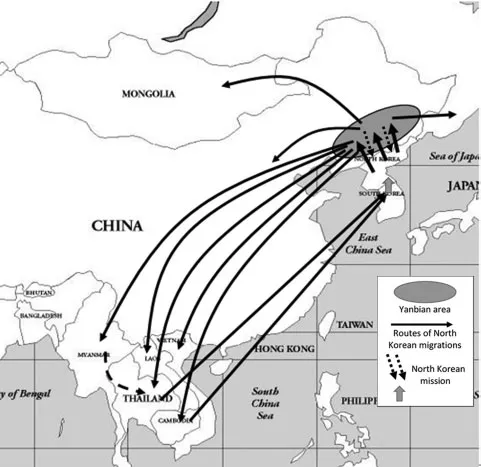
Accordingly, North Korean conversion is dynamic and saturated in meaning in the context of the fashioning of a new national subject. My ethnographic data highlights the veritable contest over what constitutes “true” or authentic Christianity and what Korean-ness should look like in a transforming East Asia. This chapter, then, continues by reviewing the main theoretical concerns in the discussion of conversion as a cultural passage and project; and discusses North and South Korean subjects, arguing that these two cultural “dispositions,” in the Bourdieuian sense, have been constructed in a logic of mirrored distinction (i.e., from one another). The main body of the chapter discusses the ways in which North Korean-ness has been shaped by state policies over time, aiming to provide necessary background for further understanding the meaning of the church’s interventions in these matters. Finally, I introduce and summarize the remaining chapters (Figures 1.1 and 1.2).
Conversion passage and project
North Korean conversion to Christianity appears to be a cultural passage and project in which each individual transformation is closely linked to broader religious implications (see cf. Nock 1933; Hefner 1993; Austin-Broos 2003). This passage reflects more than a radical shift in consciousness, with each individual completely denying his or her past, but also a series of more complex tensions and changes that accompany the migrants’ physical relocation and internal transformation, from following Juche or Kimilsung-ism to becoming one of God’s warriors for the Christianization of the Korean (unified) nation. Conversion intertwined with capitalist citizen making is only comprehensible if one considers the ways in which churches engineer and mediate the conversion process.
Figure 1.1 The Tumen river flowing between North Korea and China
Source: Courtesy of the Author.
In most societies, it is not surprising to see previously unreligious people take on a new faith or convert from one religion to another. Robert Hefner illuminates conversion as being “influenced by a larger interplay of identity, politics, and morality” (1993: 4). Throughout this book, I shall take into account the structural conditions that push and pull migrants into the terrain of religion. My ethnography asserts that their conversion should not be considered as merely a matter of a liberal individual’s ontological transformation without serious consideration of both institutional interventions (i.e., missionary networks) and particular geopolitical conditions (i.e., the Cold War, famine, and globalization).
When Alexander Solzhenitsyn was finally able to make his acceptance speech for the Nobel Prize in literature in 1974, he depicted himself as a writer “from a land without liberty.”3 At the peak of the Cold War period, refugees or exiles from Soviet Russia, East Germany, Vietnam, and Cuba tended to appreciate “freedom” in their new liberal host societies. In comparison to these earlier cases of anticommunist dissidents, the Christian conversion of recent North Korean migrants from “the world’s most closed socialist country” rings odd or even ironic. Why, people ask, would former socialist subjects “choose” the constraints of “conservative” Christianity in the midst of their newfound freedoms? Longstanding western models of modernity most often posit an individual’s submission and devotion to religion as something far from modern and liberal life/society and closer to either “traditional” or non-western societies (van der Veer 1996).
Figure 1.2 A map of underground railways of North Korean migration
Source: Courtesy of Cartographic Research Laboratory, University of Alabama, and modified by the Author.
This ethnography of North Korean conversion therefore rests on a large number of anthropological publications on modernity and religion, and considers it in the Cold War context. First, the relationship between nationalism and religion in concert with the state–church relationship has been discussed at length in anthropological literature. Despite a logical tension between bounded nationalism and transcendent religion, the two mutually rely on each other in the practice of building both a modern nation-state and the Kingdom of God in different ways in different places (van der Veer 1996; van der Veer & Lehmann 1999; Dirks 2001). Second, and similarly, the secularization theory put forth in discussing the relationship between modernity and religion has also been severely criticized (Hefner 1993; Casanova 1994; Keane 2007). Secular modernity in socialism, however, has long been considered as irreconcilable with and antagonistic toward religion. The resurgence of religion after socialism has thus drawn scholarly attention to Christianity, with regard to how Christianity becomes a beacon of democracy, freedom, human rights, and thus universal “truth” (see Rogers 2005; Hann et al. 2006; Wanner 2007; Steinberg & Wanner 2008; Yang 2008).
It is important to study conversion as a joint process and product of the aspirations of individuals and Christian institutions (i.e., churches and missionaries). The history of Christianity is full of tales of individual conversion through either God’s calling or the convert’s “free will.” Without a consideration of power relations, however, this liberal notion of conversion is inevitably suspicious. Scholars of Christian conversion thus consider the particularities of the colonial and post-colonial context, in which Christianity itself has been perceived as a barometer of civilization and modernization in the face of western expansion (Comaroff & Comaroff 1991, 2003; Asad 1993; Burdick 1993; Appadurai 1996; Pels 1997, 1999; Martin 2002; Meyer & Pels 2003; Ong 2003; Orta 2004).
Korean Christianity is no longer a localized foreign religion. After the United States, South Korea is the largest missionary sending country (see Chapter 2), however, many questions remain unexplored regarding Korean Christianity in the global context. In its examination of the Christian encounters of North Korean migrants in the context of the transnational expansion of South Korean churches, this book maintains that conversion is a specific citizen-subject making project in a particular South Korean vision of the Kingdom of God.
My study reveals that North Korean migrants struggle to rationalize such notions as freedom, liberty, love, self, a sense of belonging, sincerity, creationism, and the nation-state, which Christianity introduces and guides them to embrace. Their conversions are not easy and their previous perceptions are not so easily cast aside. For example, some adult migrants seem to have assumed that “free” education, “free” food distribution, and “free” medical care would be guaranteed in the South, similar to what the North Korean socialist system provided before its economy collapsed. Similarly, it is a slow process for them to understand the relationship between South Korean notions of individual/self and society/nation. While South Koreans tend to feel ashamed to depend on public health care, some North Korean migrants value it as a natural state service.4 In this regard, my ethnography observes the Freedom School, a megachurch-run training program for migrants, in which those norms attributed to being a “productive” citizen—such as self-management, self-discipline, and self-development—are emphasized as Protestant ethics as opposed to “dependent” and submissive North Korean dispositions. My ethnography stresses the ways in which South Korean churches conflate the processes of Christian conversion with the fashioning of “inferior” North Koreans into “superior” South Korean people in a “superior” social system.
In church settings and conversion processes, an established South Korean church hierarchy, ideas of spiritual purity, specific ritual forms, and economic status perpetuate the imbalance of North and Sou...
Table of contents
Cover
Title Page
Copyright
Contents
List of Figures and Tables
Preface
Acknowledgments
Note on Romanization and Translation
1. Introduction: North Korean Migrants and Contact Zones
2. Evangelical Nationalism in Divided Korea
3. North Korean Crossing and Christian Encounters
4. Heroes and Citizens: Becoming North Koreans in the South
5. The Freedom School
6. Narrativization of Christian Passage
7. Conclusion: Free to Be
Notes
Bibliography
Index
Trusted by 375,005 students
Access to over 1.5 million titles for a fair monthly price.
Study more efficiently using our study tools.
Frequently asked questions
Yes, you can cancel anytime from the Subscription tab in your account settings on the Perlego website. Your subscription will stay active until the end of your current billing period. Learn how to cancel your subscription
No, books cannot be downloaded as external files, such as PDFs, for use outside of Perlego. However, you can download books within the Perlego app for offline reading on mobile or tablet. Learn how to download books offline
Perlego offers two plans: Essential and Complete
Essential is ideal for learners and professionals who enjoy exploring a wide range of subjects. Access the Essential Library with 800,000+ trusted titles and best-sellers across business, personal growth, and the humanities. Includes unlimited reading time and Standard Read Aloud voice.
Complete: Perfect for advanced learners and researchers needing full, unrestricted access. Unlock 1.5M+ books across hundreds of subjects, including academic and specialized titles. The Complete Plan also includes advanced features like Premium Read Aloud and Research Assistant.
Both plans are available with monthly, semester, or annual billing cycles.
We are an online textbook subscription service, where you can get access to an entire online library for less than the price of a single book per month. With over 1.5 million books across 990+ topics, we’ve got you covered! Learn about our mission
Look out for the read-aloud symbol on your next book to see if you can listen to it. The read-aloud tool reads text aloud for you, highlighting the text as it is being read. You can pause it, speed it up and slow it down. Learn more about Read Aloud
Yes! You can use the Perlego app on both iOS and Android devices to read anytime, anywhere — even offline. Perfect for commutes or when you’re on the go. Please note we cannot support devices running on iOS 13 and Android 7 or earlier. Learn more about using the app
Yes, you can access Migration and Religion in East Asia by Jin-Heon Jung in PDF and/or ePUB format. We have over 1.5 million books available in our catalogue for you to explore.