eBook - ePub
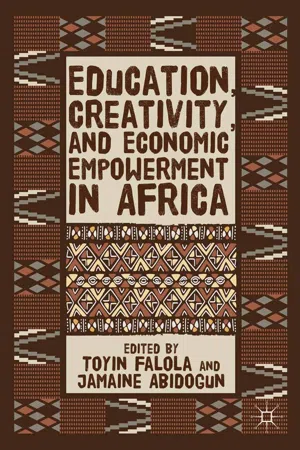
Education, Creativity, and Economic Empowerment in Africa
- English
- ePUB (mobile friendly)
- Available on iOS & Android
eBook - ePub
Education, Creativity, and Economic Empowerment in Africa
About this book
Education and the arts offer multiple, mutually clarifying lenses through which to examine and understand issues of poverty and empowerment. Here, both are combined in a fascinating look at how these two often overlooked elements promote social equality and cultivate personal agency across Africa's diverse political-economic landscapes.
Information
Print ISBN
9781137438492
Subtopic
Education Theory & PracticeSECTION I

EDUCATION AS EMPOWERMENT: ENFORCING RIGHTS AND BUILDING COMMUNITY
CHAPTER 1
ADVANCING THE ANTI-POVERTY CRUSADE THROUGH THE ENFORCEMENT OF THE FUNDAMENTAL RIGHT TO EDUCATION UNDER NIGERIAN LAW
Eteete Michael Adam
INTRODUCTION
Poverty is a ubiquitous concept whose impact on humankind has been felt throughout all civilizations. From generation to generation of humanity, the struggles in society, whether intentionally or unwittingly, were always about poverty and how best to confront this socio-economic “monster.” Poverty is the inability of humans to meet their most basic needs like food, shelter, and clothing. This can also refer to the low quality of the basic necessities of life—for instance, the food affordable by an individual may make for an imbalanced diet that can lead to poor health. Therefore, even when a person or community can afford some basic needs of food, shelter, and clothing, these should be of some minimum standard. This presupposes a distinction between basic needs and felt needs. While the phenomenon of poverty clearly applies to basic needs, felt needs are those not immediately required on the scale of priority. Such needs may include cars, wristwatches, telephones, and other such objects that may even extend to ostentatious goods. The standards of assessment of poverty differ from community to community, and from generation to generation. What may be perceived as poverty in one community or time period may be seen as affluence in another.
Defining poverty in Nigeria has been problematic because the database on individual incomes of citizens is so deficient and, in some cases, completely non-existent. This has made it difficult for researchers to define poverty as an index of socio-economic status.1 However, an operational definition for the purpose of this work is taken outside the realm of the global benchmark of poverty that is defined as US$1.00 per person per day. The translation of one dollar income per day in Nigeria is agonizingly insufficient to meet even the identified basic needs of food, clothing, and shelter. In 2013 a dollar in Nigeria was equivalent to about 160 Naira (N). A pot of food at an average restaurant costs about N 200. Three meals a day would cost not less than N 600, excluding clothing and accommodation. On average, a rural “poor” Nigerian requires about N 1,600 per day, if he is to meet all the basic needs without ostentatious living. At the family level, a family of four will find it difficult to cook a sufficiently large pot of soup with N 1,500. In urban communities the cost differential may be more than double, as food production is essentially concentrated in rural areas. Also, though urban dwellers with comparatively better employment opportunities earn higher incomes, they have to bear the attendant additional demands such as daily transportation costs. Therefore, in Nigeria, the benchmark should be raised from US$1 to US$10 per day. It is in this light that Garner’s definition of poverty is recommended: “The condition of being indigent, or the scarcity of the means of subsistence.”2 Indigence connotes poverty or a being financially unable to pay one’s bills. This is not an uncommon occurrence in the Nigerian socio-economic setting. The poor are so many that it has almost ceased to be an issue for concern. The social fabric of Nigerian society appears to have accepted as a normalcy the presence of beggars on major city streets with little or no governmental action.
Into this darkness, education is throwing light by bringing knowledge where there is none. It is a process that may be structured in phases. Across the history of nation states, growth, development, and prosperity have been directly dependent on the quality of education available to the citizens. Education or the lack of it can positively or negatively influence the economic indices of particular generations or communities. One word that didactically describes education is learning. There is usually a direct correlation between a reorganization or rebirth in learning, and economic or technological improvements. An eloquent example of this is the accelerated and massive revival of economic advances that followed the Renaissance era toward the end of the sixteenth century in Europe.
Education is also defined as a process of teaching, training, and learning, especially in schools or colleges, to improve knowledge and develop skills.3 As simple as this definition appears, it creates the impression that education occurs only when it is acquired in a formal institutional setting. It is the view of this essay that education is far more composite and far reaching than learning acquired in colleges or universities. It represents every form of learning, whether formal or informal. In fact, it may be argued that the greatest of educationists or teachers are actually mothers, fathers, or family members in the home setting. After all, true education, according to Ellen White, means more than following a particular course of study, “It has to do with the whole person and with the whole period of existence possible to human beings. It is the harmonious development of the physical, the mental and the spiritual powers.”4 This portrays a position of all-encompassing learning from the point of birth until death. It covers all facets of human endeavor, including the socio-economic spheres.
EDUCATION AND ITS IMPLICATIONS FOR NATIONAL DEVELOPMENT
Education is a direct panacea to end poverty or in other words to support national development. The fruits of transfer of technology from the West will continue to be illusory as long as the educational capacity of Nigerian citizens are not sufficiently educated to appreciate the imperatives of national development. Mere construction or funding of super-infrastructural amenities by the government or transnational corporations have met with monumental failure as long as such developmental initiatives are not endorsed or supported by the population. In other words, the noticeable degree of apathy of citizens toward the maintenance of donated social amenities can be avoided if the people are first educated and then empowered to develop or build these themselves....
Table of contents
- Cover page
- Half Title page
- Title page
- Copyright
- Contents
- List of Figures
- List of Tables
- Notes on Contributors
- Introduction
- Section I Education as Empowerment: Enforcing Rights and Building Community
- Section II Messages of Empowerment in Languages and Literature
- Section III Art Empowerment for the Economy’s Sake
- Section IV Music: Economic and Political Empowerment Venues
- Index
Trusted by 375,005 students
Access to over 1.5 million titles for a fair monthly price.
Study more efficiently using our study tools.
Frequently asked questions
Yes, you can cancel anytime from the Subscription tab in your account settings on the Perlego website. Your subscription will stay active until the end of your current billing period. Learn how to cancel your subscription
No, books cannot be downloaded as external files, such as PDFs, for use outside of Perlego. However, you can download books within the Perlego app for offline reading on mobile or tablet. Learn how to download books offline
Perlego offers two plans: Essential and Complete
- Essential is ideal for learners and professionals who enjoy exploring a wide range of subjects. Access the Essential Library with 800,000+ trusted titles and best-sellers across business, personal growth, and the humanities. Includes unlimited reading time and Standard Read Aloud voice.
- Complete: Perfect for advanced learners and researchers needing full, unrestricted access. Unlock 1.5M+ books across hundreds of subjects, including academic and specialized titles. The Complete Plan also includes advanced features like Premium Read Aloud and Research Assistant.
We are an online textbook subscription service, where you can get access to an entire online library for less than the price of a single book per month. With over 1.5 million books across 990+ topics, we’ve got you covered! Learn about our mission
Look out for the read-aloud symbol on your next book to see if you can listen to it. The read-aloud tool reads text aloud for you, highlighting the text as it is being read. You can pause it, speed it up and slow it down. Learn more about Read Aloud
Yes! You can use the Perlego app on both iOS and Android devices to read anytime, anywhere — even offline. Perfect for commutes or when you’re on the go.
Please note we cannot support devices running on iOS 13 and Android 7 or earlier. Learn more about using the app
Please note we cannot support devices running on iOS 13 and Android 7 or earlier. Learn more about using the app
Yes, you can access Education, Creativity, and Economic Empowerment in Africa by T. Falola, J. Abidogun, T. Falola,J. Abidogun in PDF and/or ePUB format. We have over 1.5 million books available in our catalogue for you to explore.