- English
- ePUB (mobile friendly)
- Available on iOS & Android
eBook - ePub
About this book
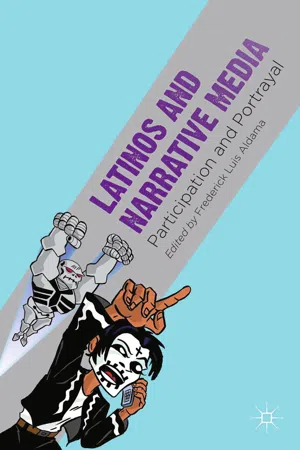
This is the first book to explore the multitude of narrative media forms created by and that feature Latinos in the twenty-first century - a radically different cultural landscape to earlier epochs. The essays present a fresh take informed by the explosion of Latino demographics and its divergent cultural tastes.
Information
Print ISBN
9781137366450
Subtopic
Film & VideoP A R T I
Border Genres . . . Borderlands
C H A P T E R 1
Border Media and New Spaces of Latinidad
Camilla Fojas
The recent upsurge in violence associated with the northbound flow of contraband and cross-national efforts to quell this violence has led to increasing media images of a bloody US–Mexican border accompanied by storylines filled with violence and mayhem. Hollywood has exploited drug-trafficking–related violence at the border as a lucrative context for spectacular stories full of action, drama, and intrigue. Even Arnold Schwarzenegger, eager to reignite his career after his stint as California governor and his personal scandals, is getting in on the action with yet another story of border violence and drug trade in The Last Stand (2013). This film, about a narcotrafficker up against a sheriff, played by Schwarzenegger, recalls that of the Western No Country for Old Men (2007) while it is a symptom of a larger transmedia context of violent border stories. Border media are no longer couched in the language of the Western, but have become a cross-genre phenomena ranging across reality television, action, drama, and comedy. The diversity of genres of border media widens the range of perspectives informing the symbolic meaning of the frontier.
The ongoing crisis at the border is intensified by nativist legislation and the public mood of anti-immigrant hysteria in the United States and has inspired a new round of anti-immigrant legislation in Arizona and other states following Arizona’s lead. Though much of Arizona’s controversial immigration law SB 1070 has since been blocked, the original language makes it a crime to be undocumented and requires agents of the law to check the immigrant status of anyone arrested for other offenses. Republican Arizona governor Jan Brewer justified the signing of this law by suggesting erroneously that border violence has led to beheadings in the Arizona desert—which, according to Dr. Eric Peters, deputy chief medical examiner for Pima county, is patently false—and that most undocumented immigrants are drug mules. She later only partially retracted the former statement by adding that she was referring to drug-trafficking–related violence in Mexico as it threatens to cross the border and she clarified the latter statement by adding that undocumented migration is controlled by drug cartels (“Arizona: Governor Admits Error” 12). In response to this clarification, renowned border studies scholar Oscar J. Martínez publically demanded that she retract the unsubstantiated and outrageous claim linking immigrants to drug trade (“Arizona: Governor Ignites Controversy” 9). The facts, or lack thereof supporting her claims, are less important than the public sentiment and the mood reflected in and intensified by these claims. The discourse of the dangerous immigrant plays on fears of native or citizen vulnerability and victimization, a common and well-worn trope of border media.
The image of the bloody border, whether from the news or entertainment media, replays the same tropes and themes of Hollywood film and media culture. Yet the border genre is dynamic and undergoes constant transformation. Genres are symptoms of culture that expose and explore the prevailing sociopolitical issues and preoccupations. They are an effect of capitalist industrial demands to produce a familiar and desirable product for consumer markets. Audiences seek out the same or similar elements of storyline, aesthetics, plot, character, and spaces associated with genre (Schatz 1981, p. 6). For instance, border media shares many features associated with the Western in terms of landscape, the presence of the law, and the moral divisions associated with borders and boundaries. Films in the border genre are often about mobility with some reference to the national boundary and a cast of characters that includes the migrant or immigrant, often a benevolent Anglo lawman, and women or migrants who express the moral character of the male protagonist. The border symbolizes various divisions in the story typically around a good/bad axis and national, racial, ethnic, gender, and sexual difference. The border is also a repository of cultural fears and anxieties around globalization, economic liberalization, drug trafficking and abuse, sex trade, and terrorism while it is also a repository of undesirable or inassimilable people such as immigrants, terrorists, and wayward women. Moreover, many of the lost battles of history—the Alamo, Vietnam, and the “war on drugs” in particular—are replayed on the border to conclusions that restore confidence in the United States in its role as global police. The genre, as commandeered by Hollywood, reflects hegemonic colonial attitudes about the Mexico, Central America, and Latin America (Fojas 2008, pp. 2–3). Critical Latino media has created a vital and rigorous genre of border media that challenges the hegemony of the US model. Cultural producers of critical media address a complex of sociopolitical issues through these diverse genres, and each genre performs a specific kind of cultural work. I trace the recent evolution of border media across various genres from the parody Day Without a Mexican (2004), the reality television series Homeland Security USA (ABC 2009), and Bordertown: Laredo (A&E 2011), the neo-Western The Three Burials of Melquiades Estrada (2005), to the critical cross-genre bordersploitation film, Machete (2010). These new interventions move border media out of the long shadow of the hegemonic Western to contest or revise the history of representations of Mexicans, Mexican Americans, and Latinas/os in general. In these media, Latinas/os are often at the helm or at the center of the narrative, displacing the Anglo heroes, upending the immigrant phobic discourse of white victimization, and often complicating the polarized racial discourse at the border. Each genre or hybrid genre performs a different kind of representational work and each contributes to the demythification of the border region, remaking it as a place of creativity and a space for the critical contestation of the meanings of Latinidad in the United States. And these new meanings take shape as part of the shifting racial dynamics in the mediated borderlands.
BORDERS OF THE NEW WEST
There have been a number of more critical Hollywood films that exploit the mood of violence, terror, and mayhem at the border in a way that hearkens to the lawlessness of the Old West: No Country for Old Men (2007), The Three Burials of Melquiades Estrada (2005), Sin Nombre (2009), and Machete (2010). But the deployment and significance of this violence is different. The violence in the stories forces the audience to react and perhaps reflect on the impact and meaning of violence for the characters in the story. For example, the seemingly senseless violence of No Country for Old Men (2007) links drug trade to terrorism and border traffic, but—like Machete does later—it also takes this association a step further. That is, the brutality perpetrated by the protagonist, Anton Chigurh—played uncannily by Javier Bardem, does not have any logic or designated goal. Instead, Anton creates a mood of violence and terrorism, one that reflects the cultural climate of North America. It forces the audience to consider the role of the United States in this violence through various cultural references to failed wars, including the Vietnam War, of which the main character is a veteran, and the war on drugs (Fojas, “Hollywood Border Cinema” 101).
The Three Burials of Melquiades Estrada is closer to the tone and aesthetic of the classical Western through its main features: the cowboy, the presence of the law, the contact between cultures, and the slow pace of a small town. Directed by Tommy Lee Jones but written by screen playwright Guillermo Arriaga—best known for writing Amores Perros and 21 Grams—The Three Burials of Melquiades Estrada is a revision of the border Western from the perspective of the South while it reorients the migration story to a North–South trajectory.
The Three Burials of Melquiades Estrada hails the return of the Mexican vaquero, described by María Herrera Sobek as the repressed precursor of the all-American cowboy, in the figure of Melquiades Estrada (3–5). The latter is a close companion of the main Anglo character, Pete, played by Tommy Lee Jones. In a relationship symptomatic of interracial transborder dynamics, Melquiades is a blank slate upon which Pete projects his fantasies of Mexico and Mexicans (Figure 1.1).
The story takes a turn when Melquiades is wrongly targeted and killed by Mike, an incompetent Border Patrol cop. Pete makes good on his promise to transport the deceased to his village and family in Mexico and takes the errant border cop hostage as his helper. Pete’s devotion to Melquiades is energized by the fantasy of an idyllic and preindustrial small town Mexico mournfully abandoned by migrants for economic liberation in the North. Mexico is the sunny refuge imagined by Hollywood Western heroes who “make a run for the border” to escape the law or other troubles. As Pete and Mike search for Melquiades’ village, it becomes apparent that this mythic utopia, like its cinematic counterpart in the classical Western, does not exist.

Figure 1.1 Three Burials of Melquiades Estrada. Tommy Lee Jones as Pete and Julio César Cedilla as Melquiades Estrada.
The Three Burials of Melquiades Estrada demythologizes the border Western through the figure of the border patrolmen as the subject of a different migration story. It is Mike who undergoes forced migration to face his racialized prejudices and imperial chauvinism. During his journey, he meets one of the migrants that he roughed up and intimidated as a border cop and he accepts his fate when she returns the favor. His experience as a migrant in Mexico changes him. In the final scene, when Pete demands that he ask the deceased Melquiades for forgiveness, Mike is truly contrite. The transformation belongs not to the liberal and paternalistic Anglo hero whose care for the Mexican character makes him sympathetic; this colonial dynamic is reminiscent of the relationship of John Wayne to Pedro Gonzalez Gonzalez in the border Western Rio Bravo (1959) or, as Rosa Linda Fregoso has noted, with Chris Cooper and Elizabeth Peña in the border film Lonestar (1996) (62–64). Rather, it is the figure representing the state, the border cop, whose transformation shifts the coordinates of the genre. The onus and responsibility for social change is on the Anglo character mostly closely aligned with the state; this new target of border media will reappear in a similar manner in Robert Rodriguez’s Machete.
Each genre performs a different kind of visual and, consequently, affective labor. While the violent atmosphere at the border is ripe for stories of action and intrigue, there are also stories that use humor to shift audience consciousness. Border comedies and parodies such as Born in East L.A. (1987) and Day Without a Mexican (2004) deploy border tropes in an exaggerated manner to expose humorous or ludicrous incongruities and inconsistencies. Day Without a Mexican shows what would happen to California if all Mexicans were to disappear (Figure 1.2).

Figure 1.2 A Day Without a Mexican. Empty Freeway in Los Angeles.
This political fable is a response to the growing resentment toward Latino immigrants that was officially endorsed and set in motion by the passage of Proposition 187 “Save Our State” (SOS) in 1994. Like Arizona’s SB 1070, Prop 187 includes citizenship screening and prohibits undocumented immigrants from access to social services. A Day Without a Mexican parodies the isolationist discourse of the state of California and the nation to which it belongs, while it reveals how Latinos are fundamental parts of the economic engine of the state. By playing out the ludicrous premise of the “immigrant go home” discourse and the presumption that all Latinos are immigrants, the film urges audiences to rethink assumptions about race as it relates to ethnicity, the social and cultural contributions of Latinos, and the reality of an interconnected global economy. The film is humorous, poking fun at the presumptions that are exploded for audience pleasure. Audience laughter implies absorption, however unconscious, of the critical discourse of the film and opens the possibility for shifts in thinking that may result in social change.
Day Without a Mexican seemed to prophesy events that would take place just two years after the release of the film. On May 1, 2006, International Workers’ Day, millions of workers, including many immigrants, boycotted their jobs and took to the streets to march for the rights of workers and to protest a bill that would unfairly target undocumented immigrants and propose to build a wall on the border. These marches were an incredible realization of the fictional world of A Day Without a Mexican. The filmmakers, Sergio Arau and Yareli Arizmendi, were very much aware of this coincidence. They issued the following statement just prior to the marches across the nation on May 1, and their words ring with the political possibilities of cinema to reflect and even incite social change:
In the spring of 2006, reality has imitated art. Immigration issues have exploded onto the national stage and currently there is a call for a National Boycott on May 1st—No work, no school, no buying, no selling—in support of immigration reform in the United States. All artists dream of changing the world. Our goal is to create work that is relevant to our times. If our work has encouraged social change, that is the ultimate satisfaction. In making this film, our objective was to open the dialogue on the issue of immigration by including factual information and alternative views that would change the terms of the discussion. This, in the hope of having the Latino community take its rightful place as an important contributor and player in the history and future of the United States. The film was meant as a fable, a warning to be heeded (A Day Without a Mexican, dir. Sergio Arau, official movie Web site).
Arau and Arizmendi follow their prophetic musings with their postmarch analysis in a work collected under the title Un día sin Inmigrantes: Quince voces, una causa that explores the various repercussions and permutations of these massive marches in US cities and across Latin America (2006: 23–30). In their contribution to the volume, they reiterate the main issues in the film, while noting that the marches initiated a momentous change in social and cultural dynamics evident in the magnitude of the visibility of immigrants and their supporters. This landmark moment of visibility for migrants and immigrants and their struggles provides a new political and cultural context for border media.
ON THE FRINGES
Though the generic work of each medium is different, television shows and Hollywood film are part of the same intertextual landscape. Border stories are now part of the extensive docket of reality television shows. Homeland Security USA and Bordertown Laredo are as much part of the police genre reality shows iconized by Cops as they are a response to the increased interest in policing at the border. Both shows appeal to audiences seeking participation in the action of border security by creating a sense of immediacy and urgency within a procedural drama that always ends with the apprehension of a suspect or suspects. The audience identifies with the honorable cop and engages in all parts of the action leading up to the arrest. These shows are not racially aligned or divided, that is, Latinos constitute border patrol and patrolled alike. There is no racialized moral or amoral position unlike Hollywood border films—The Border (1982) and Borderline (1980)—in which Anglo heroes are the moral center of the narrative through whom our sympathies are engaged and motivated. The more complex “reality” of these...
Table of contents
- Cover
- Title
- Multimediated Latinos in the Twenty-First Century: An Introduction
- Part I Border Genres . . . Borderlands
- Part II Transmedial . . . Transracial Crossings
- Part III Matters of Form, Mind, and Audience
- Multimediated Latinos Come Full Circle—an Afterword
- Works Cited
- Filmography
- Notes on Contributors
- Index
Trusted by 375,005 students
Access to over 1.5 million titles for a fair monthly price.
Study more efficiently using our study tools.
Frequently asked questions
Yes, you can cancel anytime from the Subscription tab in your account settings on the Perlego website. Your subscription will stay active until the end of your current billing period. Learn how to cancel your subscription
No, books cannot be downloaded as external files, such as PDFs, for use outside of Perlego. However, you can download books within the Perlego app for offline reading on mobile or tablet. Learn how to download books offline
Perlego offers two plans: Essential and Complete
- Essential is ideal for learners and professionals who enjoy exploring a wide range of subjects. Access the Essential Library with 800,000+ trusted titles and best-sellers across business, personal growth, and the humanities. Includes unlimited reading time and Standard Read Aloud voice.
- Complete: Perfect for advanced learners and researchers needing full, unrestricted access. Unlock 1.5M+ books across hundreds of subjects, including academic and specialized titles. The Complete Plan also includes advanced features like Premium Read Aloud and Research Assistant.
We are an online textbook subscription service, where you can get access to an entire online library for less than the price of a single book per month. With over 1.5 million books across 990+ topics, we’ve got you covered! Learn about our mission
Look out for the read-aloud symbol on your next book to see if you can listen to it. The read-aloud tool reads text aloud for you, highlighting the text as it is being read. You can pause it, speed it up and slow it down. Learn more about Read Aloud
Yes! You can use the Perlego app on both iOS and Android devices to read anytime, anywhere — even offline. Perfect for commutes or when you’re on the go.
Please note we cannot support devices running on iOS 13 and Android 7 or earlier. Learn more about using the app
Please note we cannot support devices running on iOS 13 and Android 7 or earlier. Learn more about using the app
Yes, you can access Latinos and Narrative Media by F. Aldama in PDF and/or ePUB format. We have over 1.5 million books available in our catalogue for you to explore.