eBook - ePub
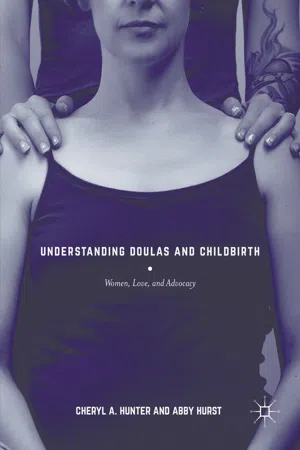
Understanding Doulas and Childbirth
Women, Love, and Advocacy
- English
- ePUB (mobile friendly)
- Available on iOS & Android
eBook - ePub
About this book
Information
© The Author(s) 2016
Cheryl A. Hunter and Abby HurstUnderstanding Doulas and Childbirth10.1057/978-1-137-48536-6_11. Childbirth, Women, and Doulas
Cheryl A. Hunter1 and Abby Hurst2
(1)
University of North Dakota, Grand Forks, North Dakota, USA
(2)
A.T. Still University, Allen, Texas, USA
The other day I was finally able to write down my thoughts and memories in a journal. Writing it all down helped me realize how much the labor transformed me as an individual. I was able to find strength deep within myself that I never knew I had. Thank you. (Amy, mother)
This note of thanks written to Amy’s labor support woman, referred to as her doula, displays the intensity with which some women view the childbirth with a doula and the birthing experience itself as transformative. While not every birthing woman has the same experience with a doula, the overall medical consensus is that doulas provide positive childbirth outcomes for women and their babies. One of the roles of the doula, specifically in hospital childbirth, is to advocate for the laboring woman as she navigates the medical system in addition to providing continuous physical and emotional support. How and in what way this happens is the target of this book. This research investigated the work of doulas and the perceptions of how doulas differed from other medical personnel. It examined the different aspects of the doulas’ role as they prepared, accompanied, and then reflected back with the birthing woman and her partner about the childbirth experience.
This book offers several critiques. Firstly, it critiques the medical institutional model for asserting that medical knowledge, specifically through the use of technology and interventions, is the only valid knowledge about childbirth, and as a result, women in childbirth no longer possess any authority to define their own knowledge as “expertise.” The institutionalized structures of power that define what knowledge is and who can possess it (Code 1991, p. 177) impose an external authority upon women, relegating women’s bodily knowledge as, at best, inferior or simply as nonexistent. Secondly, the female body has been portrayed as pathological and deficient, requiring external intervention during childbirth for all women, not just those with risk factors. In contrast, the doula views women’s bodies as inherently capable and resilient in childbirth, and that normal birth requires no need for intervention. The doula also focuses on the experience of birth, and views it as something transformative and to be privileged. Likewise, the doula-led experience is centered on the woman’s body in an active role in the childbirth process, creating an embodied experience. Lastly, doulas model to their clients both love and advocacy because doulas believe that modeling these behaviors will translate as women become mothers through the process of childbirth.
Defining the Role of the Doula
According to Doulas of North America International (DONA), one of the largest doula training and advocacy organizations in the USA, doulas are trained and experienced in childbirth to provide women and their partners physical, emotional, and informational support during labor and birth (DONA 2005). Doula is a Greek word meaning “woman servant,” (ICEA Position Paper 1999). Historically, laboring women have turned to other women for help and support during the laboring process (Ashford 1998; Wertz and Wertz 1989; Barry and Paxson 1971). The progression from a labor support woman with personal birth experience to a paraprofessional woman trained in childbirth education and labor support techniques has led the recent generation of labor support women to carve a newly legitimized social role for themselves, being referred to as doulas.
The doula offers help and advice on comfort measures, such as breathing, relaxation, movement, and positioning. She also assists families in gathering information about the course of their labor and their options. Doulas specialize in nonmedical skills and do not perform clinical tasks, such as vaginal exams or fetal heart rate monitoring. Doulas do not diagnose or give medical advice. An important distinction to make is that the role of the doula is not to interfere with the roles of other labor support staff, or provide a dissenting opinion to what the medical staff is recommending.
According to advocacy literature, the doula’s goal is to help the birthing woman have a safe and satisfying childbirth as the woman concerned defines it, which results in a multiplicity of outcomes such as decreased use of analgesics, fewer complications during labor, and higher initiation rates of breast-feeding (Gruber et al. 2013). It has been noted that when a doula was present, some women felt reduced need for pain medications, or postponed them until later in labor; however, many women chose or needed pharmacological pain relief (DONA 2005). Doulas do not offer opinions or voice disapproval of decisions the laboring woman makes (Gilliland 2011; Meyer et al. 2001). The doulas’ role as educator is defined as helping women become informed about various options, including the risks, benefits, and accompanying precautions or interventions for safety (Gurevich 2003). The doula provides information about normal birthing processes and medical options available during the birth. The doula demonstrates to family members and friends how to help the mother be more comfortable and how to play a useful role in her labor and delivery (DONA 2005). A doula can provide suggestions to the partner as to what comfort measures may help the birthing mother. Doulas can also work with the birth partner in order to relieve any stress of the partner so that he/she is fully able to participate in the birth process (Bäckström and Hertfelt Wahn 2011).
Therefore, the doula has been identified as performing three overarching roles: physical and emotional support, education, and advocacy (DONA 2005). Physical and emotional support can include providing a constant, supportive presence and empowering the woman to ask questions. Doulas also provide nonjudgmental support and education, allowing for informed decision-making by the mother and partner (Amram et al. 2014). Doulas, in advocating for the laboring woman, “facilitate positive communication between provider and client, helping both partners and providers address and consider the woman’s fears” (Pascali-Bonaro 2003, p. 5).
Why might women need a doula during childbirth? The notion of an external advocate brought into the hospital may reflect the “alien environment” of the hospital where “women need someone to explain medical jargon or express her wishes to the clinicians” (Madi et al. 1999, p. 5). The doula provides a fundamentally different service than clinical health care professionals in the hospital setting. Doulas traditionally served women in the homebirth setting until their recent professionalization and organization, which promoted their role in hospital births (Morton 2002). The role of the doula is not well-defined in many health care facilities, and as such, many health care providers do not fully understand the role of the doula within the facility. Health care providers may even believe the doula is there to oppose any medical intervention. The narratives in this book support the belief that doulas often question the high rates of medical interventions in childbirth, fundamentally lodging a critique about the medicalization of childbirth.
The Medicalization of American Birthing Practices
Pregnancy and childbirth were once considered an exclusively female domain. Women who were in labor would rarely give birth in a hospital setting, choosing instead to deliver at home, with the support of other women assisting with the labor. Women attended to each other during labor and weeks of postpartum recovery. Medical intervention was rare. It was not until the late 1700s that medical doctors began attending childbirth (Wertz and Wertz 1989). The idea that childbirth is a natural process and not a medical procedure remained popular in the USA until the 1920s. Up until that time, less than 5 % of childbirths took place in a hospital (Wertz and Wertz 1989). After the 1920s there was a drastic shift toward the medicalization of childbirth. It is estimated that by the mid-1950s, almost 95 % of childbirths took place within a hospital (van Teijlingen et al. 2009). By this time, labor was no longer thought of as a natural process that occurs without the need for medical intervention, but instead, a procedure that requires input and monitoring from physicians and nurses. Today women rarely choose to give birth at home with only the support of other women. Now, women are being taught the potential risks of childbirth and encouraged to accept the medicalized nature of childbirth (Chmell 2012).
Conrad (1992) defined medicalization as “a process by which non-medical problems become defined and treated as medical conditions, usually in terms of illnesses or disorder” (p. 210). The medicalization of childbirth caused a paradigm shift in the way society viewed the need for medical intervention. Childbirth has been redefined as a dangerous event that women are incapable of handling without the support of physicians and other clinical staff. Obstetricians and other clinical staff have taken over the responsibility of aiding women even during uncomplicated labor. This is being done despite the recommendation that medical interventions should occur only if “they are of benefit to the woman or her baby” (Department of Health 2004, p. 4). Often women with uncomplicated pregnancies are encouraged to use epidural analgesics, fetal monitoring, and other medical interventions with no documented outcome to the mother or baby (Johanson et al. 2002).
Medical Interventions Used on Women in Childbirth
Some of the more common medical interventions during labor include induction of labor, electronic fetal monitoring (EFM), episiotomies, and cesarean sections (c-sections). Physicians may recommend medical interventions due to either the baby or the mother being in distress, or to speed up the process of labor for the convenience of either the medical staff or the patient.
Elective Induction
Elective induction involves artificially stimulating the uterus to initiate labor. Typically this is performed by either rupturing the amniotic membranes or administering Pitocin. Pitocin is a synthetic version of oxytocin—the naturally produced hormone that stimulates uterine contractions and lactation. With noninduced labor, oxytocin allows for more regulated contractions as it is secreted in bursts, rather than continuously. Pitocin, conversely, is administered in a steady intravenous flow, thus leading to more powerful and faster contractions. The stronger Pitocin-induced contractions may lead to a decrease in uterine blood flow, possibly decreasing oxygen to the fetus (WHO 2011). The stronger contractions and decrease in oxygen to the fetus also necessitate the use of EFM.
Additionally, unlike oxytocin, Pitocin does not cross the blood–brain barrier. When oxytocin circulates through the blood–brain barrier, it causes the release of endorphins. Endorphins work on the same receptors in the brain as do chemical opiates, providing pain relief. In addition to this, they can also induce feelings of euphoria. Therefore, without crossing the blood–brain barrier, a Pitocin-induced labor is unlikely to provide the same natural pain relief (Lothian 2006). Thus, in order to provide pain relief during an induced labor, an epidural or other analgesic must be administered, consequently leading to a cascade of additional medical interventions.
Electronic Fetal Monitoring (EFM)
Electronic fetal monitoring (EFM) is a common medical intervention used during pregnancy. It is used in order to evaluate the uterine contractions of the mother and subsequent heart rate of the fetus. EFM was developed in order to provide a way to monitor the fetus for any signs of crisis and subsequent need for a quick delivery. The impetus for the development of this technology was to reduce the rate of cerebral palsy and mental retardation caused by insufficient oxygen flow to the baby during labor and resultant hypoxia (ACOG 2009) as physicians could intervene at the first signs of abnormal heart rate patterns.
EFM requires the woman to be attached to electronic bands and monitors; this can decrease the comfort of the woman by limiting her ability to ambulate. Even portable monitors have been shown to be cumbersome and limit the movements of laboring women (Jansen et al. 2013). More importantly, EFM has been shown to have a very high rate of false positive readings, leading to an increase in unnecessary forceps-assisted births and c-sections. Randomized clinical trials have show...
Table of contents
- Cover
- Frontmatter
- 1. Childbirth, Women, and Doulas
- 2. Nurses, Families, and Doulas: An Overview of Different Roles in Childbirth
- 3. Alienation and a Challenge to Authority in Childbirth
- 4. Birthing with Doulas: The Embodied Birth Experience
- 5. Love and Advocacy in Childbirth
- Backmatter
Trusted by 375,005 students
Access to over 1.5 million titles for a fair monthly price.
Study more efficiently using our study tools.
Frequently asked questions
Yes, you can cancel anytime from the Subscription tab in your account settings on the Perlego website. Your subscription will stay active until the end of your current billing period. Learn how to cancel your subscription
No, books cannot be downloaded as external files, such as PDFs, for use outside of Perlego. However, you can download books within the Perlego app for offline reading on mobile or tablet. Learn how to download books offline
Perlego offers two plans: Essential and Complete
- Essential is ideal for learners and professionals who enjoy exploring a wide range of subjects. Access the Essential Library with 800,000+ trusted titles and best-sellers across business, personal growth, and the humanities. Includes unlimited reading time and Standard Read Aloud voice.
- Complete: Perfect for advanced learners and researchers needing full, unrestricted access. Unlock 1.5M+ books across hundreds of subjects, including academic and specialized titles. The Complete Plan also includes advanced features like Premium Read Aloud and Research Assistant.
We are an online textbook subscription service, where you can get access to an entire online library for less than the price of a single book per month. With over 1.5 million books across 990+ topics, we’ve got you covered! Learn about our mission
Look out for the read-aloud symbol on your next book to see if you can listen to it. The read-aloud tool reads text aloud for you, highlighting the text as it is being read. You can pause it, speed it up and slow it down. Learn more about Read Aloud
Yes! You can use the Perlego app on both iOS and Android devices to read anytime, anywhere — even offline. Perfect for commutes or when you’re on the go.
Please note we cannot support devices running on iOS 13 and Android 7 or earlier. Learn more about using the app
Please note we cannot support devices running on iOS 13 and Android 7 or earlier. Learn more about using the app
Yes, you can access Understanding Doulas and Childbirth by Cheryl A. Hunter,Abby Hurst in PDF and/or ePUB format, as well as other popular books in Social Sciences & Gender Studies. We have over 1.5 million books available in our catalogue for you to explore.