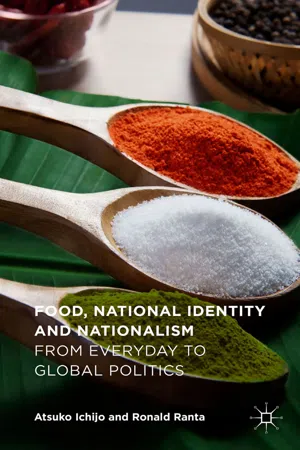
Exploring a much neglected area, the relationship between food and nationalism, this book examines a number of case studies at various levels of political analysis to show how useful the food and nationalism axis can be in the study of politics.
eBook - ePub
Food, National Identity and Nationalism
From Everyday to Global Politics
- English
- ePUB (mobile friendly)
- Available on iOS & Android
eBook - ePub
About this book
Information
Part I
Unofficial/Bottom-Up: Nationalism and National Identity through Food Away from the State
1
Everyday Creation of the Nation
Introduction
The chapter investigates the ways in which the nation is created, given meaning and maintained by everyday/banal acts of cooking, talking about and consuming food. The chapter pursues its aim by exploring the parameters of everyday nationalism, in particular talking and choosing the nation, and through the case study of Japanese-style pasta. In this case study, the creation, revision and maintenance of ‘Japaneseness’ are examined, with data collected from two recipe sites to which interested members of the public submit their recipes for collective evaluation without explicit commercial motive. By analysing the ways in which the Japaneseness of Japanese-style pasta is constructed, claimed and evaluated, the chapter charts the process of making a foreign food item – pasta – into an item which is widely recognised as Japanese through the accumulative participation of ordinary people. The chapter seeks to illuminate the ways in which everyday actions of the individual reinforce the dominant idea of the nation as well as contest the official version, leading to an emergence of an alternative view.
Food and national identity: The theoretical context
The importance of food in constituting the social is widely acknowledged, to the point that stating ‘food plays an essential role in facilitating and maintaining social relationships’ would be met by a blank stare. The significance of food in the investigation of human society, history and various aspects of politics has been well articulated. For instance, Fischler (1988: 277) identifies two important dimensions of human beings’ relationship with food as the ‘omnivore’s paradox’ and the ‘incorporation principle’. He states:
Because we are omnivores, incorporation is an act laden with meaning. Because of the principle of incorporation, identification of foods is a key element in the construction of our identity. Finally, because identity and identification are of both vital and symbolic importance, man has ‘invented’ cuisine.
Cuisine in this context is understood to represent the most fundamental aspect of human life. Another anthropologist, Emiko Ohnuki-Tierney (1999: 244), uses a less value-laden concept of food and describes food as ‘a unique metaphor of the self of a social group’. In elaborating the mechanisms of assigning power to food, she adds, ‘when each member of the social group consumes the food, it becomes a part of his or her body. Thus this important food becomes embodied in each individual and functions as metonym by being part of the self’ (ibid.: 244).
Lien (2004: 6–7) not only notes ‘the immediate biological implication’ of food but also acknowledges food as ‘a convenient medium for the expression of social and economic distinctions, and for naturalising relations of community and hierarchy’, as well as its link to nutritional science, which interacts with interests of science and business. In a similar vein, Grew (1999: 6–7) points out the two major dimensions that a focus on food would bring: First, food can be used as a tool for investigating a society’s political economy because its production is embedded in a particular labour system and its consumption in an ever-evolving trading pattern. Second, food has the symbolic function that works as ‘an aesthetic, cultural and semiotic code’ in defining and reinforcing group membership.
This brief review of literature is sufficient in reiterating the relevance of focusing on food in investigating social relations. Given that much emphasis has been placed on food’s symbolic power in relation to group membership, the relationship between food and the nation is no doubt a legitimate topic for research. In investigating the relationship between food and the nation, in particular, national identity, this chapter draws from the theoretical approach called ‘everyday nationalism’. The use of the approach is merited based on the fact that food represents a routinised everyday practice (Lien, 2004: 6).
The goal in studying everyday nationalism is to understand how ordinary people make sense of and enact nationalism, nationhood and national belonging in their everyday life. By ordinary people we mean those acting outside of elite structures and not for commercial gain. The focus on everyday nationalism is articulated as a critique of conventional macro-focused analyses of nationalism that tend to prioritise the elite’s behaviour propagated through the state and other formal structures in understanding nationalism. The conventional focus, according to the advocates of research into everyday nationalism, does not tell the whole story because it is a ‘top-down’ approach, which tends to treat ordinary people as passive recipients of messages transmitted from the above without any room for exercising their agency. The ‘top-down’ approach also portrays the experience of nationalism as homogeneous; it ignores the great diversity that exists in the manner in which nationalism, national identity and national belonging are experienced and understood by individuals in their everyday lives. Ultimately, therefore, the urge to study everyday nationalism corresponds to the inherent tension between agency and structure in social sciences and continued efforts to strike the right balance between the two in any investigation into social phenomena.
Interest in what is now termed as ‘everyday nationalism’ has been observed in different guises. In particular, Michael Billig’s focus on the permeation of nationalism as a discursive form into the everyday in his Banal Nationalism (1995) and Tim Edensor’s work on the routinised nature of national identity (2002, 2006) appear to have inspired a large number of scholars to investigate the everyday-ness of nationalism and nationhood more closely. One of the works on food and national identity inspired by the idea of banal nationalism is by Catherine Palmer (1998), in which the link between the body, food and the landscape on the one hand and national identity on the other is explored by focusing on its banality. Everyday nationalism by its very nature, which synthesises research concerns on banal nationalism and the routinised practice of national identity, opens up new and distinct research areas.
Jonathan Fox and Cynthia Miller-Idriss (2008a) have identified four areas of research into everyday nationhood: ‘choosing the nation’, the nation implicated in people’s choice; ‘talking the nation’, the discursive construction of the nation through routine talks; ‘performing the nation’, the ritualised enactment of nationhood through symbols; and ‘consuming the nation’, expression of nationhood and belonging to the nation through daily consumption habits. Looking into these four areas, as Fox and Miller-Idriss contend, would provide insight as to how the nation is produced and reproduced by ordinary people and hence can address nationalism ‘from below’.
Choice
What we do with food, therefore, how we think about it and use it, inheres in what we are, as societies and as individuals.
(Ferguson, 2006)
The definition provided by Fox and Miller-Idriss regarding choosing the nation narrows it down to mainly institutional choices people make, for example, which school to enrol in.1 We propose a broader and more expansive way of understanding this area, and this includes a wide range of mundane choices and decisions made by ordinary people in their everyday lives and what these mean with regard to the nation and national identities. In particular, we focus on the decisions and choices of what and how to eat and cook as well as on the manner in which people categorise and classify food in everyday life.
People’s first encounter with issues concerning national, religious and/or ethnic identity is normally through their palates. The food people eat is directly linked to where they grow up, the groups they belong to and the cultural and social spaces they inhabit. In other words, the food people eat and cook conveys a lot of information about who they are. It is, therefore, not surprising that there is a strong correlation between peoples’ acquired taste and food preference and their national identities, though it is not clear whether taste fosters or expresses this identity (Ferguson, 2011). In reference to Levi-Strauss, Barthes notes that taste ‘might well constitute a class of oppositions that refer to national characters (French versus English cuisine, French versus Chinese or German cuisine, and so on)’ (Counihan and Van Estrik, 2008: 31). Though we agree with Mintz (1986) that food items and ingredients cannot be easily or neatly divided into national categories, it is widely accepted that certain foods are closely linked to particular images of nations, for example, rice and Japan, pasta and Italy, and corn and Mexico. One would not, for example, expect to find chilli, lime and ginger in French cuisine or chickpeas, cumin and cinnamon in Japanese cuisine. Additionally, with regard to staple foods, many nations show a particular preference for certain types of grains, for example rice or wheat (Rae Oum, 2005). The preference for certain types of staple foods cannot be explained with reference to geography alone. This is particularly noticeable in settler colonial countries, such as the United States, Australia and Israel, where settlers had a strong desire to replicate their previous food culture rather than adopt local foodways (see, with regard to the United States, Gabaccia, 1998). It leads from this that the correlation between certain foods and national identities is such that adding or removing ingredients from nationally recognised dishes would transform and change them.
The choices individuals make everyday regarding how and what to eat and cook, therefore, are directly related to how they view and engage with their national identity – that is, by choosing whether to eat or cook specific foods people engage with their national identity and project who they are. Rae Oum (2005) demonstrates how the decision to include specific dishes, such as kimchi, which is seen as a Korean national dish, in the family meal is strongly correlated to expressions of Korean or American national identity within the Korean diaspora in the United States. These choices are directly related to where Koreans in the United States situate themselves within the Korean-American spectrum; Rae Oum accepts that these choices also relate to other factors such as gender and class. Additionally, he notes that the inclusion or exclusion of specific ingredients can in turn help give rise to hybridised foods and identities, for example, Hawaiian kimchi (with the addition of pineapple) and bulgogi (meat marinated in a soy-sauce blend) burger. These innovations relate to levels of cultural diffusions, desire for integration and family relations. They might, for example, arise in mixed marriages. It is interesting to note that the idea of creating cultural food hybrids is also used by multinational food corporations as a way of making their brands more appealing: in its South Korean restaurants, McDonald’s offers the choice of bulgogi burgers. As demonstrated, the meanings assigned to food dishes and ingredients are not static or immutable. By adding or removing ingredients, and changing and adapting recipes, individuals transform and manipulate not only flavours and textures but also meanings, which can be used as a vehicle for engaging with and expressing national identities.
Talking the nation
What is meant by the discursive construction of the nation and how do ordinary people participate in it? Discourses are means of constructing meaning and of representing ideas. For example, sociologist Uri Ram argues that nationality can be viewed as a discourse: ‘a story which people tell about themselves in order to lend meaning to their social world’ (quoted in De Cillia, Reisigl and Wodak, 1999: 155). National discourses, which may be presented in a variety of different forms – oral, from speeches to stories, and textual, from books to newspaper articles – convey ideas about the dimensions and particularities of the nation and help bring about the idea of the nation as an imagined community: a community with shared values, culture, boundaries and history.
Much of the study on food discourses and nationalism has tended to focus on texts and in particular on the relationship between cookbooks and the formation and maintenance of national identity (see, e.g., Appadurai, 1988 and Montanari, 2004). This is because cookbooks are among the most published and accessible forms of food discourses. Nowadays, most of the cookbook writing is done by professionals working in the food industry. However, this was not the case in the past. Many of the best-known and most influential cookbooks were written by middle- and upper-class women as a way of sharing with and providing fellow women with useful housekeeping and culinary information. Cookbooks such as Mrs Beeton’s Book of Household Management (1861) and Amelia Simmons’ American Cookery (to use its shortened title; 1798) go beyond discussing matters relating to measurements, procedures and nutrition. They contain additional information relating to history, tradition, geography, values and identities. For example, in the introduction to her book, Simmons (1798) writes that the book has been written for ‘the improvement of the rising generation of females in America’ and that the recipes provided had been ‘adapted to this country’ (US); even the book’s title conveys the idea that the recipes and advice given are related to a particular nation.
The focus on ordinary people, however, and the way in which they discursively construct the nation through food in everyday life brings up a number of methodological difficulties. Ordinary people rarely write cookbooks; so accessing how they engage with nationalism/national identities within the context of food discourses is not straightforward. Additionally, as noted by Fox and Miller-Idriss (2008a), the nation is not a constant or regular topic of everyday conversation, but it is context dependent. How then should one go about collecting and analysing how ordinary people talk about and discursively construct the nation?
Most of the research done on the everyday discursive construction of the nation has been limited to interviews, focus groups, surveys and ethnographic research. A particularly innovative and useful way of examining how people discursively construct the nation is through the study of recipes, and in particular those that members of the public upload to popular cooking websites. Recipes are, first and foremost, a discursive product that identifies, describes and gives meaning to a dish. They tend to be viewed as instruction manuals. To some extent this is correct: recipes provide lists of ingredients, measurements and instructions to be followed. However, as will be demonstrated in the following sections, these ingredients and instructions also contain information regarding how members of the public perceive issues regarding taste, identity, geography, authenticity and tradition. Moreover, the focus on recipes uploaded to popular cookery websites provides additional tools for studying how people engage with food in the everyday.
The methods and ideas suggested by Fox and Miller-Idriss limit the study of everyday discursive construction of the nation to how people talk about the nation. The study of online recipes allows for a wider engagement with how ordinary people also talk to the nation. In effect, ordinary people influence one another through their food discourses and observe, through the comments and feedbacks generated, how others perceive and/or react to these. What is particularly interesting about these exchanges is that they allow the researcher to observe how ordinary people experience and engage with the nation in everyday life in, what used to be, the hidden space of home and in an apolitical context. To give a brief example, ‘All Recipes’ is one of the most widely used international cookery website. It is a multilingual site, has over three million members and is visited tens of millions of times a month; it was recently sold for $175 million.2 ‘All Recipes’ has tens of thousands of unique recipes that are provided free of charge by members of the public. The first step in uploading a recipe is providing it with a title and placing it within one of the categories provided. Many of the titles proposed and the categories provided are related to the idea of nations and national cuisines. By uploading a recipe and either characterising it or categorising it based on national cuisines people are engaged in choosing the nation; the act of writing these recipes and titling them is part of the discursive construction of the nation. For instance, ‘All Recipes’ has 40 recipes for ‘Moroccan Chicken’. These recipes provide an indication of how recipes are defined and constructed as Moroccan by members of the public in different parts of the world. By way of recipes, ordinary people transform a list of raw ingredients that correspond to ideas of taste and textures to a nationally consumed culinary artefact. In these recipes the Moroccan elements correlate to the addition of cumin, coriander and cinnamon to either the chicken marinade or sauce and the serving of the dish with couscous.
Japanese-style pasta
As demonstrated earlier, a focus on recipes is particularly appropriate for an investigation of everyday nationhood in food. In our case study, this will be pursued through an in-depth analysis of recipes of Japanese-style pasta. In relation to the four areas suggested by Fox and Miller-Idriss, by identifying a dish as ‘Japanese-style pasta’, people are involved in an active process o...
Table of contents
- Cover
- Half Title
- Title Page
- Copyright
- Contents
- List of Figures and Tables
- Acknowledgements
- Introduction
- Part I: Unofficial/Bottom-Up: Nationalism and National Identity through Food Away from the State
- Part II: Official/Top-Down: The Nation-State, Food and Nationalism
- Part III: Food and Nationalism/National Identity at the Global Level
- Notes
- References
- Index
Trusted by 375,005 students
Access to over 1.5 million titles for a fair monthly price.
Study more efficiently using our study tools.
Frequently asked questions
Yes, you can cancel anytime from the Subscription tab in your account settings on the Perlego website. Your subscription will stay active until the end of your current billing period. Learn how to cancel your subscription
No, books cannot be downloaded as external files, such as PDFs, for use outside of Perlego. However, you can download books within the Perlego app for offline reading on mobile or tablet. Learn how to download books offline
Perlego offers two plans: Essential and Complete
- Essential is ideal for learners and professionals who enjoy exploring a wide range of subjects. Access the Essential Library with 800,000+ trusted titles and best-sellers across business, personal growth, and the humanities. Includes unlimited reading time and Standard Read Aloud voice.
- Complete: Perfect for advanced learners and researchers needing full, unrestricted access. Unlock 1.5M+ books across hundreds of subjects, including academic and specialized titles. The Complete Plan also includes advanced features like Premium Read Aloud and Research Assistant.
We are an online textbook subscription service, where you can get access to an entire online library for less than the price of a single book per month. With over 1.5 million books across 990+ topics, we’ve got you covered! Learn about our mission
Look out for the read-aloud symbol on your next book to see if you can listen to it. The read-aloud tool reads text aloud for you, highlighting the text as it is being read. You can pause it, speed it up and slow it down. Learn more about Read Aloud
Yes! You can use the Perlego app on both iOS and Android devices to read anytime, anywhere — even offline. Perfect for commutes or when you’re on the go.
Please note we cannot support devices running on iOS 13 and Android 7 or earlier. Learn more about using the app
Please note we cannot support devices running on iOS 13 and Android 7 or earlier. Learn more about using the app
Yes, you can access Food, National Identity and Nationalism by Atsuko Ichijo,Ronald Ranta in PDF and/or ePUB format, as well as other popular books in Social Sciences & Politics. We have over 1.5 million books available in our catalogue for you to explore.