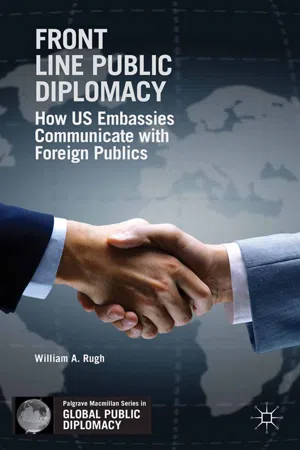
This book presents the first-ever close and up-to-date look at how American diplomats working at our embassies abroad communicate with foreign audiences to explain US foreign policy and American culture and society. Projecting an American voice abroad has become more difficult in the twenty-first century, as terrorists and others hostile to America use modern communication means to criticize us, and as new communication tools have greatly expanded the worldwide discussion of issues important to us, so that terrorists and others hostile to us have added negative voices to the global dialogue. It analyzes the communication tools our public diplomacy professionals use, and how they employ interpersonal and language skills to engage our critics. It shows how they overcome obstacles erected by unfriendly governments, and explains that diplomats do not simply to reiterate set policy formulations but engage a variety of people from different cultures in a creative ways to increase their understanding of America.
- English
- ePUB (mobile friendly)
- Available on iOS & Android
eBook - ePub
About this book
Trusted by 375,005 students
Access to over 1.5 million titles for a fair monthly price.
Study more efficiently using our study tools.
Information
P A R T I
The Context
C H A P T E R O N E
Legacy: Public Diplomacy’s Philosophy and Legal Basis
The Concept of Public Diplomacy
The term “public diplomacy” was coined in 1966, but as far back as 1776 American leaders were thinking about the concept. America’s forefathers believed then that foreign public opinion was important and that American views are not always well understood, so it serves our interests to make an open explanation to foreign audiences of our country’s views. The Declaration of Independence therefore stated in its Preamble:
When in the Course of human events it becomes necessary for one people to dissolve the political bands which have connected them with another . . . a decent respect to the opinions of mankind requires that they should declare the causes which impel them to the separation.
Then the first paragraph of the Declaration, before presenting a long list of grievances, offers this explanation of its purpose:
The history of the present King of Great Britain is a history of repeated injuries and usurpations, all having in direct object the establishment of an absolute Tyranny over these States. To prove this, let Facts be submitted to a candid world.
The idea of explaining ourselves to the world remains in the twenty-first century as the fundamental rationale for public diplomacy. Before World War I the principle was only a declaration, without institutional expression. And until then it only applied to foreign policy explication, but after that the idea expanded to include an understanding of American society and culture, and later the promotion of mutual understanding.
America’s focus on public diplomacy has always has been sporadic. Concern about wars and foreign threats to the United States has been the main stimulus attracting attention to the need to employ public diplomacy to communicate with foreign publics and influence foreign public opinion. World Wars I and II, the Cold War and then the twenty-first–century Global War on Terrorism (GWOT) all focused American interest on public diplomacy, but after these crises seemed to subside, that interest declined.1
Institutionalization of public diplomacy began under Woodrow Wilson who established a Committee on Public Information (CPI) led by George Creel. The CPI was the US government’s first formal government agency for providing information to foreign publics. It initially began as a program to inform domestic opinion but, starting in 1917, it was given a mandate to address foreign audiences as well. Creel called it “the fight for the mind of mankind.” The CPI had a foreign section which produced news and picture services, and arranged for foreign journalists to visit the United States. It also disseminated Hollywood films abroad. Those were clearly public diplomacy projects, antecedents of today’s programs. But the CPI ended in 1919 when the war ended; Congress withdrew funding, saying it had been too partisan.2
In 1935, motivated by the growing threat from Germany and a desire to counter Nazi propaganda against the United States, the State Department began to transmit a daily bulletin of news to overseas posts. In July 1938, the State Department created the Division of Cultural Relations that worked with American academics to provide cultural programs to Latin America. In 1940, President Franklin D. Roosevelt appointed Nelson Rockefeller as Coordinator for Commercial and of Cultural Relations, renamed in 1941 as the Coordinator of Inter-American Affairs. His staff opened libraries and bi-national centers and established exchange programs, sponsored traveling musical presentations and art exhibitions, and published a magazine. Roosevelt’s prewar public diplomacy was therefore focused on Latin America.3
But in 1941, while the United States was at war with Germany, President Roosevelt broadened the concept. He established the Office of the Coordinator of Information (later the Office of Strategic Services, OSS), that had a “Foreign Information Service” (FIS). Roosevelt appointed Robert Sherwood, his speechwriter and a playwright, to head FIS. The new FIS opened ten information offices around the world, each called the US Information Service (USIS), a name that was used throughout the rest of the century. In February 1942, three months after the Japanese attack on Pearl Harbor, the State Department started a broadcast service called Voices of America, soon renamed The Voice of America (VOA). It began with the announcement, “Today and every day from now on we shall be speaking to you about America and the War. Here in America we receive news from all over the world. This news may be favorable or unfavorable. Every day we shall bring you the news—The Truth.”4 This concept became a revered VOA principle and is fundamental to the practice of public diplomacy today.
In June 1942, Roosevelt created the Office of War Information (OWI), and made the FIS its overseas arm. OWI operated VOA and an expanding chain of information centers around the world. It also published and distributed magazines and books abroad and worked with Hollywood to produce and distribute films abroad. It worked with the US military to help defeat the enemy by providing leaflet drops and broadcasts calling for the Germans to surrender. In 1944, OWI’s Division of Cultural Relations moved into the State Department. By then State’s International Information Division was distributing American media products around the world, including films, newsreels, and magazines such as Reader’s Digest. During the war, OWI set up field posts abroad, first in London, then in liberated cities, so that by the end of the war in 1945 they existed in forty countries. Also, by 1945 OWI was distributing a news service product of 100,000 words each day to sixty US diplomatic posts worldwide.5
Postwar Organization
President Truman abolished OWI in 1945 at the end of the war, but transferred its overseas information activities including information, broadcasting and exchanges to the Department of State. Psychological operations continued separately under the Department of Defense. That year, Congress authorized spending for educational exchanges, when Senator J. William Fulbright, a Rhodes Scholar, proposed that proceeds from the sale of surplus property be used to fund educational exchange programs. In August 1946, Congress passed an act to amend the Surplus Property Act of 1944, authorizing expanded educational exchanges. The first agreement was signed in November 1947 to bring Chinese students to the United States, and the first American “Fulbrighters” left for Burma in the fall of 1948.6
The Cold War that began in 1946 revived interest in what was later called public diplomacy, but Americans wanted to distinguish it from the negative connotations of “propaganda” being deceptive, as employed by Nazi Germany. In April 1947, Secretary of State George C. Marshall expressed the philosophical basis of today’s public diplomacy when he urged the use of information to counter the Soviet Union. He said: “The use of propaganda as such is contrary to our generally accepted precepts of democracy and to statements I have made. Another consideration is that we could be playing into the hands of the Soviets who are masters in the use of such techniques. Our sole aim in our overseas information program must be to present nothing but the truth, in a completely factual and unbiased manner. Only by this means can we justify the procedure and establish a reputation before the world of integrity of action.”7
As the Cold War intensified, Congress saw this as reason to pass new legislation supporting public diplomacy. In January 1948, Truman signed Public Law 402, informally called the Smith-Mundt Act. It has been amended since 1948, but it remains today the most important legislative foundation for the US government’s entire public diplomacy program. Its purpose was “to enable the Government of the United States to promote a better understanding of the United States in other countries, and to increase mutual understanding between the people of the United States and the people of other countries. Among the means to be used in achieving these objectives are . . . an information service to disseminate abroad information about the United States, its people, and policies promulgated by the Congress, the President, the Secretary of State and other responsible officials of Government having to do with matters affecting foreign affairs.” The Act said that information dissemination should be accomplished “through press, publications, radio, motion pictures, and other information media, and through information centers abroad.”8
In 1972 and 1985, Congress amended Smith-Mundt explicitly to ban domestic distribution of materials produced for foreign audiences. This ban became its one controversial provision, challenged on the grounds that it was anachronous and unenforceable because it is impossible to separate domestic from foreign information, especially now that new information technology has made international communication so easy that almost anything that is done for public diplomacy purposes is accessible to Americans now.9 In practice, no one was ever prosecuted for violating the ban, and although over the years it was of concern to lawyers in Washington, it has not affected the daily operations of public diplomacy practitioners abroad who tended to regard it as irrelevant to their daily tasks and not an important issue to worry about.
In 2012 Congress passed the Smith-Mundt Modernization Act that basically lifted the domestic dissemination ban in Smith-Mundt, and in January 2013, President Obama signed it into law. The act now permits Americans to view taxpayer funded material intended for audiences abroad and allows the dissemination of that material inside the United States. However it retains the original provision in Smith-Mundt that emphasizes that such dissemination must not compete with existing domestic media.10
USIA 1953–1999
Under President Eisenhower, Congress in 1953 created the US Information Agency (USIA), a foreign affairs agency that managed America’s public diplomacy until 1999.
Eisenhower’s Secretary of State John Foster Dulles disdained consideration of public opinion in foreign policy and he wanted to move information, education and culture out of State so he could focus on traditional diplomacy.11 Senator Bourke Hickenlooper (R-IA), chair of the Senate Foreign Relations Committee, also supported the idea of a separate agency, but for different reasons. He explained that the goals of an effective overseas information program “could hardly be met within the outlines of a cautious, tradition-bound, bureaucratic foreign office.”12 (Hickenlooper’s comment has found an echo half a century later in criticism of the decision to merge USIA back into the State Department.) Senator J. William Fulbright of Arkansas, a prominent Democrat on that committee (and later chairman, 1959–74) who had sponsored the exchange program that carried his name, agreed to a separate, new agency provided it only dealt with information and did not include the educational and cultural functions he cared so much about. He wanted them kept instead at State, and the new law did that. This anomaly mattered little to USIA’s public diplomacy professionals working at embassies, however, because they handled education and culture along with information matters. In 1979, under the Carter administration, these programs were transferred to USIA headquarters.
In 1961, Congress passed the Mutual Educational and Cultural Exchange Act of 1961, informally called the Fulbright-Hayes Act. This act consolidated existing programs, added initiatives in book translations, exhibitions and American studies, and provided for new cultural centers abroad.13 It said its purpose was “to strengthen the ties that unite us with other nations by demonstrating the educational, cultural interests, developments and achievements of the people of the United States and other nations, and the contributions being made toward a more peaceful and fruitful life for the people throughout the world; to promote international cooperation for educational and cultural advancement; and thus to assist in the development of friendly, sympathetic and peaceful relations between the United States and the other countries of the world.” It authorized funding for educational exchanges for study, research, instruction, and other educational activities, and it authorized cultural exchanges in music, arts, sports, or any other form of cultural expression. It also authorized exchanges of books, periodicals, and translations, the establishment of cultural centers, and the promotion of research and language training.14
In these early years, various terms were applied to the US government’s communication efforts abroad, including international communication, educational and cultural exchange, or both. Then in 1966, Edmund Gullion, a retired foreign service officer (FSO) who was the dean of the Fletcher School at Tufts University, proposed the term “public diplomacy” and it stuck. Although Gullion’s original formulation did not confine the term to activities by the government, US officials have consistently used it to mean only the US government’s efforts to communicate with foreign audiences.15 Note also that the public diplomacy professionals who serve abroad work in the “public affairs section” of the embassy, that is headed by a “Public Affairs Officer,” although when the term “public affairs” is used in Washington it usually refers to the function of communicating to an American domestic audience.
Professor Joseph Nye added to the discussion by coining the term “soft power,” which he defined as “the ability to shape the preferences of others” by attraction rather than coercion, which is the use of “hard power.” He said that soft power “rests on a country’s culture, values and policies.”16 Soft power is not the same as public diplomacy but the two are connected. To the extent that America’s culture, values and policies are admired and respected abroad, they are beneficial to the United States and support American public diplomacy. Public diplomacy can benefit by communicating their positive aspects to foreign audiences. But to the extent that these attributes are seen in a negative light, they are harmful to the US and American public diplomacy needs ...
Table of contents
- Cover
- Title
- Introduction
- Part I The Context
- Part II Field Office Management
- Part III Information Programs
- Part IV Cultural and Educational Programs
- Part V Pentagon Communications
- Part VI Conclusion
- Notes
- Index
Frequently asked questions
Yes, you can cancel anytime from the Subscription tab in your account settings on the Perlego website. Your subscription will stay active until the end of your current billing period. Learn how to cancel your subscription
No, books cannot be downloaded as external files, such as PDFs, for use outside of Perlego. However, you can download books within the Perlego app for offline reading on mobile or tablet. Learn how to download books offline
Perlego offers two plans: Essential and Complete
- Essential is ideal for learners and professionals who enjoy exploring a wide range of subjects. Access the Essential Library with 800,000+ trusted titles and best-sellers across business, personal growth, and the humanities. Includes unlimited reading time and Standard Read Aloud voice.
- Complete: Perfect for advanced learners and researchers needing full, unrestricted access. Unlock 1.5M+ books across hundreds of subjects, including academic and specialized titles. The Complete Plan also includes advanced features like Premium Read Aloud and Research Assistant.
We are an online textbook subscription service, where you can get access to an entire online library for less than the price of a single book per month. With over 1.5 million books across 990+ topics, we’ve got you covered! Learn about our mission
Look out for the read-aloud symbol on your next book to see if you can listen to it. The read-aloud tool reads text aloud for you, highlighting the text as it is being read. You can pause it, speed it up and slow it down. Learn more about Read Aloud
Yes! You can use the Perlego app on both iOS and Android devices to read anytime, anywhere — even offline. Perfect for commutes or when you’re on the go.
Please note we cannot support devices running on iOS 13 and Android 7 or earlier. Learn more about using the app
Please note we cannot support devices running on iOS 13 and Android 7 or earlier. Learn more about using the app
Yes, you can access Front Line Public Diplomacy by W. Rugh in PDF and/or ePUB format, as well as other popular books in Social Sciences & Cultural Policy. We have over 1.5 million books available in our catalogue for you to explore.