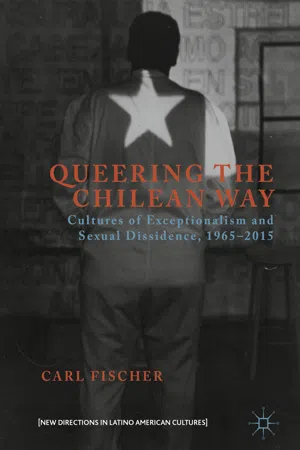
This book examines and critiques the fact that Chile's claims to economic exceptionalism have been embodied, often quite aggressively, in a heterosexual, and primarily male, ideal. Despite the many shifts Chilean economics and politics have undergone over the past fifty years, the country's view of itself as a "model" in contrast to other Latin American countries has remained constant. By deploying an artistic, literary, and cinematic archive of queer figures from this period, this book draws parallels among the exceptionalisms of Chile's economic discourse, the subjects deemed most (and least) apt to embody it, and the maneuvers of its cultural production between local and global ideas of gender and politics to delineate its place in the world. Queering the Chilean Way thus sheds light on the sexual, economic, and aesthetic dimensions of exceptionalism—at its heart, a discourse of exclusion that often comprises a major element of nationalism—in Chile and throughout the Americas.
eBook - ePub
Queering the Chilean Way
Cultures of Exceptionalism and Sexual Dissidence, 1965–2015
- English
- ePUB (mobile friendly)
- Available on iOS & Android
eBook - ePub
About this book
Information
Print ISBN
9781137563859
Subtopic
Amerikanische Regierung© The Author(s) 2016
Carl FischerQueering the Chilean WayNew Directions in Latino American Cultures10.1057/978-1-137-56248-7_11. Introduction
Carl Fischer1
(1)
Fordham University, Bronx, New York, USA
“The Chilean Way”: Exceptionalism as Exclusion
In 2010, after then-president of Chile Sebastián Piñera oversaw the daring and ultimately successful rescue of 33 miners trapped underground, he triumphantly used an English-language phrase to invoke the rescue, both at home and abroad: it was proof of the “Chilean way” of doing things. The “Chilean way” has become, in fact, a semi-official slogan aimed at showing off Chile’s prosperity (which, as Piñera pointed out, had made it possible for the country to harness the resources for the rescue) to the world in general, and to potential foreign investors in particular. 1 The rescue of the miners, a news story that riveted a billion people around the world, became the latest platform for Chile to set itself apart from its supposedly unstable, chaotic Latin American neighbors as uniquely affluent, humane, and prudent. The attention paid in media spheres to Chile’s exceptional economic success was matched by that received by the workers and functionaries involved in the rescue; indeed, inherent to the economic calculus of the “Chilean way” were its protagonists’ performances of heterosexual masculinity. Mining Minister Laurence Golborne was glowingly portrayed (initially, at least) as a family man who had made the personal sacrifice to leave an extremely lucrative job as manager of a retail holding company and work in public service. The miners’ masculinity was also the subject of media attention: Héctor Tobar, author of Deep Down Dark (2014)—an account of the mining accident and subsequent rescue—stated in an interview that the miners’ jobs “were dangerous, but also very fulfilling for them, because in Chile, being a miner is sort of like being a man.” 2 Gleeful accounts of the heterosexual exploits of the miners—including Yonni Barros, whose wife and girlfriend were portrayed in Patricia Riggen’s 2015 film The 33, based on Tobar’s book, as fighting over their man while waiting for him to emerge on the surface—figured them as model workers and healthy (if roguish) machos. Film heartthrob Antonio Banderas’ role as the miners’ leader further displaced their precarious, dangerous labor into the realm of spectacle. The queer subjects who helped make the rescue possible—such as Pedro Rivero, a travesti leading the first rescue team to arrive on the scene of the accident (Tobar 79)—were relegated to obscurity. 3 Piñera’s rhetoric, and those it encompassed and excluded, is just one of many examples of how Chile’s exceptional economic success has been tied, in the country’s public discourse, to masculine, heteronormative sexual praxis.
I use the term “exceptionalism” here as a productively contradictory way to think about how certain states, persons, cultural objects, and commodities set themselves apart as one-of-a-kind and yet, at the same time, are firmly situated within a particular group of peers. Crowded fields of contenders—countries vying for foreign investment, applicants competing for jobs, authors and filmmakers seeking audiences, and products looking for consumers—often make use of the rhetoric of exceptionalism to highlight their comparative advantage in relation to others. In this way, they make themselves intelligible and attractive to whoever is looking for the “best”—even if, as a paradoxical consequence of this, they once again find themselves indistinguishable from others who are also proclaiming their superiority. The rhetoric of the superlative, the unprecedented, and the extraordinary remains a daily fact of life under regimes of capital that force their subjects to compete amongst themselves for notoriety, visibility, and prominence; however, there are political, as well as economic, motives to set oneself apart as exceptional. Indeed, traces of exceptionalism can be found in the nationalist discourses of most countries, including the USA, as American Studies scholars such as Daniel Rodgers (2004), Jasbir Puar (2007), and Donald Pease (2009) have suggested. Since the nineteenth century, Americans imagined that their country was “a chosen land, inherently and irrevocably, with a world-historical covenant and mission that set it apart from the rest of the world,” depending “on an imagined ‘elsewhere’” (Rodgers 23–24). Just as New England was, for John Winthrop, a “city upon a hill” (Rodgers 24), Chileans, too, have conceived of their exceptionalism in spatial terms. In a text seminal to Chilean nationalist discourse, Benjamín Subercaseaux (1941) elegized how the country’s “loca geografía” set it apart from what lay beyond its dramatic borders, which comprised the vast Pacific, the bone-dry Atacama Desert, the towering Andes, and the hostile Antarctic. Yet this apartness was always in implicit comparison with other places whose geography is presumably more “sane” (and therefore less notable).
Particularly over the last 50 years—the scope of this study—Chile has conceived of itself as apart from, and unique in, the world, in an economic and political sense as well as a geographic one. Official discourse held up the country’s 1966 agrarian reform as the one in Latin America that most closely followed US Alliance for Progress directives; Salvador Allende’s government (1970–1973) was the world’s only socialist democracy; and Augusto Pinochet’s dictatorship (1973–1990) stood out as much for its orthodox adaptation of neoliberal structural reforms as for its murderous efficiency. Later, postdictatorship political leaders took over the economy and called it an even more shining example: they had balanced neoliberalism with increasing social protections and democracy, while reckoning with the dictatorship’s violent past—albeit always “en la medida de lo posible,” as former President Patricio Aylwin famously said. 4 Michelle Bachelet, elected in 2006 (and again in 2014), has been figured as a model for new kinds of female participation in the world’s highest spheres of power. The word modelo in Chile, on its own, continues to be used metonymically to describe the country’s entire political and economic system 5 ; in recent years, the country’s politicians have attacked their opponents by accusing them of undermining Chile’s “exceptional” economic image. 6 Despite drastic economic and political changes, then, Chile has continuously projected itself in the world as an exceptional specimen of whatever type of economy it has at the time.
The present study will critique Chilean economic exceptionalism as an inherently violent phenomenon that works not only to make the material exploitation upon which it often depends invisible, but also to exclude those subjects deemed unworthy to partake in its apparent success. These erasures are enacted through the “state of exception,” a phenomenon in which a sovereign government temporarily suspends “constitutional procedures and individual guarantees,” deploying “repressive measures” in order to sustain its power (Loveman 1993: 12). This idea, first coined by the German philosopher Carl Schmitt (1922) to justify lawmaking outside of democratic institutions in Weimar Germany, has been little explored a propos of Chile, although it has been amply theorized. As Puar has shown, US exceptionalism can only operate under some degree of a state of exception, so that when the country suspends the constitutional rights of its citizens, by, for example, summarily executing them with drone strikes, 7 it is a way to “restore, protect, and maintain … the normative ordering that then allows the United States to hail its purported universality. […] State of exception discourses rationalize egregious violence in the name of the preservation of a way of life and those privileged to live it” (8–9). The USA justified its neocolonial interventions abroad—including its well-documented support for the military coup that overthrew Allende 8 —by proclaiming its status as “the norm that others ought to envy” (Rodgers 25). In effect, its conviction that other countries should be like it justified its interventions abroad to make it so that other countries were like it. What Pease calls exceptionalist fantasy, then, provides its American adherents “with the psychosocial structures that permitted them to ignore the state’s exceptions” (12) and thus to justify and excuse many of the violent, illegal acts it has committed.
In Chile, states of exception have been a way of life since the inception of the republic, and are thus key to understanding its rhetoric of exceptionalism. The country’s 1833 constitution—drafted by the authoritarian “ministerial dictator” Diego Portales (Loveman 1993: 329) and marking the “final consolidation” of the country’s long, chaotic process of independence from Spain—concentrated power into very few hands. This meant that the country’s leaders “perfectly and frequently implemented the regimes of exception that became familiar to other Spanish Americans in the nineteenth century” (Loveman 1993: 315), by taking unilateral control of the different apparatuses of nominally democratic government whenever it was convenient. 9 Moreover, this dependence on the state of exception became an inherent part of the country’s exceptionalism: Chile “became the envy of other Spanish American nations” thanks to its frequent suspensions of democracy. In fact, those suspensions allowed Chile to avoid “the caudillismo, fragmentation, and disorder characteristic of the region” (Loveman 1993: 314), which permitted the country to conceive of itself as so particularly stable, politically speaking. But there have been other instances of Chilean exceptionalism being propped up by the state of exception throughout its republican history. Ericka Beckman (2009) points out how the Chilean state’s sense of nationalist superiority stemmed from the way in which it situated its role in the War of the Pacific (1879–1883) as a righteous struggle against the supposedly “inferior” races of Peru and Bolivia—an “assertion of Chilean racial superiority … foundational to discourses of Chilean particularity as a ‘white’ and modern country in Latin America” (Beckman 74). This gave the state grounds to justify its annexation of the lands (and suspension of the rights) of the Mapuche and Rapa Nui people, in a Chilean iteration of “manifest destiny” (Beckman 74). Portales and Schmitt’s authoritarian ideals were of great inspiration, meanwhile, to Augusto Pinochet and other ideologues of the 1973 military coup like Jaime Guzmán, 10 as Renato Cristi (2011) shows. Guzmán’s creation of Chile’s 1980 constitution, which remains in place to this day, was borne out of a state of exception that resulted from the overthrow of the Allende government: a rupture of the established order, putatively (and paradoxically) meant to save that order. This coup, wrought (in part) to shore up Chile’s “exceptionally” capitalist credentials, had the effect of annihilating almost 3000 people identified with the Left, and torturing and exiling many others. In the twenty-first century, the same discourse of Chileans as more “‘white’, ‘virile’ and ‘civilized’” than their neighbors has been deployed against “Peruvians [who] emigrated in large numbers to Chile as maids and service workers” (Beckman 84, 87). 11 Chile’s contemporary discourse of national superiority and prosperity is made possible by laws that simultaneously single out certain workers for extra scrutiny and relax labor legislation when the need for foreign labor arises—a contemporary iteration of the state of exception. 12 These authoritarian, exclusive ideals thus lie at the heart of how official Chilean political and economic institutions conceive of themselves as exceptional.
Queerness and the Re/Production of Exceptionalism
C...
Table of contents
- Cover
- Frontmatter
- 1. Introduction
- 2. The Monstrous Masculinities of Chile’s Agrarian Reform, 1965–1970
- 3. The Exceptional Art of Gendered Utopias, 1970–1973
- 4. Queering the State of Exception, 1973–1990
- 5. Politicizing the Loca Body After the Dictatorship, 1990–2005
- 6. Exceptionalism, the Female Body, and the Public Sphere in the Bachelet Era, 2006–2015
- Backmatter
Trusted by 375,005 students
Access to over 1.5 million titles for a fair monthly price.
Study more efficiently using our study tools.
Frequently asked questions
Yes, you can cancel anytime from the Subscription tab in your account settings on the Perlego website. Your subscription will stay active until the end of your current billing period. Learn how to cancel your subscription
No, books cannot be downloaded as external files, such as PDFs, for use outside of Perlego. However, you can download books within the Perlego app for offline reading on mobile or tablet. Learn how to download books offline
Perlego offers two plans: Essential and Complete
- Essential is ideal for learners and professionals who enjoy exploring a wide range of subjects. Access the Essential Library with 800,000+ trusted titles and best-sellers across business, personal growth, and the humanities. Includes unlimited reading time and Standard Read Aloud voice.
- Complete: Perfect for advanced learners and researchers needing full, unrestricted access. Unlock 1.5M+ books across hundreds of subjects, including academic and specialized titles. The Complete Plan also includes advanced features like Premium Read Aloud and Research Assistant.
We are an online textbook subscription service, where you can get access to an entire online library for less than the price of a single book per month. With over 1.5 million books across 990+ topics, we’ve got you covered! Learn about our mission
Look out for the read-aloud symbol on your next book to see if you can listen to it. The read-aloud tool reads text aloud for you, highlighting the text as it is being read. You can pause it, speed it up and slow it down. Learn more about Read Aloud
Yes! You can use the Perlego app on both iOS and Android devices to read anytime, anywhere — even offline. Perfect for commutes or when you’re on the go.
Please note we cannot support devices running on iOS 13 and Android 7 or earlier. Learn more about using the app
Please note we cannot support devices running on iOS 13 and Android 7 or earlier. Learn more about using the app
Yes, you can access Queering the Chilean Way by Carl Fischer in PDF and/or ePUB format. We have over 1.5 million books available in our catalogue for you to explore.