eBook - ePub
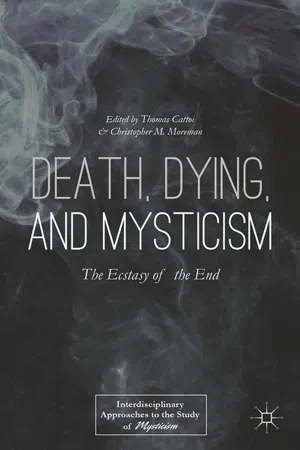
Death, Dying, and Mysticism
The Ecstasy of the End
- English
- ePUB (mobile friendly)
- Available on iOS & Android
eBook - ePub
Death, Dying, and Mysticism
The Ecstasy of the End
About this book
This volume offers a sample of reflections from scholars and practitioners on the theme of death and dying from scholars and practitioners, ranging from the Christian tradition to Hinduism, Lacanian psychoanalysis, while also touching on the themes of the afterlife and near-death experiences.
Information
Topic
Theology & ReligionSubtopic
Comparative Religion1
Lady Jacopa and Francis: Mysticism and the Management of Francis of Assisi’s Deathbed Story
Darleen Pryds
“Praise be you, my Lord, through our Sister Bodily Death, from whom no one living can escape. Woe to those who die in mortal sin. Blessed are those whom death will find in Your most holy Will, for the second death shall do them no harm.”1 On his deathbed in 1226 Francis of Assisi composed these words and added them as the final verses to his “Canticle of the Creatures,” thereby making known his acceptance of death to his followers and securing a place for this attitude toward death in the Franciscan spiritual tradition. His was not a passive acquiescence to death; instead he welcomed it. Francis saw death as a reason to offer praise to God since it provided yet another indication of God’s will and it initiated the Christian believer into new life. The ease and tenderness toward death expressed in the canticle, however, belies contested efforts to write the definitive account of Francis’s decline and death. As the founder of a rapidly growing order and as a canonized saint by 1228 just two years after his death, Francis was the focus of widespread spiritual attention, admiration, and even imitation. How to account for his life and his death in appropriate ways to edify and inspire the faithful while excising stories of spiritual traits that could be misunderstood and potentially misappropriated by his admirers including fellow friars was of concern to contemporary ecclesial authorities including the leaders of the Franciscan Order.
In the first one hundred years after Francis’ death, there were dozens of vitae, personal accounts, sermons, liturgies, and letters written about him.2 From these many accounts, there was agreement that Francis endeavored to conform his own life as much as possible to the life of Jesus. By adopting a life of humility, poverty, and itinerant preaching, Francis modeled his life on that of Jesus. This conformity was made complete through the physical suffering he endured in the final years of his life. Francis’s followers and admirers were quick to draw a spiritual significance from his suffering.3 Already in physical decline by 1224, Francis was rumored to have received the stigmata, the five wounds of Christ imprinted on his body.4 While he tried to hide these wounds in the last two year of his life, his followers including hagiographers were quick to write about his bleeding wounds, and interpreted them to be a somatic sign of Francis’s mystical union with Christ. The early sources agree that his mystical connection with Christ was not only a spiritual one, but also a physical one. He lived out his life in such a way that he very quickly became known by contemporaries and was even further crafted by subsequent writers and artists as an alter Christus, or another Christ.5
There was, however, less agreement in these early sources on the details of his life and death. Naturally, anecdotes contained in vitae vary as a result of authorial choice and intention. But the variations in Francis’s deathbed accounts warrant special attention. Specifically in five accounts of the saint’s death, Francis is said to have requested the presence of a specific woman: Lady Jacopa dei Settesoli, an aristocratic, lay woman from Rome. For most deaths during the European Middle Ages, the presence of a woman during the dying process and at death was routine. Women helped keep the dying person clean and as comfortable as possible, and they remained present to make the final preparations of the body for burial, by washing the body and wrapping it in appropriate shrouding.6 But for Francis of Assisi the anecdote of his request for the presence of a lay woman to be at his side as he was dying warrants explanation, since women had been forbidden to enter the enclosure of any of the friaries and since Francis himself had expressed intense anxiety about interactions with women.7 In addition the story of Jacopa’s presence circulated in limited circles, but originated in the stories told by Francis’s original companions. It would seem that some effort was taken to suppress and restrict the circulation of the story of Jacopa’s presence at Francis’s death.
This chapter argues that the particularly close spiritual relationship between Jacopa and Francis that is illustrated by her deathbed visit was suppressed and marginalized by administrators of the order because of its potential for misunderstanding and scandal. Subsequent historiography further suppressed the story. For Francis it may have been a simple truth that he experienced a respect and spiritual love for a particular lay woman that was so profound, that he requested her presence as a source of comfort at his death. But for his contemporaries and for many interpreters through the centuries since his death, such a relationship seemed so potentially scandalous, and the potential for misappropriating such a relationship so dangerous, it was best to manage the story by removing it from the written record. When the story was recorded in writing, it was told as a miracle with mystical elements so that the reports of a lay woman caring for the friar at his death would be disconnected from the normal, matter-of-fact event that it would have been considered outside of a Christian vowed religious compound. In this way, the authors preserved Francis’s saintly reputation by removing most of the ordinary details of bodily care offered by a woman that could be interpreted as unseemly and inappropriate. Even if the historical veracity of the story of Jacopa’s visit is questioned, it remains an important element in the hagiographic tradition of Francis since as a hagiographic theme the story of Jacopa’s visit completes the image of Francis as the mystical alter Christus. By presenting the figure of a woman with Francis as he died, the hagiographers who included the story of Jacopa’s visit cast Francis as following in the footsteps of Christ – indeed as another Christ. Therefore, this chapter explores the story of Jacopa’s visit as a plausible event that took place given the evidence of the spiritual connection between Jacopa and Francis. In an effort to protect the order from accusations of scandal, effort was made to remove the story from the hagiographical canon. When it was included in written form, the story was reframed into a miraculous account infused with mystical overtones to remove it from the ordinary. Within this reframing, hagiographers made use of Jacopa’s visit to cast Francis into the mystical figure of an alter Christus.
There are several sections to this argument. First, a delineation and analysis of pertinent original sources concerning Jacopa set the groundwork for showing how the story of Jacopa’s final visit to Francis was either framed as a miraculous occurrence of divine intervention or ignored completely Within this discussion is an analysis of Jacopa’s role in the presentation of a particular mysticism credited to Francis in the hagiography through the image of him as an alter Christus, or another Christ. Second, a discussion on the complexity of how men and women interacted in the Christian Middle Ages with the twelfth-century lay movement of the vita apostolica and the thirteenth-century rise of the mendicant orders will help explain how Jacopa’s and Francis’s relationship came about and why it would have caused confusion and anxiety for the friars and for ecclesial authorities. Crafting the story into one of mysticism and miraculous divine intervention was the means taken to salvage the story of spiritual companionship and care at the time of death. A brief look at subsequent historiography will show how the story remains marginalized.
Splicing Together the Evidence for Jacopa and Francis
The textual evidence documenting Jacopa’s connection to Francis’s life is sparse. The written narrative accounts reporting her presence at Francis’s death are all hagiographic and date from the mid-thirteenth century or later. There is no independent telling of the story. There are, however, several pieces of legal and financial evidence documenting Jacopa’s life apart from this story. When spliced together these caches of evidence offer a picture of a distinguished benefactor of the early Franciscan order who very likely cultivated a close spiritual relationship with Francis and who certainly generously supported the order with property and her personal influence in Rome and Assisi.
Jacopa dei Settesoli
Jacopa was born in the late twelfth century and married into the powerful Frangipane family, a clan that engaged in ongoing conflict with the papacy and its Conti family connections through much of the thirteenth century.8 By 1212 when she met Francis during one of his evangelization trips to Rome, Jacopa was likely already a widow. As a widow she forged an independent path using her economic, social, and political resources for purposes she determined. For example in 1217 she unilaterally agreed to a peace agreement with the Holy See, thereby setting new precedents and reversing family allegiances.9 Jacopa’s independent policy was likely inspired by her spiritual conversion and deepening spiritual friendship with Francis as this new allegiance was completely unprecedented. Although her actions make it appear that Jacopa was deeply moved by the teachings of Francis, she did not presume to take up that central tenet of Franciscan spirituality—evangelical poverty—for herself. Instead, she used the resources she inherited to support the vocation of the friars. The extant document-trail reveals a woman who understood the fiscal resources she had inherited from her husband, and put them to use as she saw appropriate. In addition to all the domestic responsibilities that rarely get recorded into textual evidence—caring for her family, tending to domestic economics, educating her children—Jacopa is known to have become a prominent benefactor to the friars, funding their first house and their first church in Rome.10 She traveled across Italy with a retinue befitting her station. This retinue required her administration and leadership. At Francis’s death, some sources report that she paid for his funeral and subsequently became a prominent benefactor for the building of the basilica of San Francesco in Assisi.11 Shortly after Francis died, Jacopa moved to Assisi to live out her life in relative peace and prayer, but she never renounced her property. Instead, she continued to manage her vast estate until she died.12 Her prominence to Francis and the early order is signaled by the fact that her remains were buried in the lower basilica of San Francesco in Assisi, and according to André Vauchez, she is the only lay person whose remains are buried there.13 Therefore from a wide range of sources independent of the hagiographic tradition, we know that Jacopa became an important benefactor of the Franciscan order and began supporting the order with political influence and significant material resources soon after meeting Francis.
Jacopa and the Hagiographic Narrative of Her Visit
In turning to the hagiographical sources that include the anecdote of her deathbed visit to Francis, we find plenty of correspondence to her characterization as a wealthy and influential woman, which could amplify the historicity of the episode. In addition there are intimations of the close cherished friendship and spiritual connection shared by Jacopa and Francis, which is obscured by the imposition of hagiographic topoi of miracle and mystici...
Table of contents
- Cover
- Title
- Introduction Ars Moriendi after Kant’s Turn to the Subject
- 1 Lady Jacopa and Francis: Mysticism and the Management of Francis of Assisi’s Deathbed Story
- 2 Mystical Dying in Contemporary Autobiographies
- 3 Traces of Resurrection: The Pattern of Simone Weil’s Mysticism
- 4 Thoreau’s Religious Response to Death
- 5 You Create Your Own Reality: The Fallacy of Death in the Seth Material Paradigm
- 6 Symbolic Death of the Subject in the Structure of Jacques Lacan
- 7 Anomalous Experiences and the Bereavement Process
- 8 Heaven Is for Real and America’s Fascination with Near-Death Experiences
- 9 Mystical Knowledge and Near-Death Experience
- 10 The Experience of Death as Non-Death
- 11 Death Visions of the Goddess Kali: The Bengali Shakta Corpse Ritual at the Burning Ground
- 12 Samādhi as True Death in the Yogasūtra
- 13 At Our End Is the Beginning: Death as the Liminal Real in the Art of Frida Kahlo
- 14 Modern Requiem Compositions and Musical Knowledge of Death and Afterlife
- Bibliography
- Notes on Contributors
- Index
Trusted by 375,005 students
Access to over 1.5 million titles for a fair monthly price.
Study more efficiently using our study tools.
Frequently asked questions
Yes, you can cancel anytime from the Subscription tab in your account settings on the Perlego website. Your subscription will stay active until the end of your current billing period. Learn how to cancel your subscription
No, books cannot be downloaded as external files, such as PDFs, for use outside of Perlego. However, you can download books within the Perlego app for offline reading on mobile or tablet. Learn how to download books offline
Perlego offers two plans: Essential and Complete
- Essential is ideal for learners and professionals who enjoy exploring a wide range of subjects. Access the Essential Library with 800,000+ trusted titles and best-sellers across business, personal growth, and the humanities. Includes unlimited reading time and Standard Read Aloud voice.
- Complete: Perfect for advanced learners and researchers needing full, unrestricted access. Unlock 1.5M+ books across hundreds of subjects, including academic and specialized titles. The Complete Plan also includes advanced features like Premium Read Aloud and Research Assistant.
We are an online textbook subscription service, where you can get access to an entire online library for less than the price of a single book per month. With over 1.5 million books across 990+ topics, we’ve got you covered! Learn about our mission
Look out for the read-aloud symbol on your next book to see if you can listen to it. The read-aloud tool reads text aloud for you, highlighting the text as it is being read. You can pause it, speed it up and slow it down. Learn more about Read Aloud
Yes! You can use the Perlego app on both iOS and Android devices to read anytime, anywhere — even offline. Perfect for commutes or when you’re on the go.
Please note we cannot support devices running on iOS 13 and Android 7 or earlier. Learn more about using the app
Please note we cannot support devices running on iOS 13 and Android 7 or earlier. Learn more about using the app
Yes, you can access Death, Dying, and Mysticism by T. Cattoi, C. Moreman, T. Cattoi,C. Moreman,Kenneth A. Loparo,G. C. Harcourt, T. Cattoi, C. Moreman, G. C. Harcourt in PDF and/or ePUB format, as well as other popular books in Theology & Religion & Comparative Religion. We have over 1.5 million books available in our catalogue for you to explore.