eBook - ePub
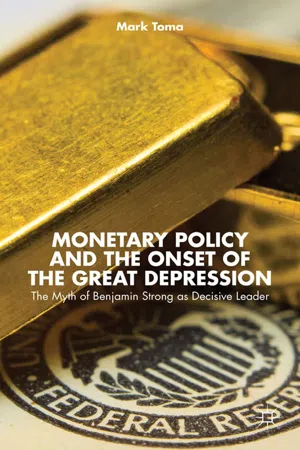
Monetary Policy and the Onset of the Great Depression
The Myth of Benjamin Strong as Decisive Leader
- English
- ePUB (mobile friendly)
- Available on iOS & Android
eBook - ePub
Monetary Policy and the Onset of the Great Depression
The Myth of Benjamin Strong as Decisive Leader
About this book
Monetary Policy and the Onset of the Great Depression challenges Milton Friedman and Anna Schwartz's now consensus view that the high tide of the Federal Reserve System in the 1920s was due to the leadership skills of Benjamin Strong, head of the Federal Reserve Bank of New York.
Information
C H A P T E R 1

MONETARY POLICY AS SCAPEGOAT
1. INTRODUCTION
The Federal Reserve of the 1920s did not mismanage money. Indeed, the Fed could not have mismanaged money even if so motivated. I am fully aware that this claim flies in the face of monetary theories of the onset of the Great Depression that have been famously advanced at various times in the past. On the Austrian side, Friedrich Hayek and, particularly, Murray Rothbard have attributed the onset to excessive money growth during the early and mid-1920s. On the Monetarist side, Milton Friedman, Anna Schwartz, and, particularly, James Hamilton have pointed to undue monetary restriction during the last two years of the 1920s. More recently, the Monetarists have been joined by the “Golden Fetterers”: the thesis that the proximate cause of the onset of the Great Depression was a too tight monetary policy attributed at a fundamental level to a stubborn refusal by nation-states to abandon the gold standard in a timely fashion—they were “fettered” by gold.1 While differing in the details, all camps share the thesis that money matters. That is, the rate at which the money supply grows, as established by central banks, determines the rate at which the price level grows in the long run and influences the rate at which real income grows, or does not grow, in the short run.
My intent in this book is to explain and document a flaw in the theories underlying both the “too much” and “too little” sides of the debate. To state things colloquially, monetary policy in the 1920s has been made a scapegoat. In the United States, Reserve banks and the gold standard setting within which they were situated have been falsely accused. The Federal Reserve of the 1920s produced exactly the right amount of money.
To what do we owe this happy outcome? More than luck was involved, though there may have been a fair amount of that too. The answer can be traced back to the blueprint of the Federal Reserve System, the Federal Reserve Act, though in its original manifestation, the act was something less than an optimal blueprint. Indeed, before WWI, strict interpretation of a currency-backing clause (Federal Reserve Act, Section 16) effectively placed a strait-jacket on the Federal Reserve banks (Fishe 1991), preventing them from achieving what the preamble of the act called upon them to do: “to furnish an elastic currency.” But as the system evolved, a more liberal interpretation of the act freed Reserve banks from the strait-jacket. In the aftermath of WWI, the system was up and running, arguably, in the way the founders intended, producing neither too little nor too much money.
2. WHY MONEY WAS JUST RIGHT
What features of the Federal Reserve Act rendered monetary policy “just right” in the 1920s? To lay bare those features requires an investigation of both sides, supply and demand, of the 1920s money market. While a full-blown investigation awaits the next chapter, the outline can be presented here. The Federal Reserve Act authorized the issue of a new type of currency, the Federal Reserve note, backed by a legally binding constraint requiring the Fed to redeem those dollars on demand for gold. Actually, the act authorized 12 different currencies, each issued by one of the 12 newly created Reserve banks, each with an inscription identifying the issuing Reserve bank and each backed by the requirement that the bank of issue redeem its dollars for gold. The effect was to make the dollar of each of the Reserve banks at least as good as gold in the sense that the purchasing power of the dollar would be greater than or equal to the purchasing power of gold. Conversely, the gold price of output would be greater than or equal to the dollar price of output (the price level), leading to the powerful conclusion that there was nothing the individual Reserve banks could do to push the price level above the level established by the gold anchor. If Reserve banks tried to do so by printing and distributing new notes, the public would simply refuse to hold them. In particular, if the dollar price of output climbs above the gold price of output, then the purchasing power of the dollar falls below the purchasing power of gold, and the public would have an incentive to redeem their dollars for the more valuable gold, either at the issuing Reserve bank, or its branch, or at the US Treasury in Washington, DC.
Note, however, that redemption alone, while precluding Reserve banks from decreasing the purchasing power of the dollar, potentially leaves the Fed with one margin of influence. By refusing to accommodate the demand for Reserve bank money, currency and reserves, the Reserve banks would be able to push the purchasing power of the dollar above the purchasing power of gold. Conceptually, the Fed has the power to make currency and reserves so scarce that the value of the dollar soars above the value of gold. The public and banks bang on the Reserve banks’ doors for money, but the Reserve banks do not listen.
The conditions sufficient to render Reserve banks completely powerless to influence monetary aggregates are as follows:
1.The public must be able to redeem bank deposits into currency and currency into gold at relatively low cost.
2.Reserve banks must have an incentive to accommodate the public’s demand for currency and member banks’ demand for reserves.
3.An individual Reserve bank’s demand for gold comprises an insignificant part of the total worldwide demand for gold.
4.The individual Reserve banks do not act collusively in choosing how much gold to hold.
Condition 1 makes Fed money at least as good as gold. Condition 2, in combination with 1, makes Fed money exactly as good as gold. Conditions 3 and 4 insure that Reserve bank decisions, with respect to how much gold to hold, have no effect on the purchasing power of gold and, therefore, no effect on the overall price level. To be sure, the price level may rise or fall over time, but only if forces outside the control of the Reserve banks cause the purchasing power of gold to fall or rise.
Given conditions 1–4, the Fed is able to control neither the total amount of its monetary liabilities nor how those liabilities are divided between currency and reserves. Instead, based on the prevailing price level, the public determines their real holdings of deposits and currency by choosing their nominal holdings. Then, banks choose how many (excess) reserves to hold behind those deposits. Seemingly, the accommodating Fed is left with nothing to do.
There is, however, one margin of choice. The Reserve banks must decide how to allocate their source of funds, currency and reserves, across possible assets: gold, government securities, and discount loans. The latter two are the Reserve banks’ earning assets that constitute Federal Reserve credit. Since, as an accounting identity, total assets must equal total liabilities, and since in the current setting, total liabilities are determined by the general public and banks, the Reserve banks’ asset allocation decisions (gold versus Fed credit) have no special monetary significance. A Reserve bank decision to increase Fed credit is a decision to decrease gold reserves with no effect on the monetary base (currency and reserves). But there is nothing significant about highlighting Fed credit in this setting. A Reserve bank decision to increase one component of Fed credit, say government security holdings, is a decision to decrease the sum of gold holdings and discount loans with no effect on the monetary base. Conceptually, there are innumerable ways that gold, government securities, and discount loans can be combined to back up the given level of the monetary base. The particular mix chosen by Reserve banks does not matter from a monetary economic perspective.
The irrelevancy of Fed credit is an important but, I would argue, almost universally denied conclusion. Indeed, it is not too much of an exaggeration to claim that Friedman and Schwartz’s masterpiece, A Monetary History of the United States (1971), can be read as a monument to the theme that Fed credit, and only Fed credit, matters. For this reason, further commentary seems justified. I suggest that the mistake made by Friedman and Schwartz, as well as other modern monetary economists analyzing the early Fed, was to (subconsciously?) apply a modern fiat money model to a gold standard setting. If an effective gold anchor is absent, then the public’s nominal demands for currency and deposits are free floating. If the Fed decides to increase Fed credit, say by purchasing government securities, then the public deposits the new dollars in their pockets as currency or in their banks as reserves, the reserves serving as the base for a further increase in deposits. These new dollars are willingly held because the price level moves up hand-in-hand. There is no offsetting decrease in either of the other assets of the Fed, gold and discount loans, implying that the open market operation is associated with an increase in overall assets and liabilities of the Fed. Here, the chain of causation runs from open market operations to Fed credit to monetary base to the price level. Open market operations are important because they affect nominal values. Note, also, that open market operations are associated with a change in the gold ratio, the ratio between gold and the Fed’s monetary liabilities, so that by purchasing government securities the Fed is choosing to reduce the gold ratio and expand the money supply. Is it any surprise, then, that Friedman and Schwartz devote a good part of their Monetary History to documenting movements in Fed credit and in the Fed’s gold ratio?
My point is that nominal magnitudes were not free floating in the monetary environment of the 1920s. The supply and demand for gold determined the price level, the public determined real money holdings, and, given an accommodative Fed, nominal values were determined residually. Return to the open market operation example. A Fed decision to purchase government securities with newly created dollars temporarily increases the real amount of deposits and currency above the amount the public desires. Someone, somewhere in the economy will transform the excess into gold by, for example, withdrawing cash from their checking account, or from their pocket, and redeeming the cash for gold. The increase in Fed credit has been accompanied by a decrease in Fed gold, with the nominal value of the Fed’s total assets and liabilities unaffected. Alternatively, the Fed may combine the open market purchase with a decrease in discount loans giving the same result: the Fed’s total assets and liabilities are unaffected.
At this point the temptation is to conclude that the mix of Fed assets is indeterminate and that the move out of one and into another asset should be of no interest to a money/macro economist employed at a Reserve bank. To a Fed manager, however, the composition of Reserve bank assets would matter. In the 1920s each Reserve bank faced a bottom-line, each had to cover costs. This financing constraint ruled out some asset combinations. For instance, Reserve banks would be unable to back up their monetary liabilities with 100 percent gold, since no revenue would be generated to cover expenses. At the other extreme, refusing to hold any gold would also not be a viable option. As discussed in detail in chapter 4, with zero gold reserves, the (liquidity) costs of abiding by the legal requirement to redeem currency into gold would tend to be prohibitively high. The upshot is that the gold reserve ratio is bounded by lower and upper limits. While not having broader macroeconomic implications, the ratio does have net revenue implications for the Reserve banks, and therefore will be of more than passing interest to Reserve bank managers.
3. GOLDEN FETTERS
But what about the golden fetters? Let’s grant for the sake of argument that the Fed of the 1920s accommodated monetary demand, given the general price level. But changes in supply and demand conditions in the market for gold would result in a moving anchor for the price level. The particular concern in the golden fetters’ camp is that increases in the worldwide demand for gold during the interwar period increased the purchasing power of gold resulting in worldwide deflation. Only those countries that abandoned the gold standard early-on were able to escape deflation’s ravages on the real economy.
Several issues are raised by the golden fetters thesis. First, the possibility of a moving price anchor does not overturn the conclusion that the Fed of the 1920s was structured in a way that stripped the individual Reserve banks of any power to produce a monetary policy that was too tight or too easy. As price-takers, individual Reserve banks respond to an increase in the price of gold by economizing their gold holdings; that is, they substitute Fed credit for gold, thereby changing the composition of the monetary base. True, the nominal size of the Fed’s balance sheet shrinks as the private sector, seeking to preserve real values, responds to the fall in prices by reducing its nominal demand for currency and reserves. But, as before, Reserve banks passively accommodate demand.
Of course, this picture of powerless Reserve banks presumes that they are price-takers: they do not act jointly. If, instead, the Reserve banking system is better viewed as a unified system, then Reserve banks may have the power to affect demand conditions in the gold market and thereby the general price level. So, here a clear distinction emerges between my thesis of monetary policy as scapegoat and the golden fetters thesis. The scapegoat thesis sees intense rivalry among Reserve banks while the golden fetters thesis sees a unified Fed. As the challenger, the burden of proof rightly lies on my side. One of my goals in this book is to demonstrate that inter-Reserve bank competitive pressures rendered collusive, cooperative behavior among Reserve banks unlikely.
Finally, we get to the main golden fetters issue. Maybe Reserve banks were not powerful. Maybe Reserve banks did not comprise a unified system. Still, the scramble for gold in the 1920s caused a deflation that had a profoundly depressing effect on real economies worldwide. That is, the deflation had a depressing effect on those economies that stubbornly clung to the gold standard. According to the golden fetters thesis, monetary policy is not a scapegoat. Choosing to cling, or not cling, to the gold standard is a policy decision, a monetary policy decision. The clingers found themselves rushing head-on into the Great Depression. The nonclingers were able to sidestep the brunt of the impact. Monetary policy in this sense was all-important.
Even here, my inclination is to cry-out, scapegoat. My concern is that the golden fetters’ side too quickly constructs a causal-bridge from deflation to the real economy. Deflation means falling prices, not necessarily falling output. Depending on the context, some episodes of deflation are benign and some harmful.
The critical factor that decides the issue is whether deflationary pressures are unanticipated or anticipated. Sudden, surprise deflation, by upsetting the plans of economic agents, most likely does have significant, real negative consequences; gradual, expected deflation less so. With respect to the late 1920s, when the source of deflationary pressures was the return of nation-states to gold, deflationary pressures were more of the second type. Gold restoration started picking up steam in 1924: among core countries, the first to return was Germany (1924), then England (1925), and later France (1928). As each of the core countries rejoined, colonial noncore nations soon followed. There was nothing particularly surprising about the timing and sequence of core and noncore countries return to gold. Indeed, the timing and sequence of return was a subject of much discussion and analysis throughout the decade. On this basis, it seems a bit far-fetched to argue that ongoing deflation in the mid- and late-1920s caught the public by surprise. If we want to assign blame, we must search elsewhere. Golden fetters were not responsible for the onset of the Great Depression.
4. A LOOK AHEAD
The agenda for the remainder of the book is ambitious: build and test a model of the early Federal Reserve System that is consistent with the thesis that the onset of the Great Depression cannot be attributed to an activist policy of monetary mismanagement commonly understood as either too much or too little money. The assumptions of the basic model are motivated by an examination in chapter 2 of the Federal Reserve Act of 1913, which esta...
Table of contents
- Cover
- Title
- 1 Monetary Policy as Scapegoat
- 2 Founding of the Federal Reserve System
- 3 Beyond the Founders’ Vision: Benjamin Strong as Decisive Leader or Figurehead?
- 4 Modeling Discretion and Self-Regulation
- 5 The Riefler-Burgess Doctrine
- 6 Coming to Terms with the Scissors Effect
- 7 Austrian and Monetarist Theories of the Onset of the Great Depression
- 8 Coming to Terms with Benjamin Strong
- 9 Did Reserve Banks Really Compete?
- 10 The Seductiveness of the Decisive Leader View
- Epilogue
- Appendix
- Notes
- Works Cited
- Index
Trusted by 375,005 students
Access to over 1.5 million titles for a fair monthly price.
Study more efficiently using our study tools.
Frequently asked questions
Yes, you can cancel anytime from the Subscription tab in your account settings on the Perlego website. Your subscription will stay active until the end of your current billing period. Learn how to cancel your subscription
No, books cannot be downloaded as external files, such as PDFs, for use outside of Perlego. However, you can download books within the Perlego app for offline reading on mobile or tablet. Learn how to download books offline
Perlego offers two plans: Essential and Complete
- Essential is ideal for learners and professionals who enjoy exploring a wide range of subjects. Access the Essential Library with 800,000+ trusted titles and best-sellers across business, personal growth, and the humanities. Includes unlimited reading time and Standard Read Aloud voice.
- Complete: Perfect for advanced learners and researchers needing full, unrestricted access. Unlock 1.5M+ books across hundreds of subjects, including academic and specialized titles. The Complete Plan also includes advanced features like Premium Read Aloud and Research Assistant.
We are an online textbook subscription service, where you can get access to an entire online library for less than the price of a single book per month. With over 1.5 million books across 990+ topics, we’ve got you covered! Learn about our mission
Look out for the read-aloud symbol on your next book to see if you can listen to it. The read-aloud tool reads text aloud for you, highlighting the text as it is being read. You can pause it, speed it up and slow it down. Learn more about Read Aloud
Yes! You can use the Perlego app on both iOS and Android devices to read anytime, anywhere — even offline. Perfect for commutes or when you’re on the go.
Please note we cannot support devices running on iOS 13 and Android 7 or earlier. Learn more about using the app
Please note we cannot support devices running on iOS 13 and Android 7 or earlier. Learn more about using the app
Yes, you can access Monetary Policy and the Onset of the Great Depression by M. Toma in PDF and/or ePUB format, as well as other popular books in Economics & Economic History. We have over 1.5 million books available in our catalogue for you to explore.