- English
- ePUB (mobile friendly)
- Available on iOS & Android
eBook - ePub
About this book
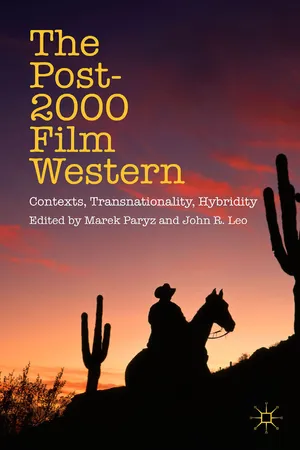
This collection explores the post-2000 film Western. With examples ranging from major American films, through acclaimed international productions, to works such as experimental films and television commercials, the contributors seek to account for the appeal and currency of the film Western today.
Information
Subtopic
Art GeneralPart I
The Western “At Home”: Dialogues with the Tradition
1
“Is There Actually Any Jiménez?”: Believing as Seeing in The Three Burials of Melquiades Estrada
Lee Clark Mitchell
No other film since John Ford’s The Man Who Shot Liberty Valance (1962) has offered so sustained a rumination on the classic Western as Tommy Lee Jones’s The Three Burials of Melquiades Estrada (2005). Yet unlike its predecessor, Jones’s film seems hardly a Western at all, with neither nostalgia for a simpler past, nor investment in the triumph of law and order, nor contemplation of the redemptive power of violence, nor (most importantly) attention to appropriate forms of masculine behavior. All those aspects familiar to the genre are absent—aspects that Ford’s film embodies in the coffin holding the dearly departed John Wayne, representing the death of Western heroism itself, resuscitated in the long flashback that forms the film’s central narrative. Yet four decades later, after hundreds of reinventions, the corpse of the Western is harder to revive. And perhaps for that reason, Jones begins in a more fragmented fashion, presenting a series of random gestures that remind us vaguely of the genre yet fail to contribute to a coherent narrative. Even the meaning of the central event, the shooting of Melquiades Estrada (Julio Cedillo), is left indeterminate. Only as his best friend, the rancher Pete Perkins (Tommy Lee Jones), seizes control of these disparate scenes does the narrative coalesce. After he abducts the guilty border patrolman and compels him to return the corpse to its Mexican home for proper burial, the disconnected materials of the film’s first half come together as a resurrection of the Western itself. In this, the film resuscitates stock materials long since drained of imaginative life, as Ford’s masterpiece had done, affirming anew in the process how fully a genre’s conventions themselves create the facts that confirm its informing myth.1
Key to the film’s Western ambitions is its strangely split structure, with a first half of bewildering flashbacks and scenes fractured from different angles, then a second that suddenly shifts into a familiar chronological flow, as if the prospect of viable narrative all of a sudden has mysteriously appeared. Following the credit sequence, the film opens with a corpse on an autopsy table, a man named Melquiades whom we discover has been shot for no reason at all.2 And although the ensuing mélange of scenes defies our effort to understand that murder, isolated events become shaped by formulaic conventions into a familiar Western trajectory. Surprisingly, however, we discover belatedly how fully expectations have been upended by facts, even in the fulfillment of a solemn Western vow to return a dead body home, validating ritual codes. For Jones swerves suddenly at the end to cast doubt on that alleged “home,” and thereby on all we have seen. Why else are we left to wonder if Melquiades’s identification of Jiménez was a lie? Is this “return” to a place that everything suggests is not his home a testament to our belief despite the facts?
Such questions notwithstanding, what does remain clear is that dead as the classic Western may appear to be, our own residual faith in the genre brings it alive once again. It is as if Melquiades Estrada’s body comes to represent the very conventions to which the film pays homage, in first being simply covered up, then officially interred and finally invested with a mythic resonance through restoration to native soil. Gradually, dislocated scenes pull together (as if despite themselves), enforcing a generic structure not quite warranted by the sequence we are given: of west Texas landscapes posed against small-town civic tension; of celebrations of male camaraderie clashing with challenges to loyalty and honor; of frustration with justice in the absence of legal remedy. While such staples of the Western seem in this film at first unintelligible, the forced march of its second half defines a narrative trajectory that elicits meaning from incoherence, replicating John Ford’s triumph in celebrating a genre he simultaneously deconstructs. For in the absence of any confidence that Melquiades has finally been buried at “home,” we are left wondering at a narrative that has led us to believe in generic resolution based on little more than generic constraints themselves.
Fragmentation, “For Nothing”
Director Tommy Lee Jones delighted in his film’s defiance of narrative structure: “If you turn the movie sound off and just watch the movement of it and try to look at it the way a dog or a bird would, not recognize any shapes, it’s quite pleasing, it’s a balletic event. It moves beautifully, the shapes, and colors have an abstraction” (“Bonus Feature”). Yet even with the sound on, the “beautiful delicate colors” (“Bonus Feature”) that Jones admires are drained of meaning by the film’s disruption of narrative sequence, through the flashbacks and maddeningly varied perspectives devised by Guillermo Arriaga in his brilliant screenplay.3 Douglas Pye observes that “the fragmentation of our experience (39 scenes in 54 minutes, with constant movement between past and present) provides brief snapshots of a society that lacks any cohesiveness. We see several locations but have no sense of their spatial relationship to one another” (3). And he adds that a “further effect of the fragmented and elliptical first half is to enable the film to restrict access to context and motive without obviously doing so” (3). Pye’s shrewd assessment of the film’s sleight of hand is worth pursuing more specifically with Melquiades’s first appearance at Perkins’s ranch, followed by the brief five-second scene of the killer, Mike Norton (Barry Pepper), burying him the first time. Yet we are unaware that this is Norton since the figure is seen from behind, nor even that it is the corpse of Melquiades (though the film’s title should clue us in). Immediately, Pete appears in front of the hospital after viewing the corpse (even that temporal progression is unclear at first), causing us to wonder whether this first burial is only Pete’s memory, since he appears right after (even as we soon realize this could not have been). Pausing here, stymied by the exchange with Sheriff Frank Belmont (Dwight Yoakum), we can only gather the intense emotional effect the death has had on Pete, without comprehending why.
Soon after, possibilities simply clash. Pete walks into the Sands Motel Restaurant to query a border agent about his favored rifle round, only to be followed by Norton walking out of that same restaurant prior to killing Melquiades. Or later, a simple one-second flashback occurs as Norton watches his wife strut into the Odessa mall while he recalls the dead Melquiades. In each case, narrative continuity is sacrificed for a dissociated scene. Moreover, the meanings of these scenes are eerily transformed by the frequency with which they are shot in close-up, often gradually intensified (whether Norton, Pete or Belmont), as if a focus on faces might offer a clue to character, in expressions of regret and intent, of decisiveness or impassivity. Occasionally, we are simply confused by such sequences, as in the strange two-shot of Pete and Lou Ann Norton (January Jones), after he has abducted her husband and bound her, both now facing the camera in a sequence that seems as much kind hospitality as admonitory threat.
Had Arriago settled for a more conventional screenplay, he would have simply unraveled the knotted chronology of the film’s first half, beginning some months before the killing and alternating in a routine chronological manner between Pete’s first meeting with Melquiades and the Nortons’ arrival in the Permian Basin town. The budding friendship between rancher and Mexican hand might have played out against the gradual estrangement of the displaced Cincinnati couple, while the side story of the waitress Rachel (Melissa Leo) and her running affairs with Pete and Belmont would have woven through the narrative. Yet Arriaga structured the screenplay to avoid any such typical strategy, in an effort to drain away the cumulative investment we otherwise feel in these separate relationships. It is as if he wanted to counter the normal course of understanding by isolating characters from the sequence of their lives, attenuating any insight into personalities by focusing on isolated moments plucked from a larger interpretive order. The swelling arc of Pete and Melquiades’s friendship, like the gradual dissolution of the Nortons’ marriage, does not quite refuse to matter in Arriaga’s screenplay, but it seems less compelling in terms of the narrative than other patterns and moments. That helps to explain why scenes are so often repeated or later filled in, offered from different perspectives or otherwise redacted. Take the tabloid television show of Johnny confronting his wife about their fraught marriage, which appears a few days before Melquiades’s death and then three weeks later in a rebroadcast south of the border. In the first, Norton is unaware, mounting his bored wife from behind as she watches the estranged couple; in the second, watching the show with amused Mexicans alongside the road, Norton cries tearfully. That transition, however, seems simply silly and sentimental, part of pop cultural inanity, and certainly revealing nothing of Norton’s psychology, before or after. Other actions in the film function likewise, often replicated by different characters at different moments, even lending a certain recognizable pattern to events, though they fail to furnish any greater insight into motive or intent. Mike Norton races after two illegals, beating them brutally into submission in a scene echoed later by Pete, riding after Norton himself, tracking him down. At one point early in his own pursuit, Sheriff Belmont carefully takes aim at Pete riding off with his captive, only to decide not to pull the trigger—again, a scene replicated almost exactly in Pete’s later decision not to shoot Mike as he scrambles to escape. Earlier, Pete callously slams Norton’s face against his truck, then again later whacks him in the nose when taking his boots, both of which correspond to Norton’s breaking of the illegal Mariana’s nose as she tries to escape the border patrol—and her own later smashing a coffee jug into his face for revenge. It is as if, in each exact repetition, behavior were being revealed as somehow derivative, even clichéd, exposing a certain impersonal quality to events that simply reproduce an earlier pattern.
The deliberate fragmentation and selective repetition of Arriago’s script has the effect of draining interest in the customary developments of relationships, concentrating attention instead on the central death itself, as if anticipating it, recalling it, trying to make sense of it—with the actual killing itself given to us only 40 minutes in. Even a brief flashback to Norton bending over Melquiades’s bloodied body with his own bloodied hands (the flashback that torments Norton at the Odessa mall) occurs immediately prior to a sequence of Lou Ann a week earlier as part of a foursome with Melquiades, happily dancing in his arms to a Freddy Fender song. Again, the emphasis is less on loss of affection for Mike than on the presence (and absence) of Melquiades himself. More importantly, the scenes expose the stark chasm that lurks beneath the surface of relationships, adding to the weight of Melquiades’s death, central to all that occurs. Tommy Lee Jones observed that “If you read this script, really it doesn’t look like anybody’s saying anything that actually matters” (“Bonus Feature”). And the dialogue endorses his assessment, in the strained relationships in which even basic understanding is unacknowledged. Notably, Sheriff Burnett and Pete never concede their mutual involvement with Rachel. More eerily, Pete refuses to reveal he knows Lou Ann, both having spent convivial time as a foursome with Rachel and Melquiades. When he finally breaks into the Nortons’ trailer to drag Mike away, his declaration to her is mercilessly blunt: “You scream again I’ll kill you.” Adding to this strange ruthlessness, he answers in Spanish her query about what her husband did (“él mató Melquiades Estrada”), though he knows she speaks no Spanish. In fact, the Nortons’ ignorance of all things Hispanic reinforces a lack of acknowledgment that occurs throughout the film, mirrored in Melquiades’s own minimally broken English. Pete alone is perfectly bilingual, at home in both linguistic worlds, although the film suggests that such knowledge is hardly essential to acknowledgment, even sympathy. As the blind old man (Levon Helm) explains to Pete when they arrive at his desert homestead: “I like listening to this Mexican radio station. I can’t understand anything, but I like the way Spanish sounds, don’t you.” Later, in another scenic repetition, this sentiment will silently be endorsed by four Mexicans watching reality TV on the trail, not understanding a word they hear but enthralled nonetheless.
The film seamlessly alternates between English and Spanish (signaled by subtitles), and does so as a means of reinforcing yet questioning border constraints, but also to augment a more general inscrutability of character. Lou Ann best embodies this “difficulty of knowing other people” (Pye 4), not only as isolated outsider or as a character limited by language but more importantly as a figure unclear about her own desires. Despite the film’s dislocations, her evolving consciousness gradually emerges via muted expressions, as she eyes an overweight woman in a two-piece squeezing into her trailer. That explains her earlier comment to Mike that she feels fat “a little bit,” as we suppose her imagining herself in west Texas 20 years on. Later, sitting with Mike outside their trailer at dusk, she wordlessly reaches out with a mournful look, even though she is unaware that Melquiades is dead, her husband the killer. Two scenes later again, Rachel nods to Lou Ann in the restaurant in silent assent about her marriage to Bob. All is meant to explain why she might be willing to stray in her marriage, though not quite enough to explain why she goes with Melquiades. After Mike is abducted by Pete, Lou Ann disappears from the film for half an hour only to appear in the restaurant to tell Rachel “I hate this place.” Next, she leaves town on a bus, heading back to Cincinnati as Mike is driven south to Mexico. The transition from initially content home-buyer to disaffected woman only a few months later is presented as at once strange and predictable, with Lou Ann unable to articulate her own feelings or otherwise to understand her life.
More generally, characters seem unknowable, acting out of inexplicable anger (explaining Mike’s life) or boredom (Rachel’s) or some deep sense of nostalgia (which seems to explain Pete), but otherwise remaining mysterious to the viewer. And the most dramatic mystery is represented by Melquiades, who claims to have left his wife and children five years before he describes them to Pete—though we later discover he may have had no family at all. It is as if history had become irrelevant, as if memory were made up, for reasons never clear. In that regard, Melquiades seems only a more extreme version of nearly everyone else in a film that offers character types we recognize but in a plot whose lack of sequence compels us to register scenes as simply a series of discrete moments and distinctive gestures. The fact that those gestures are generic, reminding us of nothing so much as the classic Western—of shoot-outs and transcendent landscapes, fraught encounters with law coupled with issues of masculine self-construction—becomes itself the film’s most distinctive and ingenious premise.
Deconstructing the Western
The Three Burials of Melquiades Estrada comes at the end of a long line of Westerns, though it refuses to follow other twenty-first-century examples that rearrange familiar generic materials in innovative ways—Billy Bob Thornton’s All the Pretty Horses (2000), Ang Lee’s Brokeback Mountain (2005)—or that more simply update earlier films—Andrew Dominik’s The Assassination of Jesse James by the Coward Bob Ford (2007), James Mangold’s 3:10 to Yuma (2007). Guillermo Arriaga’s script instead engages the essential features of the genre by inventively avoiding a narrative sequence we might recognize as Western and presenting instead a series of gestures and scenes that lure us into imposing a mythic plot on materials. The film introduces this deconstruction initially through framing itself, following a series of unremarkable scenes that begins with the credit sequence of a coyote shot as it feeds on something half-buried; then, a gray-lit autopsy of a corpse, followed by the Nortons’ bland encounter with a realtor selling them a trailer home; and last, a brief encounter between Pete and Sheriff Belmont outside the hospital. These scenes all seem random, disconnected and unexplained, before the cinematographer, Chris Menges, frames the first encounter of Pete and Melquiades, in a sequence that quotes the opening and closing shots of John Ford’s The Searchers (1956): of Melquiades on a horse viewed from a dark interior perspective out beyond barn doors. It is as if cinematography itself established the classic prism of the Western through which the scene needed to be interpreted, of natural landscape framed by domestic structures that the archetypical horseman cannot enter.
Thereafter, that perceptual prism shifts from framing to color, in precisely the fashion that Jones himself noted in speaking of the film’s abstract beauty, but also as a contrast between leaden interiors and colorful landscapes, New West and Old. Repeatedly, indoor scenes are lit with fluorescent lighting that lends them a blue, cold, stark sensibility, as if to accentuate the transition of wide-open landscape to shabby double-wides, cinder-block motels and lackluster lives. As soon as one ventures out, however, the camera captures the rich hues of the trans-Pecos panorama, its luminescent sunsets and redemptive scenery. The film is regularly broken up this way, whether it is Pete and Melquiades holding the photo of the latter’s family against an opulent natural...
Table of contents
- Cover
- Title Page
- Copyright
- Contents
- Acknowledgments
- Notes on Editors
- Notes on Contributors
- Introduction
- Part I: The Western “At Home”: Dialogues with the Tradition
- Part II: The Western “Abroad”: Transnational Variations
- Part III: The Western “Out There”: The Allure of the Fantastic
- Part IV: The Western “Elsewhere”: Classic Inspirations and New Technologies
- Index
Trusted by 375,005 students
Access to over 1.5 million titles for a fair monthly price.
Study more efficiently using our study tools.
Frequently asked questions
Yes, you can cancel anytime from the Subscription tab in your account settings on the Perlego website. Your subscription will stay active until the end of your current billing period. Learn how to cancel your subscription
No, books cannot be downloaded as external files, such as PDFs, for use outside of Perlego. However, you can download books within the Perlego app for offline reading on mobile or tablet. Learn how to download books offline
Perlego offers two plans: Essential and Complete
- Essential is ideal for learners and professionals who enjoy exploring a wide range of subjects. Access the Essential Library with 800,000+ trusted titles and best-sellers across business, personal growth, and the humanities. Includes unlimited reading time and Standard Read Aloud voice.
- Complete: Perfect for advanced learners and researchers needing full, unrestricted access. Unlock 1.5M+ books across hundreds of subjects, including academic and specialized titles. The Complete Plan also includes advanced features like Premium Read Aloud and Research Assistant.
We are an online textbook subscription service, where you can get access to an entire online library for less than the price of a single book per month. With over 1.5 million books across 990+ topics, we’ve got you covered! Learn about our mission
Look out for the read-aloud symbol on your next book to see if you can listen to it. The read-aloud tool reads text aloud for you, highlighting the text as it is being read. You can pause it, speed it up and slow it down. Learn more about Read Aloud
Yes! You can use the Perlego app on both iOS and Android devices to read anytime, anywhere — even offline. Perfect for commutes or when you’re on the go.
Please note we cannot support devices running on iOS 13 and Android 7 or earlier. Learn more about using the app
Please note we cannot support devices running on iOS 13 and Android 7 or earlier. Learn more about using the app
Yes, you can access The Post-2000 Film Western by M. Paryz, J. Leo, M. Paryz,J. Leo in PDF and/or ePUB format, as well as other popular books in Media & Performing Arts & Art General. We have over 1.5 million books available in our catalogue for you to explore.