- English
- ePUB (mobile friendly)
- Available on iOS & Android
eBook - ePub
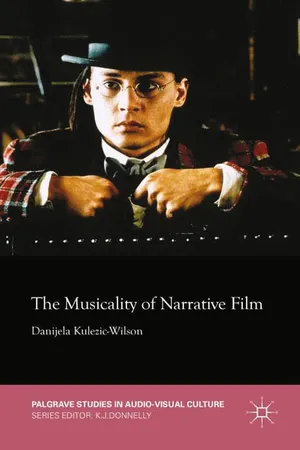
The Musicality of Narrative Film
About this book
The Musicality of Narrative Film is the first book to examine in depth the film/music analogy. Using comparative analysis, Kulezic-Wilson explores film's musical potential, arguing that film's musicality can be achieved through various cinematic devices, with or without music.
Information
Subtopic
Art GeneralPart I
The Topography of Film Musicality
1
Introduction
‘Film is like music’, we often hear. It is one of cinema’s most enduring analogies and is usually understood simply as a metaphor. Yet, since its birth, film has not only been compared to music, but it has also been explained through the use of musical terms and even conceived and structured using music as a model. From the French school of Impressionists to the MTV generation of directors, filmmakers as diverse as Sergei Eisenstein, Jean-Luc Godard, Sergio Leone, David Lynch, Stanley Kubrick, Martin Scorsese, Mike Figgis and many others have been inspired by music and stimulated to think about film in musical terms. While it is now accepted that at the very beginning the comparison with music was motivated by the need to challenge the general view of film as cheap entertainment and to demonstrate its artistic importance, what inspired this comparison in the first place is the fact that both music and film are arts that unfold in time, generating a sense of movement and rhythm. Over the years, various interpretations and versions of the ‘musical metaphor’ applied to film have appeared in both theory and practice, but in the last few decades this idea received fresh impetus thanks to a new generation of filmmakers whose notable musical sensibility is not only displayed in carefully assembled soundtracks or musically edited sequences but also in the internal logic of their films. However, despite its high-profile advocates among practitioners, the idea of film musicality has never been explored with a fully-developed theoretical argument which would justify filmmakers’ enthusiasm for comparing film to music and provide evidence that film’s musical qualities are not only metaphorical. This book intends to do precisely that by conducting a thorough comparative analysis of the common denominators shared by these two arts – time, rhythm and movement – exploring both the depth and the limits of the film/music analogy.
To allay any scepticism I should promptly add that, while this book examines the indisputable similarities between film and music and the numerous ways in which they have influenced both theoretical and practical aspects of filmmaking, I do not suggest that film, particularly narrative film, is musical per se nor will I try to argue here that any motion picture is musical just because it unfolds in time, creating a certain sense of movement and rhythm. The existence of common features between music and film, however, suggests that film is potentially very musical. This potential, which is of a composite, audio-visual nature, can be fulfilled and enhanced by employing different filmmaking strategies and devices such as the organization of the mise-en-scène, camera movement, movement within a shot, editing, sound design and music itself. Basically, any aspect of film’s audio-visual texture that may invest the parameters of time, rhythm and movement with musical qualities can be considered a carrier of film’s musicality.
At the same time, since rhythm, movement and time in film are part of an audio-visual texture which is defined by the presence of sound and music as much as by the content of the images, music and film can be viewed as partners in a relationship that can be explored in both analogous as well as interactive terms. Thus one of this book’s aims is to maintain what I perceive to be a necessary balance between two paths of inquiry: one which will examine the enduring idea of music as a model for film, and the other which will address music’s role in realizing film’s own musical potential by exploring its contribution to and influence on film rhythm, movement and time as subjects of comparative analysis. What is emphasized in this context are the sensual and aesthetic aspects of film and their ability to produce the effects of fluency, immediacy and affectiveness similar to those found in music. All this means that the presence of music in film will be explored in this book from a perspective that differs from the usual historical, semiotic, musicological or cultural approaches and will instead focus on different roles that music plays in enabling film to realize its own musical potential.
The recognition of this potential is not the sole purpose of this book. Another aim which ranges beyond familiar topics of film music scholarship is to treat the soundtrack in its totality – speech and sound effects included – as a significant and potentially as effective a source of musicality as composed or pre-existing scores might be.1 This is only natural considering that in the musical approach to film the notion of music as an ingredient which is added to film in post-production to enhance its various features has been replaced with a practice in which the boundaries between the score, sound effects, speech and noise are significantly blurred, while also allowing editing, camera movement or movement within the shot, narrative rhythm and acting to express their own musical rhythm and fluency. Consequently, I will argue that the dedicated utilization of musical principles in film not only breaks traditional hierarchical relationships established in classical narrative between speech, music and sound effects but has also contributed significantly to the recent changes in contemporary cinema’s audio-visual aesthetics, indicating a shift from the habitual segregation of the visual and sonic aspects of film towards a practice which recognizes their interdependence in realizing film’s musicality. My case studies will also show that the dominance of musical logic in this type of approach to film can lead to the abandonment of classical narrative rules altogether – even when it involves directors who normally abide by them – steering the form towards a reflexive and/or highly stylized, rhythmicized structure, fluent movement and musicalized sound design as the most effective vehicles for exploring the sensual side of cinema.
What is musical(ity)?
In the most basic sense, the word ‘musical’ is an adjective that describes something relating to or producing music, but also something ‘sounding pleasant and melodious’. It can also mean ‘being good at music’ for which the psychology of music also uses the term ‘musicality’. However, even in the narrow field of music psychology the concept of musicality can still provoke debate with questions of whether being musical marks a creative or interpretative talent, whether the investigation of musicality should focus more on acoustic properties or the emotional side of the musical experience, whether the possession of musical abilities presumes an understanding of musical (aesthetic) content, and so on (Revez, 1947). Moreover, the concept of ‘being musical’ supposes the existence of its antithesis in the concept of being ‘unmusical’, which challenges one of the oldest views on musicality voiced by Plato. In his Phaedo, Plato comments on musicality not as a property of individuals but as an essential attribute of the human species. As Zuckerkandl explains,
the implication is not that some men are musical while others are not, but that man is a musical animal, that is, a being predisposed to music and in need of music, a being that for its full realization must express itself in tones and owes it to itself and to the world to produce music.
(1976, pp. 7–8)
And one should bear in mind that Plato’s view of musicality originates in a time before music was established as an artistic profession, let alone a noble one.
On the other hand, the comparison with music and the use of the words ‘musical’ and ‘musicality’ in the sense of ‘being in possession of attributes typical of music’ are commonly used in many different non-musical contexts. Writers as diverse as Samuel Beckett, Paul Auster, Nick Hornby and Aaron Sorkin, for instance, have often used the musical metaphor to describe their commitment to creating melodic and rhythmic qualities in dialogue and large-scale form. And while Auster and Hornby often speak about the musicality of the writing process in purely metaphorical terms,2 in The Book of Illusions Auster also describes the acting style of the silent film actor Hector using a musical analogy. When he says that Hector’s ‘gags unfold like musical compositions, a confluence of contrasting lines and voices’ (p. 38), this echoes a noticeable tendency among actors to use comparisons with music when describing certain styles of acting, especially comic ones. The performative dimension is obviously an important factor that can lend a musical quality to spoken language – Sorkin made the same point when he said that hearing dialogue on stage during his first visit to the theatre was like a musical experience which he had been trying to recreate in his own writing (Gross, 2012). And while Sorkin might have used the analogy metaphorically, Beckett took it quite literally and reinvented modern theatre by creating plays more concerned with the sonic and musical qualities of language and the rhythm of its delivery than its denotative meaning. While this resulted in a painstaking purification of language on paper, the perceptual musical effect that Beckett strove for is ultimately dependent on the precision and virtuosity of the performers who are requested to deliver their lines at breakneck speed (Kulezic-Wilson, 2011a).
Discussing the musicality of other arts or musicality in non-musical contexts implies the possession of certain attributes that are recognized as being typical of music, but is there a quality that can be described as music’s specificity? The existence of diverse music traditions reminds us that different cultures respond to different types of music. The Western musical practice has evolved around a concept of musical time that is completely different from those typical of Asian or African practices. Between these concepts and even within them one can recognize a number of diverse approaches to the employment of rhythm, melody and harmony, different ranges of tastes and preferences.
It is also important to consider that the concept of musicality and the definition of music itself are different today from what they were, for instance, seven or eight decades ago prior to Cage’s revolutionary ideas of including indeterminacy, noise and silence into musical pieces and performances, the invention of electronic music, musique concrète,noise music and so on. It is indisputable that not all these types of music are recognized as such by the general public, so it would be wise to admit at this stage that my personal understanding of musicality is very broad, informed by a Western-centric musical education and ideas from the 1950s and 1960s avant-garde which encourage us to look for music beyond the written score and outside of the concert hall – to be open to the idea that one can find music in sounds of nature, industrial noise or everyday traffic. That being said, this ‘extended’ understanding of music, while relevant when discussing the musical qualities of the film soundtrack in its integral form (speech, music and sound effects combined), is not at all essential when addressing the musicality of other aspects of film and particularly its rhythm, movement and temporality, since these parameters are inherent to traditional concepts of music and musicality. Therefore traditional forms of music practice present a perfectly adequate starting point for asking the question: is there a certain quality of music which is independent of style and convention, whether we talk about the ritual drumming of African tribes, Indian ragas, Gregorian chants, or various forms of popular music, a quality that makes us recognize any of these performances as music even if we don’t necessarily respond to all of them with equal enthusiasm? What is indisputably musical about all these music genres and traditions?
If one takes away the idiosyncrasies of various rhythmic, harmonic and melodic approaches that are typical of different styles and traditions, what is left has certainly something to do with the kinetic and rhythmic aspects of music, a perception of movement that is inherent to the experience of listening to music. Music scholars generally agree that music is perceived as motion even though it has proved to be difficult to obtain a consensus on what might be the source of that perception. Hanslick’s famous definition of music as ‘tonally moving forms’ (1854/1986, p. 29), or ‘sounding form in motion’ (depending on the translation of the phrase tonend-bewegte Form) has been varied many times without being seriously disputed. Roger Sessions even gives movement priority over sound (‘basic ingredient of music is not so much sound as movement’, 1962, p. 18) while for Edmund Gurney, music is nothing less than ‘ideal motion’ (Zuckerkandl, 1973, p. 78). Or as David Epstein (1995, p. 5) sums it up, motion may be ‘the quintessential factor in music, the aspect of music to which all else is ultimately subservient, the aspect that in turn “moves” us in our affective experience with music’.
However, despite the general consensus that music is perceived as motion, there is also the fact that movement in music does not really fit into the concept of motion as defined by physics. More than that, the movement of music does not fit into the concept of just any movement either (more about that in Chapter 5). Rather, when Hornby, Auster and Scorsese compare the experience of reading books, acting and watching films with listening to music, they generally refer to the continuity of flow that in our minds makes certain activities similar to music, and has the same effect of immediacy. Thus, it is not only the feeling of movement but the sense of effortlessness of movement and fluidity that is the source of music’s appeal or even, as Sessions claims, the ‘essential and inherent quality of music’ (1962, p. 66).
At the same time, the sense of flow generated by music does not always imply the consistent kinetic drive typical of goal-oriented forms of Western music based on tonality. We can also sense an inherently musical type of flow in genres which produce a sense of stasis and what Jonathan Kramer (1988) calls vertical temporality, such as minimalist and ambient music. However, what makes the perception of music’s movement different from any other is that it is associated with the experience of immersivity, which relates to the concept of flow developed by the psychologist M. Csikszentmihalyi (1990). This concept refers to a state of ‘intense yet effortless involvement in activity’ and it is characterized by full concentration on the relevant stimuli, total absorption in the activity, altered perception of time and loss of self-consciousness. According to Csikszentmihalyi, flow may appear in connection with various activities, like rock climbing, sailing, dancing or performing music and it can be so enthralling that it is almost painful to interrupt it (p. 39). Although Csikszentmihalyi’s concept of flow clearly refers to an experience that originates from the personal performance of a certain activity, I would suggest that a similar experience might also be achieved due to the visceral and emotional responses elicited by the process of immersive listening to music. In fact, the absence of self-consciousness which characterizes the flow activity might connect with the state of absorption in any art, not only music. The fact that music in particular has been traditionally associated with this sense of immersivity is probably one of the reasons it has been held by many in higher regard than other arts.
Closely connected with the concept of flow is the process of transformation or morphing. In the musical context these two processes are practically inseparable from each other as the pull of music in many ways results from the fact that its flow embodies a process of change/movement which is generally associated with the experience of listening to music. From the simplest musical forms which might be based on the change of a single musical parameter to complex orchestral textures in which the process of morphing is so palpable in every aspect that it can be experienced on a visual or a spatial level, music brings the sense of transformation of sound in time. Even works which emphasize the idea of stasis and nonlinear temporality utilize the process of morphing on some level, whether rhythmical, harmonic, melodic or timbral.
Music as flow is also connected with Bergson’s concept of temp durée which is not endurance, Bergson insists, but is rather experienced as a ceaseless flow: ‘a melody to which we listen with our eyes closed and thinking about nothing else, is very close to coinciding with this time which is the very fluidity of our inner life’ (quoted in Zuckerkandl, 1973, p. 244). However, while time flows without sound or presence, leaving only a possible trace in memory, the flow of music occupies the present with its sound, anticipates the future and uses the past to reveal its temporal Gestalt. Although as elusive as flow is by definition, music nevertheless displays an ability to inspire and move that exceeds the power of any other art. At the same time that very fluidity is what invites the comparison between film and music.
The notion of film musicality, however, is not widely recognized in film practice or scholarship and is certainly not characteristic of the mainstream film industry. Apart from Noël Burch’s Theory of Film Practice (1969/1973), which explores the influence of the concepts of atonality and musical serialism on cinema, and David Bordwell’s article on film/music analogies from 1980, film theory has not paid much attention to the practice of adopting musical principles in filmmaking. Its cause was certainly not helped by the fact that in the same year in which Bordwell’s article called for the ‘persistence’ of the musical analogy, Burch expressed ‘embarrassment’ with his theory in his forward to the second edition of Theory of Film Practice in English (1981, pp. vi–vii), denouncing its formalism, elitisms, ‘musicalism’ and ‘flight from meaning’. It is maybe no surprise then that, even though this direction has been identified by other scholars as a potentially rich source of knowledge about film (Cook, 1998; Donnelly, 2013, 2014), hardly any research has been done in this area. If the significance of music for film has begun to be recognized in the last few decades, it has primarily come from scholarship focused on the role of music within a narrative. However, the connections between music and film are more subtle and complex than those that can be identified by the analysis of a film’s diegetic or non-diegetic music and its narrative functions. The fact that film shares the features of time, rhythm and movement with music suggests that the depth and nature of that connection surpass the interactive relationship between visual content and the music that accompanies it. It also provides the opportunity to explore the actual degree of correspondence between these two arts.
Comparison of the common parameters between music and film also includes applying some musical criteria to film in order to examine how much certain characteristics typical of music can be found in different creative processes of filmmaking and in the final product. And since film is an audio-visual medium that includes music as part of its content and structure, an exploration of the interactive relationships between music and film has to be part of the equation. I see these comparative and interactive aspects of analysis as complementary because the former provides the theoretical basis for exploring film’s musical potential, while the latter addresses the matter of realizing that potential. I believe that this conceptual framework supplies an ...
Table of contents
- Cover
- Title Page
- Copyright
- Contents
- List of Figures
- Acknowledgements
- Part I: The Topography of Film Musicality
- Part II: Comparative Analysis of Music and Film
- Part III: Case Studies
- Conclusion
- Notes
- Bibliography
- Filmography
- Index
Trusted by 375,005 students
Access to over 1.5 million titles for a fair monthly price.
Study more efficiently using our study tools.
Frequently asked questions
Yes, you can cancel anytime from the Subscription tab in your account settings on the Perlego website. Your subscription will stay active until the end of your current billing period. Learn how to cancel your subscription
No, books cannot be downloaded as external files, such as PDFs, for use outside of Perlego. However, you can download books within the Perlego app for offline reading on mobile or tablet. Learn how to download books offline
Perlego offers two plans: Essential and Complete
- Essential is ideal for learners and professionals who enjoy exploring a wide range of subjects. Access the Essential Library with 800,000+ trusted titles and best-sellers across business, personal growth, and the humanities. Includes unlimited reading time and Standard Read Aloud voice.
- Complete: Perfect for advanced learners and researchers needing full, unrestricted access. Unlock 1.5M+ books across hundreds of subjects, including academic and specialized titles. The Complete Plan also includes advanced features like Premium Read Aloud and Research Assistant.
We are an online textbook subscription service, where you can get access to an entire online library for less than the price of a single book per month. With over 1.5 million books across 990+ topics, we’ve got you covered! Learn about our mission
Look out for the read-aloud symbol on your next book to see if you can listen to it. The read-aloud tool reads text aloud for you, highlighting the text as it is being read. You can pause it, speed it up and slow it down. Learn more about Read Aloud
Yes! You can use the Perlego app on both iOS and Android devices to read anytime, anywhere — even offline. Perfect for commutes or when you’re on the go.
Please note we cannot support devices running on iOS 13 and Android 7 or earlier. Learn more about using the app
Please note we cannot support devices running on iOS 13 and Android 7 or earlier. Learn more about using the app
Yes, you can access The Musicality of Narrative Film by D. Kulezic-Wilson in PDF and/or ePUB format, as well as other popular books in Media & Performing Arts & Art General. We have over 1.5 million books available in our catalogue for you to explore.