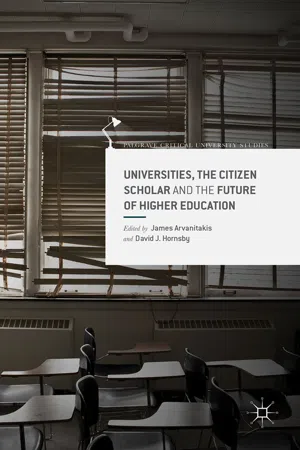
The future of higher education is in question as universities struggle to remain relevant to the present and future needs of society. The context in which learning occurs is rapidly changing and those engaged and interested in the place and position of university education need to figure out to adapt. This book embodies a vision for higher education where graduate attributes and proficiencies are at the core of the academic project, where degree programs move beyond disciplinary content and where students are encouraged to be Citizen Scholars. Through a series of cross-disciplinary and contextual cases, the contributors to this book articulate how this vision can be achieved in our pedagogical environments, future proofing higher education.
eBook - ePub
Universities, the Citizen Scholar and the Future of Higher Education
- English
- ePUB (mobile friendly)
- Available on iOS & Android
eBook - ePub
Universities, the Citizen Scholar and the Future of Higher Education
About this book
Information
1
Are Universities Redundant?
Modern higher education is faced with a common problem regardless of location and developmental contexts: How do we educate students in a time of disruption?
This is a disruption that is occurring at every level – societal, cultural, economic and environmental – and is echoed within institutions of higher education through rapid changes in tuition, enrolment, diversity of student populations and medium of instruction (Christensen et al., 2003). The context in which learning occurs is rapidly changing and we, as educators and those interested in the place and position of higher education, must wrap our minds around just how we adapt and respond.
For example, how do we deal with the fact that a graduate today enters what is described as the ‘four-year career’ (Kamenetz, 2012)? Indeed, graduates today may end up with something like seven to nine careers in their lifetime. That is not seven to nine jobs, but actually career changes. Even for those remaining within the same industry, statistics show that the number of people in the United States aged 25–64 who held the same job for more than ten years fell from 51% in 1980 to 39% in 2005. Today, we can think of living in a world inhabited by what has been described as ‘Generation Flux’ (Safian, 2012).
How, then, do educators prepare students for such an environment?
The truth is that traditionally we do not do very well at it. Universities are 1,000-year-old institutions based on distinct disciplines that students select before they enter and often continue on a journey of specialisation until they graduate. While the world has changed drastically over the last few decades requiring multi-disciplinary and modal thinking, the vast majority of universities tend to maintain a philosophy of education similar to that at the turn of the twentieth century: delivery of disciplinary-based content.
Certainly, we have seen some innovations and improvements – the emergence of the flipped classroom; new technologies introduced both within the classroom and beyond and the emergence of experiential and service-based learning. These innovations tend to be the focus of certain staff in some disciplines, and only a handful of experimental institutions across the sector have yet been able to make the transition.
More concerning, though, is that we have not witnessed a shift in the way that universities approach education: we still see many colleagues focusing on the delivery of disciplinary-based content. This content is based on knowledge that is delivered in a building block approach in which disciplinary gatekeepers make decisions on what is to be taught, what is to be ignored and how it will be assessed.
Those of us who have tried to implement innovative pedagogical approaches or to rethink our pedagogical environment consistently confront challenges. Even when senior management and engaged staff are both eager and willing to see change happen, the disciplinary barriers built over the generations have made structural innovation near impossible.
If universities cannot keep up with the ongoing change of the contemporary world, then we must ask the most disturbing of questions: Are universities now redundant?
Like newspapers and record labels, universities used to both produce and own content. Such organisations held a revered place in society, and the information produced was seen to shape the world: newspaper editors decided what was newsworthy; record label executives decided who was going to be the next ‘big thing’; and universities were the primary source of post-secondary education. Not only did institutions of higher education produce knowledge, but they were also responsible for distributing it through the traditional delivery mechanisms of books and expensive academic journals.
In short, universities used to control content.
Today, like newspapers and record labels, universities and educators must accept that we are no longer the primary manufacturers and distributors of content: we compete with other content producers for both the attention of the public and the ear of decision-makers. These include private corporations, religious organisations, media outlets, bloggers and online forums such as Wikipedia – in fact, it includes almost anyone who is connected to the Internet.
Some of these organisations make valuable contributions that add to the level of public debate and accountability. In Australia, for example, the active citizen organisation ‘GetUp!’, based on the US group ‘MoveOn’, raises questions that rally hundreds of thousands of Australians on issues from the need to respond to climate change, to religious tolerance and the fair treatment of refugees. Similarly, in South Africa, the ‘Right2Know’ Campaign, through mass mobilisation, has successfully challenged government plans to extend secrecy and curb media freedom. In Canada, the ‘Me to We’ organisation seeks to promote a generation of socially aware and conscious individuals interested in development.
While we see ‘GetUp!’, ‘Right2Know’ and ‘Me to We’ collaborating with a cross section of highly reputable academics to distribute high-quality information regarding a whole range of social, economic and environment issues, we see similar ‘public interest’ organisations such as the Institute of Public Affairs in Australia, the Fraser Institute in Canada and oil and petroleum interests in South Africa assist in the distribution of highly questionable research findings (Moran, 2010; Olver, 2013; McKitrick, 2014). In all three countries, there are shock jocks spreading misinformation, and, in some instances, misogyny and Islamaphobia over public airwaves.
The research from private organisations can be powerful and insightful, as well as misleading and destructive. Special interest groups and a globalised media compete for the attention of consumers who produce knowledge themselves. Love it or hate it, Wikipedia remains one of the most consulted and referenced sources.
Just as challenging is the idea that we as lecturers must also compete for the attention of our students. We are not just describing the distractions that technologies provide – students have always found ways to be distracted – like doodling or passing notes to each other – but we as university educators need to realise that in order to achieve student commitment to deep learning we have to engage and secure their attention.
If universities do not adapt to this changing world and acknowledge their own failings, the chances are that they will become redundant, very quickly.
This was the challenge that the authors in this volume gathered to confront, and one that we understand has no simple answer.
Education, Malcolm X once said, ‘is the passport to the future, for tomorrow belongs to those who prepare for it today’. While this is a powerful quote, it is also somewhat limiting because it falls short for two reasons. First, education is not just about preparing today, but doing it in a way that makes us think about the contours of tomorrow as well as understanding how we can help shape those contours. Second, education that is based on the way we currently do things will only replicate what we now know, and this is not good enough. If we are to prepare university graduates for a changing world, then we have to do things differently.
To reinforce this, consider just how quickly the world is changing. Twenty years ago a ‘mobile’ was a toy that dangled from a cot; ten years ago, Facebook was only for a handful of students in the United States; five years ago, the words cloud and computing had never appeared adjacent to each other – well not in popular discourse anyway – and a ‘tablet’ was for headaches. Today, smart phones provide access to the libraries of the world and a myriad of apps mean to make accessing information easy and quick – a technology that seemed fantastical five years ago.
So, how do we educate in a world that changes so very quickly?
Sir Kenneth Robinson, a high-profile education reformer, argues that educational institutions prepare students for opportunities that have ceased to exist. This is not only in the content but in the style of teaching: we produce graduates who are preparing for a world where opportunities were location specific, people had a single career in a lifetime and the life journey of an employee followed a clear process with a predictable goal.
Such a world no longer exists: today’s university graduates will have multiple careers, the world in which they work and in which they live may be on different continents and are required to be entrepreneurial or even ‘intrepreneurial’, that is, entrepreneurs within their own employment environment. In response, there is a need to revisit and redefine what graduates take away from their university experience.
The question is, are universities preparing students for this world? The answer is, in most cases, no!
Jay Elliot (2012), who worked closely with Steve Jobs in the leadership team of Apple Computer Inc., in his recent book Leading Apple with Steve Jobs, quotes Steve’s vision of innovation:
Innovation comes from people meeting up in the hallways or calling each other at 10:30 at night with a new idea, or because they realized something that shoots holes in how we have been thinking about the problem. It’s ad hoc meetings of six people called by someone who thinks he has figured out the coolest new thing ever and who wants to know what other people think of his idea.
In terms of what students should be taking from the university experience, Job’s vision indicates that there are some additional essential characteristics, in addition to the disciplinary knowledge and expertise.
So what is the answer?
In this book, we argue that universities, to remain relevant and meet the needs of our societies and economies, need to redefine their roles. We can no longer simply rely on producing research papers and educating students about the ‘truth’.
‘Climate change’ provides a relevant yet disturbing example: no matter how many refereed scientific papers are produced confirming that human-induced climate change is real and happening, as we write these words, with destructive impacts, there is enough misinformation produced that the general public feels that the science is still uncertain.
The traditional response has been to rely on teaching ‘the facts’. This is the belief that if we explain clearly what the research shows, students will understand.
Facts are undoubtedly important, but the challenge is to arm students not with just knowledge, but skills and proficiencies that allow them to deal with the many changes described above. Included here is the challenge of dealing with information abundance: how do we teach students to decipher the millions of hits they find on a Google search? And, this is only going to become more challenging: IBM, for example, estimates that 90% of all data has been created in the last two years.
Future-proofing higher education: The Citizen Scholar
A key argument in this book is that because of the ongoing structural changes driven by global and technological advancements, we need to future-proof higher education by looking beyond the provision of content alone and focusing on a new set of ‘Graduate Proficiencies’ for the century ahead. The Citizen Scholar encapsulates the idea that the role of universities is to promote both scholarship and active and engaged citizens. That is, universities need to inculcate a set of skills and cultural practices that educate students beyond their disciplinary knowledge. This arguably pushes the debate beyond the simple transfer of skills, as part of the activities and academic development necessary to complete a degree. Rather it takes on a broader, more societal focus.
Such thinking comes from the idea that universities maintain a social mission that mobilises knowledge for the benefit of society. That is, we believe that a central purpose of higher education is to improve the societies in which we live and foster citizens who can think outside of the box and innovate with the purpose of community betterment. Indeed, Martin Luther King Jr, said it best: ‘Life’s most persistent and urgent question is, “What are you doing for others?” ‘
Further, we mobilise the Citizen Scholar concept as a means of integrating aspirations of social change into higher education pedagogical development. It is well established that pursuing university studies can play a role in addressing inequalities in society because graduates tend to be more healthy and lead prosperous lives. The pursuit of a university degree can help to rectify structural injustices where certain groups are more privileged over others (Bloom et al., 2005; OECD, 2008). But these facts only stand if we develop curricula and pedagogical stances that prepare students to participate in the economy, that challenge them to apply the knowledge they have gained to innovate and make them aware and interested in understanding the societal structure in which they live. By developing curricula or teaching that narrowly focuses on the content of our disciplines, we only enhance disciplinary knowledge and reinforce disciplinary boundaries. This inertia means that we fail to inculcate the vital significance of breadth of understanding across disciplines and the importance of appreciating meaning and gaining not only knowledge but also cultivating wisdom. By advocating learning environments that place new Graduate Proficiencies that have at their core particular skills and cultural practices, we are suggesting that higher education will be future-proofed.
Inspiration for the Citizen Scholar...
Table of contents
- Cover
- Title Page
- Copyright
- Contents
- List of Tables and Figures
- Series Editor’s Preface
- Notes on Contributors
- List of Acronyms
- Introduction
- 1. Are Universities Redundant?
- 2. In Search of the Citizen Scholar: Modern Pedagogical Approaches Compared
- 3. Educating Citizen Scholars: Interdisciplinary First-Year Seminars at the University of Guelph
- 4. The Citizen Scholar: The Academy at the University of Western Sydney
- 5. Cultural Humility in Education and Work: A Valuable Approach for Teachers, Learners and Professionals
- 6. Giving Voice to the Citizen Scholar: Generating Critical Thinking by Combining Traditional and Non-Traditional Genres in a First-Year English Course
- 7. Open-Ended Dialogue and the Citizen Scholar: A Case Study of the Writing Component of a University-Led Enrichment Programme for School Learners
- 8. Reframing Large Classes through Fostering the Citizen Scholar
- 9. University Massification and Teaching Non-Traditional University Students
- 10. Changing Mindsets: Moving from the Acceptance of Facts to Critical Thinking
- 11. Medical Education: Training for the Desirable Traits in Past, Present and Future Doctors?
- 12. Experiential Learning: The Game as a Teaching Tool to Reach Multiple Audiences and Cross-Disciplinary Divides
- 13. Contra Coloniality on Campus: Teaching an Inclusive Philosophy of Practice under Precarious Conditions
- 14. Cultivating the Cultivators: Peer Mentorship as a Means of Developing Citizen Scholars in Higher Education
- 15. Playing with Learning: Childhood Pedagogies for Higher Education
- 16. Critical Thinking Pedagogy and the Citizen Scholar in University-Based Initial Teacher Education: The Promise of Twin Educational Ideals
- Index
Trusted by 375,005 students
Access to over 1.5 million titles for a fair monthly price.
Study more efficiently using our study tools.
Frequently asked questions
Yes, you can cancel anytime from the Subscription tab in your account settings on the Perlego website. Your subscription will stay active until the end of your current billing period. Learn how to cancel your subscription
No, books cannot be downloaded as external files, such as PDFs, for use outside of Perlego. However, you can download books within the Perlego app for offline reading on mobile or tablet. Learn how to download books offline
Perlego offers two plans: Essential and Complete
- Essential is ideal for learners and professionals who enjoy exploring a wide range of subjects. Access the Essential Library with 800,000+ trusted titles and best-sellers across business, personal growth, and the humanities. Includes unlimited reading time and Standard Read Aloud voice.
- Complete: Perfect for advanced learners and researchers needing full, unrestricted access. Unlock 1.5M+ books across hundreds of subjects, including academic and specialized titles. The Complete Plan also includes advanced features like Premium Read Aloud and Research Assistant.
We are an online textbook subscription service, where you can get access to an entire online library for less than the price of a single book per month. With over 1.5 million books across 990+ topics, we’ve got you covered! Learn about our mission
Look out for the read-aloud symbol on your next book to see if you can listen to it. The read-aloud tool reads text aloud for you, highlighting the text as it is being read. You can pause it, speed it up and slow it down. Learn more about Read Aloud
Yes! You can use the Perlego app on both iOS and Android devices to read anytime, anywhere — even offline. Perfect for commutes or when you’re on the go.
Please note we cannot support devices running on iOS 13 and Android 7 or earlier. Learn more about using the app
Please note we cannot support devices running on iOS 13 and Android 7 or earlier. Learn more about using the app
Yes, you can access Universities, the Citizen Scholar and the Future of Higher Education by J. Arvanitakis, D. Hornsby, J. Arvanitakis,D. Hornsby in PDF and/or ePUB format, as well as other popular books in Politics & International Relations & Education Administration. We have over 1.5 million books available in our catalogue for you to explore.