One view of the author in eighteenth- and nineteenth-century Britain held that poetic genius could reside in the lady or gentleman of fashion. Fashioning Authorship in the Long Eighteenth Century examines this cultural trope of genius-as-fashionista by applying an innovative mix of approaches—book history, Enlightenment and twentieth-century philosophy, visual studies, and material analyses of fashions in books and in dress—to specific editions of Alexander Pope, Mary Robinson and Lord Byron. In its material analyses of these books, Fashioning Authorship looks closely at bindings, letterforms, engravings, newspaper advertisements, correspondence, and other ephemera. In its theoretical approaches, it takes up the interventions of Locke and Kant in connection with the visual theories of Richardson, Hogarth, and Reynolds. These investigations point ultimately to a profound connection between Enlightenment formulations of subjectivity, genius, and fashion, a linkthat is relevant to the construction of celebrity in our own cultural moment.
eBook - ePub
Fashioning Authorship in the Long Eighteenth Century
Stylish Books of Poetic Genius
- English
- ePUB (mobile friendly)
- Available on iOS & Android
eBook - ePub
About this book
Information
© The Author(s) 2016
Gerald EganFashioning Authorship in the Long Eighteenth CenturyPalgrave Studies in the Enlightenment, Romanticism and the Cultures of Print10.1057/978-1-137-51826-2_11. Introduction
Gerald Egan1
(1)
Department of English, California State University at Long Beac, Long Beach, California, USA
In August of 1715 Alexander Pope placed the following advertisement in London’s Daily Courant:
On Tuesday next will be Published, A Print of Mr. Alexander Pope, done from the Original Painting of Mr. Jervasi, by Mr. Vertue. Printed for Bernard Lintott between the Temple Gates: where his Translation of Homer, and all his other Pieces may be had.
The public offer for sale of this engraved portrait, a daring act of self-promotion for a little-known twenty-seven-year-old, suggests that early in his career Pope understood that poetic laurels might follow not just from the artful arrangement of words on the pages of his books, but from a carefully composed image of himself in full array, outfitted in periwig, ruffled cuffs, and velvet jacket, as the early eighteenth-century “modish” young man of fashion. The engraving would reappear two years later in Pope’s Works of 1717, and its conspicuous size in relation to the book—it had to be folded twice to fit into the quarto volume—indicates the importance the image held for him. In his Preface to the book Pope writes that “a good Poet no sooner communicates his works … but it is imagined he is a vain young creature given up to the ambition of fame,” the defensive assertion followed a page later by the complaint that “it is with a fine Genius as with a fine fashion, all those are displeas’d at it who are not able to follow it.” In portrait and prefatory text, in both instances with a characteristic mix of deference and combativeness, Pope affiliates poetic genius with fashionable contemporaneity.
Pope’s suggestive trope provides the starting point in the present study for an examination of the yoking of poetic genius to fashion over the long eighteenth century, a cultural metaphor whose terms are most strikingly visible in the stylish quarto and octavo editions, themselves objects of fashion and luxury, that gain in popularity over the period as the large folio chained to a library table gives way to the polite hand-held book designed for a genteel urban audience. While recent studies of eighteenth-century and romantic genius have at times touched on material histories of the book and portraits of authors, none has considered how the poetic edition in its materiality might itself represent the image of poetic genius as a figure of stylish urbanity. Pope’s prefatory attempt at self-promotion in 1717 suggests the paradox at work, the faculty of genius—traditionally timeless, unconditional, seated in immaterial soul or mind—manifest in the most particular, sensory, and conditional of cultural formations, fashion. This study explores the possibility that it is not just in the sign systems of single-author editions of the period, in their signifying words and images, that the poet of genius appears as London lady or gentleman of fashion; it is in the material properties of the books themselves that the metaphor is fully realized as page layout, typography, illustrations, and binding effectively package the timeless truths of high art in the fashionable luxury object. Daniel Leonhard Purdy has written eloquently of fashion’s “struggle with itself,” the ongoing self-critical desire of fashion “to insist that is above fashion” (10). Although Purdy associates this struggle with twentieth-century fashion and modernism, part of my argument in this study is that this self-critical engagement with the contemporary and the modish is intrinsic to the formulations of the autonomous subject that evolve in the long eighteenth century, and that this self-critical struggle is perhaps most clearly evident in that fashionable individual, the poet of genius. It is visible, as we shall see, in the details of the products that mark their public images, in the letterforms, the disposition of white space, and the punctuation that mark the pages of their books, and in the details of the portraits that represent them. The emergence of fashionable genius is related to the eighteenth-century emergence of aesthetics, both founded on the empiricist notion that the senses might serve as the primary instruments of knowledge; this notion, I will suggest, is vividly imaged in the portraits of authors that appear in this period in which the primary organs of sensory perception, the eyes and the hands, take on new prominence.
Pope was among the first to grasp the promise that the book held for those who sought to establish and maintain control over a public persona, and the 1717 Works is thus one of the earliest in a series of authorial attempts to represent genius through a deployment of image and text in the printed book. In the chapters that follow, I examine this mode of self-representation through close readings of poems and frontispiece portraits in editions of Pope, Mary Robinson, and Lord Byron, discovering in these books a process of public image-making that anticipates (in the case of Pope) and reflects (in those of Robinson and Byron) the crisis of the self of the 1780s and 1790s that culminates politically in the chaos of post-revolutionary France and intellectually in the critical philosophy of Immanuel Kant. The aporia famously identified by Kant separates the domain of nature, the sensible world of appearances in which all phenomena are subject to the laws of causation, from the supersensible domain of that which is essential to the moral and rational life: freedom, which by definition transcends spatial and temporal conditions. Kant writes of “an incalculable gulf fixed between the domain of the concept of nature, as the sensible, and the domain of the concept of freedom, as the supersensible, so that from the former to the latter … no transition is possible” (II. 176). As beings who exist in the phenomenal world of space and time we are in the Kantian view conditioned by and subject to the laws of nature; and yet as free and moral beings we necessarily partake of that which transcends that world, that which is self-caused, unconditioned, and distinct from the sensible world of appearances. It is this “incalculable gulf” that Kant addresses in the Critique of Judgment and that the German idealists and early German romantics, in their responses to the corpus of Kant’s critical philosophy, labored to close. The gulf, ultimately, is that of a noumenal self inaccessible to the understanding and reason, a self unrepresentable to itself. Kant’s proposed solution to this dilemma in the third Critique, however tentative and qualified, is that through a faculty of reflective judgment that discovers the beautiful and the sublime in the particularity of nature, we might bridge this seemingly impassable gap. The product of reflective judgment is what Kant terms the “aesthetic idea,” and the faculty that originates such ideas is genius.
This dilemma of an insuperable gulf between the material and the immaterial had, however, been a problem for Enlightenment philosophy since Descartes, and part of my argument is that Pope, Robinson, and Byron engage with this dilemma in books that seek to clothe timeless genius in the materials of fashionable contemporaneity. These three poets differ in fundamental ways: their origins and private lives, the shapes that their public careers took and the decades in which these careers progressed, the types of public personae that with uneven success each attempted to present to an increasingly anonymous readership. It is in the public personae, however, so carefully crafted and yet always just beyond control, that Pope, Robinson, and Byron share a characteristic that sets them largely apart from other authors of the period, for each enjoyed a mode of contemporary fame founded as much on the visual presentation of a distinctive physicality as on the textual presentation of truth in poetry. This is a style of fame in which image becomes “image,” the accumulation of textual and visual references made public that, in sum, exceeds the allotment of fame usually accorded authorship in the eighteenth and nineteenth centuries. The processes of image-making which each of these poets sets in motion, over which each maintains only sporadic control, are culturally and historically significant instances of what Kant, Novalis, and Friedrich Schlegel refer to as Darstellung, the figural representation of the unknowable in sensible form. For Pope, Robinson, and Byron the medium for the representation of the noumenal self of genius—for Darstellung itself—is the book, an object of fashion in its own right, which emerges in this process as one of the primary vehicles for the practice of self-representation that links fashion to the mysterious faculty of genius. It is in part as a consequence of the influential cultural productions associated with these three poets that the nascent figure of the autonomous subject that emerges in the long eighteenth century is in one of its most visible incarnations the book author: the poetic genius-celebrity variously embodied in authorized and pirated editions manufactured and disseminated by congeries of collaborators, publishers, printers, patrons, pirates, satirists, subscribers, painters, illustrators, and engravers, to name a few of the parties to this process and to make clear that no single agent, no autonomous subject, is responsible for this deployment.
The advertisement that Pope placed in the Daily Courant in August 1715 is an appropriate document with which to begin this investigation, as it brings into focus a core tenet of this study: that the formation of fashionable genius in the long eighteenth century is founded on the image, specifically on the authorial portrait designed for commercial distribution, either separately or bound in an edition which it authorizes as frontispiece. In the authorial engravings featured in eighteenth- and nineteenth-century books of poetry, the conventions of a burgeoning visual culture sanctified the body of the poet as the Homeric or Sapphic figure of the bard or prophet, as timeless and transcendent genius; and yet the engravings, by their very nature as realistic, perspectival representations of living individuals, tended also to magnify the accidental and particular, to represent the body in all of its contingent contemporaneity, bewigged and powdered, modishly arrayed and made up for the fashionable public spaces of London. The body represented in its particularity is inevitably sexualized, imperfect, even malformed, and the accoutrements of fashion and urbanity in these fashionable images adumbrate what they teasingly conceal from an increasingly avid viewing public: the body in its disarray. In this context, the images of Pope, Robinson, and Byron current in their years of fame and disgrace participate in Darstellung, the process of symbolic figuration rendered by Kant’s English translators as exhibition: “fine Genius,” as Pope’s apt simile has it, on display as “fine fashion” in the troubled figure of incipient celebrity. Fashion is here the emblem of scandal, and the Kantian chasm that yawns between the conditioned and the unconditioned is embodied in the paradoxical figure of noumenal genius as the man or lady about town, an image of genius refracted in the gazes of approval and opprobrium that arise from London’s pleasure gardens and drawing rooms.
My exploration of the nexus of ideas that late Enlightenment philosophy ultimately brings to the fore in the 1780s and 1790s—the redemptive possibility that in a mechanistic universe we might rationally deduce what is transcendent, that the aesthetic idea might bridge the gap between nature and freedom, that such redemption is embodied in the person of genius—focuses upon the way in which these transcendental deductions are complicated and distressed as they materialize in the fashionable figure of the book author as contemporary celebrity in the eighteenth and nineteenth centuries. While my theoretical approach references Kant’s critical philosophy in terms of its visual and representational modalities, my study is not oriented teleologically towards Kant as the resolution or end-point of intractable questions of self-representation. Rather, my approach is ultimately grounded in close readings of editions of Pope, Robinson, and Byron, three poets whose very different careers, in succession spanning the period, share certain important characteristics. Each enjoyed or endured an extensive fame or notoriety disproportionate to the reception of his or her poetry; was publicly associated, through the publication of numerous portraits and satirical prints, with idiosyncratic styles of personal presentation; was the subject of reports and rumors of sexual impropriety; and suffered chronic physical frailty or disability. I hope to show in the pages that follow that this matrix of characteristics helps to define the public persona of each poet as flawed genius implicated in the snares of contemporaneity—in the world, so to speak, of fashion—and that the opposition of genius to fashion is most visible in the books, the complex objects of fashion that are the centerpieces of these public careers. In its focus on three singular poets, this study spans the century from Pope’s optimistic embrace of fashion in the 1717 Works, followed by the abnegation of fashion that will characterize his public image into the 1740s; to Robinson’s ambivalence in her 1791 Poems about the fashionable image on which her fame as actress and celebrity had in large part been based; and finally to Byron’s rejection of fashion as an element of authorial celebrity in his 1818 Childe Harold’s Pilgrimage, Canto IV, a refusal that is despite itself a fashionable mode of public presentation. This century-long narrative suggests that we might approach the evolution of “genius” in the period—the movement from the early eighteenth-century supposition that faculties of mental representation could provide a polite engagement with the world, towards the later contrary formulation that the exercise of these faculties at the highest levels of creativity disengages the genius, sequestering him or her from society—in the contexts of the material book and fashion.
Chapter 2, “Freedom, Nature, and the English School of Commercial Art,” lays the theoretical foundation for this study by situating the eighteenth-century theories of visual representation of Jonathan Richardson, William Hogarth, and Joshua Reynolds in relation to Locke’s theories of ideas and representation, and Kant’s articulation of figural representation or Darstellung as the characteristic mode of genius. Richardson, Hogarth, and Reynolds were not only theorists of the visual arts, but practicing portraitists familiar with styles of dress and personal presentation in eighteenth-century London. The theories of visuality that Richardson formulated in 1715 would evoke a series of responses and reformulations in eighteenth-century Britain that, taken together, constitute the theoretical-philosophical substratum of the English school of commercial art, a commerce- and print-centered culture in which urbane, fashionable representations of genius feature prominently. Richardson writes within memory of the 1688 Glorious Revolution and in the context of such consequent developments as the loosening and ultimate removal of government restrictions on the importation of paintings and engravings into England from continental Europe in the 1690s 1 ; the publication of Locke’s Essay (1689); the expiration of the Stationers’ Company’s monopoly on printed books (1694) and the institution of modern copyright (the “statute of Anne” in 1709); the development of partisan, party politics of Whig versus Tory; and the Act of Union of 1707. The responses to Richardson’s theory, which like his written treatises follow upon this welter of historical conditions and events, take two paths that initially diverge and ultimately join in the evolution of British eighteenth-century visual culture: through a subversively urban empiricism exemplified by William Hogarth in his “moral subjects” and his Analysis of Beauty (1753); and a commercially inflected classical idealism typified by Joshua Reynolds in his celebrity portraits and his Discourses on Art (1769–90). The commercially oriented theories of all three prove crucial links between eighteenth-century philosophical formulations of subjectivity, mental representation, and artistic genius, and the conditional realms of fashion and politeness.
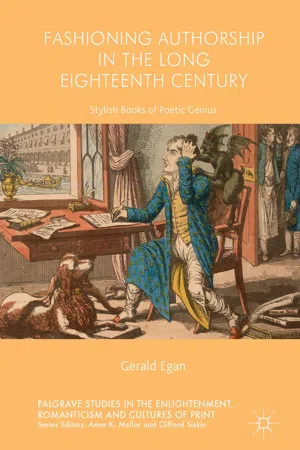
In Chap. 3, “The Plural Book and the Authorial Portrait,” I consider how Lacoue-Labarthe and Nancy’s notion of the “plural book” suggests that we might understand the single-author edition, traditionally idealized as a “unitary” book, in terms of the intransigently diverse particulars of which it is constituted and which follow from collaborative work processes in print shop and bindery. This chapter presents a summary history of these processes in relation to the plural book’s visual and textual potential for self-representation, focusing in particular on a historicized image of the author present in medieval images of authors as solitary writers cloistered in monastic cells such as those of Heinrich von Veldeke and Christine de Pizan. In the eighteenth and nineteenth centuries, this visual motif of the cloistered author evolves into depictions of fashionably melancholic, head-in-hand poses, the writer here depicted as a version of Charles Taylor’s “buffered” Enlightenment subject, sequestered from environment and world by his or her representational powers of genius.
Chapter 4, “Pope’s Fashionable Handbook,” analyzes text and image in Pope’s Works of 1717, considering specifically the Essay on Criticism in relation to the outsized frontispiece portrait in which Pope puts himself on display as timeless genius in the guise of fashionable London urbanity. In the Essay Pope sets himself apart from his predecessors in a dazzling performance of poetic virtuosity borne out in the material properties of his innovative quarto book, including its page layout and the foldout frontispiece portrait of him as London gentleman that opens the volume. As we shall see, a close reading of a specific page from the Essay—a reading that focuses as much on the layout of the page as the text—suggests that the curling brace that marks poetic triplets in the right margin of the page is more than just a typographical convention, that in this book in particular it is an emblem for the assertive “licentiousness” and originality of a poet whose “master hand” reaches out to enclose the nameless graces of poetic inspiration. The image of himself as the fashionably urbane “master hand” of poetic genius which Pope authorizes and publicizes in his 1717 Works emerges in the context of the numerous unauthorized satirical representations of him already in circulation this early in his career, texts and images which suggest a public avidity to view the po...
Table of contents
- Cover
- Frontmatter
- 1. Introduction
- 2. Freedom, Nature, and the English School of Commercial Art
- 3. The Plural Book and the Authorial Portrait
- 4. Pope’s Fashionable Hand Book
- 5. Mary Robinson: Fashioning Freedom
- 6. Byron’s Fashionable Abstention
- Backmatter
Trusted by 375,005 students
Access to over 1.5 million titles for a fair monthly price.
Study more efficiently using our study tools.
Frequently asked questions
Yes, you can cancel anytime from the Subscription tab in your account settings on the Perlego website. Your subscription will stay active until the end of your current billing period. Learn how to cancel your subscription
No, books cannot be downloaded as external files, such as PDFs, for use outside of Perlego. However, you can download books within the Perlego app for offline reading on mobile or tablet. Learn how to download books offline
Perlego offers two plans: Essential and Complete
- Essential is ideal for learners and professionals who enjoy exploring a wide range of subjects. Access the Essential Library with 800,000+ trusted titles and best-sellers across business, personal growth, and the humanities. Includes unlimited reading time and Standard Read Aloud voice.
- Complete: Perfect for advanced learners and researchers needing full, unrestricted access. Unlock 1.5M+ books across hundreds of subjects, including academic and specialized titles. The Complete Plan also includes advanced features like Premium Read Aloud and Research Assistant.
We are an online textbook subscription service, where you can get access to an entire online library for less than the price of a single book per month. With over 1.5 million books across 990+ topics, we’ve got you covered! Learn about our mission
Look out for the read-aloud symbol on your next book to see if you can listen to it. The read-aloud tool reads text aloud for you, highlighting the text as it is being read. You can pause it, speed it up and slow it down. Learn more about Read Aloud
Yes! You can use the Perlego app on both iOS and Android devices to read anytime, anywhere — even offline. Perfect for commutes or when you’re on the go.
Please note we cannot support devices running on iOS 13 and Android 7 or earlier. Learn more about using the app
Please note we cannot support devices running on iOS 13 and Android 7 or earlier. Learn more about using the app
Yes, you can access Fashioning Authorship in the Long Eighteenth Century by Gerald Egan in PDF and/or ePUB format, as well as other popular books in Literature & European Literary Criticism. We have over 1.5 million books available in our catalogue for you to explore.