eBook - ePub
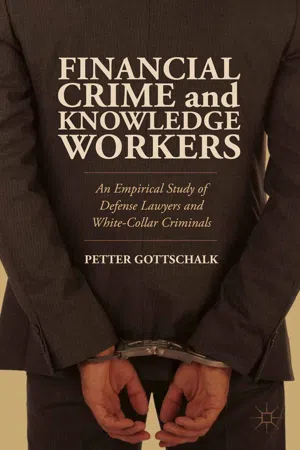
Financial Crime and Knowledge Workers
An Empirical Study of Defense Lawyers and White-Collar Criminals
- English
- ePUB (mobile friendly)
- Available on iOS & Android
eBook - ePub
Financial Crime and Knowledge Workers
An Empirical Study of Defense Lawyers and White-Collar Criminals
About this book
Financial Crime and Knowledge Workers examines the role of lawyers in court cases involving white-collar crimes, revealing fresh insights into the relationship between a lawyer's stature and a case's potential verdict.
Information
Topic
Ciencias socialesSubtopic
Contabilidad1
White-Collar Criminals and Crime
Who are the perpetrators of white-collar crime? According to a survey conducted by auditing firm KPMG (2009), it has become extremely difficult to profile a typical white-collar criminal. They argue that the person can be of any age group, income level, or tenure of employment. However, they found that most fraudsters are from 26 to 40 years of age, earn a substantial annual income, and have been employed for between 2 and 5 years.
The most economically disadvantaged members of society are not the only ones committing crime. Members of the privileged socioeconomic class are also engaged in criminal behavior (Brightman, 2009). The types of crimes these people commit may differ from those of criminals of lower classes. Some examples of crimes committed by members of the upper classes include business executives bribing public officials to get contracts, chief accountants manipulating balance sheets to avoid taxes, and procurement managers approving fake invoices for personal gain.
Criminal behavior that involves financial crime by members of the privileged socioeconomic class is labeled white-collar crime (Benson and Simpson, 2009). It is often argued that women commit fewer white-collar crimes when compared to men (Haantz, 2002; Holtfreter et al., 2010; Huffman et al., 2010). Suggested reasons for possible gender differences in the commission of white-collar crime include risk aversion and lack of opportunity.
Characteristics of White-Collar Criminals
Sutherland’s theory of white-collar crime from 1939 postulates that privileged persons commit financial crime by abusing their powersand the trust placed in them. He defined white-collar crime as crime committed by a person of respectability and high social status in the course of his occupation. According to Brightman (2009), Sutherland’s theory of white-collar crime was controversial, particularly since many of the academicians in the audience perceived themselves to be members of the upper echelon of American society. Despite his critics, Sutherland’s theory of white-collar criminality served as the catalyst for an area of research that continues today. In particular, differential association theory proposes that a person associating with individuals who have deviant or unlawful mores, values, and norms learns criminal behavior. Certain characteristics play a key role in placing individuals in a position to behave unlawfully, including the proposition that criminal behavior is learned through interaction with other criminals in the upper echelon of society, as well as through interactions occurring in small, intimate groups (Hansen, 2009).
Brightman (2009) differs slightly from Sutherland regarding the definition of white-collar crime. While social status may still determine access to wealth and property, Brightman argues that the term “white-collar crime” should be broader in scope and include virtually any nonviolent act committed for financial gain, regardless of one’s social status. For example, access to technology, such as personal computers and the Internet, now allows individuals from all social classes to buy and sell stocks or engage in similar activities that were once the bastion of the financial elite. This would imply that lawful online stock trading should be considered a white-collar crime, but that is not in line with Sutherland’s definition or with our definition in this book, where other characteristics of white-collar criminals exclude most online stock traders.
In Sutherland’s definition of white-collar crime, white-collar criminals are people of respectability and high social status who commit financial crimes by nonphysical means in the course of their occupations. This excludes many crimes of the upper class such as most cases of murder, adultery, and intoxication, since these are not customarily a part of their procedures (Benson and Simpson, 2009). It also excludes lower-class criminals committing financial crimes, as Brightman (2009) points out.
What Sutherland meant by “respectable” and “high social status individuals” is not quite clear, but we may assume he was referring to what in today’s business world are managers and executives. They are, for the most part, the individuals with the power and influence that are associated with respectability and high social status.
Part of the standard view of white-collar offenders is that they are mainstream, law-abiding individuals. They are assumed to be irregular offenders, not people who engage in crime on a regular basis. As Benson and Simpson state, “Unlike the run-of-the-mill common street criminal who usually has had repeated contacts with the criminal justice system, white-collar offenders are thought not to have prior criminal records” (2009: 39). According to this view, when typical white-collar criminals appear before their sentencing judges, they can correctly claim to be first-time offenders. They are wealthy, highly educated, and socially connected. They are elite individuals, according to the description and attitudes of white-collar criminals as suggested by Sutherland (1940, 1949, 1983). Because of these factors, very few white-collar criminals are put on trial, and even fewer upper-class criminals are sentenced to imprisonment. This is in contrast to the prosecution and sentencing of financial criminals who are not wealthy, highly educated, or socially connected, such as individuals abusing the welfare system by getting too much money in public support for nonexistent children.
What Podgor (2007) finds most interesting about Sutherland’s work is that a scholar needed to proclaim that crimes of the upper socioeconomic class were in fact crimes that should be prosecuted. It is apparent that prior to the coining of the term “white collar crime,” wealth and power allowed some people to escape criminal liability. Sutherland stresses the importance of the offender-based perspective, rather than the offense-based perspective, on white-collar crime. Sutherland’s offender-based perspective is applied in this book.
In contrast, the offense-based perspective, as suggested by researchers such as Pontell (2005), stresses the importance of the organization as a vehicle for perpetrating crime. In an organizational setting, it is difficult to distinguish between regular business transactions and criminal business transactions. Criminal transactions appear as ordinary business transactions so as not to attract attention or rouse suspicion.
Pickett and Pickett (2002) use the terms “financial crime,” “white-collar crime,” and “fraud” interchangeably. They define white-collar crime as the use of deception for illegal gain, normally involving breach of trust and some concealment of the true nature of the activities. White-collar crime is often defined as crime against property (Benson and Simpson, 2009; Heath, 2008), involving the unlawful conversion of property belonging to another to one’s own personal use and benefit. Financial crime is profit-driven crime to gain access to and control over property that belongs to someone else. Bucy et al. (2008) argue that white-collar crime refers to nonviolent, business-related violations of state and/or federal criminal statues, and they make a distinction between “leaders” and “followers” in white-collar crime.
White-collar crime can be defined in terms of the offense, the offender, or both. If white-collar crime is defined in terms of the offense, it means crime against property for personal or organizational gain, committed by nonphysical means and by concealment or deception (Benson and Simpson, 2009). If white-collar crime is defined in terms of the offender, it means crime committed by upper-class members of society for personal or organizational gain. These individuals are wealthy, highly educated, and socially connected, and they are typically employed by legitimate organizations (Hansen, 2009).
One of the most famous white-collar criminals is Bernhard Ebbers, former chief executive officer of WorldCom, who was convicted in 2005 of several kinds of fraud and other crimes that led to WorldCom’s eventual downfall:
Bernard Ebbers was extremely wealthy by the time WorldCom began to experience difficulties in 2000. Unfortunately for Ebbers (and ultimately for WorldCom shareholders), his desires exceeded his income. Ebbers’s purchases included an enormous ranch, timber lands, and a yacht-building company, and his loans totaled over $400 million. To secure these loans, he used millions of shares of WorldCom stock as collateral. Any time the price of WorldCom stock went down he needed more cash or assets to maintain his collateral. At one of WorldCom’s financial meetings, Ebbers told his employees that “his ‘lifeblood was in the stock of the company’ and that if the price fell below approximately $12 per share, he would be wiped out financially by margin calls.” Bernard Ebbers could not allow WorldCom’s stock price to fall even if it was realistically inevitable that this would eventually occur. As Judge Winter [the trial judge] stated, “The methods used were specifically intended to create a false picture of profitability even for professional analysts that, in Ebbers’s case, was motivated by his personal financial circumstances.” (Wagner, 2011: 978)
An American study by Collins and Schmidt (1993) concluded that, as compared to other white-collar individuals, two main characteristics of white-collar criminals are irresponsibility and antisocial behavior. This study examined the construct validity of personality scales, a personality-based integrity test, and homogenous bio data scales as reflected in their ability to discriminate between white-collar criminals and other white-collar employees. A bio data scale is a systematic method of scaling life history experiences. The sample included 365 prison inmates incarcerated in 23 federal correctional institutions for white-collar offenses and 344 individuals employed in upper-level positions of authority.
The various measures were administered to prisoners at the prison sites and to employees at their workplaces. Results showed that nonoffenders scored significantly higher on performance than offenders. Individuals with high scores on the performance scale are described as dependable, reliable, responsible, rule abiding, motivated to high performance on the job, and conscientious in their work behavior.
Furthermore, results showed that nonoffenders scored significantly higher on socialization than offenders. Individuals who score high on this scale are predicted to be dependable, honest, conscientious, and rule abiding, and are not inclined to be opportunistic or manipulative.
The third measure was responsibility, which shares some common characteristics with socialization. The responsibility scale measures the degree to which the individual is conscientious, responsible, dependable, and committed to social, civic, or moral values. Persons who score low on this scale often show antisocial behavior, and, in the workplace, higher scores predict responsibility and attention to duty. Results of Collins and Schmidt’s 1993 study showed that offenders scored significantly lower on the responsibility scale than nonoffenders.
The fourth and final measure was tolerance, where nonoffenders had a significantly higher score. Persons scoring high on the tolerance scale are tolerant and trusting, whereas low scorers tend to be suspicious and judgmental toward others and do not believe they can depend on others.
The common themes running through these four scales applied by Collins and Schmidt (1994) are conscientiousness and positive attitudes toward responsible and prosocial behaviors and activities, suggesting that the discriminating factor between offenders and nonoffenders might be conscientiousness.
A 2006 study in Germany concluded that, as compared to other white-collar individuals, two main characteristics of white-collar criminals are hedonism and narcissism. The study by Blickle et al. examined the following hypotheses in their research:
Hypothesis 1: The greater the degree of hedonism present in a business person, the greater is the tendency to commit economic offenses.
Hypothesis 2: The more diagnostic features of a narcissistic personality disorder an individual in a high-ranking white-collar position exhibits, the higher is the probability that this person will commit a white-collar crime.
Hypothesis 3: The lower the behavioral self-control of a person in a high-rankin...
Table of contents
- Cover
- Title
- copyright
- Contents
- List of Figures
- List of Tables
- Introduction
- 1 White-Collar Criminals and Crime
- 2 White-Collar Crime Defense Lawyers
- 3 White-Collar Crime Defense Strategies
- 4 Lawyers as Knowledge Workers
- 5 Law Firms as Knowledge Organizations
- 6 Knowledge Management in Law Firms
- 7 Theoretical Perspectives on Defense Lawyers
- 8 Empirical Study of White-Collar Lawyers
- 9 Prosecution in Court
- Conclusion
- Literature
- Index
Trusted by 375,005 students
Access to over 1.5 million titles for a fair monthly price.
Study more efficiently using our study tools.
Frequently asked questions
Yes, you can cancel anytime from the Subscription tab in your account settings on the Perlego website. Your subscription will stay active until the end of your current billing period. Learn how to cancel your subscription
No, books cannot be downloaded as external files, such as PDFs, for use outside of Perlego. However, you can download books within the Perlego app for offline reading on mobile or tablet. Learn how to download books offline
Perlego offers two plans: Essential and Complete
- Essential is ideal for learners and professionals who enjoy exploring a wide range of subjects. Access the Essential Library with 800,000+ trusted titles and best-sellers across business, personal growth, and the humanities. Includes unlimited reading time and Standard Read Aloud voice.
- Complete: Perfect for advanced learners and researchers needing full, unrestricted access. Unlock 1.5M+ books across hundreds of subjects, including academic and specialized titles. The Complete Plan also includes advanced features like Premium Read Aloud and Research Assistant.
We are an online textbook subscription service, where you can get access to an entire online library for less than the price of a single book per month. With over 1.5 million books across 990+ topics, we’ve got you covered! Learn about our mission
Look out for the read-aloud symbol on your next book to see if you can listen to it. The read-aloud tool reads text aloud for you, highlighting the text as it is being read. You can pause it, speed it up and slow it down. Learn more about Read Aloud
Yes! You can use the Perlego app on both iOS and Android devices to read anytime, anywhere — even offline. Perfect for commutes or when you’re on the go.
Please note we cannot support devices running on iOS 13 and Android 7 or earlier. Learn more about using the app
Please note we cannot support devices running on iOS 13 and Android 7 or earlier. Learn more about using the app
Yes, you can access Financial Crime and Knowledge Workers by Petter Gottschalk in PDF and/or ePUB format, as well as other popular books in Ciencias sociales & Contabilidad. We have over 1.5 million books available in our catalogue for you to explore.