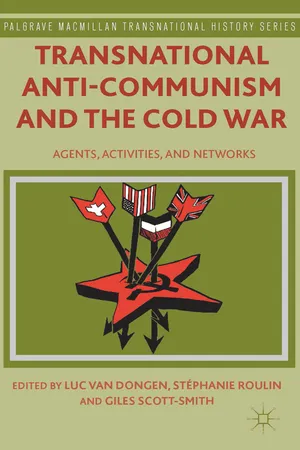
How was anti-communism organised in the West? This book covers the agents, aims, and arguments of various transnational anti-communist activists during the Cold War. Existing narratives often place the United States – and especially the CIA – at the centre of anti-communist activity. The book instead opens up new fields of research transnationally.
eBook - ePub
Transnational Anti-Communism and the Cold War
Agents, Activities, and Networks
- English
- ePUB (mobile friendly)
- Available on iOS & Android
eBook - ePub
Transnational Anti-Communism and the Cold War
Agents, Activities, and Networks
About this book
Information
Part I
The Wurlitzer Revisited
1
The American Society of African Culture: The CIA and Transnational Networks of African Diaspora Intellectuals in the Cold War
Hugh Wilford
In February 1967, the US Cold War effort suffered a major setback. The west coast magazine Ramparts revealed that the CIA was secretly funding the ostensibly independent American student organization, the US National Student Association, via an array of “pass-through” foundations. The New York Times, which previously had sat on stories about the covert US effort in the Cold War battle for “hearts and minds”, followed up the Ramparts revelation with a series of articles exposing concealed Agency subsidies to a variety of other supposedly private citizen groups with overseas programmes. This unwanted publicity profoundly damaged the image of the organizations in question, effectively destroying some, and dealt the reputation of the CIA itself a blow from which it arguably never recovered.
Aspects of this episode are by now well known, especially its calamitous consequences for the Congress for Cultural Freedom (CCF), the CIA’s Paris-based front group in the “Cultural Cold War”. The story of many other organizations exposed as recipients of secret US government grants in 1967, however, remains untold. The purpose of this essay is to relate the history of one such body, the American Society of African Culture (AMSAC), a group of African Americans engaged in cultural exchange with other diasporic African communities and on the African continent itself. By focusing in particular on AMSAC’s origins, programme and relations with the CIA, the essay will, it is hoped, help illuminate what even now remains a little understood dimension of the Cold War: the US government’s attempt to turn transnational citizen networks into weapons of anti-communist political warfare.
The picture that will emerge is a complex one. On the one hand, the CIA’s effort to capture diasporic, transnational African networks for national, Cold War purposes might be judged as extremely successful, given that many of the foremost black intellectuals and artists of the day became involved in it. In this respect, AMSAC’s case study serves as a corrective to recent scholarship about the transnational dimension of Cold War-era African American culture and politics that omits the role of the US government in enabling and controlling African diasporic networks.1 On the other hand, the activities of AMSAC’s African Americans were dogged with problems, including resistance on the part of other diasporic African communities, appropriation of the organization’s resources for oppositional projects presumably never visualized by the CIA, and a number of other unintended consequences. In short, the Cold War nation-state never entirely succeeded in repressing the transnational, non-governmental network; the repressed kept returning.
AMSAC’s Origins
The origins of the AMSAC lay in a spontaneous decision by a group of French African intellectuals living in Paris to call an international conference in 1956, the “Congress of Negro Writers and Artists”. The group, gathered around the literary journal Présence africaine, was dedicated to the principles of “Negritude”, a movement started by the Senegalese poet-politician Léopold Senghor during the 1930s, in “celebration of African cultural heritage in the Francophone world”.2 As such, Negritude might be seen as a French African variant of “Pan-Africanism”, a global effort to promote a transnational sense of shared identity and community among the peoples of Africa and the African diaspora, a programme that was profoundly stimulated by the wave of decolonization that swept the African continent, starting in the late 1950s.
The US government was interested in this development for several reasons. To begin with, the communist movement had a history of “front” activities in the African diaspora, including in the US itself, where as recently as 1951 the communist-controlled Civil Rights Congress had presented a petition to the United Nations alleging that the country was engaged in a campaign of genocide against its black citizens.3 The emergence in the mid-1950s of the African American Civil Rights Movement – in a sense, another local expression of a transnational phenomenon, the global struggle of black people against white domination – only served to increase the US government’s growing awareness that America’s domestic race problems, in particular the continuing existence of southern segregation, invited exploitation by communist propagandists. Finally, with European colonialism receding around the world, and the communist powers showing an interest in capturing the ideological allegiance of postcolonial peoples, the nation’s foreign policy-makers were becoming increasingly conscious of the “Third World” as a theatre of the Cold War. This awareness increased sharply after the Asian-African conference that took place in Bandung, Indonesia, in April 1955. Alioune Diop, the Senegal-born editor of Présence africaine, described the conference scheduled to take place in Paris in 1956 as a “second Bandung”.4
To ensure that the Congress did not succumb to communist influence, US government officials weighed up the possibility of enlisting the assistance of America’s own black citizenry. There were several African Americans with an interest in Africa and its postcolonial future, most notably the world-famous singer and actor Paul Robeson, and the eminent writer, and “founding father” of Pan-Africanism, W.E.B. DuBois. The trouble was that both Robeson and DuBois were themselves leftists and, in the polarized ideological atmosphere of the early Cold War, therefore beyond the pale politically.5
Fortunately, there was another major African American figure, a resident of Paris and friend of the Présence africaine group to boot, to whom US officials could turn. Richard Wright, author of one of the great works of twentieth-century American fiction, Native Son, was sympathetic with African cultural nationalism yet, at the same time, a convinced anti-communist. Indeed, he was among the contributors to the classic volume of confessional essays by disillusioned former communists, The God That Failed. He had also received money from the Congress for Cultural Freedom to attend and report on the Bandung conference. In the run-up to the September 1956 meeting, Wright was in regular contact with officials at the US Embassy in Paris, trying to ensure both that the venture did not fall prey to communist control and that it would be attended by some African Americans who would advocate for the Western cause in the Cold War.6 Thanks in part to Wright’s efforts, a delegation did come from the US, consisting mainly of leading African American educators, among them the president of Lincoln University (and father of civil rights campaigner Julian Bond) Horace Mann Bond, and a professor of government at New York’s City College, John A. Davis. These men were interested in African culture but did not share Robeson and DuBois’s politics of leftist anti-colonialism; rather they were liberal anti-communists.
In facilitating the attendance of black Americans at the Paris conference, Wright was not acting entirely on his own. Since 1954, John Davis had helped run the American Information Committee on Race and Caste, a New York-based organization whose mission included investigating foreign attitudes toward America’s race problems and laying the foundations of an international body for promoting cultural exchange between the US and the postcolonial world. The Committee underwrote the expenses of the five-man US delegation travelling to Paris with funds that ostensibly came from prominent New York philanthropists. These included a distinguished attorney, Bethuel M. Webster, who earlier in the decade had helped set up the American Fund for Free Jurists, later revealed to be a conduit of CIA funds to the International Commission of Jurists. The American Information Committee on Race and Caste was subsequently renamed the Council on Race and Caste in World Affairs (CORAC) after it was noted that “The word ‘information’ had very unpleasant connotations and was a sure indicator to certain groups of the nature of sponsorship.”7 In 1967, CORAC also was identified as a CIA pass-through.
If the backers of the American delegation headed for France hoped that it might garner some support for the US in the Cold War, they must have been sorely disappointed. The five African Americans were regarded with considerable suspicion by the other delegates, in part because a message from W.E.B. DuBois read out during the first session of the Congress (DuBois was unable to attend in person after he had been refused a US passport) included the words, “Any American Negro traveling abroad today must either not care about Negroes, or say what the State Department wishes him to say.” According to the African American novelist James Baldwin, in Paris covering the conference for the Congress for Cultural Freedom magazine Encounter, DuBois’s intervention “very neatly destroyed whatever effectiveness the [ . . . ] American delegation then sitting in the hall might have hoped to have”.8 On their side, the African Americans suspected a hidden communist hand in the proceedings of the Congress, especially when speakers were warmly applauded for making anti-American statements. These mutual political suspicions fuelled national tensions that constantly threatened to undermine the Congress’ project of creating a sense of transnational community. Francophone and Haitian delegates commented on the light skin colour of the Americans; some even asked John Davis “just why he considered himself a Negro – he certainly did not look like one” (as Baldwin recalled).9 For their part, “the Americans were struck by the fact that the Africans were exceedingly French or British”.10
Despite these divisions, the Congress succeeded in creating a permanent international body devoted to promoting African culture, the Société africaine de culture (SAC), with headquarters in Paris and local affiliates in Africa and countries with African diaspora populations. The national tensions persisted, however. In January 1957, Alioune Diop wrote John Davis informing him that international members were being sought for SAC’s executive council – and that the individuals he had in mind to represent the US were none other than Paul Robeson and W.E.B. DuBois.11 Davis, who had begun to organize the American delegation into an SAC affiliate in the US, was appalled by this suggestion, and insisted instead on two far less controversial nominees: Duke Ellington (Davis’s “favorite of jazz musicians”) and future Supreme Court Justice Thurgood Marshall.12 Diop backed down, and peaceful relations were restored, but then another row was ignited after the SAC requested money from CORAC to supplement the small subsidies it was receiving from African governments, and Davis responded by proposing the appointment of an American to the editorial board of Présence africaine as a condition of US funding.13 This time it was Diop’s turn to protest, and Davis’s to beat a retreat. The relationship between the wealthy CORAC and the cash-strapped SAC remained tense, though. There were echoes here of the constant disputes that took place between the Parisian headquarters of the Congress for Cultural Freedom and the New York office of the CCF’s US affiliate, the American Committee for Cultural Freedom.14
AMSAC’s Programme and Relationship with the CIA
The American Society of African Culture was formally launched in June 1957, and began active operations in November. Initially, AMSAC was entirely financially dependent on CORAC, which seems to have performed a function similar to that played for the US National Student Association by the Foundation for Youth and Student Affairs, acting as a conduit of funding and policy direction from the CIA. Office space was acquired on East 40th Street (the same mid-town territory occupied by other CIA front organizations such as the American Committee for Cultural Freedom) and James T. (“Ted”) Harris, Jr, a former president of the National Student Association, was drafted in to assi...
Table of contents
- Cover
- Title Page
- Copyright
- Contents
- Acknowledgements
- Notes on Contributors
- List of Abbreviations
- Introduction
- Part I. The Wurlitzer Revisited
- Part II. Transnational Networks
- Part III. Intellectual Networks and Anti-Totalitarianism
- Part IV. Christian Networks
- Select Bibliography
- Index
Trusted by 375,005 students
Access to over 1.5 million titles for a fair monthly price.
Study more efficiently using our study tools.
Frequently asked questions
Yes, you can cancel anytime from the Subscription tab in your account settings on the Perlego website. Your subscription will stay active until the end of your current billing period. Learn how to cancel your subscription
No, books cannot be downloaded as external files, such as PDFs, for use outside of Perlego. However, you can download books within the Perlego app for offline reading on mobile or tablet. Learn how to download books offline
Perlego offers two plans: Essential and Complete
- Essential is ideal for learners and professionals who enjoy exploring a wide range of subjects. Access the Essential Library with 800,000+ trusted titles and best-sellers across business, personal growth, and the humanities. Includes unlimited reading time and Standard Read Aloud voice.
- Complete: Perfect for advanced learners and researchers needing full, unrestricted access. Unlock 1.5M+ books across hundreds of subjects, including academic and specialized titles. The Complete Plan also includes advanced features like Premium Read Aloud and Research Assistant.
We are an online textbook subscription service, where you can get access to an entire online library for less than the price of a single book per month. With over 1.5 million books across 990+ topics, we’ve got you covered! Learn about our mission
Look out for the read-aloud symbol on your next book to see if you can listen to it. The read-aloud tool reads text aloud for you, highlighting the text as it is being read. You can pause it, speed it up and slow it down. Learn more about Read Aloud
Yes! You can use the Perlego app on both iOS and Android devices to read anytime, anywhere — even offline. Perfect for commutes or when you’re on the go.
Please note we cannot support devices running on iOS 13 and Android 7 or earlier. Learn more about using the app
Please note we cannot support devices running on iOS 13 and Android 7 or earlier. Learn more about using the app
Yes, you can access Transnational Anti-Communism and the Cold War by Stéphanie Roulin,Giles Scott-Smith, Kenneth A. Loparo,Luc van Dongen, Luc van Dongen in PDF and/or ePUB format, as well as other popular books in History & Modern History. We have over 1.5 million books available in our catalogue for you to explore.