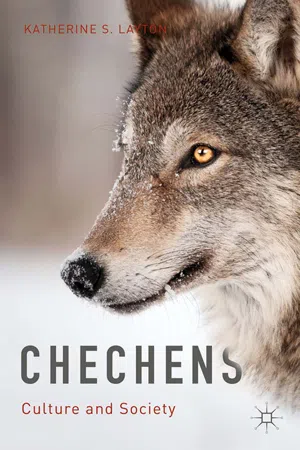
Chechens: Culture and Society is an ethnography that elaborates the lived experiences of Chechens, focusing primarily on relationships and socio-cultural norms within the context of the current conflict in the Chechen Republic.
Chechens: Culture and Society is an ethnographic analysis of the sociocultural norms of the Chechen collective nation. In particular, the book portrays the “lived experiences” of Chechens, and the meanings of cultural norms, in the context of the ongoing war in their homeland. The primary purpose of the ethnography is to present a rich but realistic portrayal of the Chechen nation, the oppression in their history, the disharmony due to hardship that plagues their collectivity, and the fact that few Chechens are extremists.
Chechens are an ancient cultural group. Dolkhan Khojaev, writing for the website Vaynakh Online, states, “The Chechens are the native inhabitants of the central North-East Caucasus. Their own term for themselves is ‘nokhchi’ (the grandsons of Prophet Nouh). The Nakh tribes arrived here and settled by the first millennium AD.” Similarly, Amjad Jaimoukha writes, “It is traditionally accepted that the Vainakh1 have existed in the Caucasus, with their territory as a nucleus of a larger domicile, for thousands of years, and that it was the ‘birthplace’ of their ethnos” (2005, p. 23).
Chechen collective culture retains early idealisms of beliefs, values, and behaviors. Chechens are a distinct collectivity; their beliefs and behaviors greatly revolve around a code of sociocultural rules, adat. They teach their children adat very young, communal mechanisms protect and reinforce adat, and the perpetuity of Chechen norms is thus ensured through generations. Chechens change very little.
Chechens have a common saying: It is hard to be a Chechen. Chechen norms are strict, allowing for little variation or deviancy, and the collective nature of Chechens ensures that every individual and family is held accountable to these norms.
Adat is a set of ideals—indisputable, propagated, and internalized. In extraordinary times of conflict, however, ideal is difficult to achieve. Moreover, though the Chechen nation is a palpable collectivity, during the hardships of war, competing goals fracture the nation. What began in 1994 as a war of independence against Russia now resembles a struggle of Chechens against Chechens.
Nokhchalla, or Chechen culture, is not undocumented. Yet this is a time of cultural exploration for Chechens, perhaps a revival, perhaps destruction. In reality, Chechen norms are in play, at a contested juncture, and are quite difficult to live up to in a fluid oppositional context.
This ethnography, thus, especially highlights Chechen differences and disputes in current times. The study examines the Chechen nation’s cultural “ideals” but also strives to locate the humanity in Chechens—in short, their fallibilities.
Self-Determination and Development
This author also possesses a practitioner-activist aim in producing the present book. Chechens are an oppressed national group, having been subjected at least once to genocide and to continuous grave human rights violations of their people. This author advocates two goals for the Chechen people: peace for themselves and their neighbors, and self-determination, both of which are human rights.
The concept of “self-determination” is controversial and disputed in international law and across sovereign states.2 This author, however, adopts the position that Chechens, as an indigenous nation, have the right to exercise their free will to determine their political status and their social and economic development, and to preserve their distinct culture.
Whether or not the Chechen nation achieves full, internationally recognized independence remains to be seen. Certainly, a continuing war is destructive to all. It may be that a lasting peace will be achieved only through a restructuring of ties with Russia. As many Chechens assert, Russia should be a neighbor, not a ruler. Nevertheless, at this moment in time, Chechens are neither prepared to function as a peaceful, independent state, nor are they capable of doing so.
This ethnography, which offers a realistic portrayal of Chechens, seeks an audience of policy makers who are working to secure a lasting peace for Chechens and their neighbors. This book presents the cultural resources at Chechens’ disposal, on which to build much that is constructive. It also outlines Chechens’ limitations that policy makers should take into account.
For what it is worth, the book also aims at Chechen readership—designed to talk to, not just about, Chechens. Interestingly, in this time of much uncertainty and conflict, many Chechens keep abreast of what others write, say, and do about them. They know of Russian policy and plans, international measures, who are their advocates, the political propaganda of their various factions, and much of the significant literature written about them. Chechens are not passive.
This author hopes and anticipates that Chechens, through any forum, will respond to this study. Some particular Chechens may take issue with this study’s inference that extremism could destroy Chechens’ culture and future. Others will concur with this conclusion. Most will welcome the presentation of Chechens’ hardship to a world audience. At present, there are few channels of communication between Chechens and the world at large, whether on an individual or on a national basis. Yet this author hopes that every reader will appreciate the objective portrayal of Chechens as both honorable and fallible. Chechens: Culture and Society is designed to be not a conclusion but a dialogue.
Historical Context of Chechen Conflict
The Chechen nation is a people of ancient origins, indigenous to the North Caucasus region. Islam appears to have disseminated into Chechnya gradually, though it was not until late eighteenth century that a definitive majority of Chechens embraced Islam: “The form of Islam practiced in Chechnya today, the Sufism of the Naqshbandi and Qadiri tariqats (orders), arrived from Dagestan in the late eighteenth century.”3
At the last federal census taken, in 2010, the number of Chechens within the homeland borders totaled about 1,300,000.4 The Ingush peoples, who number less than one-half million,5 are the closest ethnic relatives of Chechens, and together the two nations are known historically as the “Vainakh” nation. Chechnya borders Ingushetia to the east, and the republic of Dagestan to the west.
North Caucasus has been a fought-over region for centuries and finally came under Russian dominance in the sixteenth century. Although part of the Russian Federation under the Russian Constitution, a secessionist movement in Chechnya began in 1990 and, in October 1991, Chechen leadership declared Chechnya’s independence. In March 1992, this leadership also adopted a Chechen constitution that neither the Russian Federation nor the international community recognized. An uneasy period followed, which culminated in heavy Russian offensives inside of Chechnya in 1994. After a protracted war, with heavy casualties on both sides, Russian forces, unable to defeat resistance fighters in the mountainous south, withdrew from Chechnya in August 1996. In all, tens of thousands of people died, or became homeless, and much of Chechnya was destroyed.
After Chechen fighters forced Russian forces to retreat, which is a point of immense pride among many Chechens (We defeated a great army!), Chechnya experienced a period of de facto independence, from 1996 to 1999. In August 1999, Chechen rebel incursions into the Republic of Dagestan took place but Russian forces pushed these back into Chechnya. During the same period, bombs in apartment buildings in Moscow and two other Russian cities killed over 300 people. The Russian government blamed the Chechen rebels and, in October 1999, Russian forces once again moved into Chechnya and launched heavy attacks. Thousands of Chechens fled to seek refuge in neighboring republics, including Ingushetia, Dagestan, Kabardino-Balkaria, other areas of the Russian Federation, and abroad. The Russian Federation once again secured its rule in Chechnya, through the backing of a pro-Russian Chechen leadership, headed by Ramzan Kadyrov.
During the past ten years, the political landscape of the Chechen conflict has changed perceptively. Russian federal political authorities have consolidated their efforts into forcing a resolution of the seemingly intractable conflict. A variety of strategies have been designed to give the impression that the Chechnya conflict has stabilized, resistance forces have been eradicated, and that the general Chechen population rejects independence and opts to remain within the Russian Federation.
A referendum on state status, a presidential election, and a variety of “carrot” incentives, including amnesty laws, destroyed property compensation, and public announcements of reconstruction plans, are proffered to the Chechen population as proof of federal authorities’ victory, and goodwill toward peaceful rehabilitation of the republic and cohabitation with Russia. With the help of Russian federal finance, building and infrastructure repair continues in Chechnya, with Grozny hosting what is now the “largest mosque in Europe.”
However, whatever changes have occurred in political strategy, conditions in Chechnya remain precarious. Armed conflict continues in Chechnya and neighboring republics, between federal and pro-Russian Chechen forces, and resistance fighters. Numerous human rights abuses continue, including kidnapping, arbitrary detention, torture, and summary executions. Suicide bombings and other acts of hostility at the hands of insurgents are ongoing.
One of the greatest concerns voiced by human rights supporters is federal authorities’ lack of will and action to investigate grave violations committed by their own security forces. Oleg Orlov, head of the Russian human rights organization Memorial, states, “All of these cases [that Memorial filed] exemplify the participation of law enforcement agents in violent crimes, such as murders, rapes and torture. In all of these cases, the crimes’ perpetrators have remained unpunished so far. In most cases, criminal investigations were launched, but the crimes have not been investigated” (Dzutsev, 2012).6
A 2010 Council of Europe report clearly describes the “climate of fear” and impunity that pervades Chechnya today:7
In the Chechen Republic, the current authorities continue to maintain a generalised climate of fear, notwithstanding the undeniable successes in the sphere of reconstruction and the distinct improvement of the region’s infrastructures, which had been laid to waste by two cruel and devastating wars. Nevertheless, the human rights situation and the functioning of justice and democratic institutions continue to give cause for the gravest concern: successive disappearances of the government’s opponents and human rights defenders still remain widely unpunished and are not elucidated with due diligence.
Russian authorities portray the current Chechen armed conflict that began in 1994 as “finished,” or “completed,” when referred to as the “anti-terrorist operation.” Yet it continues, not diminished, but metamorphosed. What began as a national, unified, drive for independence is now a highly conflictive struggle for history, cultural meaning, and survival.
In short, the threat of violence in Chechnya is imminent, ongoing, and certain. Current-day Chechnya is a police state, reinforced by the personal police forces of pro-Russian leader Ramzan Kadyrov. In Chechnya, this repressive environment is divisive, but also fuels a burning demand for revenge on the part of many groups. Social structures are in upheaval, divisions are sharp and deadly; mere words can give reason to be killed.
Many Chechens claim the current strategy of Russian authorities is “psychological warfare”—beating down the Chechen population to force them to acquiesce, through threat, intimidation, and indiscriminate violence. Meanwhile, a large proportion of the able population is yet unemployed, infant mortality rates rival some of the poorest regions of the world, diseases like tuberculosis are widespread, and Chechens cite a recent alarming trend of “sudden death” in youth and young people—a phenomenon they say is caused by long-term crushing stress.
Perhaps one-third of the Chechen nation is living outside of the Chechen Republic, as internally displaced inside of Russia, or as refugees scattered throughout the world. Like those remaining inside of the Chechen Republic, Chechen refugees around the world exist largely without prosperity, development, or perspective for future.
Geographically, the conflict has spread throughout the Caucasus region into the heart of Russia, to the west through Europe, and southward through Turkey and parts of North Africa and the Middle East. Terror attacks and revenge killings associated with the Chechen conflicts occur in many areas of Caucasus, and Russia proper: cities, airplanes, schools, and officials are targets. Increasing assassinations abroad, including in Europe, Turkey, Dubai, and other countries, are evidence of the spread, not containment, of this war.
The Chechen armed conflict is far from over; there is ample evidence to suggest that it is widening in geographical scope, and deepening in national division. Internal divisions and the promise of “revenge,” promise to drive this conflict well into the coming decades.
SIGNIFICANCE OF THE STUDY
Chechens: Culture and Society seeks to contribute to an understanding of the Chechen conflict, with solid realistic reflection on how Chechens interpret themselves, and how they explain the conflict. The text is designed to present the multidimensional nature of Chechens, and the ongoing violence in the Chechen homeland.
Chechens are a little known, largely misunderstood, and often misrepresented, tiny nation with a worldwide population of perhaps not more than 3 million. Historically Chechens have remained isolated—geographically, and also politically—under the dome of Russian oppression. Chechens are also extremely self-isolating: they are a highly secretive, closed collectivity, sharply suspicious of any manner of threat from outside.
To Russia, Chechens are a nuisance, a danger, an embarrassment, and a need. Russia needs Chechnya—its oil and mineral resources, but especially its territorial location and integrity. Chechnya is geopolitically important because of its location between Russia and southern neighbors, and because of the symbolism of Chechnya. Russia, reduced with the fall of the Soviet Union, cannot acquiesce to Chechen independence, at the risk of enticing other Caucasus nations to demand the same.
To stomp out this threat, Russian media (which is vastly state controlled) typically brands Chechens as “bandits” and “terrorists,” while federal and pro-Russia Chechen authorities maintain a police state in the region, exterminating resisters, and removing witnesses, including both local and foreign human rights defenders and humanitarian assistance organizers. The US government has listed the Chechen insurgent movement as a “terrorist organization,” a designation that for the uninformed public demonizes the entirety of the Chechen nation.
The European Court of Human Rights continues to decide cases in favor of Chechens, against the Russian Federation. Yet Russia has world standing and power, and a far-reaching military apparatus. A handful of local and foreign humanitarian and human rights organizations remain active in the Chechen conflict, yet are routinely blocked access, are heavily repressed, their members...
Table of contents
Cover
Title
1. Introduction
2. Living in Tales
3. Cultural Symbolisms
4. Men and Women
5. In the Looking Glass, and Looking Out
6. Chechens as Refugees
7. Development: What Way Forward?
8. Additional Literature and Discussion
Notes
Bibliography
Index
Trusted by 375,005 students
Access to over 1.5 million titles for a fair monthly price.
Study more efficiently using our study tools.
Frequently asked questions
Yes, you can cancel anytime from the Subscription tab in your account settings on the Perlego website. Your subscription will stay active until the end of your current billing period. Learn how to cancel your subscription
No, books cannot be downloaded as external files, such as PDFs, for use outside of Perlego. However, you can download books within the Perlego app for offline reading on mobile or tablet. Learn how to download books offline
Perlego offers two plans: Essential and Complete
Essential is ideal for learners and professionals who enjoy exploring a wide range of subjects. Access the Essential Library with 800,000+ trusted titles and best-sellers across business, personal growth, and the humanities. Includes unlimited reading time and Standard Read Aloud voice.
Complete: Perfect for advanced learners and researchers needing full, unrestricted access. Unlock 1.5M+ books across hundreds of subjects, including academic and specialized titles. The Complete Plan also includes advanced features like Premium Read Aloud and Research Assistant.
Both plans are available with monthly, semester, or annual billing cycles.
We are an online textbook subscription service, where you can get access to an entire online library for less than the price of a single book per month. With over 1.5 million books across 990+ topics, we’ve got you covered! Learn about our mission
Look out for the read-aloud symbol on your next book to see if you can listen to it. The read-aloud tool reads text aloud for you, highlighting the text as it is being read. You can pause it, speed it up and slow it down. Learn more about Read Aloud
Yes! You can use the Perlego app on both iOS and Android devices to read anytime, anywhere — even offline. Perfect for commutes or when you’re on the go. Please note we cannot support devices running on iOS 13 and Android 7 or earlier. Learn more about using the app
Yes, you can access Chechens by Katherine S. Layton in PDF and/or ePUB format, as well as other popular books in Politics & International Relations & Politics. We have over 1.5 million books available in our catalogue for you to explore.