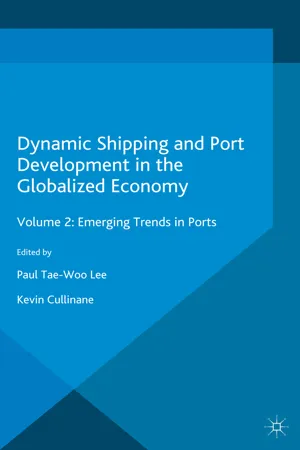
This two volume book presents an in-depth analysis of many of the most important issues facing today's shipping and port sectors. Volume 2 of Dynamic Shipping and Port Development in the Globalized Economy focuses on the emerging trends in ports.
eBook - ePub
Dynamic Shipping and Port Development in the Globalized Economy
Volume 2: Emerging Trends in Ports
- English
- ePUB (mobile friendly)
- Available on iOS & Android
eBook - ePub
Dynamic Shipping and Port Development in the Globalized Economy
Volume 2: Emerging Trends in Ports
About this book
Information
1
Introduction
Paul Tae-Woo Lee and Kevin Cullinane
The global maritime network underpinning the world economy is currently facing critical challenges. These include, inter alia, relatively stagnant economic and trade activity, China’s growing impact on international trade, changes in the structural pattern of international trade as a consequence of emerging free trade agreements, the need to further integrate maritime logistics systems, fierce port competition and the influence of mega carriers, terrorist attacks and other security issues, natural disasters and the need for enhanced resilience, as well as global warming and other environmental concerns. Within the context of a globalized world economy, the continued emergence of new developments which fundamentally affect it (such as China’s growing engagement in Africa and South America) and aspects such as the pursuit of an integrated logistics environment, the competitiveness of alternative production bases, the potential for the relocation of production lines, and the associated establishment of new supply chains have all attracted the attention of manufacturers, maritime logistics providers, academics, and policymakers. This is the context which has prompted the production of this book entitled Dynamic Shipping and Port Development in the Globalized Economy. Consisting of two volumes, the first concentrates on aspects of maritime economics and logistics which revolve around Applying Theory to Practice in Maritime Logistics. The second volume is entitled Emerging Trends in Ports. As the name suggests, it brings into sharp focus the impact on ports of the contemporary practices in maritime logistics which have been discussed and analyzed in Volume 1. The two volumes encompass a total of 15 contributions from 23 visionary scholars of international repute, which together provide a truly comprehensive scientific, practical, and contemporary perspective on the developments and challenges that have necessitated Dynamic Shipping and Port Development in the Globalized Economy.
Volume 1 of this book brings together an eclectic collection of papers which seek to apply a range of different theories to contemporary issues affecting the shipping and port industries. In so doing, a number of new concepts pertinent to maritime logistics have emerged. The first contribution by Jasmine Siu Lee Lam (Chapter 2) is a discourse on strategies for developing transhipment hub status and is based on a case study of the Port of Singapore, the world’s largest transhipment hub in terms of overall container throughput. With more than 80% of its total container throughput being transhipment containers, the Port of Singapore faces several challenges in an increasingly competitive business environment. Among the various types of cargoes handled by ports, transhipment containers are considered the most “footloose” in that they are not naturally bound to any specific port. Therefore, as the author points out, transhipment ports probably encounter the most severe inter-port competition. In other words, Singapore and other transhipment ports must continuously improve their performance by providing higher standards of service at competitive prices in meeting the needs of port users. The author’s analysis adopts a variety of perspectives in order to identify the key success factors required for achieving and maintaining transhipment hub status. In relation to the Port of Singapore, she highlights its strong links to the global shipping network and its consequent high level of connectivity (Cullinane and Wang, 2012; Wang and Cullinane, 2014) which generates significant benefits for port users. In addition, the author attributes much of the success achieved by the Port of Singapore to several measures introduced by both the Port of Singapore Authority (PSA) Corporation and the Maritime and Port Authority of Singapore (MPA) which have led to its emergence as a highly efficient terminal operator, a customer-centric service provider, a proactive investor in both infrastructure and superstructure within the port, and an innovator and leader in research and development, particularly with respect to the introduction of the port’s electronic port community system – Portnet. All of this has strengthened the Port of Singapore’s status as a transhipment hub.
In Chapter 2, Lam further highlights key success factors of the Port of Singapore in addressing green port policies and sustainable terminal operations and expansions. These success factors are credited to the port’s governance system and its interaction with, and relationship to, national maritime policy. They are quite similar to the key success factors of the Port of Singapore which were identified by Tongzon (2005): strategic location, high level of operational efficiency, high port connectivity, adequate infrastructure/info-structure, and a wide range of port services. Lam emphasized that several challenges remain for the Port of Singapore. The first comes from neighboring countries – for example, Malaysia and Indonesia – which are developing container port infrastructure, in tandem with national policies, to establish load and logistics centers. Consequently, the Port of Singapore may lose some of its transhipment cargoes. Another challenge the Port of Singapore faces is to develop a policy for the country to achieve the status of a premier international maritime center so that the port can mitigate fierce inter-port competition within the region through port diversification and differentiation. In so doing, the author recommends a double-pronged policy of growing both the transhipment hub and maritime services at the same time, by offering four types of maritime cluster in association with maritime ancillary services including marine insurance, ship finance, and ship broking.
Highlighting China’s fast-growing engagement in Africa and South America over the last two decades, Paul Tae-Woo Lee (Chapter 3) addresses emerging markets in maritime logistics and in the shipping and port sectors. Greater liberalization and more free trade agreements in the context of regional economic blocs, such as IBSA (India, Brazil, and South Africa), the Regional Comprehensive Economic Partnership (RCEP) led by China and the Association of Southeast Asian Nations (ASEAN) + 3 (China, Japan, and Korea), have contributed to increasing and robust container cargo volumes, causing structural changes in trade patterns on the newly emerging route of China–Africa–South America (CASA). Moreover, these developments have led China to expand her economic and political influence in the emerging markets of Africa and South America. As a result, a new maritime geography is developing on the world maritime map. The author emphasizes the necessity to analyze the impact of greater trade liberalization on container trade volume on the basis of 20-foot equivalent units (TEUs) rather than container value. This is because data on container volume in TEUs and container cargo flows among major trading partners yield greater insights and are more valuable, therefore, for fleet deployment and management, container network development, and port capacity planning. The author introduces an approach for converting trade value data acquired from the Computable (Applied) General Equilibrium (CGE) or Global Trade Analysis Project (GTAP) models into container volumes in TEUs by combining them with UNCOMTRAD data. Examples of how to estimate container cargo volume by container cargo type and flow route on the basis of a series of his research team’s work are also provided (e.g., Lee and Lee, 2012; Lee et al., 2008; Lee et al., 2012; Lee et al., 2013). A series of applications of the conversion model to the South Africa case and CASA trade route confirm that the continents of sub-Saharan Africa (SSA) and South America do constitute emerging markets in shipping, port, and maritime logistics. In addition, the confirmed robust increase in the estimated container cargo volume on the CASA route drives stakeholders to consider several challenges and responses, such as the location of logistics distribution centers (LDCs), feeder services in SSA, a relay service between SSA and South America, a multiple gateway port system in South Africa, and China’s strategic options.
Following his work on data conversion, Lee explores the best location for LDCs to develop transhipment hub ports, as well as to promote South Africa’s engagement with China in SSA, serving the sub-Saharan region and relaying container cargoes to South America. Looking ahead, another objective is to answer the question: What are the likely challenges China is facing, and what are China’s options and likely responses? The author concludes that trade liberalization and connectivity developments among regional economic blocs and their members contribute to increasing maritime cargo flows and that, on the basis of several measures such as degree of centrality, betweenness centrality, and clustering coefficients of the hub and gateway functions of ports, South Africa can be seen as a rising container hub in SSA. The author regards the Port of Ngqura as the best location for locating an LDC and as a transhipment hub for China’s trade, providing it can create a new dynamic maritime clustering system that combines a maritime and trade cluster with manufacturing and assembly companies, as well as research and education. This is because such a center can lead stakeholders in the private and public sectors to work together and integrate maritime logistics actors, the port, third-party logistics providers, the single window system (SWS), the port management information system, electronic data interchange (EDI), and radio-frequency identification (RFID) into a one-stop service, based on a platform of fusion technology.
Based on recent studies by his research team (Chang et al., 2013, 2014), Young-Tae Chang in Chapter 4 addresses the green issues facing the contemporary shipping and port sectors. The vast majority (95%) of the world’s shipping fleet runs on diesel which emits a range of pollutants, not only when operating on the high seas, but also within ports. Because of the impoverished quality of the fuels used, even the most modern marine engines produce higher emissions per power output than regulated on-road diesel engines (Corbett and Farrell, 2002; Cullinane and Bergqvist, 2014). Based on the methodology applied in Corbett et al. (2009) and Chang and Wang (2012), the author estimates greenhouse gas (GHG) emissions within the Port of Incheon in South Korea in order to understand how best to assess emissions in ports in terms of vessel types, stage of vessel movement, and vessel characteristics. The second element of this chapter goes on to assess the emissions of noxious gases (specifically, SO2, NOx, and PM) from vessel operations in the Port of Incheon by applying the Tier 3 methodology developed by the European Energy Agency (Chang et al., 2014). Although there currently exist no International Maritime Organization (IMO)-designated Emission Control Areas (ECAs) in Korea, the author examines how much these noxious emissions could be reduced within any future ECA that is applied within the Port of Incheon. Alternative scenarios are tested with variations in maximum allowable ship speed, the size and boundaries of the ECA, and the sulfur content of ship fuel. In a third element of the chapter, Chang measures the pollution abatement cost at ports in currently designated ECAs. By building on the environmental directional distance functions he derives to drive his model, and switching from an additive to a multiplicative version of his model, he measures what volume of cargo and passengers may have been lost at ports due to the imposition of ECA regulations. By taking the Port of Incheon as a reference, together with the vanguard ECA ports within the European Union, the work reported in this chapter addresses some of the major and growing concerns of various stakeholders in seeking to reduce the emissions of GHG and noxious gases in ports.
The contribution from Koichiro Tezuka and Masahiro Ishii (Chapter 5) analyses the applicability of game theoretical models to port policies, by utilizing a case study of Japanese container ports. The authors first identify the types of port competition problems that might be solved using game theory – both cooperative and non-cooperative games – through a comprehensive literature review. De Borger et al.’s (2008) is acknowledged as the first work which investigated the general competition between ports using a two-stage game, and this work has stimulated a series of studies that have modified these models to depict more specific situations among competitive ports. The authors review these subsequent related studies to reveal the relationships and interactions among factors and variables associated with port competition. Tezuka and Ishii move on to briefly outline recent Japanese port policies, namely the Super Core Port (SCP) policy and the International Strategic Container Ports policy, which were introduced to improve the competitiveness of Japanese ports within the East Asian context. By reference to economic structure and, in particular, the nature of the congestion, hinterlands, and vertical supply chains in the region, the authors go on to explain the gap which exists between the actual competitive situation which prevails among East Asian ports and the outputs derived from the game theoretical models they have reviewed. Moreover, the authors focus on the ownership and operational structures of a port to verify the assumptions underpinning the game theoretic models they have reviewed and to evaluate their robustness. Having taken the above into consideration, they examine how to apply the results of game theoretic models to actual situations of inter-port competition and draw inferences relating to congestion and capacity constraints, the final point of demand and port governance structure. In so doing, they account for Japanese port policies in the context of inter-port competition, particularly in relation to that which exists between the Port of Busan in Korea and the SCP ports in Japan. It is interesting to note that lack of capacity is not a problem in the region. Rather, severe price competition occurs because of overcapacity. In addition, because the Japanese central government uses grants and regulations to support container ports which are owned and operated by local governments, recently privatized companies do not necessarily have the discretion to determine port charges. As a consequence, the authors claim that not only should the appropriateness of the objectives of Japanese port competition policy be confirmed and reset, but also the appropriateness of the assumption that a single port entity is simply a private profit maximizer should be questioned.
Recognizing that the study of maritime security as a new dimension of enhancing maritime safety is attracting growing international attention, Zaili Yang, Jin Wang, and Adolf K.Y. Ng (Chapter 6) propose a new conceptual methodology for determining the security requirements of shipping and ports. This work aims to prompt a paradigm shift in maritime security management and advancing the state-of-the-art to a point where robust quantitative security assessment is feasible. The authors draw together and review pioneering research on the analysis of piracy data, maritime security regulations, security risk quantification, the use of uncertainty methods in maritime safety assessment, and the innovative use of economic evaluation in security management. In so doing, the authors apply eclectic methods comprising an extended Analytic Hierarchy Process (AHP) and an heuristic approach which is based on techniques such as Bayesian networks, entropy, the Technique for Order Preference by Similarity to an Ideal Solution (TOPSIS), and System Dynamics in order to develop a novel maritime security assessment (MSA) methodology. The newly proposed MSA methodology contributes to integrating several studies focusing on maritime security risk quantification and safety management, consisting of the identification of threats and vulnerabilities, subjective security risk estimation, security risk mitigation and protection, security cost and benefit analysis, dynamic security-economic evaluation, and security inspection and maintenance. Having said that, the significance of the newly proposed MSA methodology lies in, among other things, the fact that it presents a scientific framework capable of realizing quantitative security risk analysis under uncertainty to aid decision making and rationalizing maritime security management under economic constraints. In addition, the development of this new MSA framework for shipping and ports not only promotes the standardization of the currently diverse practices and standards applied to “secure” facilities in different states around the world, but also facilitates a shift in maritime security management toward a proactive risk-based regime that realizes the optimal use of security resources for maritime security improvement. As such, this chapter lays down a solid and crucial platform for researchers, policymakers, industrial practitioners, and other stakeholders of the maritime sector to collaborate meaningfully to deliver maritime security effectively.
For the purposes of their analysis, Stephen X.H. Gong, Michael Firth, and Kevin Cullinane (Chapter 7) define a “financing method” as representing a joint decision on both governance structure and available financing mechanisms. Based on this premise, the authors propose a new analytical framework for the analysis of financing methods that, it is suggested, should replace the more traditional and orthodox perspective that is usually adopted in neoclassical finance theory. A review of the alternative theories that seek to explain the corporate choice of capital structure leads the authors to conclude that, in terms of explaining real-life behavior in shipping finance decisions, an approach based on transactional cost economics (TCE) due to Williamson (1988) is likely to prove superior to one based either on the capital structure irrelevance propositions (Modigliani and Miller, 1958) or on the pecking order theory (Myers, 1984). The authors go on to outline and advocate an approach to the analysis of financing methods in the shipping industry that fundamentally revolves around the TCE paradigm, but which is informed by a range of eclectic influences from other areas of economics and, most poignantly, by real-life behavior. Specifically, they suggest that the TCE paradigm helps explain the combinations of capital structure and corporate governance decisions that are found to exist in the wider transport industry. The reason why this is the case is because asset specificity, the characteristics of the product (service) market under consideration (in particular, in the case of the shipping industry), and the nature of the seekers and providers of finance in this arena are all fundamentally transactional characteristics that exert a considerable influence on what decisions are taken.
Arguing that a port generates freight traffic by means of its interconnectedness with inland trade routes and with other regional and international ports, Francesca R. Medda and Simone Caschili (Chapter 8) estimate the Port Attractiveness Index (PAI) for the South Pacific Islands in order to identify possible policy recommendations to attract private finance into port investments. The authors define the PAI, which is rooted in the causality relationships among the determinants of port attractiveness, as the combination of the productive capacity of a port and its level of international competitiveness, which together provide direct and indirect economic and financial benefits. In the PAI, the authors assume that the higher the value of endogenous, exogenous, and subjective variables, the higher will be the PAI and hence the consequent increase in a port’s capacity to attract private investment. The authors apply the concept to the South Pacific Islands, where shipping is the dominant mode of transport for their international trade, using a combination of port and national da...
Table of contents
- Cover
- Title Page
- Copyright
- Contents
- List of Figures and Tables
- Acknowledgments
- Notes on Editors and Contributors
- 1. Introduction
- 2. Strategy of a Transhipment Hub: The Case of Port of Singapore
- 3. China’s Growing Engagement in the Emerging Maritime Logistics Market in Africa
- 4. Green Shipping and Ports
- 5. Applying Game Theoretic Models to Port Policies
- 6. Toward Robust Management of Maritime Risk and Security
- 7. Choice of Financing and Governance Structures in Transport Industry: Theory and Practice
- 8. Private Finance in Port Investment: The South Pacific Islands
- 9. New Concepts in the Economies of Flow, Connection, and Fusion Technology in Maritime Logistics
- Index
Trusted by 375,005 students
Access to over 1.5 million titles for a fair monthly price.
Study more efficiently using our study tools.
Frequently asked questions
Yes, you can cancel anytime from the Subscription tab in your account settings on the Perlego website. Your subscription will stay active until the end of your current billing period. Learn how to cancel your subscription
No, books cannot be downloaded as external files, such as PDFs, for use outside of Perlego. However, you can download books within the Perlego app for offline reading on mobile or tablet. Learn how to download books offline
Perlego offers two plans: Essential and Complete
- Essential is ideal for learners and professionals who enjoy exploring a wide range of subjects. Access the Essential Library with 800,000+ trusted titles and best-sellers across business, personal growth, and the humanities. Includes unlimited reading time and Standard Read Aloud voice.
- Complete: Perfect for advanced learners and researchers needing full, unrestricted access. Unlock 1.5M+ books across hundreds of subjects, including academic and specialized titles. The Complete Plan also includes advanced features like Premium Read Aloud and Research Assistant.
We are an online textbook subscription service, where you can get access to an entire online library for less than the price of a single book per month. With over 1.5 million books across 990+ topics, we’ve got you covered! Learn about our mission
Look out for the read-aloud symbol on your next book to see if you can listen to it. The read-aloud tool reads text aloud for you, highlighting the text as it is being read. You can pause it, speed it up and slow it down. Learn more about Read Aloud
Yes! You can use the Perlego app on both iOS and Android devices to read anytime, anywhere — even offline. Perfect for commutes or when you’re on the go.
Please note we cannot support devices running on iOS 13 and Android 7 or earlier. Learn more about using the app
Please note we cannot support devices running on iOS 13 and Android 7 or earlier. Learn more about using the app
Yes, you can access Dynamic Shipping and Port Development in the Globalized Economy by Paul Yae-Woo Lee, Kevin Cullinane, Paul Yae-Woo Lee,Kevin Cullinane in PDF and/or ePUB format, as well as other popular books in Business & Business Strategy. We have over 1.5 million books available in our catalogue for you to explore.