- English
- ePUB (mobile friendly)
- Available on iOS & Android
eBook - ePub
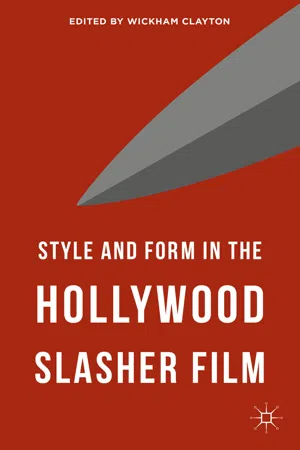
Style and Form in the Hollywood Slasher Film
About this book
Style and Form in the Hollywood Slasher Film fills a broad scholastic gap by analysing the elements of narrative and stylistic construction of films in the slasher subgenre of horror that have been produced and/or distributed in the Hollywood studio system from its initial boom in the late 1970s to the present.
Information
Subtopic
Art GeneralPart I
The Birth, Death and Revenge of the Hollywood Slasher
1
(In)Stability of Point of View in When a Stranger Calls and Eyes of a Stranger
David Roche
Carol J. Clover opened the fourth chapter, ‘The Eye of Horror’, of her book Men, Women, and Chain Saws with the statement: ‘Eyes are everywhere in horror cinema’ (1992, 167), and Linda Williams (1983/1996) before her had already insisted on the importance of the male, female and monstrous characters’ ‘looks’. Both critics are highly indebted to Laura Mulvey’s famous thesis that Hollywood narrative films posit a male gaze that punishes and/or fetishizes the female body. Clover has argued that the horror genre is just as much concerned with the ‘reactive gaze’, figured as feminine, of the spectator, and thus linked to the victim, as with the ‘assaultive gaze, figured masculine, of the camera (or some stand-in)’, and thus linked to the monster or killer (181). The fact that Clover’s corpus comprises exclusively post-Psycho (1960; dir Alfred Hitchcock) and post-Peeping Tom (1960; dir Michael Powell) horror films and mainly slasher films of the 1970s and 1980s – unlike Williams, Clover has very little to say about the classical Hollywood movies – would tend to suggest that her insights are especially pertinent when considering contemporary American horror films.
Vera Dika (1987) was among the first to identify some of the salient features of the stalker or slasher genre:
1The narrative is driven forward by both the heroine and the killer (89).
2The killer is ‘depersonalized in a literal sense, with his body and the more intricate workings of his consciousness hidden from the spectator’ (88).
3The victims’ vulnerability is a question of lack of vision: ‘they are quickly dispatched, punished in terms of the film’s formal logic not only because of their inability to see but also because they have allowed themselves to be seen’ (89).
4The POV-shots ‘tend to fragment the visual field by observing a potential victim from a variety of different focal lengths and angles’ (88).
In short, the defining features of the slasher would be, on the narrative level, a premise in the Gothic tradition whereby the Final Girl and the other victims are persecuted by a depersonalized stalker, and on the formal level, a conspicuous instability of point of view.1 Both are connected, as Dika and Clover have demonstrated, through the relationship between power, vulnerability and the gaze. Over the course of the narrative, the Final Girl assumes the gaze which then enables her to vanquish or neutralize the killer (Clover 1992, 60), the film sometimes associating devices (like the POV-shot) initially associated with the killer with the Final Girl.
Of course, the question of point of view in film cannot be limited to the usage of POV-shots. Its study is heavily indebted to the work of literary critic Gérard Genette. Whereas many film critics have directly appropriated his typology of focalization in literature, François Jost has argued that it is necessary to redefine the terms by distinguishing between focalization, the ‘cognitive point of view of the story’, and ‘ocularization’, ‘the relation between what a camera shows and what a character is supposed to see’ (1990, 130; my translation). He proposes the following typology: ‘internal focalization’ occurs when the viewer is provided with as much information as the focalizer, ‘external focalization’ when the viewer is provided with less, and ‘spectatorial focalization’ when the viewer is provided with more (138–41). Ocularization can be of two sorts: ‘internal’ or ‘zero’, depending on whether or not what is shown can be related to what a character sees. Jost then identifies two forms of ‘internal ocularization’: ‘primary internal’, which involves direct representation of a character’s perspective, and ‘secondary internal’, which involves indirect representation (132–3). The paradigmatic instances of zero, primary internal and secondary internal ocularization are, respectively, the nobody’s shot, the POV-shot and the shot/reverse shot with eyeline match. As we shall see, the instability of point of view which characterizes the slasher renders problematic, and thus interesting, the usage of Jost’s terminology.
Regardless of whether or not Halloween (1978; dir John Carpenter) is the first slasher – Black Christmas (1974; dir Bob Clark) also vies for the title – and even if it borrows much from previous films like Psycho, The Exorcist (1973; dir William Friedkin), The Texas Chain Saw Massacre (1974; dir Tobe Hooper) and Black Christmas (Wood 2003, 171), it offers a good starting point for a study of strategies and style in the genre insomuch as it is one of the rare films to have received critical attention from this perspective, film critics and scholars having tended to favour discussions about the politics of American horror films.2 Steve Neale superbly analysed Halloween as ‘a series of barely differentiated repetitions’ (1981, 356). The first two sections deploy one strategy each, that are then ‘weave[d]’ together in the final two sections that take place at Haddonfield (357). The famous POV-shot of the opening scene fulfills several functions, notably ‘to “suspend” the spectator’s knowledge, position, and sense of certainty that knowledge, position, and certainty will come with the film’s resolution’, and
to associate marked but unmotivated point-of-view shots with Michael and thus with the agent of violence and aggression in the film. Such shots will function henceforth to signify Michael’s potential (if not actual) presence and therefore danger to those characters who are caught as objects in the frame demonstrating the incidence of this look (359).
The second section, where the Shape attacks the nurse, introduces a second strategy, which I will call frame-within-the-frame composition. In Neale’s words,
Again, then, suspense and aggression are functions of a lack of knowledge and adequate viewpoint on the part of the spectator. They are articulated here, however, not around a point-of-view shot as such, but rather around fields of vision as marked by the frame (360).
The third section combines these two strategies: potential POV-shots turn out to be over-the-shoulder-shots, and thus semi-POV-shots, when the Shape steps into the frame (362). While identifying many of the points previously developed by Neale, Jean-Baptiste Thoret’s own analyses of Halloween draw attention to some other consequences of the usage of these strategies. If the film seems to resort to spectatorial focalization as the viewer is given a cognitive advantage over the heroine-victim, focalization can, to some extent, be deemed external as the spectator is at a cognitive disadvantage vis-à-vis the Shape (1998, 195). Moreover, after the POV-shot of the opening scene, all camera movements, namely the Steadycam and tracking shots used in the third and fourth sections, become ‘suspect’, signalling the Shape’s potential presence. In my own study of strategies and style in independent American horror movies of the 1970s, including Halloween, I have foregrounded the functions of the instability of point of view and frame-within-the-frame composition, probably the two most recurrent visual strategies in contemporary American horror movies. The first is often produced ‘by alternating between POV-shots and mock-POV-shots’ (Roche 2014, 270), ‘creates uncertainty regarding the origin of the gaze’ (270) and generally ‘involves spectatorial focalization’ (270). The second relies on medium and close shots to ‘convey a sense of being trapped and the impression that the threat can come from all sides’ (270). What I failed to note is that frame-within-the-frame composition also, as Neale has suggested, participates in the instability of point of view, as these shots imply internal focalization where knowledge is limited to the victim’s.
Rather than verify that ‘formulaic’ slashers systematically resort to these strategies, thereby conforming to generic conventions, I propose to examine what happens when they are used in films like When a Stranger Calls (1979; dir Fred Walton) and Eyes of a Stranger (1981; dir Ken Wiederhorn), which are generally included in the post-Halloween cycle of slashers but are actually hybrids.3 Like many slashers, both films are listed on IMDb under ‘horror’ and ‘thriller’. Yet in a way, the psychological thriller is the slasher’s inverted double since the criminal is personalized, with notable consequences on the narrative and formal levels. When a Stranger Calls and Eyes of a Stranger are, then, slasher-thriller hybrids because they personalize the depersonalized stalker before the film is halfway over.4 I will further argue that Eyes of a Stranger does not follow the rules of the genre, as Robin Wood has said (2003, 177), but comments on these rules by wielding them as a slasher and undermining them as a thriller in order to produce the intelligent feminist critique of masculine attitudes both Wood and Clover have celebrated (Wood 2003, 175–9; Clover 1992, 151, 190–1).
The similarities between both films go well beyond the way their titles seem to echo (a ‘stranger’) and play off (the voice vs. the gaze) each other. Both films have received little critical attention, though Eyes of a Stranger has been defended by both Wood and Clover. As far as narrative structure is concerned, they can be divided into four acts.
When a Stranger Calls:
1Jill Johnson is tormented by a disembodied voice on the phone at the Mandrakis house.
2John Clifford searches for Curt Duncan while the latter attempts to survive and befriend Tracy, a woman he just met at a bar called Torchy’s.
3Clifford chases Duncan, who escapes.
4Jill’s family, the ironically named Lockarts, fail to lock out Duncan, who torments them.
Eyes of a Stranger:
1Debbie Ormsley and her boyfriend, Jeff, are murdered by a psychokiller.
2News anchorwoman Jane Harris increasingly suspects her neighbour Stanley Herbert across the way.
3Jane takes matters into her own hands, eventually turning the tables on Herbert by calling him [76:40].
4Herbert realizes that Jane is tormenting him and attacks her near-catatonic sister Tracy.5
The first acts are the only ones clearly based on a recognizable slasher premise: a babysitter or waitress tormented by a male pervert on the phone;6 in this respect, the opening scene of Eyes of a Stranger clearly revisits that of When a Stranger Calls, with Herbert calling Debbie four times before she calls the police. The second and third acts, which make up the bulk of both films, mainly adopt the conventions of the psychological thriller: the emphasis is on the investigations, and the murderers are personalized to the extent that Duncan’s inner life is represented [66:50] and Herbert’s distress at being found out is portrayed [59:10]. What’s more, the second act of When a Stranger Calls immediately makes Duncan a figure of pathos: he gets beaten up by a patron at Torchy’s after getting told off by Tracy [32:45] and later begs for money before drinking coffee alone instead of with Tracy, whom he previously invited [54:35]; he is ultimately tormented by repressed images of the horrific murder of the Mandrakis children he committed [66:55].
The two films differ as to the cohesion with which they articulate the slasher and the psychological thriller. Both films, as we shall see, continue to utilize slasher strategies in the stalking and murder scenes. However, the two stalking scenes of When a Stranger Calls are limited to the second act, while the three murder scenes are more evenly spaced out over the second and third acts of Eyes of a Stranger and mark transitions between the various acts. In other words, When a Stranger Calls almost entirely adheres to the psychological thriller during the second and third acts, whereas Eyes of a Stranger does so progressively as the psychopath’s identity becomes increasingly certain, thereby retaining a structure based on repeated attacks characteristic of the slasher. Accordingly, Herbert remains entirely personalized in the final act, except, perhaps, from Tracy’s perspective, since she cannot see him, and it is not certain whether she is aware of her older sister’s investigation.7 When a Stranger Calls, on the other hand, attempts to return to the slasher in the final act. This is announced in the last scene of the third act through a backward tracking shot of Duncan’s face disappearing in the darkness and becoming once again the disembodied voice from the first act: ‘No one can see me anymore. Nobody can hear me. No one touches me. I’m not here. I don’t exist. I was never born. I won’t be seen anymore. No one can hear me . . . ’ [75:55]. The final act initially appears as a replay of the first act, with events having come full circle – it is now Jill’s children who are going to be babysat while she and her husband Stephen go to the restaurant – but expectations are thwarted: it is Jill, not Sharon the babysitter, who receives a phone call at the restaurant, and when the Lockarts return home, their children and the babysitter are safe and sound.8 The final scenes ultimately blend slasher conventions with those of the psychological thriller by cross-cutting between Jill Lockart and Clifford, who manages to achieve his goal of executing Duncan.
Analysing the instability of point of view in these hybrid films will ultimately be a way of testing how genre specific it is. Obviously, this does not meant that all films that produce an instability of point of view are slashers but that the instability of point of view is what Rick Altman would call a ‘syntactic’ characteristic of the genre, just as the POV-shot is a ‘semantic’ characteristic.9 In so doing, I hope to qualify Clover’s statement that ‘[c]amerawork may play with the terms’ of identifications in the horror film, ‘but it does not set them’ (1992, 10). I argue that the depersonalization of the killer is largely an effect of the mise en cadre, in other words, the frames and camera movements.
When a Stranger Calls
The famous first act of When a Stranger Calls develops several strategies that introduce an instability of point of view and that are, like the premise, borrowed from Black Christmas and especially Halloween. It opens with an establishing shot of a suburban neighbourhood while the as-yet-unknown heroine, Jill Johnson, walks up to the Mandrakis house on the opposite side of the street [0:40]. The camera’s position, its panning left and its resemblance to similar shots from Halloween [9:20, 20:25], suggest this shot is a potential POV-shot, a cue that is reinforced by the title of the film and the eerie string score. Subsequent scenes reutilize similar establishing shots, maintaining the possibility that the threat is lurking outside [4:15]. One full shot in particular shows Jill, framed by the window, looking back over her shoulder outside after the stranger’s rephrased question – ‘Have you checked the children?’ has become ‘Why haven’t you checked the children?’ – has made her aware of his potential omniscience [12:25]. This first form of instability of point of view conveys uncertainty as to whether or not the outdoor shots reflect the point of view of the stranger from the title.
The instability increases when the outdoor shots are countered by ambiguous shots inside the house. Instability, then, would equally be spatial, evoking the stranger’s potential ubiquity.10 Indeed, the third scene opens with a series of three shots of a dark kitchen, a dark living room and the central hallway and staircase [3:00]. Though these shots recall those at the end of Halloween which reveal spaces having previously been occupied by the Shape now occupied by nothing but his heavy breathing [84:50], at this point where the stranger’s ...
Table of contents
- Cover
- Title
- Copyright
- Dedication
- Contents
- List of Figures and Tables
- Acknowledgements
- Notes on Contributors
- introduction: The Collection Awakes
- Part I: The Birth, Death and Revenge of the Hollywood Slasher
- Part II: Older, Darker and Self-Aware
- Part III: Form versus Theory
- Bibliography
- Filmography
- Index
Trusted by 375,005 students
Access to over 1.5 million titles for a fair monthly price.
Study more efficiently using our study tools.
Frequently asked questions
Yes, you can cancel anytime from the Subscription tab in your account settings on the Perlego website. Your subscription will stay active until the end of your current billing period. Learn how to cancel your subscription
No, books cannot be downloaded as external files, such as PDFs, for use outside of Perlego. However, you can download books within the Perlego app for offline reading on mobile or tablet. Learn how to download books offline
Perlego offers two plans: Essential and Complete
- Essential is ideal for learners and professionals who enjoy exploring a wide range of subjects. Access the Essential Library with 800,000+ trusted titles and best-sellers across business, personal growth, and the humanities. Includes unlimited reading time and Standard Read Aloud voice.
- Complete: Perfect for advanced learners and researchers needing full, unrestricted access. Unlock 1.5M+ books across hundreds of subjects, including academic and specialized titles. The Complete Plan also includes advanced features like Premium Read Aloud and Research Assistant.
We are an online textbook subscription service, where you can get access to an entire online library for less than the price of a single book per month. With over 1.5 million books across 990+ topics, we’ve got you covered! Learn about our mission
Look out for the read-aloud symbol on your next book to see if you can listen to it. The read-aloud tool reads text aloud for you, highlighting the text as it is being read. You can pause it, speed it up and slow it down. Learn more about Read Aloud
Yes! You can use the Perlego app on both iOS and Android devices to read anytime, anywhere — even offline. Perfect for commutes or when you’re on the go.
Please note we cannot support devices running on iOS 13 and Android 7 or earlier. Learn more about using the app
Please note we cannot support devices running on iOS 13 and Android 7 or earlier. Learn more about using the app
Yes, you can access Style and Form in the Hollywood Slasher Film by Wickham Clayton in PDF and/or ePUB format, as well as other popular books in Media & Performing Arts & Art General. We have over 1.5 million books available in our catalogue for you to explore.