- English
- ePUB (mobile friendly)
- Available on iOS & Android
eBook - ePub
About this book
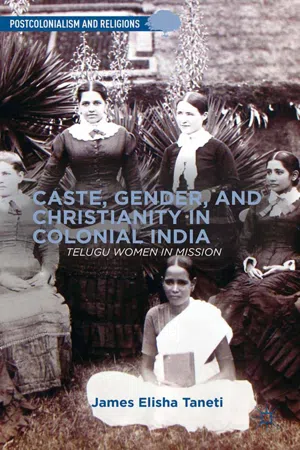
Beginning in the nineteenth century, native women preachers served and led nascent Protestant churches in much of Southern India, evolving their own mission theology and practices. This volume examines the impact of Telugu socio-political dynamics, such as caste, gender, and empire, on the theology and practices of the Telugu Biblewomen.
Information
Print ISBN
9781137383082
Subtopic
Storia dell'Asia1
INTRODUCTION
DEPLOYING RELIGIOUS RESOURCES
The Telugu proverb—if available at hand, monkeys use coconuts as weapons—is meant to denigrate the wisdom of the weak, but there is a kernel of truth in it. As children growing up in South India, we chased monkeys when they visited our yard. We pelted them with stones, finding pleasure when they raced for safety. Our parents warned us that the monkeys might seek revenge against our surliness using coconuts as their missiles. As anticipated, our invading visitors plucked coconuts, or any fruits on our trees, and deployed them as weapons against us. The weak skillfully use available resources to equalize the powers of the dominant in social struggles as well. Relegated to the fringes, the vulnerable groups in the Indian subcontinent, such as women and Dalits,1 turned hostile political conditions and even natural calamities to their advantage to garner bargaining power.
Deploying cultural resources and religious institutions of the dominant, both the indigenous and imported, has been one of the strategies of social resistance in South Asia. Social conflict might not have been the only birthing factor, but it certainly contributed to the origins of religious traditions such as Buddhism and Sikhism. In their attempt to maintain a distinct identity, Dalit communities nurtured nature (primal) spiritualities and sought to exert religious authority as priests and musicians even among the high-ranking caste communities with whom they normally had little, or forbidden, contact. Identifying caste system as a Hindu practice, many Dalits converted to non-Hindu religions, such as Islam, Buddhism, and Christianity, in order to escape the traditional caste restrictions. Incorporating useful resources from Hindu worldviews, some Dalits collaborated with other subaltern groups and developed eclectic movements that promised better social status. The Rajayogi movement was one such movement.2 Hoping to climb the social hierarchy, a few Dalits, on the other hand, embraced Hindu identity and emulated the practices of the dominant, a strategy that sociologist M. N. Srinivas called the process of sanskritization.3 Thus the subaltern groups, with notable success, had employed religious and cultural resources in their social struggles, just as the dominant groups legitimized their social and political control with religious rhetoric.4
Religious beliefs have also been used in South Asian women’s struggles for social respect. Women played prominent roles in nature spiritualities and messianic movements as priests and prophetesses. They contributed significantly to popular expressions of Hinduism. For example, female poets such as Meera Bai of the sixteenth century from what now is known as Rajasthan shaped the Bhakti piety through her songs. Nineteenth-century women, as informal agents and professional preachers, led their families and communities in conversion movements toward Christianity. Some of these women led and served their communities as schoolteachers, nurses, and Biblewomen,5 the principal subject of this book.
The colonial presence in the Indian subcontinent substantially influenced these social movements. The British colonial administration disrupted the traditional social structures through its judiciary. By opening educational and employment opportunities to the marginalized segments of the society, the British colonial administration inadvertently provided them space to renegotiate their social standing. The preaching of Christianity by Protestant missionaries and the legal protection to make religious choices under the British Raj muddied the cultural norms. The exposure to modernity resulted in dissent within the dominant and heightened the aspirations of the disenfranchised for reforms. Taking advantage of the cultural unrest and educational opportunities, the subjugated groups pursued their struggles against the status quo and made inroads not seen before.
This book analyzes how Telugu Biblewomen, marginalized on account of their gender and social location, marshaled religious symbols and institutions in their social struggles.6 To fulfill their social and religious aspirations, these native women preachers skillfully appropriated the evangelical Christianity that Protestant missionaries introduced to them. They deftly embraced an alien religious institution imported from London. At the same time, they retained some local customs and concepts. The colonial backdrop shaped this process of subversion as did the gender and caste aspirations of these women.
The colonial environment certainly played a decisive—disruptive as well as empowering—role in the transplanting of the office of Biblewoman among the Telugus. But the historical processes in the subcontinent were not remote-controlled by the British Parliament, nor were the groups at the social fringes in the colonies absent in these movements. Social dynamics and gender roles played a decisive role in the development of this profession in the region. Indigenous worldviews and messianic movements profoundly impacted this process. Through an analysis of what these women perceived their mission to be and how they engaged in it, and an examination of its social sources and ramifications, this book demonstrates how Telugu Biblewomen appropriated an alien religious institution, using indigenous resources, and how social dynamics and political contexts contributed to this process.
While focusing on the impact of social and political dynamics on religious beliefs, I do not imply that faith convictions are incapable of fuelling social resistance or unsettling social symmetry. Religious beliefs influence economic behavior and social relationships of individuals and groups. The Biblewomen whose theologies and practices we examine in this book became professional preachers and promoted cultural change not merely because of their social aspirations. A sense of religious obligation guided their ministerial practices. This volume underlines this dialogical relationship between religious beliefs and social dynamics.
A CONVOLUTED CULTURAL WEB
The field of action is the coastal belt on the Bay of Bengal, which the British administrators christened as the Northern Circars. This territory was also identified as “ceded districts” in the British imperial records. The British East India Company claimed territorial control over the region after Shah Alam II, the eighteenth emperor in the Mughal dynasty, “ceded” it in 1765. The newly crowned but beleaguered emperor granted the British control over the region after his losses to the former at the battle at Buxar. The nizam of Hyderabad, who was in direct political control over the land, grudgingly conceded his rights the following year. The British East India Company, a trading agency, gradually consolidated political control, military supremacy, and market monopoly over this coastal belt, which included the present-day districts of Srikakulam, Vizianagaram, Visakhapatnam, East Godavari, West Godavari, Krishna, and Guntur.
After quelling the resistance of the native troops in the Sepoy Mutiny7 of 1857, the British Parliament inherited the Circars from the company. Control of the subcontinent was no longer corporate. The British collected revenues, regulated the market, introduced a penal code, and even installed a judicial system. They maintained a strong army, enforcing law and order, safeguarding their political and market interests, and aiding the local sovereigns in their rivalries.8 The imposition of pax Britannica, by and large, was complete by the end of the nineteenth century, claimed a missionary observer.9
The political arrangement in the Northern Circars differed slightly from that of the state of Hyderabad, a centralized amalgamation of conquered territories ruled by the nizams with the help of local zamindars. Muslim princes popularly known as nizams (or administrators of the realm) ruled the state of Hyderabad, which later has been occupied by the Union of India in 1948.10 The British stationed their agents in the palace and collected tributes from the nizams but could not interfere in the governance as often as they would have wished. By contrast, the Northern Circars constituted various decentralized kingdoms ruled by local princes. By fomenting rivalries, supplying military aid, and influencing succession choices in various dynasties, the British gradually and effectively curtailed the political influence of the local sovereigns. The native princes and feudal lords did not hesitate to collaborate with the colonial rulers, seeking a larger share in the booty. They opposed some imperial policies but only when their economic interests conflicted with those of the British.11 But the British, by and large, could control the local administration and revenue collections with little resistance from the native kings.

Map 1.1 The Indian Empire.
Source: Map from the Imperial Gazetteer of India, new edition, held by University of Chicago library. Courtesy of the Digital South Asia Library, http://dsal.uchicago.edu.
The colonial presence of the British also opened up the religious market among the Telugus. With Christianity as a new option now open to them, Malas and Madigas, the largest Dalit groups in the region, began to convert to it, especially after the Sepoy Mutiny of 1857. The British Parliament implemented a policy of religious neutrality, which allowed greater room for the activities of Christian missionaries.12 Colonial officials with evangelical convictions sheltered and encouraged Protestant missionaries, whose arrivals dramatically surged after the mutiny.
The Telugus in the Northern Circars have always been a culturally diverse group, even before the arrival of Christianity. They embraced myriad worldviews and lifestyles. They followed various local expressions of Hinduism, Islam, and Buddhism. Although they had different beliefs and customs, they shared some things in common. For example, Telugu was their lingua franca. Because of the fecundity of the land, most of them engaged in agricultural labor. The region, often known as the rice bowl of the subcontinent, was rural and agrarian. The rivers that flowed into the Bay of Bengal and large ponds watered the land, increasing its fertility. The irrigation system introduced by British engineers further enriched that fecundity. The landlords benefitted from these resources as well as from the cheap labor that the caste system legitimized.
The social mechanism of caste was not unique to the region but it had its local contours. As it did elsewhere in south Asia, the caste system stratified Telugu society, assigning different occupations and rankings to various groups. Telugus were born into their castes and individuals had little or no freedom to choose an occupation other than the one traditionally assigned to their community. Prohibition of intercaste marriages ensured that no one blurred the caste boundaries.
Brahmins were placed at the top of the social hierarchy in the classical varnashrama dharma but their social influence was limited in this region. As they did elsewhere, the Brahmin subgroups engaged in ritual occupations but only to legitimize the social order. They allied with the British and served as attorneys, an occupation that sustained their social leverage. In return for this opportunity, the Brahmins often supported the power claims of feudal lords and the British Raj and were content to play subsidiary roles in the power structures. A series of anti-Brahminical movements and the land ownership patterns in the region might have contributed to this local contour.13
In contrast, although traditionally placed at the bottom of the social pyramid, Sudhra communities, especially Kammas and Reddies, with access to land and money, dominated the social life of the community in the North Circars. With their ability to patronize priests with alms, they demanded obeisance and respect from the latter. Further, as owners of the cultivable lands, Kammas and Reddies demanded free or cheap labor fr...
Table of contents
- Cover
- Title
- 1 Introduction
- 2 Foremothers and Foreign Sisters
- 3 The Meeting of Two Worlds in One Office: 1880–1921
- 4 Institutionalizing a Ministry: 1922–1947
- 5 A Local Manifestation of a Global Office
- 6 Conclusion
- Appendix: Letters of Marian Bowers as Quoted by Ellen Ranyard
- Notes
- Bibliography
- Index
Trusted by 375,005 students
Access to over 1.5 million titles for a fair monthly price.
Study more efficiently using our study tools.
Frequently asked questions
Yes, you can cancel anytime from the Subscription tab in your account settings on the Perlego website. Your subscription will stay active until the end of your current billing period. Learn how to cancel your subscription
No, books cannot be downloaded as external files, such as PDFs, for use outside of Perlego. However, you can download books within the Perlego app for offline reading on mobile or tablet. Learn how to download books offline
Perlego offers two plans: Essential and Complete
- Essential is ideal for learners and professionals who enjoy exploring a wide range of subjects. Access the Essential Library with 800,000+ trusted titles and best-sellers across business, personal growth, and the humanities. Includes unlimited reading time and Standard Read Aloud voice.
- Complete: Perfect for advanced learners and researchers needing full, unrestricted access. Unlock 1.5M+ books across hundreds of subjects, including academic and specialized titles. The Complete Plan also includes advanced features like Premium Read Aloud and Research Assistant.
We are an online textbook subscription service, where you can get access to an entire online library for less than the price of a single book per month. With over 1.5 million books across 990+ topics, we’ve got you covered! Learn about our mission
Look out for the read-aloud symbol on your next book to see if you can listen to it. The read-aloud tool reads text aloud for you, highlighting the text as it is being read. You can pause it, speed it up and slow it down. Learn more about Read Aloud
Yes! You can use the Perlego app on both iOS and Android devices to read anytime, anywhere — even offline. Perfect for commutes or when you’re on the go.
Please note we cannot support devices running on iOS 13 and Android 7 or earlier. Learn more about using the app
Please note we cannot support devices running on iOS 13 and Android 7 or earlier. Learn more about using the app
Yes, you can access Caste, Gender, and Christianity in Colonial India by J. Taneti in PDF and/or ePUB format. We have over 1.5 million books available in our catalogue for you to explore.